
Printed Sensor Market Size, Share, Trends Analysis, 2032

Printed Sensor Market By Printing Technology (Screen Printing, Gravure Printing, Flexography, Inkjet Printing, and Others), By Type (Printed Proximity Sensor, Printed Humidity Sensor, Printed Biosensor, Printed Pressure Sensor, Printed Touch Sensor, Printed Temperature Sensor, and Printed Gas Sensor Printed Image Sensor), By Application (Industrial Equipment, Consumer Electronics, Building Automation, Automotive, Smart Packaging, Medical Devices, Environmental Testing, and Others), and By Region: Global Industry Analysis, Size, Share, Growth, Trends, and Forecast 2024 - 2032
| Market Size in 2023 | Market Forecast in 2032 | CAGR (in %) | Base Year |
|---|---|---|---|
| USD 10.20 Billion | USD 18.29 Billion | 6.7% | 2023 |
Description
What is the Printed Sensor Market Size?
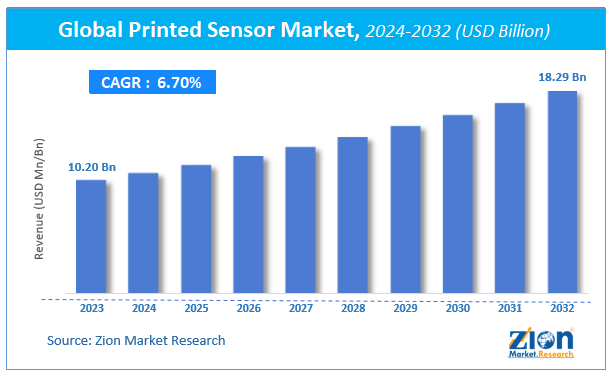
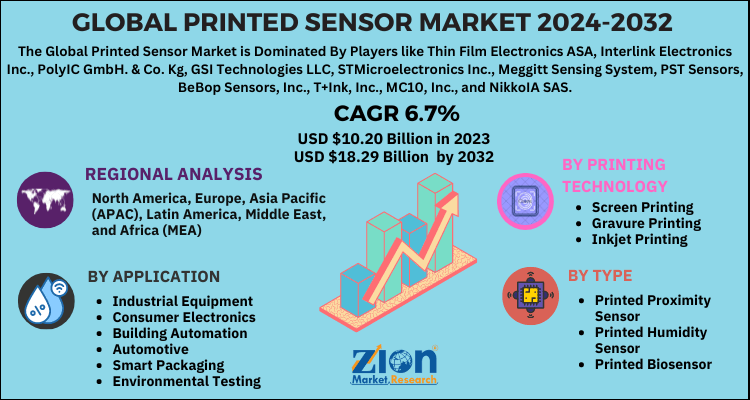
According to the report published by Zion Market Research, the global Printed Sensor Market size was valued at USD 10.20 Billion in 2023 and is predicted to reach USD 18.29 Billion by the end of 2032. The market is expected to grow with a CAGR of 6.7% during the forecast period. The report analyzes the global Printed Sensor Market's growth drivers, restraints, and impact on demand during the forecast period. It will also help navigate and explore the rising opportunities in the Printed Sensor industry.
 Request Free SampleRequest Free Sample
Global Printed Sensor Market: Overview
An electronic module, that can detect events, responses, or changes and notify them in the form of optical or electrical signals, is known as a printed sensor. This sensor is extensively used in logistics and retail industries for keeping records of the date of packaging of products, shelf life, inventory, and others. It offers several advantages such as flexible and low-cost substrates over conventional silicon technology. It is eco-friendly and the miniaturization of the printed sensors can fit in various shapes of electronic devices.
Global Printed Sensor Market: Growth Factors
Growing demand for printed sensors from automation, consumer electronics, and automotive to improve productivity and enhance operational efficiency is driving the printed sensor market. Rising demand for advanced features such as assistive touch and 3D along with declining prices of printed sensors and the growing demand for smart packaging may fuel the growth of the printed sensor market.
Printed sensors utilize printing technologies on flexible substrates which include plastics and paper, rather than metal oxides or silicon and they are used to manufacture conventional sensors. Eco-friendly printed sensors ensure the user's safety and eradicate any health risks, which in turn is boosting the printed sensor market growth in the future.
 Request Free SampleRequest Free Sample
Global Printed Sensor Market: Segmentation
The global printed sensor market is segregated based on the printing technology, type, and application.
On the basis of printing technology, the market is classified as screen printing, gravure printing, flexography, inkjet printing, and others.
The type segment is divided into printed proximity sensor, printed humidity sensor, printed biosensor, printed pressure sensor, printed touch sensor, printed temperature sensor, printed gas sensor, and printed image sensor. The biosensors are the dominating type segment in the global printed sensor market. Biosensors are broadly used in medical devices to keep watch on a patient's blood pressure, glucose level, and much more.
Based on application segment, the market is bifurcated into industrial equipment, consumer electronics, building automation, automotive, smart packaging, medical devices, environmental testing, and others. Consumer electronics is further sub-segmented into wearable devices, smartphones, and others.
Printed Sensor Market: Report Scope
| Report Attributes | Report Details |
|---|---|
| Report Name | Printed Sensor Market |
| Market Size in 2023 | USD 10.20 Billion |
| Market Forecast in 2032 | USD 18.29 Billion |
| Growth Rate | CAGR of 6.7% |
| Number of Pages | 192 |
| Key Companies Covered | Thin Film Electronics ASA, Interlink Electronics Inc., PolyIC GmbH. & Co. Kg, GSI Technologies LLC, STMicroelectronics Inc., Meggitt Sensing System, PST Sensors, BeBop Sensors, Inc., T+Ink, Inc., MC10, Inc., and NikkoIA SAS. Other influencing players include ISORG SA, Tekscan, Inc., Peratech Holdco Limited, RISE Acreo, Integrated Device Technology, Sensitronics, Canatu Oy, ON Semiconductors, and KWJ Engineering Inc |
| Segments Covered | By Printing Technology, By Type, By Application and By Region |
| Regions Covered | North America, Europe, Asia Pacific (APAC), Latin America, Middle East, and Africa (MEA) |
| Base Year | 2023 |
| Historical Year | 2018 to 2022 |
| Forecast Year | 2024 - 2032 |
| Customization Scope | Avail customized purchase options to meet your exact research needs. Request For Customization |
Global Printed Sensor Market: Regional Analysis
Europe contributed to the largest market share due to stable economic growth. Western Europe is supported by the European Union and other public authorities for process development and prototyping facilities and the availability of a large number of printed electronics R&D institutions is expected to augment the printed sensor market growth.
Asia Pacific is growing at a faster rate owing to rapid industrialization; a rise in the production of commercial and non-commercial vehicles coupled with touch infotainment systems and driver assistance systems is projected to drive the market. North America is another potential market for printed sensors as the number of diabetic population is higher in the region, which is expected to fuel the global printed sensor market in the coming years.
Global Printed Sensor Market: Competitive Players
Key market players in the global printed sensor market include;
- Thin Film Electronics ASA
- Interlink Electronics Inc.
- PolyIC GmbH. & Co. Kg
- GSI Technologies LLC
- STMicroelectronics Inc.
- Meggitt Sensing System
- PST Sensors
- BeBop Sensors, Inc.
- T+Ink, Inc.
- MC10, Inc.
- NikkoIA SAS
- ISORG SA
- Tekscan, Inc.
- Peratech Holdco Limited
- RISE Acreo
- Integrated Device Technology
- Sensitronics
- Canatu Oy
- ON Semiconductors
- KWJ Engineering Inc.
The global printed sensor market is segmented as follows;
Global Printed Sensor Market: By Printing Technology Segment Analysis
- Screen Printing
- Gravure Printing
- Flexography
- Inkjet Printing
- Others
Global Printed Sensor Market: By Type Segment Analysis
- Printed Proximity Sensor
- Printed Humidity Sensor
- Printed Biosensor
- Printed Pressure Sensor
- Printed Touch Sensor
- Printed Temperature Sensor
- Printed Gas Sensor Printed Image Sensor
Global Printed Sensor Market: By Application Segment Analysis
- Industrial Equipment
- Consumer Electronics
- Wearable Devices
- Smartphones
- Others
- Building Automation
- Automotive
- Smart Packaging
- Medical Devices
- Environmental Testing
- Others
By Region
- North America
- The U.S.
- Canada
- Mexico
- Europe
- France
- The UK
- Spain
- Germany
- Italy
- Rest of Europe
- Asia Pacific
- China
- Japan
- India
- Australia
- South Korea
- Rest of Asia Pacific
- The Middle East & Africa
- Saudi Arabia
- UAE
- Egypt
- Kuwait
- South Africa
- Rest of the Middle East & Africa
- Latin America
- Brazil
- Argentina
- Rest of Latin America
What Report Provides
- Full in-depth analysis of the parent market
- Important changes in market dynamics
- Segmentation details of the market
- Former, on-going, and projected market analysis in terms of volume and value
- Assessment of niche industry developments
- Market share analysis
- Key strategies of major players
- Emerging segments and regional markets
- Testimonials to companies to fortify their foothold in the market.
Table Of Content

FrequentlyAsked Questions
A printed sensor is created using printing techniques on flexible substrates. It enables low-cost and lightweight sensing solutions.
The global Printed Sensor market is expected to be driven by the Driven by growth of flexible electronics, demand for low-cost sensors in wearables and packaging, and increased use in healthcare monitoring. Scalability, lightweight designs, and mass production capability support adoption.
According to study, the global Printed Sensor market size was worth around USD 10.20 Billion in 2023 and is predicted to grow to around USD 18.29 Billion By 2032.
The global Printed Sensor market is expected to grow at a Compound Annual Growth Rate (CAGR) of around CAGR 6.7% during the forecast period from 2024-2032.
The global Printed Sensor industry is projected to be challenged by Challenges include performance limitations versus traditional sensors, durability and environmental stability issues, scaling challenges in mass production, and standardization gaps.
The Opportunities include growth in smart packaging and wearables, demand for low-cost flexible electronics, expansion in healthcare patches and monitoring, and adoption in IoT for large-area sensing will offer significant growth opportunities in the Printed Sensor market.
Low-cost flexible sensors via roll-to-roll printing; improved conductive inks and encapsulation; integration into packaging, wearables, and industrial labels are the emerging trends and innovations impacting the Printed Sensor market.
The global Printed Sensor market is expected to be led by APAC during the forecast period.
Some of the prominent players operating in the global Printed Sensor market are; Thin Film Electronics ASA, Interlink Electronics Inc., PolyIC GmbH. & Co. Kg, GSI Technologies LLC, STMicroelectronics Inc., Meggitt Sensing System, PST Sensors, BeBop Sensors, Inc., T+Ink, Inc., MC10, Inc., and NikkoIA SAS. Other influencing players include ISORG SA, Tekscan, Inc., Peratech Holdco Limited, RISE Acreo, Integrated Device Technology, Sensitronics, Canatu Oy, ON Semiconductors, and KWJ Engineering Inc and others.
The report explores crucial aspects of the Printed Sensor market, including a detailed discussion of existing growth factors and restraints, while also browsing future growth opportunities and challenges that impact the market.
HappyClients

