
Power Pedestal Market Size, Share, Trends, Growth & Forecast 2034

Power Pedestal Market By Type (Stainless-Steel Power Pedestal, Polycarbonate Power Pedestal, Lightweight Composites, Aluminum Power Pedestal, and Others), By Application (Marina Power and Lighting, Recreation Vehicle Parks, Construction Site, Mobile Home Panels, and Others), and By Region - Global and Regional Industry Overview, Market Intelligence, Comprehensive Analysis, Historical Data, and Forecasts 2025 - 2034
| Market Size in 2024 | Market Forecast in 2034 | CAGR (in %) | Base Year |
|---|---|---|---|
| USD 195.50 Million | USD 283.82 Million | 4.77% | 2024 |
Power Pedestal Industry Perspective:
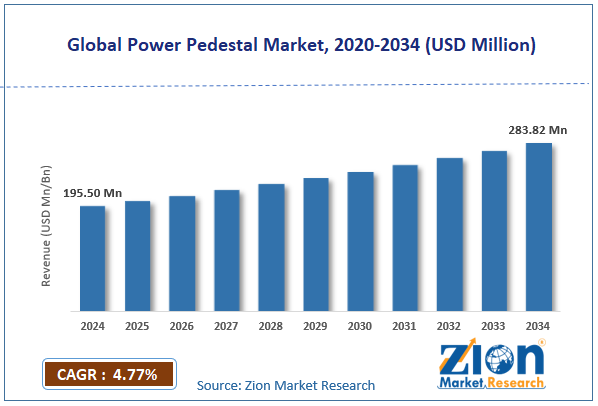
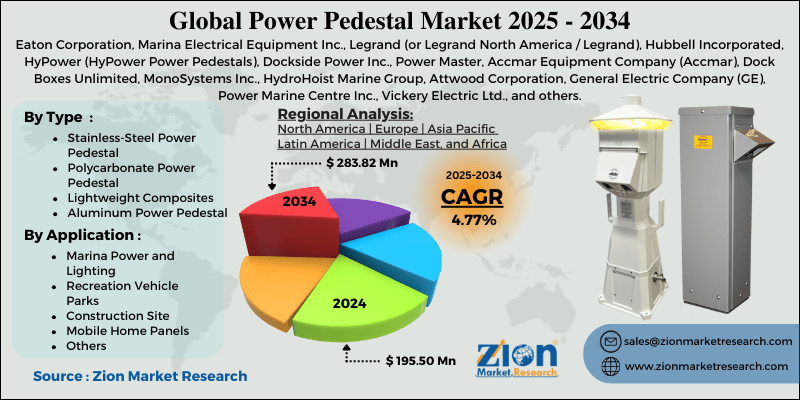
The global power pedestal market size was approximately USD 195.50 million in 2024 and is projected to reach USD 283.82 million by 2034, with a compound annual growth rate (CAGR) of approximately 4.77% over 2025-2034.
Key Insights:
- As per the analysis shared by our research analyst, the global power pedestal market is estimated to grow annually at a CAGR of around 4.77% over the forecast period (2025-2034)
- In terms of revenue, the global power pedestal market size was valued at around USD 195.50 million in 2024 and is projected to reach USD 283.82 million by 2034.
- The power pedestal market is projected to grow significantly, driven by rising recreational boating, urban infrastructure development, and environmental and regulatory pressures.
- Based on type, the stainless-steel power pedestal segment is expected to lead the market, while the polycarbonate power pedestal segment is expected to grow considerably.
- Based on application, the marina power and lighting segment is the dominating segment, while the recreation vehicle parks segment is projected to witness sizeable revenue over the forecast period.
- By region, North America is projected to dominate the global market during the forecast period, followed by Europe.
Power Pedestal Market: Overview
A power pedestal is a free-standing, weather-resistant electrical unit commonly used at RV parks, marinas, and outdoor event sites to provide reliable, safe access to power. It houses circuit breakers, outlets of various voltages, and sometimes additional features such as lighting, water hookups, or metering. They help distribute electricity efficiently while protecting equipment and users from environmental threats. The global power pedestal market is projected to witness substantial growth driven by the expansion of waterfront and marina infrastructure, the growing adoption of smart and advanced technologies, and heightened demand for reliability, compliance, and safety. Worldwide investment in marina construction and waterfront development is on the rise, particularly in tourist and coastal regions. Power pedestals are crucial components of these advanced facilities. Their installation provides efficient and safer access to utilities for visitors and vessels.
Moreover, newer power pedestals are embedded with remote monitoring, smart metering, and safety-enhanced controls. These technological upgrades attract operators seeking enhanced energy management and reduced maintenance. The integration of IoT capabilities is becoming a strong competitive feature. Furthermore, marine and outdoor environments need durable electrical solutions that comply with strict safety standards. Power pedestals designed with advanced protection features and corrosion resistance are vastly preferred. Regulatory pressure also fuels the replacement of older non-compliant systems.
Although drivers exist, the global market is constrained by high installation and capital costs, maintenance and operational costs, and technical complexity. Power pedestals, especially smart or marine-grade models, require a significant upfront investment. Campgrounds and smaller marinas may find this expense challenging. This financial obstacle slows the adoption rate in budget-conscious markets. Likewise, marine and outdoor environments demand regular inspections, corrosion management, and grounding checks. These maintenance needs add to operators' long-term operational costs. Technical complexity can also hamper adoption among less experienced facility managers.
Even so, the global power pedestal industry is well-positioned due to smart, IoT-integrated pedestal solutions and EV charging and electrified vessel support. There is a rising demand for pedestals that support smart billing, remote monitoring, and digital metering. These features reduce maintenance and enhance user convenience for parks and margins. The shift towards connected infrastructure creates robust long-term potential.
Additionally, the growth of electric boats and electric vehicles creates new technical requirements for outdoor power systems. Pedestals that support high-capacity charging are progressively valuable in newer facilities. This convergence of markets offers manufacturers fresh revenue streams.
Power Pedestal Market Dynamics
Growth Drivers
How is the power pedestal market segmented by urbanization, smart‑city development, and infrastructure modernization?
As urbanization advances, developers, municipalities, and planners need scalable, safe power distribution for public spaces, parks, residential areas, and waterfronts. Power pedestals offer modular, durable, and weather-resistant solutions ideal for these infrastructures. Smart-city projects integrating lighting, utilities, and EV charging often rely on pedestal systems for safety and flexibility; as a result, infrastructure modernization and urban growth are driving pedestal demand beyond traditional marinas and campgrounds.
How are technological advancements and the integration of smart features driving growth in the power pedestal industry?
Modern power pedestals now feature smart capabilities, including energy metering, remote monitoring, modular designs, and safety circuits. These features offer facility owners better control over maintenance, energy use, and billing. Advancing technology shifts demand from basic pedestals to smart variants, motivating fresh installations and replacements. This positions pedestals as integral components of smart infrastructure in campgrounds, marinas, and public spaces, thereby driving growth in the power pedestal market.
Restraints
Competition from alternative or portable power solutions unfavorably impacts the market progress
Power pedestals face robust competition from alternatives such as solar-powered units, portable generators, underground wiring, and battery systems, which are low-cost and more flexible. In remote, cost-sensitive, or temporary locations, such as seasonal resorts or small campsites, these options are more practical than permanent installations. Users seeking lower costs, flexibility, or temporary solutions prefer these substitutes. This reduces the demand for traditional pedestal systems in some segments. Subsequently, the need for fixed infrastructure is restricted, hampering overall industry penetration.
Opportunities
How do favorable regulatory and environmental policies present favorable prospects for the expansion of the power pedestal market?
Governments are increasingly promoting compliant, standardized infrastructure to reduce environmental impact and improve safety—tighter regulations on shore-power systems and outdoor electrical installations are fueling the adoption of certified pedestals. The facility sustains demand to replace older, non-compliant systems. Regulatory support is expected to sustain demand in emerging and developed markets. This offers a robust tailwind for the growth of the power pedestal industry.
Challenges
Raw material cost volatility and supply-chain risks restrict the market growth
Power pedestal manufacturing relies on corrosion-resistant materials and metals, which are sensitive to price fluctuations. Geopolitical stresses, economic instability, or shipping delays can disturb supply chains. Growing product costs may hinder adoption or squeeze manufacturer margins. Supply chain volatility offers uncertainty for buyers and manufacturers. This continues to challenge consistent industry growth.
Power Pedestal Market: Report Scope
| Report Attributes | Report Details |
|---|---|
| Report Name | Power Pedestal Market |
| Market Size in 2024 | USD 195.50 Million |
| Market Forecast in 2034 | USD 283.82 Million |
| Growth Rate | CAGR of 4.77% |
| Number of Pages | 214 |
| Key Companies Covered | Eaton Corporation, Marina Electrical Equipment Inc., Legrand (or Legrand North America / Legrand), Hubbell Incorporated, HyPower (HyPower Power Pedestals), Dockside Power Inc., Power Master, Accmar Equipment Company (Accmar), Dock Boxes Unlimited, MonoSystems Inc., HydroHoist Marine Group, Attwood Corporation, General Electric Company (GE), Power Marine Centre Inc., Vickery Electric Ltd., and others. |
| Segments Covered | By Type, By Application, and By Region |
| Regions Covered | North America, Europe, Asia Pacific (APAC), Latin America, Middle East, and Africa (MEA) |
| Base Year | 2024 |
| Historical Year | 2019 to 2023 |
| Forecast Year | 2025 - 2034 |
| Customization Scope | Avail customized purchase options to meet your exact research needs. Request For Customization |
Power Pedestal Market: Segmentation
The global power pedestal market is segmented based on type, application, and region.
Based on type, the global power pedestal industry is divided into stainless-steel power pedestal, polycarbonate power pedestal, lightweight composites, aluminum power pedestal, and others. The stainless-steel power pedestal segment leads the global market because of its durability and corrosion resistance, making it suitable for outdoor and harsh marine environments, such as coastal RV parks, docks, and marinas. Their robust construction ensures minimal maintenance and a long service life, making them ideal for heavy-duty, permanent installations.
On the other hand, the polycarbonate power pedestal segment holds a dominant share, as it is widely used as a more cost-effective, lighter option, especially for small RV sites, campgrounds, or locations where extreme durability is not needed. Their easy installation and lighter weight make them more suitable when low upfront costs and portability are prioritized. In these practical cases, they consistently represent the second-largest share.
Based on application, the global power pedestal market is segmented into marina power and lighting, recreation vehicle parks, construction sites, mobile home panels, and others. The marina power and lighting segment is poised for substantial growth, as waterfront and marina facilities need corrosion-resistant, reliable power pedestals to supply shore power, utilities, and lighting for yachts and boats. As marina infrastructure and recreational boating expand worldwide, the demand for specialized pedestals in these environments remains significant. This makes marina-side installations the leading application segment for power pedestals.
Conversely, the recreation vehicle parks segment ranks second in the market due to growing RV travel, demand for outdoor leisure amenities that require reliable power hookups, and the popularity of camping. Pedestals in this segment supply electricity to trailers, RVs, and campground facilities, offering convenience and flexibility for mobile living and recreation. As interest in outdoor recreation continues to grow, RV-park applications remain the leading segment of marina use.
Power Pedestal Market: Regional Analysis
What gives North America a competitive edge in the global Power Pedestal Market?
North America is likely to maintain its leadership in the power pedestal market due to strong recreational boating and marina infrastructure, a large RV-park and campground network, and safety compliance and regulatory standards. North America has well-developed waterfront and marina infrastructure, with a large number of recreational yachts and boats that depend on safe shore power connections. Therefore, demand for marina-grade power pedestals is high and continuous. In reality, recent market reports indicate that the region contributed 38-42% of the worldwide market share.
Moreover, the region hosts a sophisticated and extensive network of RV parks, recreational-vehicle infrastructure, and campgrounds, fueled by a robust RV culture and substantial recreational-travel demand. Because many RV sites require standardized, reliable electrical hookups, power pedestals are in constant demand. This large base of end users significantly contributes to the region's dominance in the global market.Furthermore, North American electrical safety standards and building codes, particularly for RV parks, marinas, and outdoor power installations, drive facility operators to use certified, code-compliant, and weather-resistant pedestals. This compliance requires replacing older or substandard equipment and adopting modern power pedestals.
Europe continues to hold the second-highest share in the power pedestal industry, owing to its extensive marine network, growing leisure boating, and regulatory compliance. Europe has a sophisticated network of inland waterways and marinas that support recreational yachting and boating. These facilities require reliable shore power pedestals to supply lighting, electricity, and other utilities to vessels. The broader distribution of marinas promises consistent and sustained demand. This makes the marina segment the backbone of the regional market. Growing tourism, rising interest in recreational boating, and high disposable incomes are driving demand for pedestal installations. As boating activities expand, upgrades and new pedestals are installed regularly. This trend contributes to steady industry growth in Europe.
Additionally, stringent European electrical safety and environmental standards force marina operators to install weather-resistant, certified, and durable pedestals. Noncompliant or outdated systems are replaced to comply with these regulations. Compliance assures a continuous market for advanced pedestal solutions. It also motivates the adoption of high-quality, long-lasting units.
Power Pedestal Market: Competitive Analysis
The leading players in the global power pedestal market are:
- Eaton Corporation
- Marina Electrical Equipment Inc.
- Legrand (or Legrand North America / Legrand)
- Hubbell Incorporated
- HyPower (HyPower Power Pedestals)
- Dockside Power Inc.
- Power Master
- Accmar Equipment Company (Accmar)
- Dock Boxes Unlimited
- MonoSystems Inc.
- HydroHoist Marine Group
- Attwood Corporation
- General Electric Company (GE)
- Power Marine Centre Inc.
- Vickery Electric Ltd.
Power Pedestal Market: Key Market Trends
Integration with renewable energy & sustainability focus:
More pedestals are designed to support renewable energy, comprising solar-powered units or hybrid systems that reduce dependence on the grid. As environmental awareness grows and carbon-footprint regulations tighten, low-impact, sustainable pedestal solutions are gaining prominence. This trend supports eco-tourism, sustainable campground developments, and green marinas.
Modular, flexible & scalable pedestal deployments:
Manufacturers are offering modular pedestal systems that can be configured for a range of settings, from large marinas serving yachts to small campgrounds, temporary event sites, or docks. This flexibility facilitates installations, enables scaling as demand changes, and reduces upfront costs. As infrastructure in tourism, coastal, and recreational projects expands, modular pedestals help meet different needs efficiently.
The global power pedestal market is segmented as follows:
By Type
- Stainless-Steel Power Pedestal
- Polycarbonate Power Pedestal
- Lightweight Composites
- Aluminum Power Pedestal
- Others
By Application
- Marina Power and Lighting
- Recreation Vehicle Parks
- Construction Site
- Mobile Home Panels
- Others
By Region
- North America
- The U.S.
- Canada
- Europe
- France
- The UK
- Spain
- Germany
- Italy
- Rest of Europe
- Asia Pacific
- China
- Japan
- India
- South Korea
- Southeast Asia
- Rest of Asia Pacific
- Latin America
- Brazil
- Mexico
- Rest of Latin America
- Middle East & Africa
- GCC
- South Africa
- Rest of Middle East & Africa
Table Of Content
Methodology
FrequentlyAsked Questions

HappyClients

