
Global Plastic Jar Packaging Market Size, Share, Trends, Growth and Forecasts 2032

Plastic Jar Packaging Market By Material (Polyethylene Terephthalate (PET), Polyethylene (PE), Low-Density Polyethylene (LDPE), High-Density Polyethylene (HDPE), Polyvinyl Chloride (PVC), Polypropylene (PP), Polystyrene (PS), and Others), By Capacity (Less Than 10 Oz, 11 – 30 Oz, 31 – 60 Oz, and More Than 61 Oz)), By End-Use Industry (Food and Beverages, Personal Care and Cosmetics, Homecare, Pharmaceuticals, Chemicals, and Others), and By Region - Global and Regional Industry Overview, Market Intelligence, Comprehensive Analysis, Historical Data, and Forecasts 2024 - 2032-
| Market Size in 2023 | Market Forecast in 2032 | CAGR (in %) | Base Year |
|---|---|---|---|
| USD 26.83 Billion | USD 36.82 Billion | 3.58% | 2023 |
Plastic Jar Packaging Industry Perspective
What will be the global plastic jar packaging market size during the forecast period?
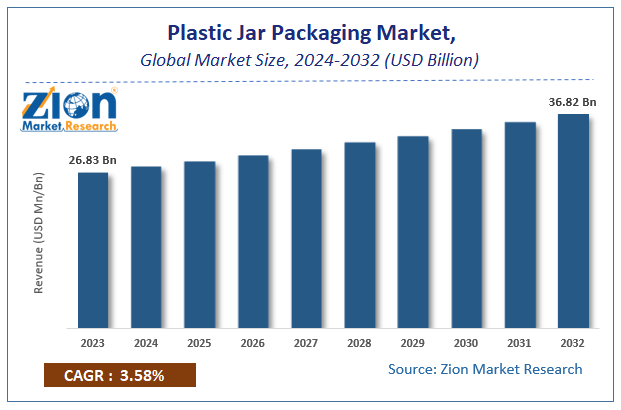
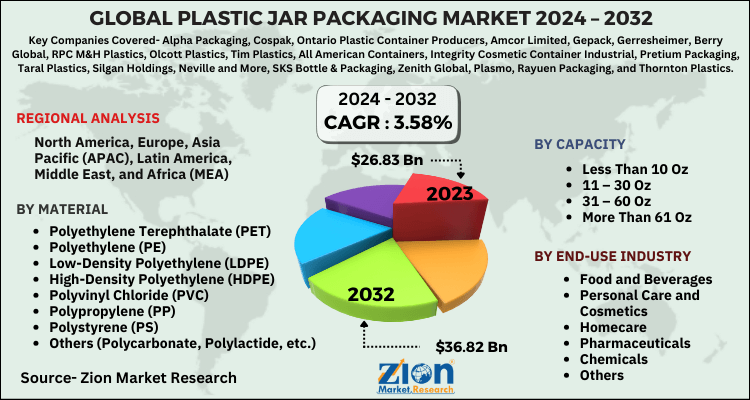
The global plastic jar packaging market size was worth around USD 26.83 billion in 2023 and is predicted to grow to around USD 36.82 billion by 2032 with a compound annual growth rate (CAGR) of roughly 3.58% between 2024 and 2032.
This report provides a comprehensive analysis of the growth drivers, restraints, and challenges shaping demand across the global plastic jar packaging market throughout the forecast period, while highlighting high-potential emerging opportunities within the industry.
Key Insights
- As per the analysis shared by our research analyst, the global plastic jar packaging market is estimated to grow at a CAGR of approximately 3.58% during the forecast period from 2024 to 2032.
- In terms of revenue, the global plastic jar packaging market size was valued at around USD 26.83 billion in 2023 and is projected to reach USD 36.82 billion by 2032.
- The market is driven by growing demand for lightweight, durable, impact-resistant, and cost-effective packaging formats, particularly across the food and beverages sector, along with rapid urbanization and improving living standards.
- Based on the material, polyethylene terephthalate (PET) was the fastest-growing segment and accounted for a significant share due to its clarity, strength, and suitability for food-contact applications.
- Based on capacity, 11–30 Oz support a large portion of demand by balancing convenience and product volume for everyday consumer goods.
- Based on the end-use industry, the food and beverages segment led the market because of high volume requirements for sauces, spreads, dairy, and other packaged food products that rely on plastic jars.
- Asia Pacific was the largest market and is anticipated to remain the fastest-growing region, supported by rising urbanization, industrialization, and expanding use across food and beverages, personal care, and related industries.
Plastic Jar Packaging Market: Overview
Plastic jar packaging refers to the use of plastic containers, typically fitted with screw-on or snap-on closures, for the storage and transportation of a wide range of products. These jars are employed extensively across industries including food and beverages, personal care and cosmetics, pharmaceuticals, homecare, and chemicals.
Plastic jars offer advantages such as light weight, impact resistance, design flexibility, and cost-effectiveness compared with many rigid alternatives, while supporting product visibility, convenience, and shelf stability.
Plastic Jar Packaging Market: Growth Drivers & Restraints
The plastic jar packaging market is likely to experience significant growth globally in the upcoming years, owing to the growing demand for lightweight, durable, impact-resistant, and cost-effective packaging formats. The demand for effective and budget-friendly packaging formats across various industries, particularly in the food and beverages sector, is expected to further fuel the plastic jar packaging market over the forecast time period. Rapid urbanization and improving living standards of people will also increase the demand for plastic jar packaging in the years to come.
However, the growing raw material prices of plastic jar packaging may hamper the plastic jar packaging market development on a global scale. The flourishing food and beverages sector in emerging countries and advancements in plastic jar packaging technology will generate new opportunities for the major market players.
Plastic Jar Packaging Market: Report Scope
| Report Attributes | Report Details |
|---|---|
| Report Name | Plastic Jar Packaging Market |
| Market Size in 2023 | USD 26.83 Billion |
| Market Forecast in 2032 | USD 36.82 Billion |
| Growth Rate | CAGR of 3.58% |
| Number of Pages | 255 |
| Key Companies Covered | Alpha Packaging, Cospak, Ontario Plastic Container Producers, Amcor Limited, Gepack, Gerresheimer, Berry Global, RPC M&H Plastics, Olcott Plastics, Tim Plastics, All American Containers, Integrity Cosmetic Container Industrial, Pretium Packaging, Taral Plastics, Silgan Holdings, Neville and More, SKS Bottle & Packaging, Zenith Global, Plasmo, Rayuen Packaging, and Thornton Plastics. |
| Segments Covered | By Material, By Capacity, By End-use Industry, and By Region |
| Regions Covered | North America, Europe, Asia Pacific (APAC), Latin America, Middle East, and Africa (MEA) |
| Base Year | 2023 |
| Historical Year | 2018 - 2022 |
| Forecast Year | 2024 - 2032 |
| Customization Scope | Avail customized purchase options to meet your exact research needs. Request For Customization |
Plastic Jar Packaging Market: Segmentation
The plastic jar packaging market is segmented by material, capacity, end-use industry, and region. All the segments of the plastic jar packaging market have been analyzed based on present and future trends and the market is estimated from 2024 to 2032.
Based on Material, the plastic jar packaging market is divided into polyethylene terephthalate (PET), polyethylene (PE), low-density polyethylene (LDPE), high-density polyethylene (HDPE), polyvinyl chloride (PVC), polypropylene (PP), polystyrene (PS), and others. Polyethylene terephthalate was the fastest-growing segment and accounted for a significant share, driven by its clarity, strength, recyclability profile, and suitability for food-contact applications. HDPE and PP also play important roles due to their toughness and chemical resistance, supporting use in personal care, household, and industrial products. The diversity of available resins allows converters to match material properties to specific product and performance requirements, thereby supporting broad market adoption.
Based on Capacity, the market is divided into less than 10 Oz, 11 – 30 Oz, 31 – 60 Oz, and more than 61 Oz. Mid-range capacities such as 11–30 Oz address a large share of consumer and commercial needs by offering convenient portion sizes for food, personal care, and household products. Smaller sizes serve single-serve or sample applications, while larger capacities support bulk or institutional use. The ability to supply a full range of sizes enables manufacturers to serve diverse channel and end-use requirements and contributes to overall market volume.
Based on End-Use Industry, the plastic jar packaging market is divided into food and beverages, personal care and cosmetics, homecare, pharmaceuticals, chemicals, and others. The food and beverages segment led the market because of high-volume demand for jars used in sauces, spreads, dairy products, and other packaged foods. Personal care and cosmetics represent an important secondary category driven by the need for attractive, functional packaging. Homecare, pharmaceuticals, and chemicals further diversify demand, collectively reinforcing market stability and growth across multiple consumer and industrial applications.
Plastic Jar Packaging Market: Regional Analysis
Why will Asia Pacific continue to dominate the global market during the projection period?
Asia Pacific was the largest plastic jar packaging market and is anticipated to remain the fastest-growing region in the years ahead. The region benefits from rising use of plastic jar packaging across food and beverages, personal care and cosmetics, homecare, pharmaceuticals, and chemical industries. Rapid urbanization and industrialization continue to expand the consumer base and manufacturing capacity for packaged goods. Growing middle-class populations and improving retail infrastructure further support demand for convenient, affordable packaging formats. These dynamics enable Asia Pacific to drive overall market volume, influence packaging trends, and attract continued investment in production capacity and technology.
North America maintains significant demand supported by established food and consumer goods industries and high per-capita consumption of packaged products. Europe follows with steady requirements shaped by mature markets and evolving sustainability standards. Latin America and the Middle East & Africa represent emerging opportunities where rising urbanization and expanding retail channels are expected to support gradual growth in plastic jar packaging adoption.
Plastic Jar Packaging Market: Competitive Analysis
The global plastic jar packaging market is led by players like:
- Alpha Packaging
- Cospak
- Ontario Plastic Container Producers
- Amcor Limited
- Gepack
- Gerresheimer
- Berry Global
- RPC M&H Plastics
- Olcott Plastics
- Tim Plastics
- All American Containers
- Integrity Cosmetic Container Industrial
- Pretium Packaging
- Taral Plastics
- Silgan Holdings
- Neville and More
- SKS Bottle & Packaging
- Zenith Global, Plasmo
- Rayuen Packaging
- Thornton Plastics
Segments Covered
This report segments the global plastic jar packaging market into:
By Material
- Polyethylene Terephthalate (PET)
- Polyethylene (PE)
- Low-Density Polyethylene (LDPE)
- High-Density Polyethylene (HDPE)
- Polyvinyl Chloride (PVC)
- Polypropylene (PP)
- Polystyrene (PS)
- Others (Polycarbonate, Polylactide, etc.)
By Capacity
- Less Than 10 Oz
- 11 – 30 Oz
- 31 – 60 Oz
- More Than 61 Oz
By End-Use Industry
- Food and Beverages
- Personal Care and Cosmetics
- Homecare
- Pharmaceuticals
- Chemicals
- Others
By Region
- North America
- The U.S.
- Canada
- Mexico
- Europe
- France
- The UK
- Spain
- Germany
- Italy
- Rest of Europe
- Asia Pacific
- China
- Japan
- India
- Australia
- South Korea
- Rest of Asia Pacific
- The Middle East & Africa
- Saudi Arabia
- UAE
- Egypt
- Kuwait
- South Africa
- Rest of the Middle East & Africa
- Latin America
- Brazil
- Argentina
- Rest of Latin America
Table Of Content
Methodology
FrequentlyAsked Questions
Plastic jar packaging refers to plastic containers, typically fitted with screw-on or snap-on closures, used for the storage and transportation of products across industries such as food and beverages, personal care and cosmetics, pharmaceuticals, homecare, and chemicals.
The global plastic jar packaging market is driven by growing demand for lightweight, durable, impact-resistant, and cost-effective packaging formats, strong requirements from the food and beverages sector, rapid urbanization, and improving living standards that increase consumption of packaged goods.
The global plastic jar packaging market size was worth around USD 26.83 billion in 2023 and is predicted to grow to around USD 36.82 billion by 2032.
The global plastic jar packaging market a compound annual growth rate (CAGR) of roughly 3.58% between 2024 and 2032.
Asia Pacific is expected to contribute notably and remain the largest and fastest-growing region, supported by rising urbanization, industrialization, and expanding use across multiple end-use industries.
Some major players of the plastic jar packaging market are Alpha Packaging, Cospak, Ontario Plastic Container Producers, Amcor Limited, Gepack, Gerresheimer, Berry Global, RPC M&H Plastics, Olcott Plastics, Tim Plastics, All American Containers, Integrity Cosmetic Container Industrial, Pretium Packaging, Taral Plastics, Silgan Holdings, Neville and More, SKS Bottle & Packaging, Zenith Global, Plasmo, Rayuen Packaging, and Thornton Plastics.

HappyClients

