
Plant Tissue Culture Market Size, Share, Growth, Opportunities 2034

Plant Tissue Culture Market By Stage (Explant Preparation & Inoculation, Multiplication, and Hardening), By Plant (Annual, Biennial, and Perennial), By Crop Type (Floriculture, Fruit, Wood Producing, Ornamental, Aquatic, and Vegetable), By End-Use (Gardening & Decoration, Agriculture, Forestry & Botanical Garden, Research, and Others), and By Region - Global and Regional Industry Overview, Market Intelligence, Comprehensive Analysis, Historical Data, and Forecasts 2026 - 2034
| Market Size in 2025 | Market Forecast in 2034 | CAGR (in %) | Base Year |
|---|---|---|---|
| USD 570.22 Million | USD 1,205.01 Million | 8.66% | 2025 |
Plant Tissue Culture Industry Perspective:
What is the anticipated size of the plant tissue culture market during the projection period?
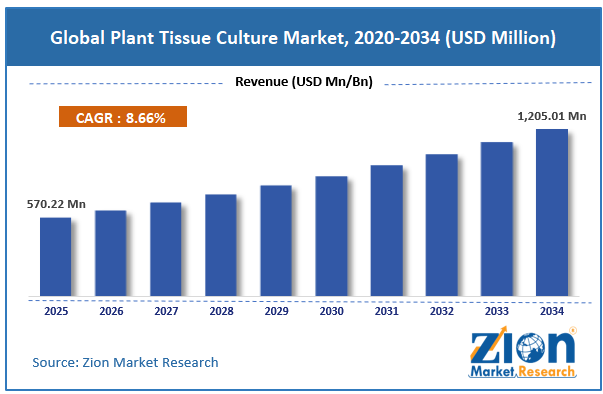
The global plant tissue culture market size was worth around USD 570.22 million in 2025 and is predicted to grow to around USD 1,205.01 million by 2034, with a compound annual growth rate (CAGR) of roughly 8.66% between 2026 and 2034.
Key Insights:
- As per the analysis shared by our research analyst, the global plant tissue culture market is estimated to grow annually at a CAGR of around 8.66% over the forecast period (2026-2034)
- In terms of revenue, the global plant tissue culture market size was valued at around USD 570.22 million in 2025 and is projected to reach USD 1,205.01 million, by 2034.
- The plant tissue culture market is projected to grow at a significant rate due to the increasing food demand, favorable government policies, expansion of floriculture & horticulture, and adoption of micropropagation techniques.
- Based on the stage, the multiplication segment is expected to lead the market growth trend with a CAGR of 8.91% due to rising focus on high-volume production of genetically uniform plantlets during the forecast period.
- Based on the plant, the biennial segment is anticipated to command the largest market share.
- Based on the crop type, the fruit segment is expected to lead the market growth trends.
- Based on the end-use, the agriculture segment is projected to influence revenue in the market.
- Based on region, Asia-Pacific is projected to dominate the global market during the forecast period.
Plant Tissue Culture Market: Overview
Plant tissue culture is the biotechnological process of maintaining and developing plant organs, tissues, and cells in vitro. This technique involves separating plant tissue from the source organisms and keeping it within a nutrient-rich culture medium. Plant tissue culture has several applications, including increasing genetic variability, genetic breeding, and producing genetically modified plants. Plants grown using tissue culture techniques are independent of climatic and geographical factors, as well as the technical and economic problems generally associated with field crops. During the forecast period, factors such as increasing food demand, favorable government policies, expansion of floriculture & horticulture, and adoption of micropropagation techniques will help fuel market growth rate. However, high investment cost, skilled labor shortage, and technical limitations of plant tissue culture will affect overall market revenue in the long run.
Impact of the USA-Israel and Iran war on the Plant Tissue Culture Market:
The USA-Israel and Iran war is expected to affect the plant tissue culture market by increasing the cost of agricultural raw materials such as fertilizers and energy supplies. However, in the long run, concerns about global food security may drive more investment in plant tissue culture. The war is also expected to encourage domestic reliance and the introduction of new supply chains.
Plant Tissue Culture Market: Dynamics
Growth Drivers
How will growing demand for disease-free plantlets influence revenue in the plant tissue culture market?
The global plant tissue culture market is expected to be driven by the growing focus on disease-free plantlets. According to market analysis, plant tissue culture is an effective technique for producing healthy planting material. Techniques such as micropropagation can produce planting material free of contamination, which is common in conventional agricultural practices. Vegetatively propagated crops such as cassava, potato, and banana can benefit from plant tissue culture techniques. Plant diseases are causing severe crop losses, driving a shift toward disease-free alternatives. In a recent event, Pagadian City in the Philippines launched its first dedicated banana tissue culture laboratory to supply regional farmers with disease-free plantlets.
Expansion of horticulture and floriculture to propel market revenue in the coming years
Horticulture and floriculture trends have grown significantly in the last few years. This growth is driven by higher demand for fresh, safer food and vegetables. Additionally, changes in consumer lifestyle, urbanization, and commercialization are driving demand for uniform plants and ornamental flowers. This is further supported by advancements in farming techniques. The global plant tissue culture market will continue to benefit as more investment flows into horticulture and floriculture.
Restraints
High cost of investment and lack of skilled workforce to limit plant tissue culture industry growth
The global plant tissue culture industry is expected to be restricted due to high cost of initial investment and operating expenses. A commercial plant tissue culture facility has to be equipped with cutting-edge technologies, including sterilization equipment and quality control tools. In addition, these facilities have recurring expenses that fluctuate with external economic factors. A lack of a sufficient skilled workforce will further impact industry revenue in the coming years.
Opportunities
Why will climate change create growth opportunities for plant tissue culture market players?
The global plant tissue culture market is expected to grow as climate change continues to affect crop yield and quality. According to the United Nations Food & Agriculture Organization (FAO), climate change and extreme weather destroy up to 5% of global agricultural Gross Domestic Product (GDP). Around 2.8 billion tonnes of fruits & beverages have been lost in the last three decades to climate change. Global food demand continues to rise, making it difficult for crop producers to balance supply and demand. Plant tissue cultures can help produce uniform-quality end products independent of environmental change, helping meet global food security needs.
Government support to remain essential for market revenue during the forecast period
Growing government support for agriculture-based biotechnological advancements will prove beneficial for the market players. In August 2026, India’s Uttar Pradesh state government approved a project to build the region’s first tissue culture-based sugarcane plant production facility, improving productivity across the region. The US Food & Drug Administration (FDA) will manage a Congress-appropriated USD 7.5 million fund toward the Agricultural Biotechnology Education and Outreach project in the coming years.
Challenges
What are the leading technical challenges in the plant tissue culture industry?
The global plant tissue culture industry faces the risk of microbial contamination, which can affect an entire batch and cause heavy losses for companies. Additionally, prolonged in-vitro culture can develop unwanted genetic or epigenetic changes, resulting in genetic instability. Other factors, such as limited reproducibility and difficulty ensuring batch-to-batch consistency, are additional barriers to industry growth.
Plant Tissue Culture Market: Report Scope
| Report Attributes | Report Details |
|---|---|
| Report Name | Plant Tissue Culture Market |
| Market Size in 2025 | USD 570.22 Million |
| Market Forecast in 2034 | USD 1,205.01 Million |
| Growth Rate | CAGR of 8.66% |
| Number of Pages | 228 |
| Key Companies Covered | Alpha Laboratories, 3 Rivers Biotech, RuBi Bio LLC, AgriForest Bio-Technologies, AgriStarts, Merck KGaA (Sigma-Aldrich), Segra International, Caisson Laboratories Inc., Melford Laboratories, Phytoclone Inc., PlantMedia, HiMedia Laboratories, Tissue-Grown Corporation, Rancho Tissue Technologies, PhytoTech Laboratories Inc., and others. |
| Segments Covered | By Stage, By Plant, By Crop Type, By End-Use, and By Region |
| Regions Covered | North America, Europe, Asia Pacific (APAC), Latin America, Middle East, and Africa (MEA) |
| Base Year | 2025 |
| Historical Year | 2020 - 2024 |
| Forecast Year | 2026 - 2034 |
| Customization Scope | Avail customized purchase options to meet your exact research needs. Request For Customization |
Plant Tissue Culture Market: Segmentation
The global plant tissue culture market is segmented based on stage, plant, crop type, end-use, and region.
Why will the multiplication segment lead the plant tissue culture industry revenue during the forecast period?
Based on stage, the global market is fragmented into explant preparation & inoculation, multiplication, and hardening. In 2025, the highest growth was listed in the explant preparation & inoculation segment. It contributed up to 31.67% of the global revenue. During the forecast period, the multiplication segment is expected to lead the market growth trend with a CAGR of 8.91% due to rising focus on high-volume production of genetically uniform plantlets.
Which will be the fastest-growing plant during the forecast period in the plant tissue culture market?
Based on plant, the global market is divided into annual, biennial, and perennial. In 2025, around 50.0% of the global revenue was listed in the perennial segment. In the coming years, the biennial segment is expected to generate the highest CAGR of 9.1%. Growing demand for disease-free planting material offering genetic uniformity will drive segmental revenue in the future.
Which factors drive demand in the fruit segment in the plant tissue culture industry?
Based on crop type, the global market divisions are floriculture, fruit, wood producing, ornamental, aquatic, and vegetable. In 2025, the fruit segment accounted for around 26.67% of global revenue and will continue to lead market growth. Growing world population and increasing demand for fresh fruits will propel segmental revenue in the coming years.
What will be the influence of the agriculture segment on the plant tissue culture market?
By end-use, the global market is divided into gardening & decoration, agriculture, forestry & botanical garden, research, and others. The agriculture segment dominated market growth in 2025 and is expected to deliver similar results in the future. Higher demand for climate-resilient, high-yield crops will propel segmental revenue during the forecast period. Growing investments in agricultural biotechnologies will further promote market revenue.
Plant Tissue Culture Market: Regional Analysis
Why will Asia-Pacific lead the plant tissue culture market during the forecast period?
The global plant tissue culture market is expected to be dominated by Asia-Pacific during the forecast period. In 2025, it accounted for 48.51% of the global revenue and is projected to grow at a strong CAGR during the forecast period. The presence of two of the world’s largest agricultural economies, India and China, will aid regional dominance. In addition, Asian countries are expanding their presence in the biotechnology sector, supported by favorable government initiatives, driving regional market dominance.
How is North America expected to perform in the plant tissue culture market during the projection period?
North America is anticipated to deliver a CAGR of 5.92% in the global plant tissue culture market during the forecast period. It dominated around 39.21% of the total market share. Expansion of plant tissue culture facilities, growing demand for disease-free planting solutions, and higher demand for uniform ornamental flowers will promote growth across North America. Moreover, increasing government funding toward research and innovation will prove beneficial in the long run.
Plant Tissue Culture Market: Competitive Analysis
The global plant tissue culture market is led by players like:
- Alpha Laboratories
- 3 Rivers Biotech
- RuBi Bio LLC
- AgriForest Bio-Technologies
- AgriStarts
- Merck KGaA (Sigma-Aldrich)
- Segra International
- Caisson Laboratories Inc.
- Melford Laboratories
- Phytoclone Inc.
- PlantMedia
- HiMedia Laboratories
- Tissue-Grown Corporation
- Rancho Tissue Technologies
- PhytoTech Laboratories Inc.
What are the latest key trends in the plant tissue culture market?
Automated and bioreactor-based propagation
The ongoing shift from manual procedures to automated solutions such as temporary immersion bioreactors and temporary immersion systems (TIS) is a prominent market trend. This will help reduce per-unit production cost while improving multiplication rates.
Photoautotrophic micropropagation (PAM)
Photoautotrophic micropropagation (PAM) refers to a process that allows plantlets to photosynthesize during in vitro growth. In combination with ventilation and Light Emitting Diode (LED) lighting, it can help produce more resilient planting material.
The global plant tissue culture market is segmented as follows:
By Stage
- Explant Preparation & Inoculation
- Multiplication
- Hardening
By Plant
- Annual
- Biennial
- Perennial
By Crop Type
- Floriculture
- Fruit
- Wood Producing
- Ornamental
- Aquatic
- Vegetable
By End-Use
- Gardening & Decoration
- Agriculture
- Forestry & Botanical Garden
- Research
- Others
By Region
- North America
- The U.S.
- Canada
- Mexico
- Europe
- France
- The UK
- Spain
- Germany
- Italy
- Rest of Europe
- Asia Pacific
- China
- Japan
- India
- Australia
- South Korea
- Rest of Asia Pacific
- The Middle East & Africa
- Saudi Arabia
- UAE
- Egypt
- Kuwait
- South Africa
- Rest of the Middle East & Africa
- Latin America
- Brazil
- Argentina
- Rest of Latin America
Table Of Content
Methodology
FrequentlyAsked Questions
Plant tissue culture is the biotechnological process of maintaining and developing plant organs, tissues, and cells in vitro.
The global plant tissue culture market is expected to be driven by the growing focus on disease-free plantlets.
According to study, the global plant tissue culture market size was worth around USD 570.22 million in 2025 and is predicted to grow to around USD 1,205.01 million by 2034.
The CAGR value of the plant tissue culture market is expected to be around 8.66% during 2026-2034.
The global plant tissue culture industry will be challenged by the risk of microbial contamination, which can affect the entire batch, resulting in heavy losses for the companies.
Automated and bioreactor-based propagation and photoautotrophic micropropagation (PAM) are the emerging trends and innovations impacting the plant tissue culture market.
The global plant tissue culture market has performed well so far and will offer similar trends in the coming years.
Asia-Pacific will contribute notably towards the plant tissue culture market value.
The global plant tissue culture market is led by players like Alpha Laboratories, 3 Rivers Biotech, RuBi Bio LLC, AgriForest Bio-Technologies, AgriStarts, Merck KGaA (Sigma-Aldrich), Segra International, Caisson Laboratories, Inc., Melford Laboratories, Phytoclone Inc., PlantMedia, HiMedia Laboratories, Tissue-Grown Corporation, Rancho Tissue Technologies, and PhytoTech Laboratories, Inc.
The report explores crucial aspects of the plant tissue culture market, including a detailed discussion of existing growth factors and restraints, while also browsing future growth opportunities and challenges that impact the market.

HappyClients