
Plant-Based Meat Market Size, Trend, Growth, Industry Analysis 2034

Plant-Based Meat Market By Source (Soy, Wheat, Pea and Others), By Product (Burgers, Patties, Sausages, Nuggets, Tenders and Cutlets, Grounds and Others), By Type (Chicken, Beef, Pork, Fish and Others), By End User (Retail and HORECA (Hotel,Restaurant,Cafe)), By Storage (Refrigerated Plant-based Meat, Shelf-stable Plant-based Meat and Frozen Plant-based Meat) and By Region - Global and Regional Industry Overview, Market Intelligence, Comprehensive Analysis, Historical Data, and Forecasts 2025 - 2034
| Market Size in 2024 | Market Forecast in 2034 | CAGR (in %) | Base Year |
|---|---|---|---|
| USD 8.5 Billion | USD 51.3 Billion | 19.7% | 2024 |
Plant-Based Meat Industry Perspective:
What will be the size of the global plant-based meat market during the forecast period?
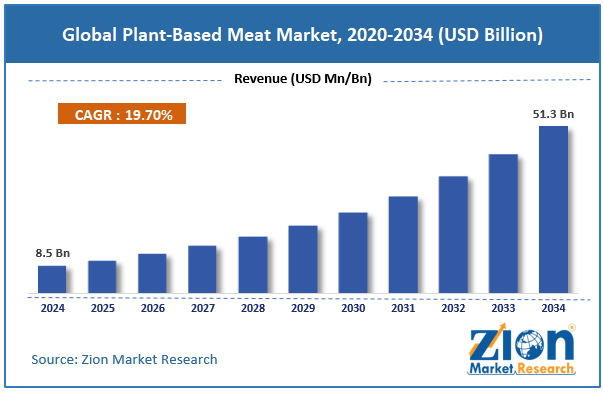
The global plant-based meat market size was worth around USD 8.5 billion in 2024 and is predicted to grow to around USD 51.3 billion by 2034 with a compound annual growth rate (CAGR) of roughly 19.7% between 2025 and 2034.
Plant-Based Meat Market: Overview
Plant-based meat can be defined as any type of plant-based foods that imitate the taste, smell, flavor, nutrition, and overall quality of animal meats through the use of plant-derived ingredients. Such products can be produced from ingredients such as soy protein, pea protein, wheat gluten, mushrooms, legumes, and vegetable oil using food technology to reproduce beef, chicken, pork, and other meats. Plant-based meat products are extensively used by people following a vegetarian and/or vegan diet who prefer healthier, more ecological options over traditional meat products. This segment of the market has become extremely popular owing to growing public concern about health, animal welfare, the environment, and further developments in the plant-based meat market.
Key Insights
- As per the analysis shared by our research analyst, the global plant-based meat market is estimated to grow annually at a CAGR of around 19.7% over the forecast period (2025-2034).
- In terms of revenue, the global plant-based meat market size was valued at around USD 8.5 billion in 2024 and is projected to reach USD 51.3 billion by 2034.
- Technological advancements in food processing are expected to propel the plant-based meat market over the projected period.
- Based on the source, the soy segment held the largest market share of over 48%.
- Based on the product, the burgers segment holds the largest market share over the projected period.
- Based on the type, the chicken segment holds a prominent revenue share in 2024.
- Based on the end user, the HORECA (Hotel/Restaurant/Café) segment holds a prominent revenue share in 2024.
- Based on the storage, the frozen plant-based meat segment holds a prominent revenue share in 2024.
- Based on region, North America captures the largest market share in 2024 of 39%.
Impact of the USA-Israel War on Iran on the Plant-Based Meat Market
The ongoing clash between the USA-Israel coalition and Iran indirectly poses challenges for the global plant-based meat industry, disrupting supply chains across energy, agriculture, and food sectors. The increase in oil and gas prices and disruptions to fertilizer exports from the Strait of Hormuz have added to the higher production and logistics costs of essential inputs like soy, peas, wheat, and vegetable oil for manufacturing plant-based meats. Higher logistics costs and inflation may reduce consumers' expenditures on premium alternative protein foods, especially among price-sensitive consumers. Nonetheless, prolonged uncertainty in the traditional meat supply chain and growing concerns over food security may force people to adopt alternative protein sources as well.
Plant-Based Meat Market: Dynamics
Growth Drivers
How does the rise of flexitarian and vegan diets drive the plant-based meat market?
The popularity of flexitarianism and veganism is one of the most powerful growth drivers of the global plant-based meat industry, as it creates an additional need for alternative protein solutions that provide a meat-like taste and texture experience, align with people's health-related and ethical considerations, and minimize negative environmental impacts. Flexitarians represent the most significant group of potential customers, as they buy plant-based meat products relatively often compared to vegetarians. According to research conducted in 2024 within the U.S. National Library of Medicine project, the percentage of American adults who consume a plant-based diet has increased from 14.4% to 17.2% over recent years, indicating a trend towards reduced meat consumption.
According to the Gallup report, only 4% of Americans are vegetarians and 1% are vegans; however, a larger part is trying to minimize their consumption of red meat due to health and sustainability issues. Moreover, governmental authorities admit changes in eating habits. In particular, the USDA National Agricultural Library reports that there is increasing interest in vegetarian, vegan, pescatarian, and semi-vegetarian diets. Besides, in the context of the USDA UK market overview, it was noted that plant-based foods are especially favored by young and urban populations, as they believe they are more sustainable and healthier than meat.
Additionally, industry sales data shows the effect of consumers' dietary changes on industry sales. Thus, according to data from the Good Food Institute, the U.S. retail market value of plant-based foods was $3.9 billion in 2017 and approximately $7.9 billion in 2025. Finally, some companies cite the growing number of flexitarian consumers as the key to success. For instance, Beyond Meat has repeatedly admitted that meat consumers seeking alternatives are its main clients.
Besides, the representatives of Impossible Foods stated in their executive statements that they see an opportunity to develop the product by targeting regular meat consumers. Food service development can be another instance of flexitarians' role in market growth. In particular, industry data show that plant-based proteins were featured on 31.5% of fast-food restaurant menus in 2022. Thus, the adoption of flexitarianism and veganism expands the target audience and promotes innovation and market development.
Restraints
How does the high product pricing hamper the growth of the plant-based meat industry?
One major factor limiting the development of the plant-based meat products industry is cost. Plant-based meat products cost too much, as they are not widely available and cannot be adopted due to their higher prices compared to competing products. This is mainly because while the production of ordinary meat products relies on traditional farming and processing techniques, the production of plant-based meat requires costly materials such as pea protein and soy isolates, as well as advanced production technologies. Hence, manufacturing processes involving such costly materials will definitely lead to end products that are more expensive than those of competitors. The products' high price means customers will view them as luxurious rather than everyday items. This aspect leads consumers to avoid the product regularly. Besides, the high prices of the products limit their access during inflationary times.
Moreover, the difficulty of offering more plant-based meat products is evident, as it results in lower sales revenue. Finally, consumers in emerging markets are also less likely to adopt the product than consumers of ordinary meat products due to lower disposable income.
Opportunities
Why does the growing development by the market players under climate strategies offer a lucrative opportunity for the plant-based meat market?
The certification of Beyond Meat products like the Beyond Burger IV and Beyond Steak as climate solutions within the Exponential Roadmap Initiative and Oxford Net Zero frameworks provides an unprecedented opportunity for the growth of the global plant-based meat market. This development enhances the environmental credentials of plant-based meat products, as they can achieve greater than 50 percent emissions reduction relative to meat alternatives.
As governments, corporates, and consumers become increasingly concerned about achieving carbon-reduction targets and sustainability goals, low-emission certified food products will see increased consumer uptake across retail, food service, and institutions. The development is likely to drive demand for these plant-based products among restaurants, grocery stores, and corporate food purchasing organizations. Consumers concerned about environmental issues and willing to buy environmentally friendly meat products are also more likely to be attracted to them.
Challenges
Limited consumer awareness in developing markets poses a significant challenge to the plant-based meat market
Consumers' limited knowledge of alternative protein sources is an essential issue affecting the development of the plant-based meat market. It should be noted that many consumers in developing countries are unaware of plant-based alternatives, their advantages, and benefits. At the same time, many traditional cultures have relied on meat in their diets, and awareness of environmental issues is not well developed in such regions. The other problem is that the perception of consumers is that plant-based meat substitutes are luxury and exotic products intended only for rich people. The marketing strategies and campaigns promoting such products are not sufficiently effective in increasing consumer awareness.
Finally, the low purchasing power of consumers and the importance of taste in their buying decisions represent additional factors that impede plant-based meat sales. Thus, consumers' low awareness hinders the industry's development in the target markets.
Plant-Based Meat Market: Report Scope
| Report Attributes | Report Details |
|---|---|
| Report Name | Plant-Based Meat Market |
| Market Size in 2024 | USD 8.5 Billion |
| Market Forecast in 2034 | USD 51.3 Billion |
| Growth Rate | CAGR of 19.7% |
| Number of Pages | 226 |
| Key Companies Covered | Impossible Foods, Beyond Meat, Redefine Meat, Maple Leaf Foods, Kellogg Company, Unilever, Nestlé, Tyson Foods, Conagra Brands, The Vegetarian Butcher, Tofurky, Quorn Foods, Amy's Kitchen, Field Roast, Gardein, Eat Just, Vezlay Foods, GoodDot, Imagine Meats, VBites, and others. |
| Segments Covered | By Source, By Product, By Type, By End User, By Storage, and By Region |
| Regions Covered | North America, Europe, Asia Pacific (APAC), Latin America, Middle East, and Africa (MEA) |
| Base Year | 2024 |
| Historical Year | 2019 - 2023 |
| Forecast Year | 2025 - 2034 |
| Customization Scope | Avail customized purchase options to meet your exact research needs. Request For Customization |
Plant-Based Meat Market: Segmentation
Source Insights
Why does the soy dominate the plant-based meat market?
The soy segment held the largest market share of over 48%. Protein sourced from soy beans has the advantage of being a complete protein, meaning that it contains all the amino acids necessary for the sustenance of life. This is very appealing to consumers seeking a healthy alternative to meat. Furthermore, soy products can be manufactured into different varieties of taste and texture to serve as substitutes for meat foods.
Product Insights
How does the burgers segment capture the largest market share in the plant-based meat market?
The burgers segment holds the largest market share over the projected period. With the rise of vegetarians and vegans due to their health-related choices, people look for satisfactory substitutes to satisfy their nutritional needs while maintaining their health concerns. Being based on the same concept as normal burgers with meat, but made with plants, it becomes a feasible choice.
Type Insights
Does the chicken segment capture the largest market share in the plant-based meat market?
The chicken segment holds a prominent revenue share in 2024. As people become more conscious of health factors, such as levels of saturated fats and cholesterol, they are trying to switch to healthier sources of protein rather than traditional meat products. The levels of saturated fats and cholesterol in plant-based chicken are generally lower than those in regular meat; however, the protein content is about the same.
End User Insights
Does the HORECA (Hotel/Restaurant/Café) segment capture the largest market share in the plant-based meat market?
The HORECA (Hotel/Restaurant/Café) segment holds a prominent revenue share in 2024. As people are turning towards vegetarianism and veganism or want to decrease their meat consumption because of health benefits, restaurants in the HoReCa industry have started introducing meat substitutes made from plants on their menu. It not only provides an opportunity to serve a growing number of customers but also boosts the business's reputation.
Storage Insights
Does the frozen plant-based meat segment capture the largest market share in the plant-based meat market?
The frozen plant-based meat segment holds a prominent revenue share in 2024. With consumers being busier than ever, there is a preference for foods that are convenient to cook and preserve. Frozen vegetarian meat products have an extended shelf life. These products also cook quickly, even when frozen. This makes them perfect for quick meals without sacrificing one’s health or food preferences.
Regional Insights
Why does North America lead the plant-based meat market?
North America captures the largest market share in 2024 of 39%. The factors behind the growth of this sector include increasing demand for health- and sustainability-friendly foods, increased adoption of flexitarian and vegetarian diets, and innovations by food companies. Some regions known for a large market share of meat substitutes include North American countries such as the United States and Canada, where people have greater awareness of sustainability, animal welfare, and the dangers of consuming too much red meat, which can negatively impact their health.
Additional income from meat substitutes in the market can be linked to their availability across different retail outlets, including supermarkets, hypermarkets, fast-food establishments, and even restaurants. Key players in the business have invested in creating products with superior taste, texture, and nutritional value to attract mainstream consumers. Factors contributing to growth include innovations in food technology, increased demand for plant proteins with clean labels, and food companies expanding their retail footprint. Favorable startup ecosystems and food manufacturing innovations also contribute to the dominance of the North American market in the global plant-based meat substitutes market.
Plant-Based Meat Market: Competitive Analysis
The global plant-based Meat market is dominated by players like:
- Impossible Foods
- Beyond Meat
- Redefine Meat
- Maple Leaf Foods
- Kellogg Company
- Unilever
- Nestlé
- Tyson Foods
- Conagra Brands
- The Vegetarian Butcher
- Tofurky
- Quorn Foods
- Amy's Kitchen
- Field Roast
- Gardein
- Eat Just
- Vezlay Foods
- GoodDot
- Imagine Meats
- VBites
The global plant-based meat market is segmented as follows:
By Source
- Soy
- Wheat
- Pea
- Others
By Product
- Burgers
- Patties
- Sausages
- Nuggets
- Tenders & Cutlets
- Grounds
- Others
By Type
- Chicken
- Beef
- Pork
- Fish
- Others
By End User
- Retail
- HORECA (Hotel/Restaurant/Café)
By Storage
- Refrigerated Plant-based Meat
- Shelf-stable Plant-based Meat
- Frozen Plant-based Meat
By Region
- North America
- The U.S.
- Canada
- Mexico
- Europe
- France
- The UK
- Spain
- Germany
- Italy
- Rest of Europe
- Asia Pacific
- China
- Japan
- India
- Australia
- South Korea
- Rest of Asia Pacific
- The Middle East & Africa
- Saudi Arabia
- UAE
- Egypt
- Kuwait
- South Africa
- Rest of the Middle East & Africa
- Latin America
- Brazil
- Argentina
- Rest of Latin America
Table Of Content
Methodology
FrequentlyAsked Questions
Plant-based meat can be defined as any type of plant-based foods that imitate the taste, smell, flavor, nutrition, and overall quality of animal meats through the use of plant-derived ingredients. Such products can be produced from ingredients such as soy protein, pea protein, wheat gluten, mushrooms, legumes, and vegetable oil using food technology to reproduce beef, chicken, pork, and other meats.
Key growth drivers for the plant-based meat market include rising health consciousness, increasing adoption of flexitarian and vegan diets, growing environmental sustainability concerns, continuous product innovation, and expanding availability across retail and foodservice channels.
Major challenges restraining the growth of the plant-based meat market include high product pricing, consumer concerns regarding ultra-processed foods, taste and texture limitations, and limited awareness in developing market.
Based on the type, the chicken segment is expected to dominate the plant-based meat market growth during the projected period.
Emerging trends and innovations impacting the plant-based meat market include the development of clean-label and minimally processed products, advancements in flavor and texture replication technologies, expansion of plant-based chicken and seafood alternatives, use of novel protein sources such as pea, oat, and mycoprotein, and increasing investments in sustainable, low-carbon food production and precision fermentation technologies.
According to the report, the global plant-based meat market size was worth around USD 8.5 billion in 2024 and is predicted to grow to around USD 51.3 billion by 2034.
The global plant-based meat market is expected to grow at a CAGR of 19.7% during the forecast period.
The global plant-based meat industry growth is expected to be led by North America over the forecast period.
The global plant-based meat market is dominated by players like Impossible Foods, Beyond Meat, Redefine Meat, Maple Leaf Foods, Kellogg Company, Unilever, Nestlé, Tyson Foods, Conagra Brands, The Vegetarian Butcher, Tofurky, Quorn Foods, Amy's Kitchen, Field Roast, Gardein, Eat Just, Vezlay Foods, GoodDot, Imagine Meats and VBites among others.
The market report covers the geographical market along with a comprehensive competitive landscape analysis. It also includes cash flow analysis, profit ratio analysis, market basket analysis, market attractiveness analysis, sentiment analysis, PESTLE analysis, trend analysis, SWOT analysis, trade area analysis, demand & supply analysis, Porter’s five forces analysis, and value chain analysis.

HappyClients

