
Photon Counting CT Market Size, Share, Value and Forecast 2034

Photon Counting CT Market By Type (Full-Body Photon Counting CT Systems, Dedicated Head and Neurological Photon Counting CT Systems), By Application (Oncology and Tumor Detection, Cardiology and Cardiovascular Imaging, Neurology and Brain Imaging, Orthopedic and Musculoskeletal Imaging, General Diagnostic Imaging), By End-User (Hospitals and Medical Centers, Diagnostic Imaging and Radiology Centers, Academic and Research Medical Institutions, Specialty Clinical Centers), By Distribution Channel (Direct Manufacturer Sales, Authorized Medical Equipment Distributors, Group Purchasing Organization Procurement, Digital and Online Procurement Channels), and By Region - Global and Regional Industry Overview, Market Intelligence, Comprehensive Analysis, Historical Data, and Forecasts 2026 - 2034
| Market Size in 2025 | Market Forecast in 2034 | CAGR (in %) | Base Year |
|---|---|---|---|
| USD 518.26 Million | USD 3,286.57 Million | 22.39% | 2025 |
Photon Counting CT Industry Perspective:
What will be the size of the photon counting CT market during the forecast period?
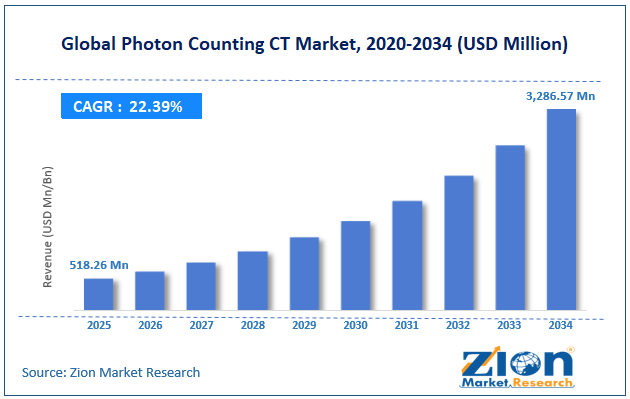
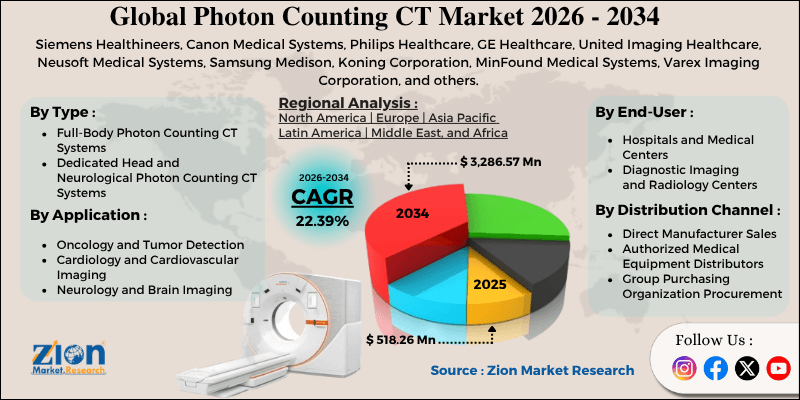
The global photon counting CT market size was valued at approximately USD 518.26 million in 2025 and is projected to reach around USD 3,286.57 million by 2034, growing at a compound annual growth rate of approximately 22.39% between 2026 and 2034.
Key Insights
- As per the analysis shared by our research team, the global photon counting CT market is estimated to grow at a compound annual growth rate of approximately 22.39% during the forecast period from 2026 to 2034.
- In terms of revenue, the global photon counting CT market was valued at approximately USD 518.26 million in 2025 and is projected to reach USD 3,286.57 million by 2034.
- The photon counting CT market is expected to grow strongly due to the superior imaging quality of photon counting technology, rising cases of cancer, cardiovascular and neurological diseases, increasing investment in advanced medical imaging infrastructure, and growing clinical evidence supporting its use across multiple healthcare applications.
- Based on type, full-body photon counting CT systems lead the market because they are widely used for diagnosing different medical conditions, while dedicated head and neurological photon counting CT systems are gaining demand for detailed brain and cranial imaging.
- Based on application, oncology and tumor detection lead the market due to the need for accurate tumor diagnosis, while cardiology and cardiovascular imaging are the fastest-growing segments because of high-quality heart imaging with lower radiation exposure.
- Based on end user, hospitals and medical centers lead the market due to high imaging volumes and advanced healthcare infrastructure, while academic and research institutions are steadily increasing adoption through clinical research.
- Based on the distribution channel, direct manufacturer sales lead the market because photon counting CT systems require specialized installation, training, maintenance, and technical support.
- Based on region, North America leads the global photon counting CT market, while the Asia Pacific is the fastest-growing region due to rising healthcare investments and increasing adoption of advanced diagnostic imaging technologies.
Photon Counting CT Market: Overview
Photon counting computed tomography (PCCT) is an advanced medical imaging technology that produces clearer, more detailed CT images while using less radiation than traditional CT scanners. Unlike conventional CT systems, which combine all X-ray signals into a single image, PCCT detects and measures each X-ray photon individually. This allows doctors to produce sharper images, better identify different types of tissues, and detect small abnormalities more accurately. The technology also supports spectral imaging, which provides additional information that helps improve diagnosis. PCCT uses advanced semiconductor materials, such as cadmium-zinc-telluride and silicon, to convert X-rays directly into electrical signals. This direct process reduces image noise, improves image quality, and delivers reliable results while exposing patients to less radiation. The technology is especially useful for detecting small tumors, examining the heart, brain, bones, and blood vessels, and diagnosing complex medical conditions.
With growing approval from healthcare regulators and increasing adoption by hospitals, photon-counting computed tomography is becoming an important part of modern medical imaging. Rising demand for early disease detection, improved diagnostic accuracy, safer imaging procedures, and continuous advancements in healthcare technology are driving global growth in the photon counting computed tomography market.
The photon counting CT industry is growing rapidly by delivering higher image quality, more accurate diagnoses, and better patient outcomes than conventional CT systems.
Impact of the USA-Israel War on Iran on the Photon Counting CT Market
The photon counting computed tomography market may face short-term supply chain disruptions due to geopolitical tensions involving the United States, Israel, and Iran. However, manufacturers are strengthening supply networks and investing in alternative sourcing strategies to reduce these risks. Strong demand for advanced medical imaging, continuous technological innovation, and growing global adoption are expected to support the market's long-term growth.
Photon Counting CT Market: Technology Roadmap 2025–2034
What is the projected development roadmap for the photon counting CT market over the forecast period?
The photon counting CT market is advancing through improved detector materials, expanded spectral imaging, AI-powered image analysis, and lower system costs, making the technology more accessible to hospitals and imaging centers. The market is expected to grow at a compound annual growth rate of approximately 22.39% over the forecast period, driven by accelerating clinical adoption, evolving reimbursement frameworks, and ongoing refinement of the underlying photon-counting detector and image reconstruction technologies.
The following roadmap outlines key development phases expected through 2034.
2025–2027: Clinical Validation and Initial Commercial Expansion Phase
- Clinical studies are expected to confirm the benefits of photon-counting CT across cancer, heart, and brain imaging, encouraging wider adoption in hospitals worldwide.
- Manufacturers are expected to introduce photon-counting CT systems in different models and price ranges, making the technology accessible to more healthcare providers.
- Artificial intelligence-powered image reconstruction is expected to improve image quality, shorten scan times, enhance workflow efficiency, and support faster, more accurate disease detection in routine clinical practice.
2028–2031: Spectral Imaging Maturity and Broader Clinical Adoption Phase
- Spectral imaging is expected to become a standard feature of photon counting CT, helping doctors better identify tissues, improve disease diagnosis, and support personalized treatment planning.
- Lower equipment costs and stronger clinical evidence are expected to encourage community hospitals and regional imaging centers to adopt photon-counting CT systems.
- Integration with radiomics and AI-based diagnostic tools is expected to improve lesion detection, disease monitoring, and clinical decision-making across multiple medical specialties.
2032–2034: Precision Imaging and Molecular Diagnostics Phase
- Photon counting CT is expected to expand into advanced molecular imaging applications, enabling earlier disease detection, improved tissue characterization, and more precise diagnostics for a wide range of complex medical conditions.
- Smaller, more affordable photon-counting CT systems are expected to expand adoption in emergency departments and point-of-care settings.
- Ultra-low-dose photon counting CT protocols are expected to significantly reduce radiation exposure while maintaining excellent image quality, making the technology increasingly suitable for pediatric imaging, routine screening, and other radiation-sensitive clinical applications.
Photon Counting CT Market: Dynamics
Growth Drivers
What is driving growth in the photon counting CT market as demand for advanced imaging rises?
The photon counting CT market is growing rapidly as hospitals and healthcare providers increasingly adopt advanced imaging systems that deliver clearer images with lower radiation exposure than traditional CT scanners. This technology helps doctors detect diseases more accurately while improving patient safety. The rising number of cancers, heart disease, stroke, and bone-related conditions is increasing the demand for high-quality diagnostic imaging around the world. Photon counting CT can more clearly identify small tumors, vascular abnormalities, and other medical conditions, helping doctors make faster, more accurate treatment decisions. Hospitals are also investing in advanced imaging technologies to improve patient care, reduce diagnostic errors, and meet higher healthcare standards. Growing clinical evidence of the benefits of photon-counting CT is encouraging more healthcare providers to replace older CT systems with this next-generation technology.
In addition, improvements in reimbursement policies for advanced imaging procedures and ongoing technological advancements are making these systems more attractive to hospitals. Increasing investments in healthcare infrastructure and the growing focus on early disease detection are expected to further drive the global photon counting CT market during the forecast period.
Growing clinical demand for precision imaging tools is driving the photon counting CT market.
The growing focus on precision medicine is creating new opportunities for the photon counting CT market across cancer care, heart disease, and neurological treatment. Doctors are increasingly looking for imaging technologies that provide more detailed information than traditional CT scanners. Photon counting CT can produce clearer images while also revealing the composition of tissues, blood vessels, and organs, helping doctors make more accurate diagnoses. In cancer care, it helps detect tumors earlier, determine disease stage more accurately, monitor treatment response, and identify signs of recurrence early.
In cardiology, it provides detailed images of the coronary arteries and plaque, helping doctors better assess heart disease and select the most appropriate treatment. It is also useful in brain imaging by improving the detection of neurological conditions. As healthcare providers continue to focus on personalized treatment and early disease detection, the demand for advanced imaging technologies is increasing. More hospitals and specialty clinics are expected to adopt photon-counting CT systems, as they improve diagnostic accuracy, support better treatment planning, and enhance patient outcomes, creating strong long-term growth opportunities for the global market.
Restraints
Very high equipment costs and limited manufacturing capacity remain significant barriers in the photon counting CT market.
The photon counting CT market faces several challenges that may slow its growth, particularly because these advanced imaging systems are expensive to purchase, install, and maintain. Many community hospitals and smaller healthcare centers have limited budgets, making it difficult to invest in this new technology. In addition, only a few companies currently manufacture photon-counting CT systems, which limits product availability and increases costs. Another challenge is the shortage of trained radiologists and technicians who can operate these systems and interpret advanced imaging results. Hospitals also need specialized engineers, replacement parts, and technical support to keep equipment running efficiently, all of which add to overall operating expenses. These factors slow adoption, particularly in developing regions and smaller healthcare facilities.
However, ongoing technological improvements, increasing production capacity, and growing clinical experience are expected to reduce costs and improve accessibility over time. As more healthcare professionals receive training and technology becomes more widely available, photon-counting CT systems are expected to reach more hospitals and diagnostic imaging centers worldwide.
Opportunities
How are expanding clinical applications and emerging markets creating opportunities in the photon counting CT market?
The photon counting CT market offers strong growth opportunities as healthcare providers continue to invest in advanced diagnostic imaging technologies. In cancer care, photon counting CT helps detect very small tumors, more accurately determine cancer stage, and monitor how well treatments are working. These advantages make it valuable for diagnosing lung, liver, and other cancers at an early stage. In cardiology, the technology provides detailed images of the heart and coronary arteries, helping doctors detect plaque buildup and, in many cases, diagnose heart disease without invasive procedures. This improves patient comfort while supporting better treatment decisions. The growing demand for early disease detection and personalized healthcare is expected to drive the adoption of photon-counting CT across hospitals and specialty clinics. Emerging economies such as China, India, Brazil, South Korea, and the Gulf countries are also investing heavily in modern healthcare infrastructure, creating new opportunities for advanced imaging equipment. At the same time, manufacturers are developing more affordable and efficient photon-counting CT systems, making the technology accessible to a broader range of healthcare facilities and supporting long-term global market growth.
Challenges
What challenges does the photon counting CT market face in sustaining growth and achieving widespread clinical adoption?
The photon counting CT market faces several challenges that may slow its wider adoption. One of the biggest barriers is the high cost of purchasing and installing these advanced imaging systems, making it difficult for many hospitals to justify the investment. Healthcare providers also need clear evidence that the technology can improve patient care, reduce repeat scans, and deliver long-term financial benefits. In many countries, reimbursement policies for advanced imaging are still developing, which can limit adoption.
Another challenge is the need for more trained radiologists, technicians, and medical physicists to operate photon-counting CT systems and accurately interpret results. Manufacturers must also obtain regulatory approvals for new clinical applications, a process that can take time and require extensive testing. In addition, photon-counting CT competes with conventional CT technologies that offer advanced imaging features at a lower cost. These factors continue to pose challenges, though ongoing research and technological advances are expected to support future market growth.
Photon Counting CT Market: Report Scope
| Report Attributes | Report Details |
|---|---|
| Report Name | Photon Counting CT Market |
| Market Size in 2025 | USD 518.26 Million |
| Market Forecast in 2034 | USD 3,286.57 Million |
| Growth Rate | CAGR of 22.39% |
| Number of Pages | 228 |
| Key Companies Covered | Siemens Healthineers, Canon Medical Systems, Philips Healthcare, GE Healthcare, United Imaging Healthcare, Neusoft Medical Systems, Samsung Medison, Koning Corporation, MinFound Medical Systems, Varex Imaging Corporation, and others. |
| Segments Covered | By Type, By Application, By End-User, By Distribution Channel, and By Region |
| Regions Covered | North America, Europe, Asia Pacific (APAC), Latin America, Middle East, and Africa (MEA) |
| Base Year | 2025 |
| Historical Year | 2020 - 2024 |
| Forecast Year | 2026 - 2034 |
| Customization Scope | Avail customized purchase options to meet your exact research needs. Request For Customization |
Photon Counting CT Market: Segmentation
The global photon counting CT market is segmented by type, application, end user, distribution channel, and region.
What makes full-body photon-counting CT systems the dominant type in the photon counting CT market?
Based on type, the global photon counting CT market is classified into full-body photon counting CT systems and dedicated head and neurological photon counting CT systems. Full-body photon counting CT systems hold about 78% of the market share, leading due to their ability to support a wide range of imaging applications across multiple hospital departments. Dedicated head and neurological photon-counting CT systems account for around 22%. They are among the fastest-growing segments due to increasing demand for high-resolution brain and neurological imaging.
How does oncology maintain its leading position in the photon counting CT market?
Based on application, the photon counting CT market is divided into oncology and tumor detection, cardiology and cardiovascular imaging, neurology and brain imaging, orthopedic and musculoskeletal imaging, and general diagnostic imaging. Oncology and tumor detection account for approximately 35% of the global market share, driven by the need for early cancer detection and accurate treatment monitoring. Cardiology and cardiovascular imaging hold around 26% share. It is the fastest-growing segment due to rising demand for detailed heart imaging with lower radiation exposure.
What makes hospitals the dominant end users in the photon counting CT market?
Based on end-user, the market is categorized into hospitals and medical centers, diagnostic imaging and radiology centers, academic and research medical institutions, and specialty clinical centers. Hospitals and medical centers lead with about 65% share because they perform high volumes of imaging procedures and invest heavily in advanced CT systems. Diagnostic imaging and radiology centers hold around 19% share. They are growing rapidly as imaging providers upgrade to advanced diagnostic technologies.
How do direct manufacturer sales shape the distribution landscape of the photon counting CT market?
Based on distribution channel, the photon counting CT industry is segregated into direct manufacturer sales, authorized medical equipment distributors, group purchasing organization procurement, and digital and online procurement channels. Direct manufacturer sales account for about 60% of the market, leading because these advanced systems require installation, training, maintenance, and long-term technical support. Authorized medical equipment distributors hold around 24% share. They are expanding steadily, particularly in emerging markets where local distribution networks support wider technology adoption.
Photon Counting CT Market: Regional Analysis
Why is North America leading the global photon counting CT market?
The North American photon counting CT market leads the global market and is expected to grow at a CAGR of around 8.3% during the forecast period. The United States is the largest market in the region because of its advanced healthcare infrastructure, strong investment in medical imaging technology, and early adoption of innovative diagnostic equipment. Many leading hospitals, cancer centers, and research institutions across the country have already begun using photon-counting CT systems to improve disease detection and patient care. The growing demand for early diagnosis of cancer, heart disease, and neurological disorders is further supporting market growth. Canada is also contributing by increasing investments in healthcare modernization, medical research, and advanced diagnostic imaging. Several hospitals and research centers are adopting photon-counting CT to improve imaging quality and support better clinical outcomes.
Mexico is gradually emerging as a promising market, supported by rising investments in private hospitals and advanced healthcare services. The presence of major medical imaging equipment manufacturers, well-established distribution networks, and skilled healthcare professionals further strengthens the regional market. Continuous technological innovation, favorable reimbursement policies, and rising healthcare spending are expected to support long-term growth in the photon counting CT market across North America.
What makes Asia Pacific the fastest-growing region in the photon counting CT market?
The Asia Pacific photon counting CT market is one of the fastest-growing regional markets and is expected to grow at a CAGR of around 10.2% during the forecast period. China is the largest market in the region due to rapid healthcare modernization, increasing investments in advanced medical imaging, and a growing number of patients with cancer, heart disease, and other chronic conditions. Government support for hospital upgrades and the expansion of healthcare infrastructure is further driving the adoption of photon-counting CT systems. Japan is another major market, supported by its advanced healthcare system, strong focus on medical technology, and early adoption of innovative imaging solutions.
South Korea is also experiencing steady growth, as both public and private hospitals continue to invest in advanced diagnostic equipment to improve patient care. India offers significant long-term growth opportunities due to expanding healthcare infrastructure, rising medical tourism, and increasing investments by private hospitals in advanced imaging technologies. Countries such as Australia, Singapore, Thailand, and Indonesia are also contributing to regional growth through higher healthcare spending and greater awareness of next-generation diagnostic imaging. Continuous technological advancements and the increasing demand for accurate disease diagnosis are expected to drive strong market growth across the Asia Pacific.
Recent Market Developments
- In March 2026, GE HealthCare received U.S. FDA 510(k) clearance for its Photonova Spectra photon counting CT system, becoming the second major global manufacturer to commercialize photon counting CT technology after Siemens Healthineers.
Photon Counting CT Market: Competitive Analysis
The leading players in the global photon counting CT market are:
- Siemens Healthineers
- Canon Medical Systems
- Philips Healthcare
- GE Healthcare
- United Imaging Healthcare
- Neusoft Medical Systems
- Samsung Medison
- Koning Corporation
- MinFound Medical Systems
- Varex Imaging Corporation
The global photon counting CT market is segmented as follows:
By Type
- Full-Body Photon Counting CT Systems
- Dedicated Head and Neurological Photon Counting CT Systems
By Application
- Oncology and Tumor Detection
- Cardiology and Cardiovascular Imaging
- Neurology and Brain Imaging
- Orthopedic and Musculoskeletal Imaging
- General Diagnostic Imaging
By End-User
- Hospitals and Medical Centers
- Diagnostic Imaging and Radiology Centers
- Academic and Research Medical Institutions
- Specialty Clinical Centers
By Distribution Channel
- Direct Manufacturer Sales
- Authorized Medical Equipment Distributors
- Group Purchasing Organization Procurement
- Digital and Online Procurement Channels
By Region
- North America
- The U.S.
- Canada
- Mexico
- Europe
- France
- The UK
- Spain
- Germany
- Italy
- Rest of Europe
- Asia Pacific
- China
- Japan
- India
- Australia
- South Korea
- Rest of Asia Pacific
- The Middle East & Africa
- Saudi Arabia
- UAE
- Egypt
- Kuwait
- South Africa
- Rest of the Middle East & Africa
- Latin America
- Brazil
- Argentina
- Rest of Latin America
Table Of Content
Methodology
FrequentlyAsked Questions
Photon counting computed tomography (PCCT) is an advanced medical imaging technology that produces clearer, more detailed CT images while using less radiation than traditional CT scanners. Unlike conventional CT systems, which combine all X-ray signals into a single image, PCCT detects and measures each X-ray photon individually.
The global photon counting CT market is expected to grow due to the superior imaging performance of photon counting technology, rising cancer and cardiovascular disease cases, increasing investment in advanced radiology infrastructure, expanding clinical evidence, and improved reimbursement support for advanced imaging procedures.
According to research, the global photon counting CT market was valued at approximately USD 518.26 million in 2025 and is projected to reach approximately USD 3,286.57 million by 2034.
The compound annual growth rate of the photon counting CT market is expected to be approximately 22.39% from 2026 to 2034.
North America is expected to lead the global photon counting CT market throughout the forecast period, driven by the presence of world-leading academic medical centers that have pioneered clinical adoption, strong institutional imaging investment capacity, and established reimbursement pathways for advanced computed tomography procedures.
The major players in the global photon counting CT market include Siemens Healthineers, Canon Medical Systems, Philips Healthcare, GE Healthcare, United Imaging Healthcare, Neusoft Medical Systems, Samsung Medison, Koning Corporation, MinFound Medical Systems, and Varex Imaging Corporation.
The report examines key aspects of the photon counting CT market, including technology drivers, adoption barriers, clinical application opportunities, competitive landscape dynamics, detailed regional market performance analysis, and a comprehensive forward-looking outlook across all major system types, clinical applications, end-user segments, distribution channels, and geographic regions through 2034.
The photon counting CT market requires stakeholders to invest in research and development, expand clinical partnerships, strengthen after-sales support, improve affordability, and integrate artificial intelligence to enhance imaging performance, accelerate adoption, and maintain a competitive advantage.
The photon counting CT market value chain includes raw material and semiconductor suppliers, detector and component manufacturing, CT system assembly, software development, regulatory approvals, distribution, installation, clinical training, and after-sales maintenance and technical support.
The photon counting CT market is led by direct manufacturer sales, as hospitals prefer purchasing these advanced imaging systems directly from manufacturers for installation, training, maintenance, software updates, and long-term technical support.

HappyClients