
Pasta And Noodles Market Size, Growth, Global Trends, Forecast 2034

Pasta And Noodles Market By Product (Dried, Instant and Frozen/Canned), By Distribution Channel (Offline and Online) and By Region - Global and Regional Industry Overview, Market Intelligence, Comprehensive Analysis, Historical Data, and Forecasts 2025 - 2034
| Market Size in 2024 | Market Forecast in 2034 | CAGR (in %) | Base Year |
|---|---|---|---|
| USD 87.8 Billion | USD 136.3 Billion | 4.5% | 2024 |
Pasta And Noodles Industry Perspective:
What will be the size of the global pasta and noodles market during the forecast period?
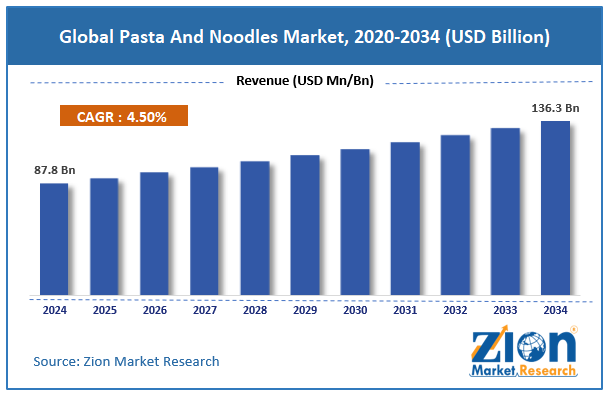
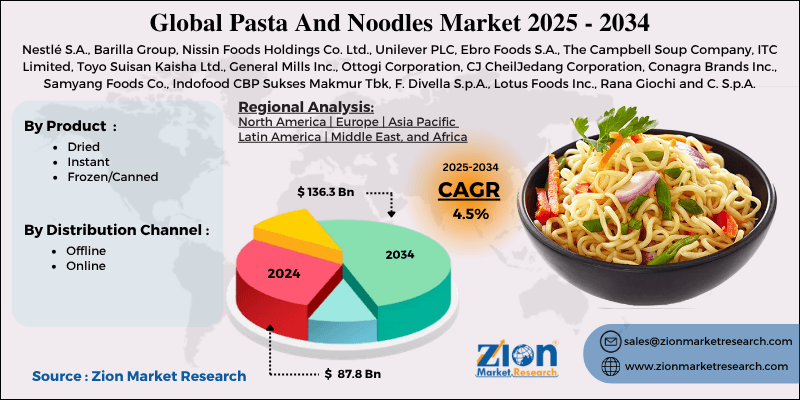
The global pasta and noodles market size was worth around USD 87.8 billion in 2024 and is predicted to grow to around USD 136.3 billion by 2034 with a compound annual growth rate (CAGR) of roughly 4.5% between 2025 and 2034.
Key Insights
- As per the analysis shared by our research analyst, the global pasta and noodles market is estimated to grow annually at a CAGR of around 4.5% over the forecast period (2025-2034).
- In terms of revenue, the global pasta and noodles market size was valued at around USD 87.8 billion in 2024 and is projected to reach USD 136.3 billion by 2034.
- Growing urban population and busy lifestyle is expected to propel the pasta and noodles market over the projected period.
- Based on the product, the instant segment captures the largest market share in 2024 of 54%.
- Based on the distribution channel, the offline segment captures the largest revenue share in 2024 of 92%.
- Based on region, Europe accounted for the largest market share of 41% in 2024.
Pasta And Noodles Market: Overview
Pasta and noodles are food products made mainly from unleavened dough containing wheat flour (such as durum wheat flour and white flour), water, and other ingredients, such as eggs. Although pasta is an important ingredient in Italian cuisine, with shapes such as spaghetti, penne, and fusilli, noodles are Asian dishes with a long, thin shape. Pasta and noodles are available in three types: fresh, dried, and instant. The popularity of pasta and noodles is explained by their multiple uses, low prices, preservation options, and ease of cooking.
Impact of the USA-Israel War on Iran on the Pasta And Noodles Market
The current war between the USA and Israel targeting Iran (2026) is significantly affecting the global pasta and noodle market indirectly because of the increases in energy prices and logistical issues. Energy prices have increased significantly due to disruptions in the transport routes for vital products such as crude oil, particularly in the Strait of Hormuz, where most of the world's crude oil passes, resulting in higher fuel and electricity costs during the processing and distribution of food. On the other hand, fertilizer prices have been significantly affected by export restrictions and rising input costs, thereby driving up wheat costs a crucial ingredient for pasta and noodle manufacture.
As a result, this trend has driven global food prices up by about 2.4% in 2026 and might lead to an even higher price rise should this war escalate. In addition to this issue, there will be interruptions in the supply of raw materials and shipping costs. The effect of this issue will result in higher manufacturing costs for pasta and noodles, thereby increasing retail prices and lowering consumer demand.
Pasta And Noodles Market: Dynamics
Growth Drivers
Why does the rising demand for convenience foods drive the pasta and noodles market?
The increasing demand for convenience foods is another factor driving the growth of the pasta and noodles market, as these products are designed to make cooking faster, easier, and less complicated. The modern lifestyle is characterized by tight schedules, work overload, and busy household members who want to cook quickly without sacrificing flavor or nutritional value. Pasta and noodles satisfy customers because the preparation process takes less than half an hour and does not require advanced culinary skills.
Apart from quickness, the convenience aspect also covers the availability and reliability of products. Noodles and instant pasta products have a longer shelf life, are easy to store, and can be bought at almost all supermarket chains and online platforms. It provides customers with an excellent opportunity to buy products that can serve as alternative dinner ideas at night. Finally, there is constant innovation in convenience food products. Different flavors, healthier versions of noodles and pasta, and innovative packaging options provide customers with many more ways to prepare food and enjoy a meal.
Restraints
Growing health concerns hamper the industry growth
Health issues continue to grow and are significantly impacting the pasta and noodles market, negatively affecting growth prospects, as backed by government data on citizens' health and diets. According to the statistics gathered by the government in India, there has been an increase in the number of lifestyle-associated disorders caused by improper eating habits. As indicated by the NFHS-5, around 24% of women and 23% of men have either excess weight or are suffering from obesity. In particular, obesity was diagnosed in 6.4% of females and 4.0% of males. Importantly, government data suggests that poor dietary habits, driven by increased consumption of processed foods, are the major factors behind the current trend. As pasta and instant noodles are processed and refined carbohydrate foods, they are now considered to contribute to this issue.
Also, dietary data from nutrition studies in the country revealed that the Indian diet is rich in carbohydrates, with cereals accounting for up to 51% of total energy consumed in the urban environment and even higher in the rural population. This means that continued consumption of foods like pasta and noodles may lead to health problems due to increased carbohydrate intake.
Moreover, instant noodles have long been criticized for containing excessive amounts of sodium, fat, and refined carbs while lacking fiber and other important nutrients. In particular, the consumption of these foods has been linked to the development of obesity and metabolic disorders such as high blood sugar. As evidenced by the data, increased consumption of ultra-processed foods led to a rise of 25% in the prevalence of overweight and obesity among people during the last decade. In light of the high rate of diabetes (9-10%) among Indian residents, various governmental and health organizations promote healthier eating practices and encourage people to cut back on processed foods.
Opportunities
Why do rapid urbanization and changing lifestyles offer a lucrative opportunity for the pasta and noodles market?
The high rate of urbanization and lifestyle changes represent an excellent opportunity for the development of the pasta and noodles industry, given their impact on the target audience's eating habits and shopping practices. In cases where the population moves from rural areas to cities (especially in developing nations such as India and China), there appears to be a trend towards shorter lives with tight schedules that include working hours and commuting. The fast pace of urban life means people spend less time cooking, which is another direct growth driver for the pasta and noodles industry. The rapid development of cities results in a higher proportion of couples who work and live independently, thus expanding their income opportunities while simultaneously reducing their time for cooking. Under such conditions, people search for products that can be made quickly and meet the demands for both taste and price, which can be achieved with pasta and noodles.
Moreover, as urban areas develop, the target audience's access to grocery shops improves, as they may visit supermarkets, corner stores, and online vendors that effectively promote pasta and noodle products through efficient advertising. Another reason for the high consumption of such products is the availability of global cuisine.
Challenges
Why do the changing consumer preferences pose a significant challenge to the pasta and noodles market?
The changing preferences of consumers pose challenges for the pasta and noodle markets, driven by shifts in refined carbohydrate and sodium intake, particularly in instant noodles, as well as a tendency to favor whole foods and minimize the use of additives. Firstly, there is a growing concern about health and wellness, with consumers demanding protein- and fiber-enriched foods and products free of refined carbs. Traditional pasta and many instant noodles do not meet these criteria, prompting consumers to turn to foods made from wholegrains and natural ingredients, such as millet-based items or vegan alternatives. In addition, this issue reduces demand for regular pasta and requires substantial investments in its modification and innovation.
Furthermore, the trend towards minimal food processing is an emerging threat to the market in question, as pasta and noodles are considered processed or highly processed products. The growing tendency to consume healthy food and prepare meals at home makes consumers reluctant to eat instant or other highly processed foods. Moreover, the increasing interest of consumers in new cuisines and foods, brought about by globalization, presents both an opportunity to expand the market and additional competition from other types of foods, including salads, ready-to-eat meals, traditional dishes, and grain bowls.
Lastly, the combination of rising price sensitivity and changing customer preferences results in a decline in pasta consumption as an affordable, easy-to-prepare product, due to consumers' unwillingness to accept foods with less-than-optimal nutritional value and composition.
Pasta And Noodles Market: Report Scope
| Report Attributes | Report Details |
|---|---|
| Report Name | Pasta And Noodles Market |
| Market Size in 2024 | USD 87.8 Billion |
| Market Forecast in 2034 | USD 136.3 Bllion |
| Growth Rate | CAGR of 4.5% |
| Number of Pages | 225 |
| Key Companies Covered | Nestlé S.A., Barilla Group, Nissin Foods Holdings Co. Ltd., Unilever PLC, Ebro Foods S.A., The Campbell Soup Company, ITC Limited, Toyo Suisan Kaisha Ltd., General Mills Inc., Ottogi Corporation, CJ CheilJedang Corporation, Conagra Brands Inc., Samyang Foods Co., Indofood CBP Sukses Makmur Tbk, F. Divella S.p.A., Lotus Foods Inc., Rana Giochi and C. S.p.A., Kraft Heinz Company, Marico Limited, Symington’s Ltd., and others. |
| Segments Covered | By Product, By Distribution Channel, and By Region |
| Regions Covered | North America, Europe, Asia Pacific (APAC), Latin America, Middle East, and Africa (MEA) |
| Base Year | 2024 |
| Historical Year | 2019 to 2023 |
| Forecast Year | 2025 - 2034 |
| Customization Scope | Avail customized purchase options to meet your exact research needs. Request For Customization |
Pasta And Noodles Market: Segmentation
Product Insights
Why does the instant dominate the pasta and noodles market?
The instant segment captures the largest market share in 2024 of 54%. This growth can be measured by increased sales of ready-to-drink (RTD), tasty, and convenient foods. The convenience of instant noodles makes them easy to consume for people who often travel or work in difficult conditions. For instance, Wow! Momo Foods began marketing its instant noodle product Wow! Noodles in March 2025, when it joined the instant noodle industry. This company adopts this approach to capitalize on the growing demand for quick meals in India.
Distribution Channel Insights
Does the offline distribution channel capture the largest market share in the pasta and noodles market?
The offline segment captures the largest revenue share in 2024 of 92%. The rising number of physical store formats, including supermarkets/hypermarkets, and the availability of a wide range of products are contributing to the segment's growth. In March 2025, the SPAR group in South Africa announced plans to open a premium store format called “SPAR Gourmet” in its supermarkets, with 30 to 40 stores catering to affluent urban consumers.
Regional Insights
Why does Europe lead the pasta and noodles market?
Europe accounted for the largest market share of 41% in 2024. The growth of this sector is greatly fueled by the well-established dietary culture in Europe, where pasta is an essential ingredient in most diets, especially in Italy, Spain, and Germany. This results in continuous low-end demand for the product. Another important contributor to the growth of pasta and noodle consumption is the increasing popularity of convenience foods among city dwellers, which is driving demand for dried and instant varieties. Other important elements include the increased demand for healthier products, such as gluten-free products, whole grains, and fortified pasta and noodles.
Moreover, the advanced retail network, robust marketing practices, and the introduction of premium and diversified products are also contributing to revenue growth in the sector.
Pasta And Noodles Market: Competitive Analysis
The global pasta and noodles market is dominated by players like:
- Nestlé S.A.
- Barilla Group
- Nissin Foods Holdings Co. Ltd.
- Unilever PLC
- Ebro Foods S.A.
- The Campbell Soup Company
- ITC Limited
- Toyo Suisan Kaisha Ltd.
- General Mills Inc.
- Ottogi Corporation
- CJ CheilJedang Corporation
- Conagra Brands Inc.
- Samyang Foods Co.
- Indofood CBP Sukses Makmur Tbk
- F. Divella S.p.A.
- Lotus Foods Inc.
- Rana Giochi and C. S.p.A.
- Kraft Heinz Company
- Marico Limited
- Symington’s Ltd.
The global pasta and noodles market is segmented as follows:
By Product
- Dried
- Instant
- Frozen/Canned
By Distribution Channel
- Offline
- Online
By Region
- North America
- The U.S.
- Canada
- Mexico
- Europe
- France
- The UK
- Spain
- Germany
- Italy
- Rest of Europe
- Asia Pacific
- China
- Japan
- India
- Australia
- South Korea
- Rest of Asia Pacific
- The Middle East & Africa
- Saudi Arabia
- UAE
- Egypt
- Kuwait
- South Africa
- Rest of the Middle East & Africa
- Latin America
- Brazil
- Argentina
- Rest of Latin America
Table Of Content
Methodology
FrequentlyAsked Questions
Pasta and noodles are food products made mainly from unleavened dough containing wheat flour (such as durum wheat flour and white flour), water, and other ingredients, such as eggs.
Key growth drivers for the pasta and noodles market include rising demand for convenience foods, rapid urbanization, increasing disposable incomes, and growing preference for diverse and ready-to-eat meal options.
The major challenges restraining the growth of the pasta and noodles market include rising health concerns over processed and high-carb foods, increasing shift toward healthier alternatives (such as whole grains and millet-based diets), fluctuating wheat and raw material prices, intense competition from substitute convenient foods, and evolving consumer preferences toward fresh and minimally processed meals.
Based on the product, the instant segment is expected to dominate the pasta and noodles market growth during the projected period.
One of the most significant trends is the shift toward healthier alternatives, including gluten-free, high-protein, and fiber-rich products made from lentils, chickpeas, quinoa, and other alternative grains. Consumers are actively seeking better nutritional profiles, pushing manufacturers to diversify beyond traditional wheat-based offerings.
According to the report, the global pasta and noodles market size was worth around USD 87.8 billion in 2024 and is predicted to grow to around USD 136.3 billion by 2034.
The global pasta and noodles market is expected to grow at a CAGR of 4.5% during the forecast period.
The global pasta and noodles industry growth is expected to be led by Europe over the forecast period.
The global pasta and noodles market is dominated by players like Nestlé S.A., Barilla Group, Nissin Foods Holdings Co. Ltd., Unilever PLC, Ebro Foods S.A., The Campbell Soup Company, ITC Limited, Toyo Suisan Kaisha Ltd., General Mills Inc., Ottogi Corporation, CJ CheilJedang Corporation, Conagra Brands Inc., Samyang Foods Co., Indofood CBP Sukses Makmur Tbk, F. Divella S.p.A., Lotus Foods Inc., Rana Giochi and C. S.p.A., Kraft Heinz Company, Marico Limited and Symington’s Ltd. among others.
The market report covers the geographical market along with a comprehensive competitive landscape analysis. It also includes cash flow analysis, profit ratio analysis, market basket analysis, market attractiveness analysis, sentiment analysis, PESTLE analysis, trend analysis, SWOT analysis, trade area analysis, demand & supply analysis, Porter’s five forces analysis, and value chain analysis.

HappyClients

