
Global Operational Analytics Market Size, Share, Growth Analysis Report - Forecast 2034

Operational Analytics Market By Type (Predictive Analytics, Prescriptive Analytics and Descriptive Analytics), By Application (Risk Management, Fraud Detection, Customer Analytics, Supply Chain Management, Asset Management, and Others), By Deployment Mode (On-premises and Cloud), By Industry (BFSI, Healthcare, Retail, Manufacturing, IT & Telecom, Government, Energy & Utilities, and Others), and By Region: Global and Regional Industry Overview, Market Intelligence, Comprehensive Analysis, Historical Data, and Forecasts 2025 - 2034
| Market Size in 2024 | Market Forecast in 2034 | CAGR (in %) | Base Year |
|---|---|---|---|
| USD 16.13 Billion | USD 75.45 Billion | 16.68% | 2024 |
Operational Analytics Market: Industry Perspective
What will be the global Operational Analytics market size during the forecast period?
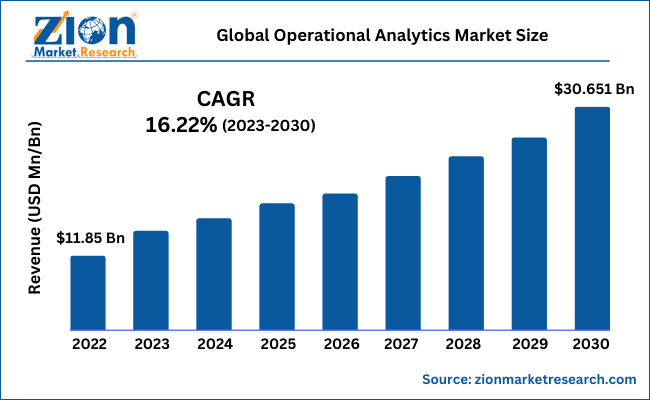
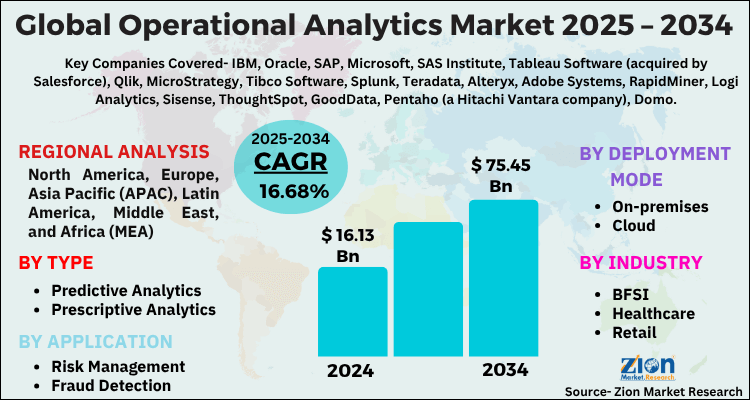
The global operational analytics market size was worth around USD 16.13 billion in 2024 and is predicted to grow to around USD 75.45 billion by 2034 with a compound annual growth rate (CAGR) of roughly 16.68% between 2025 and 2034. The Operational Analytics Market is driven by the growing need for real-time business insights and process optimization, supported by increased data availability and cloud adoption.
The report analyzes the global operational analytics market drivers, restraints/challenges, and the effect they have on the demands during the projection period. In addition, the report explores emerging opportunities in the operational analytics industry.
Operational Analytics Market: Overview
Operational analytics is a part of the modern and data-driven age which harnesses the benefits of advanced data analytics and tools to gain more knowledge or insights. This allows companies and entities to make data-backed decisions in real-time or near real-time. The end goal is to achieve operational efficiency and effectiveness.
The focus lies on analyzing operational data that is generated with the aid of several processes, systems, and activities occurring within an organization. The analyzed information is then put to use to enhance productivity, optimize performance, and streamline operations.
The operational analytics industry deals with companies that provide the necessary tools to put operational analytics into action. It is inclusive of products, solutions, and services and in recent years, the growth has been significant which will continue in the coming years.
Key Insights
- As per the analysis shared by our research analyst, the global operational analytics market is estimated to grow annually at a CAGR of around 16.68% over the forecast period (2025-2034).
- Regarding revenue, the global operational analytics market size was valued at around USD 16.13 Billion in 2024 and is projected to reach USD 75.45 Billion by 2034.
- The operational analytics market is projected to grow at a significant rate due to Growing need for real-time business insights and process optimization fuels market growth. Increased data availability and cloud adoption support expansion.
- Based on Type, the Predictive Analytics segment is expected to lead the global market.
- On the basis of Application, the Risk Management segment is growing at a high rate and will continue to dominate the global market.
- Based on the Deployment Mode, the On-premises segment is projected to swipe the largest market share.
- By Industry, the BFSI segment is expected to dominate the global market.
- Based on region, North America is predicted to dominate the global market during the forecast period.
Operational Analytics Market: Growth Drivers
Increasing volume of data to drive market growth
The global operational analytics market is projected to grow owing to the increasing volume of data across industries. Businesses and corporations are gathering vast amounts of data or information from various sources such as transactional systems, IoT devices, social media, and more.
These sources have become an integral part of company operations. With the changing work scenario and financial dynamics, companies are investing in measures that can help them survive in the long run. They are making use of the information available at hand to make predictions about future trends and business needs.
Operational analytical tools are one of the most preferred solutions that companies use to make data-driven decisions which are known to be an effective way of ensuring accurate predictions. Furthermore, in the current fast-paced world, the need for real-time insights remains unmatched which is leading to more companies opting for operational analytics.
Operational Analytics Market: Restraints
High dependence on data quality to restrict market growth
The accuracy or efficiency of operational analytics is highly influenced by the quality of information available at its disposal for further processing. It relies on information generated from multiple sources rather than focusing on only one source. This can severely impact the performance level and accuracy rate of operational analytics since not every source may convey the same trend in terms of information or data. Organizations have long suffered from data quality issues such as incomplete or inaccurate data, data silos, and lack of standardization which impacts operational analytics industry growth.
Operational Analytics Market: Opportunities
Growing investment toward artificial intelligence to provide growth opportunities
The global operational analytics industry can expect higher growth opportunities owing to the increasing investment in artificial intelligence (AI) and machine learning (ML) which are known to act as the backbone of modern-day analytical tools. For instance, in 2018, Alphabet, the parent company of Google, announced an investment of USD 1.2 billion in the French economy to build an advanced AI research center called the ‘Paris AI Research Center’. The company has acquired several AI companies to expand its revenue base and make meaningful technological contributions.
Operational Analytics Market: Challenges
Skill gap to challenge market growth
Operational analytics makes use of advanced concepts, systems, and tools to perform adequately. However, the operational analytics market is plagued with a severe lack of adequate skill and there is an evident shortage of talent who have expertise in subjects such as data analysis, statistics, data modeling, and domain knowledge. However, the gap is steadily reducing and it may not pose major challenges post the forecast period. Until then, it continues to restrict growth in the industry.
Operational Analytics Market: Segmentation
The Operational Analytics market is segmented by type, application, deployment mode, industry, and region.
Based on Type Segment, the Operational Analytics market is divided into predictive analytics, prescriptive analytics, and descriptive analytics. The predictive analytics segment currently dominates because it enables organizations to forecast future operational trends, identify potential issues before they occur, and make proactive adjustments that improve efficiency and reduce costs. Its ability to turn historical and real-time data into forward-looking insights drives strong adoption across industries and supports overall market expansion. The descriptive analytics segment holds the second-largest position, providing essential visibility into past and current performance through dashboards and reporting that form the foundation for more advanced analytical layers.
Based on Application Segment, the Operational Analytics market is divided into risk management, fraud detection, customer analytics, supply chain management, asset management, and others. The risk management segment leads the market as organizations prioritize real-time identification and mitigation of operational, financial, and compliance risks. This capability is especially critical in regulated industries and helps protect business continuity, thereby fueling sustained demand and market growth. Fraud detection ranks as the second-most prominent application, leveraging pattern recognition and anomaly detection to safeguard transactions and assets, particularly within financial services and retail environments.
Based on Deployment Mode Segment, the Operational Analytics market is divided into on-premises and cloud. The on-premises segment is projected to hold the largest share because many enterprises, especially those handling sensitive operational or regulated data, prefer full control over infrastructure, security, and customization. This preference supports continued investment in internal deployments and contributes to market stability. The cloud segment is the second-largest and fastest-growing, favored for its scalability, lower upfront costs, rapid deployment, and ability to adjust resource consumption according to business needs, which appeals strongly to mid-sized and digitally transforming organizations.
Based on Industry Segment, the Operational Analytics market is divided into BFSI, healthcare, retail, manufacturing, IT & telecom, government, energy & utilities, and others. The BFSI segment dominates due to the intensive need for real-time risk assessment, fraud prevention, customer analytics, and regulatory reporting. Financial institutions generate high volumes of operational data and invest heavily in analytics platforms, which significantly drives overall market growth. The healthcare segment holds the second position, supported by applications in operational efficiency, patient flow optimization, and risk management within clinical and administrative processes.
Operational Analytics Market: Report Scope
| Report Attributes | Report Details |
|---|---|
| Report Name | Operational Analytics Market |
| Market Size in 2024 | USD 16.13 Billion |
| Market Forecast in 2034 | USD 75.45 Billion |
| Growth Rate | CAGR of 16.68% |
| Number of Pages | 210 |
| Key Companies Covered | IBM, Oracle, SAP, Microsoft, SAS Institute, Tableau Software (acquired by Salesforce), Qlik, MicroStrategy, Tibco Software, Splunk, Teradata, Alteryx, Adobe Systems, RapidMiner, Logi Analytics, Sisense, ThoughtSpot, GoodData, Pentaho (a Hitachi Vantara company), Domo, Looker (acquired by Google Cloud), Yellowfin BI, Panorama Software, Information Builders, BOARD International, and others. |
| Segments Covered | By Type, By Application, By Deployment Mode, By Industry, and By Region |
| Regions Covered | North America, Europe, Asia Pacific (APAC), Latin America, The Middle East and Africa (MEA) |
| Base Year | 2024 |
| Historical Year | 2020 to 2023 |
| Forecast Year | 2025 - 2034 |
| Customization Scope | Avail customized purchase options to meet your exact research needs. Request For Customization |
Operational Analytics Market: Regional Analysis
North America is expected to witness the highest growth
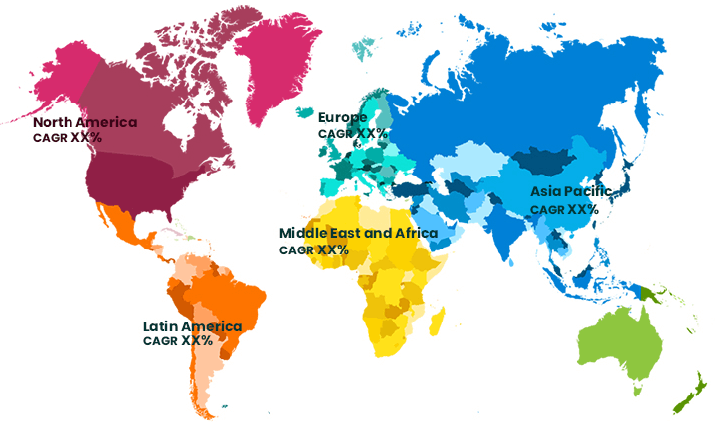
The global operational analytics market is expected to witness the highest growth in North America with the US paving the way for regional dominance. The high CAGR rate is mainly driven by the existence of a mature market that is highly comfortable with advanced technologies and systems. Every small or large company uses some form of operational analytical tool within their budget.
The availability of solutions for companies across size groups has further strengthened the hold in this region. Furthermore, the US is home to some of the largest technological giants that have invested in already accepted operational analytics tools across the globe. The giants such as IBM and Microsoft are investing higher than ever in terms of research & development which could further assert regional growth. The availability of skilled analytics professionals has been key to North America’s expansion.
Recent Developments
- In March 2023, Insight Software, a leading software technology company that provides efficient reporting, analytics, and performance management solutions, announced the expansion of its existing product line of Angles Professional for Oracle. The company has harnessed the benefits of Logi Analytics to enhance its product offerings by creating a tool helpful to all business departments
- In April 2022, Tata Consultancy Services (TCS), India’s leading technology company, announced the launch of a new risk-based monitoring tool that is currently under clinical trials. The system is highly intuitive and agile, which enables intelligent decision-making along with improved study efficacy
- In November 2022, IBM launched Business Analytics Enterprise, a new tool that works against analytical and data silos for higher performance output
Operational Analytics Market: Competitive Analysis
The global operational analytics market is dominated by players like:
- IBM
- Oracle
- SAP
- Microsoft
- SAS Institute
- Tableau Software (acquired by Salesforce)
- Qlik
- MicroStrategy
- Tibco Software
- Splunk
- Teradata
- Alteryx
- Adobe Systems
- RapidMiner
- Logi Analytics
- Sisense
- ThoughtSpot
- GoodData
- Pentaho (a Hitachi Vantara company)
- Domo
- Looker (acquired by Google Cloud)
- Yellowfin BI
- Panorama Software
- Information Builders
- BOARD International
What are the key trends in the Operational Analytics Market?
Rising demand for real-time and predictive insights
Organizations are increasingly prioritizing analytics platforms that deliver immediate visibility into operations and forecast future outcomes. This shift supports faster decision-making, proactive risk mitigation, and continuous process optimization across complex business environments.
Accelerated adoption of cloud and AI-powered analytics
Cloud deployment models combined with artificial intelligence and machine learning are enabling more scalable, automated, and intelligent operational analytics solutions. These technologies reduce infrastructure burdens while enhancing the depth and speed of actionable insights.
The global operational analytics market is segmented as follows;
By Type
- Predictive Analytics
- Prescriptive Analytics
- Descriptive Analytics
By Application
- Risk Management
- Fraud Detection
- Customer Analytics
- Supply Chain Management
- Asset Management
- Others
By Deployment Mode
- On-premises
- Cloud
By Industry
- BFSI
- Healthcare
- Retail
- Manufacturing
- IT & Telecom
- Government
- Energy & Utilities
- Others
By Region
- North America
- The U.S.
- Canada
- Mexico
- Europe
- France
- The UK
- Spain
- Germany
- Italy
- Rest of Europe
- Asia Pacific
- China
- Japan
- India
- Australia
- South Korea
- Rest of Asia Pacific
- The Middle East & Africa
- Saudi Arabia
- UAE
- Egypt
- Kuwait
- South Africa
- Rest of the Middle East & Africa
- Latin America
- Brazil
- Argentina
- Rest of Latin America
Table Of Content
Methodology
FrequentlyAsked Questions
Operational analytics is the application of advanced data analytics tools and techniques to operational data generated by an organization’s processes, systems, and activities. It enables real-time or near real-time insights that support data-backed decisions aimed at improving productivity, optimizing performance, and streamlining operations.
Key growth drivers include the increasing volume of data from transactional systems, IoT devices, and other sources, the growing need for real-time business insights and process optimization, and broader cloud adoption that supports scalable analytics deployments.
According to a study, the global operational analytics market size was worth around USD 16.13 Billion in 2024 and is expected to reach USD 75.45 Billion by 2034.
The global operational analytics market is expected to grow at a CAGR of 16.68% during the forecast period.
North America is expected to dominate the operational analytics market over the forecast period.
Leading players in the global operational analytics market include IBM, Oracle, SAP, Microsoft, SAS Institute, Tableau Software (acquired by Salesforce), Qlik, MicroStrategy, Tibco Software, Splunk, Teradata, Alteryx, Adobe Systems, RapidMiner, Logi Analytics, Sisense, ThoughtSpot, GoodData, Pentaho (a Hitachi Vantara company), Domo, Looker (acquired by Google Cloud), Yellowfin BI, Panorama Software, Information Builders, and BOARD International., among others.
The report explores crucial aspects of the operational analytics market, including a detailed discussion of existing growth factors and restraints, while also examining future growth opportunities and challenges that impact the market.
Major challenges include high dependence on data quality, with issues such as incomplete or inaccurate data, data silos, and lack of standardization, as well as a persistent skills gap in data analysis, statistics, modeling, and domain expertise.
Emerging trends include rising demand for real-time and predictive insights, accelerated adoption of cloud-based and AI-powered analytics platforms, and continuous product enhancements that break down data silos and improve cross-departmental performance management.

HappyClients

