
Global Nuclear Cardiology Market Size, Share, Trends, Growth 2034
Nuclear Cardiology Market By Product Type (SPECT, PET, and Planar Scintigraphy), By Application (Coronary Artery Disease, Cardiomyopathy, Congenital Heart Disease, and Others), By End User (Hospitals, Diagnostic Centers, Ambulatory Surgical Centers, and Others), and Region - Global and Regional Industry Overview, Market Intelligence, Comprehensive Analysis, Historical Data, and Forecasts 2026 - 2034
| Market Size in 2025 | Market Forecast in 2034 | CAGR (in %) | Base Year |
|---|---|---|---|
| USD 2.7 Billion | USD 4.9 Billion | 6.8% | 2025 |
Nuclear Cardiology Industry Perspective:
What will be the size of the global nuclear cardiology market during the forecast period?
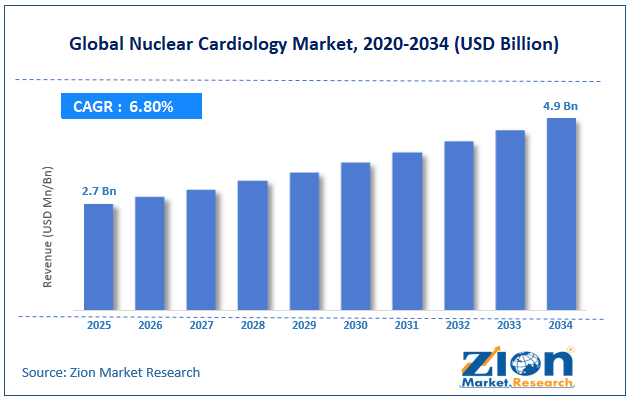
The global nuclear cardiology market size was worth around USD 2.7 billion in 2025 and is predicted to grow to around USD 4.9 billion by 2034, with a compound annual growth rate (CAGR) of roughly 6.8% between 2026 and 2034.
Key Insights
- As per the analysis shared by our research analyst, the global nuclear cardiology market is estimated to grow annually at a CAGR of around 6.8% over the forecast period (2026-2034).
- In terms of revenue, the global nuclear cardiology market size was valued at around USD 2.7 billion in 2025 and is projected to reach USD 4.9 billion by 2034.
- Increasing adoption of myocardial perfusion imaging is expected to drive the nuclear cardiology market.
- Based on the product type, the SPECT segment dominates the nuclear cardiology market with a revenue share of 47.9% in 2025.
- Based on the application, the coronary artery disease segment holds a majority of market share in 2025 of 38.3%.
- Based on the end user, the hospitals segment holds a majority of market share in 2025 of 55.4%.
- Based on region, North America dominates the Nuclear Cardiology market with a revenue share of 34.5% in 2025.
Nuclear Cardiology Market: Overview
Nuclear cardiology is a specialized field of cardiology that uses radioactive substances and nuclear imaging methods to diagnose and monitor heart health. Nuclear cardiology primarily focuses on myocardial blood flow, cardiac function, and the extent of damage and disease in the coronary vessels. MPI (myocardial perfusion imaging), stress tests, and Radionuclide ventriculography are among the most common procedures in nuclear cardiology. These tests use a radiotracer injected into the patient’s bloodstream and scanned with special cameras to create images of the heart. Nuclear cardiology helps diagnose impaired blood flow, heart attacks, and damage to the heart muscle and tissues, guiding treatment.
Impact of the USA-Israel War on Iran on the Nuclear Cardiology Market
The USA-Israel war with Iran may indirectly impact the nuclear cardiology market by disrupting transport in the region and affecting access to healthcare services, supplies, and medical radioisotopes and radiopharmaceuticals. The conflict has already disrupted shipping and logistics in the Middle East, and Iran faces widespread shortages and higher import costs for medical supplies. Nuclear cardiology depends heavily on time-sensitive radioactive elements, and prolonged supply-chain disruptions could raise procurement costs and affect some diagnostic procedures. At the same time, the disruptions may motivate countries and healthcare systems to secure their own radioisotope production and strengthen supply chains, supporting long-term investment in nuclear medicine infrastructure. For example, India continues to develop domestic sources of important medical radioisotopes while also relying on imports as a reserve supply.
Nuclear Cardiology Market: Dynamics
Growth Drivers
How does the rising prevalence of cardiovascular diseases drive the nuclear cardiology market growth?
The increasing prevalence of cardiovascular diseases (CVDs) is a major driver for the nuclear cardiology market because the growing number of patients with coronary artery disease, heart failure, myocardial ischemia, and other cardiac conditions increases the need for early diagnosis, risk assessment, and continuous monitoring. According to the WHO’s 2025 cardiovascular disease fact sheet, CVDs caused an estimated 19.8 million deaths globally in 2022, which accounts for about 32% of all deaths worldwide. About 85% of these deaths were attributed to heart attack and stroke. This growing disease burden increases demand for nuclear cardiology procedures such as myocardial perfusion imaging (MPI), SPECT, and PET, which assess myocardial blood flow and identify areas of low perfusion. The need for early detection is particularly crucial since cardiovascular disease can be asymptomatic before a serious event occurs. The WHO particularly emphasizes early detection and appropriate management to reduce cardiovascular complications. The American Heart Association’s 2025 statistics update reported 941,652 cardiovascular disease-related deaths in the U.S. in 2022, while nearly 47% of U.S. adults had high blood pressure and 42% had obesity, illustrating the significant population at risk of cardiovascular complications. Thus, the growing prevalence of CVDs is expected to increase the utilization of advanced cardiac imaging and functional assessment, supporting demand for nuclear cardiology equipment, radiotracers, imaging systems, and related diagnostic services.
Restraints
The high cost of nuclear imaging systems acts as a major restraint on the growth of the nuclear cardiology industry
The high cost of nuclear imaging systems is a major restraint for the growth of the nuclear cardiology market. Equipment such as SPECT and PET scanners is expensive. Their installation, radiation shielding, maintenance, upgrades, and special facilities add to the cost, which may hinder adoption of nuclear cardiology, especially in small hospitals, diagnostic centers, and healthcare facilities in developing countries. Moreover, recruiting and training technicians and other professionals is also expensive. Thus, the high cost of equipment, installation, and staffing may discourage hospitals and other healthcare institutions with limited budgets from adopting nuclear cardiology and limit market expansion.
Opportunities
How does the increasing use of hybrid imaging offer a lucrative opportunity for the nuclear cardiology market?
The rising number of hybrid scans presents a great opportunity for the nuclear cardiology market. SPECT/CT and PET/CT combine nuclear imaging and CT to better detect abnormalities, improve assessment of myocardial perfusion, and enhance visualization of coronary arteries. Nuclear cardiologists increasingly use these hybrid scans because they enable simultaneous display of functional and anatomical information. Advancements in image reconstruction, attenuation correction, and other hybrid imaging techniques have improved overall diagnostic efficacy and increased clinician confidence. Currently, the adoption of advanced scans to support early, accurate diagnosis of heart disease is gaining significant momentum. This is expected to create new opportunities for nuclear cardiology equipment manufacturers, radiotracer providers, and diagnostic service providers.
Challenges
Why do the complex regulatory requirements pose a significant challenge to the growth of the nuclear cardiology industry?
Complex regulatory requirements constitute a significant challenge to the growth of the nuclear cardiology market. Because it involves radioactive materials, radiopharmaceuticals, specialized equipment, and radiation exposure, nuclear cardiology imposes strict requirements on manufacturers, medical institutions, and radiopharmaceutical suppliers. Nuclear cardiology regulations cover radiation safety, product approval, isotope production, transportation, storage, handling, and disposal of radioactive materials. At the same time, variations in regulatory requirements and standards across countries can raise the cost of bringing radiotracers and nuclear imaging technologies to market and delay their launch. In addition, medical institutions may need special permits, safety equipment, trained personnel, and regular inspections, which increases operational costs and adds to the complexity of adopting and using nuclear cardiology.
Nuclear Cardiology Market: Report Scope
| Report Attributes | Report Details |
|---|---|
| Report Name | Nuclear Cardiology Market |
| Market Size in 2025 | USD 2.7 Billion |
| Market Forecast in 2034 | USD 4.9 Billion |
| Growth Rate | CAGR of 6.8% |
| Number of Pages | 229 |
| Key Companies Covered | GE HealthCare, Curium Pharma, Siemens Healthineers, Canon Medical Systems Corporation, Koninklijke Philips N.V., Advanced Accelerator Applications (a Novartis company), Bracco Imaging S.p.A., Cardinal Health Inc., Eckert & Ziegler Group, Jubilant Radiopharma, Lantheus Holdings Inc., Spectrum Dynamics Medical, Mediso Ltd., Institute of Isotopes Co. Ltd., Digirad Corporation, NorthStar Medical Radioisotopes LLC, SHINE Technologies, IBA (Ion Beam Applications S.A.), SOFIE Biosciences, Positron Corporation, and others. |
| Segments Covered | By Product Type, By Application, By End User, and By Region |
| Regions Covered | North America, Europe, Asia Pacific (APAC), Latin America, Middle East, and Africa (MEA) |
| Base Year | 2025 |
| Historical Year | 2020 - 2024 |
| Forecast Year | 2026 - 2034 |
| Customization Scope | Avail customized purchase options to meet your exact research needs. Request For Customization |
Nuclear Cardiology Market: Segmentation
Product Type Insights
Why does the SPECT segment hold a prominent position in the nuclear cardiology market?
The SPECT segment dominates the nuclear cardiology market with a revenue share of 47.9% in 2025. Growth is driven by the technology’s established role in myocardial perfusion imaging and coronary artery disease diagnosis. The modality lets physicians assess blood flow to the heart muscle and identify areas of reduced perfusion, making it widely used to detect myocardial ischemia and evaluate cardiac function. The high prevalence of cardiovascular disease, the growing need for non-invasive cardiac diagnostics, and the large installed base of SPECT systems in hospitals and diagnostic centers drive revenue growth.
Application Insights
How does the coronary artery disease segment capture the largest share in the nuclear cardiology market?
The coronary artery disease segment holds a majority of market share in 2025 of 38.3%. Nuclear cardiology procedures are used extensively to assess myocardial perfusion, detect ischemia, quantify the extent of coronary artery disease, and evaluate myocardial function. Moreover, the disease remains highly prevalent. According to the 2025 American Heart Association Statistics Update, “the number of people worldwide living with ischemic heart disease (IHD) reached 254.28 million in 2021, whereas IHD was the reason for 8.99 million deaths worldwide that same year.”
End User Insights
How does the hospitals segment capture the largest share in the nuclear cardiology market?
The hospitals segment holds a majority of market share in 2025 of 55.4%. The nuclear cardiology market is growing as more patients need cardiovascular diagnosis, risk assessment, and treatment monitoring. Hospitals are the end users of nuclear cardiology technologies such as CTasCT, PET, and myocardial perfusion imaging because they have the infrastructure and experts to perform and interpret nuclear cardiac imaging procedures, as well as the capacity to manage radiation safety. Moreover, the rising prevalence of coronary artery disease, heart failure, and other cardiovascular problems is contributing to the growing number of cardiac diagnostic procedures in hospitals.
Regional Insights
What factors drive the North America region in the nuclear cardiology market?
North America dominates the nuclear cardiology market with a revenue share of 34.5% in 2025. The region's high prevalence of cardiovascular disease, well-established nuclear medicine infrastructure, widespread adoption of cutting-edge cardiac imaging procedures, and frequent introduction of novel radiopharmaceuticals and imaging technologies drive market growth. The United States alone performs around six million myocardial perfusion imaging procedures annually, making the market for SPECT and PET cardiac imaging highly prominent.
One key development that will propel growth in the cardiac PET imaging market is the recent launch of Flyrcado™ (flurpiridaz F-18). The U.S. FDA approved the drug in September 2024 for PET myocardial perfusion imaging in patients with suspected or confirmed coronary artery disease. With a half-life of 109 minutes, Flyrcado can be supplied from distant centralized pharmacies as a unit dose, eliminating the complex logistical chains used to distribute other PET radiopharmaceuticals. As a result, Flyrcado could increase the availability of cardiac PET imaging in the U.S. As of February 2025, the first patients in the U.S. have received Flyrcado. The drug was launched commercially in select U.S. markets in February 2025, with CMS pass-through effective from April 2025.
Furthermore, in September 2025, GE HealthCare signed a distribution and service agreement with CardioNavix/CDL Nuclear Technologies. This partnership covers nearly 225 U.S. customer locations. It is expected to enable more than 220,000 cardiac PET procedures per year, increasing the availability of cardiac PET across hospitals and outpatient cardiology centers.
Nuclear Cardiology Market: Competitive Analysis
The global nuclear cardiology market is dominated by players like:
- GE HealthCare
- Curium Pharma
- Siemens Healthineers
- Canon Medical Systems Corporation
- Koninklijke Philips N.V.
- Advanced Accelerator Applications (a Novartis company)
- Bracco Imaging S.p.A.
- Cardinal Health Inc.
- Eckert & Ziegler Group
- Jubilant Radiopharma
- Lantheus Holdings Inc.
- Spectrum Dynamics Medical
- Mediso Ltd.
- Institute of Isotopes Co. Ltd.
- Digirad Corporation
- NorthStar Medical Radioisotopes LLC
- SHINE Technologies
- IBA (Ion Beam Applications S.A.)
- SOFIE Biosciences
- Positron Corporation
The global nuclear cardiology market is segmented as follows:
By Product Type
- SPECT
- PET
- Planar Scintigraphy
By Application
- Coronary Artery Disease
- Cardiomyopathy
- Congenital Heart Disease
- Others
By End User
- Hospitals
- Diagnostic Centers
- Ambulatory Surgical Centers
- Others
By Region
- North America
- The U.S.
- Canada
- Mexico
- Europe
- France
- The UK
- Spain
- Germany
- Italy
- Rest of Europe
- Asia Pacific
- China
- Japan
- India
- Australia
- South Korea
- Rest of Asia Pacific
- The Middle East & Africa
- Saudi Arabia
- UAE
- Egypt
- Kuwait
- South Africa
- Rest of the Middle East & Africa
- Latin America
- Brazil
- Argentina
- Rest of Latin America
Table Of Content
Methodology
FrequentlyAsked Questions
Nuclear cardiology is a specialized field of cardiology that uses radioactive substances and nuclear imaging methods to diagnose and monitor heart health. Nuclear cardiology primarily focuses on myocardial blood flow, cardiac function, and the extent of damage and disease in the coronary vessels.
The key growth drivers for the nuclear cardiology market include the rising prevalence of cardiovascular diseases, the growing aging population, increasing demand for early and accurate diagnosis of coronary artery disease, and wider adoption of SPECT and PET myocardial perfusion imaging. Technological advancements in nuclear imaging, increasing use of SPECT/CT and PET/CT hybrid systems, development of new radiotracers, and expansion of hospital and diagnostic infrastructure are also supporting market growth.
The major challenges restraining the growth of the nuclear cardiology market include the high cost of SPECT and PET imaging systems, expensive maintenance and specialized infrastructure requirements, concerns regarding radiation exposure, and limited availability of trained nuclear medicine professionals.
Based on the product type, the SPECT segment is expected to dominate the nuclear cardiology market growth during the projected period.
Emerging trends in the nuclear cardiology market include the increasing adoption of PET myocardial perfusion imaging, advanced SPECT/CT and PET/CT hybrid imaging, and the development of next-generation radiotracers with improved diagnostic capabilities. AI and advanced image-reconstruction technologies are also being integrated into nuclear cardiac imaging to improve image quality, automate analysis, and potentially reduce imaging time and radiation exposure.
According to the report, the global nuclear cardiology market size was worth around USD 2.7 billion in 2025 and is predicted to grow to around USD 4.9 billion by 2034.
The global nuclear cardiology market is expected to grow at a CAGR of 6.8% during the forecast period.
The global nuclear cardiology industry growth is expected to be led by North America over the forecast period.
The global nuclear cardiology market is dominated by players like GE HealthCare, Curium Pharma, Siemens Healthineers, Canon Medical Systems Corporation, Koninklijke Philips N.V., Advanced Accelerator Applications (a Novartis company), Bracco Imaging S.p.A., Cardinal Health Inc., Eckert & Ziegler Group, Jubilant Radiopharma, Lantheus Holdings, Inc., Spectrum Dynamics Medical, Mediso Ltd., Institute of Isotopes Co. Ltd., Digirad Corporation, NorthStar Medical Radioisotopes LLC, SHINE Technologies, IBA (Ion Beam Applications S.A.), SOFIE Biosciences, and Positron Corporation, among others.
The nuclear cardiology market report covers the geographical market along with a comprehensive competitive landscape analysis. It also includes cash flow analysis, profit ratio analysis, market basket analysis, market attractiveness analysis, sentiment analysis, PESTLE analysis, trend analysis, SWOT analysis, trade area analysis, demand & supply analysis, Porter’s five forces analysis, and value chain analysis.

HappyClients