
Global Nanofiltration Membrane Market Size, Share, Trends, Growth and Forecast 2034

Nanofiltration Membrane Market By Type (Polymeric, Ceramic, and Hybrid), By Application (Food & Beverages, Chemicals, Pharmaceutical, Water Treatment, and Others), and Region - Global and Regional Industry Overview, Market Intelligence, Comprehensive Analysis, Historical Data, and Forecasts 2026 - 2034
| Market Size in 2025 | Market Forecast in 2034 | CAGR (in %) | Base Year |
|---|---|---|---|
| USD 1.2 Billion | USD 3.4 Billion | 12.2% | 2025 |
Nanofiltration Membrane Industry Perspective:
What will be the size of the global nanofiltration membrane market during the forecast period?
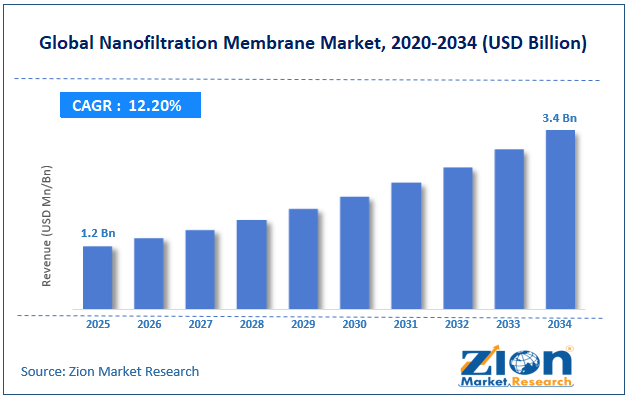
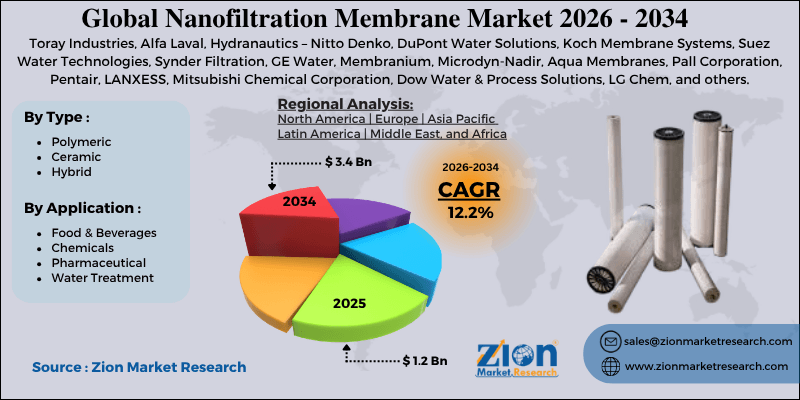
The global nanofiltration membrane market size was worth around USD 1.2 billion in 2025 and is predicted to grow to around USD 3.4 billion by 2034, with a compound annual growth rate (CAGR) of roughly 12.2% between 2026 and 2034.
Key Insights
- As per the analysis shared by our research analyst, the global nanofiltration membrane market is estimated to grow annually at a CAGR of around 12.2% over the forecast period (2026-2034).
- In terms of revenue, the global nanofiltration membrane market size was valued at around USD 1.2 billion in 2025 and is projected to reach USD 3.4 billion by 2034.
- Growing pharmaceutical and biotechnology production is expected to propel the nanofiltration membrane market over the projected period.
- Based on the type, the polymeric segment held the largest revenue share in 2025.
- Based on the application, the water treatment segment holds a majority of market share in 2025.
- Based on region, North America dominates the nanofiltration membrane market with a revenue share of 40% in 2025.
Nanofiltration Membrane Market: Overview
A nanofiltration membrane is a pressure-driven, semi-permeable membrane used in membrane separations to remove a wide range of dissolved multivalent ions, organic matter, color, hardness, microbes, and other undesirable substances from water or aqueous solutions. Nanofiltration membranes have pore sizes of about 0.5 – 2 nm and operate at pressures between those of ultrafiltration and reverse osmosis membranes. A nanofiltration membrane is used in water and waste treatment, potable water production, food and beverage, pharmaceuticals, dairy, chemicals, and desalination processes because it offers a compelling combination of high rejections of targeted contaminants with high water recovery and moderate pressures, compared to reverse osmosis membranes.
Impact of the USA-Israel War on Iran on the Nanofiltration Membrane Market
The effect of the US-Israeli dispute with Iran on the nanofiltration membrane market was moderate and somewhat positive for the industry. Increased tensions and security concerns about the water supply and industrial facilities in the Middle East region create new demand for desalination and water reclamation technologies. These technologies have extensive applications for nanofiltration membranes. However, global shipping constraints and rising energy and raw material costs, especially polymers, also contribute to higher production costs for membrane manufacturers. The growing importance of water as a resource and the expansion of industrial water management activities will affect the market positively despite the short-term disruptions.
Nanofiltration Membrane Market: Dynamics
Growth Drivers
How does the rising demand for advanced water and wastewater treatment drive the nanofiltration membrane market?
One of the key factors driving the growth of the nanofiltration membrane market is the need for advanced water and wastewater treatment, especially among government agencies and municipal authorities, as it helps provide effective ways to meet the need for clean and safe water while addressing environmental regulations. This type of membrane is capable of rejecting hardness, multivalent ions, heavy metals, pesticides, organics, color, and microorganisms by means of lower pressure in comparison with reverse osmosis.
Moreover, the growing need for nanofiltration membranes in municipal drinking water treatment plants, industrial sectors, water reuse, and desalination pretreatment is projected to propel market growth. Rising investments in sustainable water management and circular water reuse across end-use industries, including pharmaceuticals, food and beverage, chemicals, and power, among others, are anticipated to drive demand for nanofiltration membranes across the globe.
Restraints
Why do the high initial investment and installation costs act as a major restraint to the nanofiltration membrane industry's growth?
High capital and installation costs discourage growth in the nanofiltration membrane market. The nanofiltration process requires high capital investments in membranes, pressure vessels, pumps, controls, and other equipment. Moreover, there are also high costs for water pretreatment, cleaning and maintenance of the equipment, and replacement of the membranes. These costs are often too high for small businesses and municipalities, discouraging them from adopting nanofiltration techniques despite their potential advantages.
Opportunities
How does the launch of innovative technology by the key market players offer a lucrative opportunity for the nanofiltration membrane market?
The introduction of innovative technologies by major market players is expected to propel the growth of the nanofiltration membrane market. The development of high-flux thin film composite membranes, anti-fouling and antimicrobial membranes, graphene and nano membranes, ceramic nanofiltration membranes, and membranes with artificial intelligence monitoring systems contributes to higher performance, longer service life, and reduced operating costs of nanofiltration systems. Moreover, such developments allow nanofiltration systems to process a broad range of waters and reduce energy consumption and maintenance costs. These advantages make nanofiltration an attractive technology for municipal, industrial, food and beverage, pharmaceutical, and desalination applications, thus driving market growth. In addition, major manufacturers of nanofiltration membranes are focusing on the continuous development and commercialization of novel membrane technologies, increasing the number of applications and adoption rate of nanofiltration membranes across the globe.
For instance, in December 2025, Toray Industries, Inc., announced that it has developed technology to scale up a new high-durability, high-selectivity nanofiltration membrane element that can efficiently recover high yields of high-purity lithium when recycling automotive lithium-ion batteries. This advance should significantly increase the recovery of lithium that conventional recycling processes largely discard.
Challenges
Competition from alternative membrane technologies poses a significant threat to the growth of the nanofiltration membrane industry
The competition from alternative membrane technologies is a major threat to the development of the nanofiltration membrane market. In particular, the membrane markets for reverse osmosis (RO), ultrafiltration (UF), and microfiltration (MF) have well-established positions and specific advantages that may hinder the adoption of nanofiltration membranes. RO membranes are preferred in applications requiring high salt rejections and ultra-pure water, while UF and MF membranes provide lower operating costs in removing suspended matter and microorganisms. The presence of these alternative solutions with distinct advantages reduces the attractiveness of nanofiltration membranes for particular end-use areas, thus threatening the growth of the nanofiltration membrane market.
Nanofiltration Membrane Market: Report Scope
| Report Attributes | Report Details |
|---|---|
| Report Name | Nanofiltration Membrane Market |
| Market Size in 2025 | USD 1.2 Billion |
| Market Forecast in 2034 | USD 3.4 Billion |
| Growth Rate | CAGR of 12.2% |
| Number of Pages | 230 |
| Key Companies Covered | Toray Industries, Alfa Laval, Hydranautics – Nitto Denko, DuPont Water Solutions, Koch Membrane Systems, Suez Water Technologies, Synder Filtration, GE Water, Membranium, Microdyn-Nadir, Aqua Membranes, Pall Corporation, Pentair, LANXESS, Mitsubishi Chemical Corporation, Dow Water & Process Solutions, LG Chem, and others. |
| Segments Covered | By Type, By Application, and By Region |
| Regions Covered | North America, Europe, Asia Pacific (APAC), Latin America, Middle East, and Africa (MEA) |
| Base Year | 2025 |
| Historical Year | 2020 to 2024 |
| Forecast Year | 2026 - 2034 |
| Customization Scope | Avail customized purchase options to meet your exact research needs. Request For Customization |
Nanofiltration Membrane Market: Segmentation
Type Insights
Why does the polymeric segment hold a prominent position in the nanofiltration membrane market?
The polymeric segment held the largest revenue share of the nanofiltration membrane industry in 2025. This growth is mainly attributed to the extensive adoption of polymeric membranes fabricated from polymers, including polyamide (PA), polysulfone (PS), polyethersulfone (PES), and polyvinylidene fluoride (PVDF), among others, which provide a combination of desirable properties, such as separation efficiency, mechanical stability, flexibility, and affordability. Compared to their counterparts, polymeric membranes are cheaper and easier to manufacture and install, making them the most economical option for municipal water treatment, industrial water recycling and reuse, food and beverage processing, pharmaceutical manufacturing, and seawater desalination pretreatment.
Moreover, recent innovations in thin-film composite (TFC) membranes, antifouling membranes, and high-flux membranes have also augmented the separation performance of these membranes while enhancing their resistance to chemicals and reducing the cost of operation and maintenance. In addition, the surging demand for water treatment and water recycling technologies worldwide will also propel the growth of this segment, registering a substantial revenue increase in the years to come.
Application
How does the water treatment segment capture the largest market share in the nanofiltration membrane market?
The water treatment segment holds a majority of the nanofiltration membrane market share in 2025. This development is driven by the growing need for clean water, rising water scarcity worldwide, increasing urbanization, and tightening regulations on water pollution and wastewater treatment. Nanofiltration membranes are used in municipal and industrial water treatment, water reuse systems, groundwater recovery, and seawater desalination pretreatment due to their ability to remove hardness, multivalent ions, heavy metals, natural organic matter, pesticides, and microorganisms under reduced pressure compared with reverse osmosis membranes. Moreover, with the growing importance of water recycling and water reuse projects in municipal, industrial, and agricultural sectors both in developing and developed countries, nanofiltration will contribute to the high revenue growth of water treatment membranes.
Regional Insights
What factors drive the North America region in the nanofiltration membrane market?
North America dominates the nanofiltration membrane market with a revenue share of 40% in 2025. The region’s expansion is projected to be driven by tightening regulations regarding drinking water and wastewater, rising investments in municipal water treatment plants, the increasing number of industrial water reuse initiatives, and the growing demand for cutting-edge membrane technologies in municipal, pharma, food & beverage, semiconductor, and power industries. In addition, the rising concerns about PFAS, water scarcity in specific U.S. regions, and the demand for energy-efficient water treatment technologies are expected to drive the nanofiltration membrane market growth.
One of the largest North American membrane suppliers, DuPont Water Solutions, recently announced the launch of the modified FilmTec™ NF270-400/34 nanofiltration elements designed for municipal drinking water treatment. The newly introduced elements feature enhanced performance characteristics, allowing energy consumption to be reduced without compromising the desired water flux.
In addition, the engineering update decreased the system’s operating pressure by 30%, improved biofouling resistance, and increased mechanical stability. The updated nanofiltration elements enable to produce high-quality water suitable for drinking purposes while significantly reducing the OPEX of municipal treatment facilities. Thus, it may be concluded that nanofiltration is a promising solution for producing safe drinking water in North America. Apart from municipal applications, the company’s updates in nanofiltration membranes are expected to boost the adoption of NF technology in various industrial water treatment applications.
Nanofiltration Membrane Market: Competitive Analysis
The global nanofiltration membrane market is dominated by players like:
- Toray Industries
- Alfa Laval
- Hydranautics – Nitto Denko
- DuPont Water Solutions
- Koch Membrane Systems
- Suez Water Technologies
- Synder Filtration
- GE Water
- Membranium
- Microdyn-Nadir
- Aqua Membranes
- Pall Corporation
- Pentair
- LANXESS
- Mitsubishi Chemical Corporation
- Dow Water & Process Solutions
- LG Chem
The global nanofiltration membrane market is segmented as follows:
By Type
- Polymeric
- Ceramic
- Hybrid
By Application
- Food & Beverages
- Chemicals
- Pharmaceutical
- Water Treatment
- Others
By Region
- North America
- The U.S.
- Canada
- Mexico
- Europe
- France
- The UK
- Spain
- Germany
- Italy
- Rest of Europe
- Asia Pacific
- China
- Japan
- India
- Australia
- South Korea
- Rest of Asia Pacific
- The Middle East & Africa
- Saudi Arabia
- UAE
- Egypt
- Kuwait
- South Africa
- Rest of the Middle East & Africa
- Latin America
- Brazil
- Argentina
- Rest of Latin America
Table Of Content
Methodology
FrequentlyAsked Questions
A nanofiltration membrane is a pressure-driven, semi-permeable membrane used in membrane separations to remove a wide range of dissolved multivalent ions, organic matter, color, hardness, microbes, and other undesirable substances from water or aqueous solutions.
The nanofiltration membrane market is primarily driven by the rising demand for advanced water and wastewater treatment, increasing industrial water reuse and recycling, and stringent environmental regulations for water quality. Growing investments in desalination, municipal water infrastructure, and sustainable water management, coupled with technological advancements such as high-performance, anti-fouling membranes, are further accelerating market growth.
The nanofiltration membrane market faces several challenges that restrain its growth, including high initial investment and installation costs, membrane fouling and scaling, and competition from alternative membrane technologies such as reverse osmosis and ultrafiltration.
Based on the application, the water treatment segment is expected to dominate the nanofiltration membrane market growth during the projected period.
Emerging trends and innovations in the nanofiltration membrane market include the development of high-flux thin-film composite membranes, anti-fouling and antimicrobial surface coatings, graphene- and nanomaterial-enhanced membranes, and ceramic nanofiltration membranes with improved chemical and thermal resistance. Manufacturers are also integrating AI- and IoT-based membrane monitoring systems for predictive maintenance and optimizing membrane performance.
According to the report, the global nanofiltration membrane market size was worth around USD 1.2 billion in 2025 and is predicted to grow to around USD 3.4 billion by 2034.
The global nanofiltration membrane market is expected to grow at a CAGR of 12.2% during the forecast period.
The global nanofiltration membrane industry growth is expected to be led by North America over the forecast period.
The global nanofiltration membrane market is dominated by players like Toray Industries, Alfa Laval, Hydranautics – Nitto Denko, DuPont Water Solutions, Koch Membrane Systems, Suez Water Technologies, Synder Filtration, GE Water, Membranium, Microdyn-Nadir, Aqua Membranes, Pall Corporation, Pentair, LANXESS, Mitsubishi Chemical Corporation, Dow Water & Process Solutions, and LG Chem, among others.
The nanofiltration membrane market report covers the geographical market along with a comprehensive competitive landscape analysis. It also includes cash flow analysis, profit ratio analysis, market basket analysis, market attractiveness analysis, sentiment analysis, PESTLE analysis, trend analysis, SWOT analysis, trade area analysis, demand & supply analysis, Porter’s five forces analysis, and value chain analysis.

HappyClients

