
Musical Instruments Market Size, Share, Trends, Growth and Forecast 2034

Musical Instruments Market By Type (Stringed Instruments, Percussion Instruments, Wind Instruments, Keyboard Instruments and Others), By Sales Channel (Online and Offline) and By Region - Global and Regional Industry Overview, Market Intelligence, Comprehensive Analysis, Historical Data, and Forecasts 2025 - 2034
| Market Size in 2024 | Market Forecast in 2034 | CAGR (in %) | Base Year |
|---|---|---|---|
| USD 16.9 Billion | USD 34.8 Billion | 7.5% | 2024 |
Musical Instruments Industry Perspective:
What will be the size of the global musical instruments market during the forecast period?
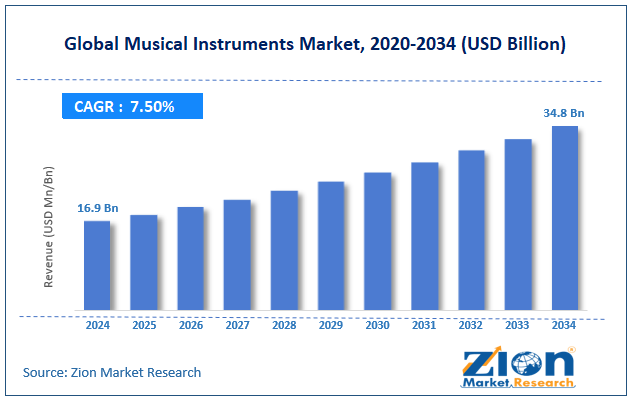
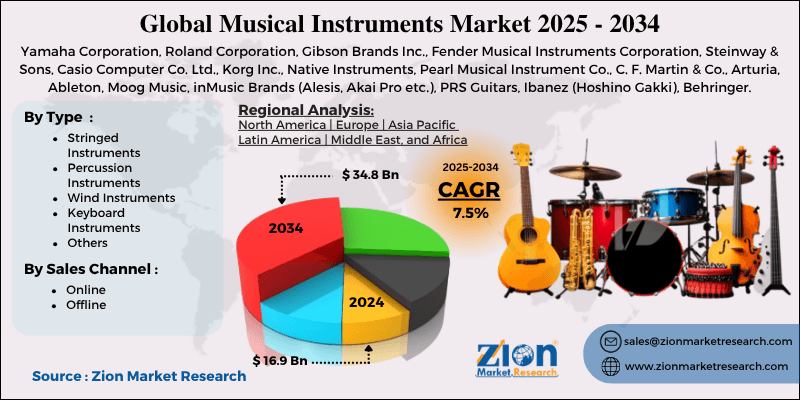
The global musical instruments market size was worth around USD 16.9 billion in 2024 and is predicted to grow to around USD 34.8 billion by 2034 with a compound annual growth rate (CAGR) of roughly 7.5% between 2025 and 2034.
Key Insights
- As per the analysis shared by our research analyst, the global musical instruments market is estimated to grow annually at a CAGR of around 7.5% over the forecast period (2025-2034).
- In terms of revenue, the global musical instruments market size was valued at around USD 16.9 billion in 2024 and is projected to reach USD 34.8 billion by 2034.
- Expansion of live concerts and entertainment industry is expected to propel the musical instruments market over the projected period.
- Based on the type, the stringed instruments segment dominated with the largest revenue share in 2024 of over 65% and is expected to continue the same pattern over the projected period.
- Based on the sales channel, the offline segment captures the largest revenue share in 2024 of 70%.
- Based on region, the Asia Pacific dominated the market with 42% of revenue share.
Musical Instruments Market: Overview
A musical instrument is a tool created or modified for the sole purpose of producing sound that is intended to be used as music either singly or collectively. Musical instruments create sounds through vibrations that occur due to the presence of strings, air columns, membranes, and electronic impulses. These vibrations are then intensified to create sounds. Musical instruments can be categorized into different types, including string instruments, which include the guitar and violin; wind instruments, such as flutes and trumpets; percussion instruments, such as drums and cymbals; and electronic instruments, such as the synthesizer and digital keyboards. Musical instruments have various uses in culture and societies all around the world.
Impact of the USA-Israel War on Iran on the Musical Instruments Market
There is no direct impact of the USA–Israel war with Iran on the global musical instruments market. However, it has an indirect effect through broader economic and supply chain disruptions. The conflict has contributed to an energy crisis, driven by disruptions in oil supply and rising prices, which in turn drive inflation and increase production and transportation costs worldwide. Since musical instruments especially electronic ones depend on materials such as metals, plastics, and semiconductors, manufacturers are facing higher input costs that ultimately influence retail prices.
Additionally, economic instability and recessionary pressures are reducing consumers’ purchasing power, leading to lower demand for non-essential products like musical instruments. Supply chain disruptions, particularly along key trade routes, are also causing shipment delays and increasing uncertainty in global trade, further impacting the market.
Musical Instruments Market: Dynamics
Growth Drivers
Why does the rising interest in music education and extracurricular activities drive the musical instruments market?
Growing awareness of the significance of music education and extracurricular activities has boosted demand for musical instruments, as people realize the benefits of learning music. Educational institutions are now integrating music into their curricula, and parents are sending their children to music classes so they can develop through it. The government’s initiative to promote arts education, coupled with an increasing preference for after-school activities, has fueled people's interest in participating in music. This trend has driven a rising demand for various musical instruments.
Restraints
High cost of instruments and maintenance hindering the musical instruments industry growth
The high cost of musical instruments and the associated ongoing costs prevent market entry and are a major limiting factor. Most high-end musical instruments, such as pianos, violins, and kit drums, usually require a significant up-front investment (the cost of an instrument at the time of purchase). These costs are then offset against additional or recurrent costs, including tuning, work repair and replacement of parts, transportation, and storage.
Purchase then becomes an extremely high investment, and as a result, the potential market of new musical instrument players is limited to a much smaller entry point and target market. Cost-conscious consumers will delay purchase or opt for rentals, which will become prohibitive to new instrument sales.
Opportunities
Why does the growing product launch offer a lucrative opportunity for the musical instruments market?
The growing product launch is expected to offer a potential opportunity to the musical instruments market over the projected period. For instance, in January 2025, Shure announced the expansion of its Nexadyne™ product line with the introduction of three all-new dynamic instrument microphones: The Nexadyne 2 Kick Drum Microphone, Nexadyne 5 Guitar Amp Microphone, and Nexadyne 6 Tom/Snare Microphone. Each Nexadyne microphone boasts Shure’s patented Revonic™ Dual-Engine Transducer Technology.
While typical instrument microphones use a single transducer, Nexadyne microphones feature two precisely calibrated transducers working together to achieve optimal performance that delivers natural, authentic clarity while minimizing unwanted noise. Nexadyne’s combination of acoustic signal processing and exceptional polar pattern linearity, enables the microphone line to deliver a stronger and clearer output. This output is more authentic to the performer and reduces audio engineers’ need to apply typical EQ corrections.
Challenges
How does the availability of digital alternatives and software pose a significant challenge to the musical instruments market?
The presence of digital substitutes and music software creates a significant challenge for the musical instruments market, as it reduces the need for physical instruments, particularly among beginners and independent creators. Modern technologies such as digital audio workstations, virtual instruments, and mobile applications can replicate the sounds of guitars, pianos, drums, and even full orchestras with high accuracy, often at a much lower cost than traditional instruments.
In addition to affordability, these tools offer advantages such as portability, ease of use, sound customization, and seamless integration with recording and editing platforms, making them highly appealing for home studios and content creators. As a result, many users are opting for software-based solutions instead of investing in expensive physical instruments, leading to reduced demand for entry-level and mid-range products. This shift toward digital ecosystems is gradually changing consumer preferences and limiting growth opportunities for traditional instrument manufacturers.
Musical Instruments Market: Report Scope
| Report Attributes | Report Details |
|---|---|
| Report Name | Musical Instruments Market |
| Market Size in 2024 | USD 16.9 Billion |
| Market Forecast in 2034 | USD 34.8 Billion |
| Growth Rate | CAGR of 7.5% |
| Number of Pages | 227 |
| Key Companies Covered | Yamaha Corporation, Roland Corporation, Gibson Brands Inc., Fender Musical Instruments Corporation, Steinway & Sons, Casio Computer Co. Ltd., Korg Inc., Native Instruments, Pearl Musical Instrument Co., C. F. Martin & Co., Arturia, Ableton, Moog Music, inMusic Brands (Alesis, Akai Pro etc.), PRS Guitars, Ibanez (Hoshino Gakki), Behringer (Music Tribe), Donner Music, DW Drums and Gretsch Drums, Guitars, and others. |
| Segments Covered | By Type, By Sales Channel, and By Region |
| Regions Covered | North America, Europe, Asia Pacific (APAC), Latin America, Middle East, and Africa (MEA) |
| Base Year | 2024 |
| Historical Year | 2019 to 2023 |
| Forecast Year | 2025 - 2034 |
| Customization Scope | Avail customized purchase options to meet your exact research needs. Request For Customization |
Musical Instruments Market: Segmentation
Type Insights
Why do the stringed instruments dominate the musical instruments market?
The stringed instruments segment dominated with the largest revenue share in 2024 of over 65% and is expected to continue the same pattern over the projected period. The guitar, violin, and bass are enduringly popular stringed instruments largely because of their diverse use across many genres. They appeal to a broad spectrum of users due to their readily accessible nature. Other advantages include a powerful capacity to express emotion effectively and an instant tonal response.
Fingerpicking and strumming a stringed instrument promote effective practice time and artistic experimentation. Their recent and current enduring popularity stems from their accessibility through formal tuition, as well as the ever-increasing number of online instructional videos and hybrid tuition, allowing users to teach themselves at their own pace.
Sales Channel Insights
Does the offline capture the largest market share in the musical instruments market?
The offline segment captures the largest revenue share in 2024 of 70%. Consumers continue to favor physical stores because musical instruments require hands-on evaluation of sound quality, build, weight, and playability factors that are difficult to judge through online listings alone. Offline music stores and specialty retailers support this preference by offering live demonstrations, sound testing, tuning assistance, and expert guidance from trained staff.
Additionally, the ability to compare different brands, models, and price ranges in real time, along with immediate product availability and after-sales services such as maintenance and repairs, reinforces the dominance of offline channels in the global market.
Regional Insights
Why does the Asia Pacific lead the musical instruments market?
The Asia Pacific dominated the market with 42% of revenue share. Sales and attention to musical instruments, including the guitar, keyboard, electronic drums, and hybrid instruments, have grown as these devices help enable recording, live sound, and digital music. Consumers, particularly younger audiences, influenced by the proliferation of smartphones and access to social media and computers, have found a treasure trove of band tutorials, instrument demonstrations, and artist performances on YouTube and other social media networks to inspire new players in the region. This is especially true in rapidly growing markets such as China, India, and Southeast Asia.
Further, the penetration of affordable e-commerce, along with better retail infrastructure and increased exposure to global music trends, is driving industry growth in entry- and mid-range instruments in the Asia Pacific, making it the global destination for Musical Instruments.
Musical Instruments Market: Competitive Analysis
The global musical instruments market is dominated by players like:
- Yamaha Corporation
- Roland Corporation
- Gibson Brands Inc.
- Fender Musical Instruments Corporation
- Steinway & Sons
- Casio Computer Co. Ltd.
- Korg Inc.
- Native Instruments
- Pearl Musical Instrument Co.
- C. F. Martin & Co.
- Arturia
- Ableton
- Moog Music
- inMusic Brands (Alesis Akai Pro etc.)
- PRS Guitars
- Ibanez (Hoshino Gakki)
- Behringer (Music Tribe)
- Donner Music
- DW Drums and Gretsch Drums
- Guitars
The global musical instruments market is segmented as follows:
By Type
- Stringed Instruments
- Percussion Instruments
- Wind Instruments
- Keyboard Instruments
- Others
By Sales Channel
- Online
- Offline
By Region
- North America
- The U.S.
- Canada
- Mexico
- Europe
- France
- The UK
- Spain
- Germany
- Italy
- Rest of Europe
- Asia Pacific
- China
- Japan
- India
- Australia
- South Korea
- Rest of Asia Pacific
- The Middle East & Africa
- Saudi Arabia
- UAE
- Egypt
- Kuwait
- South Africa
- Rest of the Middle East & Africa
- Latin America
- Brazil
- Argentina
- Rest of Latin America
Table Of Content
Methodology
FrequentlyAsked Questions
A musical instrument is a tool created or modified for the sole purpose of producing sound that is intended to be used as music either singly or collectively. Musical instruments create sounds through vibrations that occur due to the presence of strings, air columns, membranes, and electronic impulses.
Rising music education, increasing hobbyist participation, expanding live entertainment, and advancements in digital instruments are the key drivers of the musical instruments market.
The major challenges restraining the growth of the musical instruments market include the high cost of instruments and maintenance, which limits affordability; the growing availability of digital alternatives and music software that reduce reliance on physical instruments; declining long-term engagement among learners, leading to lower repeat purchases; space and noise constraints in urban areas; competition from second-hand and rental markets; and supply chain disruptions affecting raw material availability and pricing, all of which collectively hinder market expansion.
Based on the sales channel, the offline segment is expected to dominate the Musical Instruments market growth during the projected period.
Advancements in AI-powered smart instruments, digital integration with music software, online learning platforms, and the rise of sustainable and connected instrument technologies are the key emerging trends shaping the musical instruments market.
According to the report, the global musical instruments market size was worth around USD 16.9 billion in 2024 and is predicted to grow to around USD 34.8 billion by 2034.
The global musical instruments market is expected to grow at a CAGR of 7.5% during the forecast period.
The global musical instruments industry growth is expected to be led by the Asia Pacific over the forecast period.
The global musical instruments market is dominated by players like Yamaha Corporation, Roland Corporation, Gibson Brands Inc., Fender Musical Instruments Corporation, Steinway & Sons, Casio Computer Co. Ltd., Korg Inc., Native Instruments, Pearl Musical Instrument Co., C. F. Martin & Co., Arturia, Ableton, Moog Music, inMusic Brands (Alesis, Akai Pro, etc.), PRS Guitars, Ibanez (Hoshino Gakki), Behringer (Music Tribe), Donner Music, DW Drums and Gretsch Drums and Guitars among others.
The market report covers the geographical market along with a comprehensive competitive landscape analysis. It also includes cash flow analysis, profit ratio analysis, market basket analysis, market attractiveness analysis, sentiment analysis, PESTLE analysis, trend analysis, SWOT analysis, trade area analysis, demand & supply analysis, Porter’s five forces analysis, and value chain analysis.

HappyClients

