Microbial Biostimulants Market Size, Share, Trends, Growth and Forecast 2034
Microbial Biostimulants Market By Microbial Type (Bacteria, Actinomycetes, Algae, Fungi, and Mycorrhizae), By Formulation Type (Liquid, Suspension, Granular, Powder, and Emulsion), By Application (Soil Application, Hydroponics, Foliar Application, Seed Treatment, and Fertigation), By End-Use (Agriculture, Forestry, Horticulture, Turf and Ornamental, and Aquaculture), By Distribution Channel (Direct Sales, Wholesale, Retail Sales, Online Sales, and Distributors), and By Region - Global and Regional Industry Overview, Market Intelligence, Comprehensive Analysis, Historical Data, and Forecasts 2026 - 2034
| Market Size in 2025 | Market Forecast in 2034 | CAGR (in %) | Base Year |
|---|---|---|---|
| USD 4.3 Billion | USD 9.8 Billion | 9.6% | 2025 |
Microbial Biostimulants Industry Perspective:
What will be the size of the global microbial biostimulants market during the forecast period?
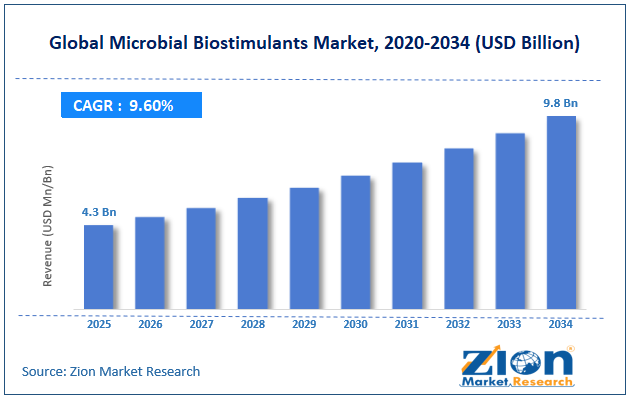
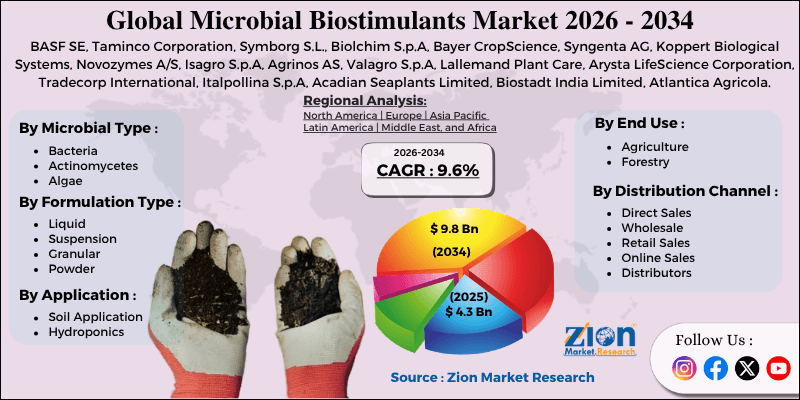
The global microbial biostimulants market size was worth around USD 4.3 billion in 2025 and is predicted to grow to around USD 9.8 billion by 2034, with a compound annual growth rate (CAGR) of roughly 9.6% between 2026 and 2034.
Key Insights
- As per the analysis shared by our research analyst, the global microbial biostimulants market is estimated to grow annually at a CAGR of around 9.6% over the forecast period (2026-2034).
- In terms of revenue, the global microbial biostimulants market size was valued at around USD 4.3 billion in 2025 and is projected to reach USD 9.8 billion by 2034.
- Supportive government policies and precision agriculture adoption are expected to propel the microbial biostimulants market over the projected period.
- Based on the microbial type, the bacteria segment captures a significant revenue share of 36% in 2025.
- Based on the formulation type, the liquid segment held the largest revenue share in 2025 of 35%.
- Based on the application, the soil application segment held the prominent revenue share in 2025 of 78%.
- Based on the end use, the agriculture segment dominates the market with a revenue share of 48% in 2025.
- Based on the distribution channel, the direct sales segment held the prominent revenue share in 2025.
- Based on region, the North America region holds a prominent market share in 2025 of 58%.
Microbial Biostimulants Market: Overview
Microbial biostimulants are biologically derived agricultural products that consist of useful microorganisms, such as bacteria, fungi, and others, to enhance plant growth and development, as well as nutrient acquisition, but not to function as fertilizers or pesticides. The microorganisms reside in the rhizosphere or inner layers of plants; create favorable soil conditions; facilitate root development; enhance nutrient absorption through nitrogen fixation and phosphate solubilization; and assist plants in building resistance to environmental stresses such as drought and salinity. Microbial biostimulants have widespread applications in cereals, fruits, vegetables, oilseeds, pulses, turf, and ornamentals to increase the productivity and sustainability of agricultural produce. The need for sustainable and regenerative agriculture is a key driver of the growing use of microbial biostimulants.
Impact of the USA-Israel War on Iran on the Microbial Biostimulants Market
There have been some indirect effects of the USA-Israel dispute concerning Iran on the global microbial biostimulants market, owing to disruptions in international trade, rising freight rates, and rising energy and raw material costs. The rise in fuel prices and supply chain risks may increase the costs of producing and transporting microbial products. At the same time, political instability may hinder the delivery of agricultural products to certain areas in the Middle East. However, the outlook for further market development is rather promising in view of the growing demand for sustainable agriculture and the reduced use of chemical fertilizers.
Microbial Biostimulants Market: Dynamics
Growth Drivers
How does the growing demand for sustainable and environmentally friendly agriculture drive the microbial biostimulants market?
Increased interest in sustainable and eco-friendly agriculture is a key driver of the microbial biostimulant market, as farmers are now seeking biological methods to achieve high crop yields without relying on chemical fertilizers and pesticides. Microorganisms improve nutrient availability, promote root growth, increase soil diversity, and make crops more resistant to abiotic stresses such as drought and salinity. The global trend toward sustainable agriculture is further supported by governments implementing policies to promote it.
For instance, the European Union's Common Agricultural Policy (CAP) 2023-2027 allocates about USD 443 billion to promote eco-friendly farming, and the USDA has spent more than USD 3.1 billion under the Climate-Smart Commodities program to promote climate-friendly farming. Increased consumer demand for sustainably grown products and the spread of organic farming are making farmers use microbial biostimulants to improve their yields.
Restraints
Limited farmer awareness and technical knowledge hamper the growth of the microbial biostimulants industry
Low farmer awareness and knowledge continue to pose challenges to the development of the microbial biostimulants market, especially in emerging agricultural nations where the use of conventional fertilizers and pesticides persists. There is low awareness among farmers of the mechanism of action, application timing, storage, and benefits of microbial biostimulants.
Further, the absence of proper extension and demonstrations in training on biological inputs by agricultural institutions hinders the use of such products in practice. Small-scale farmers remain hesitant to adopt agricultural inputs whose benefits cannot be seen immediately, unlike conventional ones. Although there have been efforts by various governments and other agricultural bodies to educate farmers, the knowledge gap remains unbridged.
Opportunities
Do expansion activities by key market players offer a lucrative opportunity for the microbial biostimulants market?
Market expansion activities conducted by major market players offer immense growth prospects for the microbial biostimulants market. Major players in the industry have been investing in production facilities, increasing microbial fermentation capacity, improving regional distribution networks, and establishing research and development centers to meet growing global demand for sustainable agricultural inputs. Collaborations and partnerships with agribusiness distributors and research organizations are further aiding the commercialization of innovative microbial strains and formulation technologies. Such activities make it easier for market players to access developing agricultural markets in the Asia-Pacific, Latin America, and Africa. Market expansion activities will offer significant growth potential in the coming years.
For instance, in February 2026, Rovensa Next, the global leader in biosolutions for agriculture, opened a new pilot fermentation plant in Brazil, strengthening its global R&D and scale-up capabilities in microbial biosolutions. The facility creates an intermediate step between laboratory research and full industrial production, reducing development risks and accelerating the launch of new bio-inputs.
Challenges
How does the competition from conventional agrochemicals pose a significant challenge to the growth of the microbial biostimulants industry?
The fierce competition in the agrochemical market poses a real challenge to the emergence of microbial biostimulants, given the effectiveness and widespread use of agrochemical products in the global agricultural sector. The issue is that farmers do not want to shift to microbial biostimulants because their effects are slow and depend not only on soil and climate but also on the specific crop. In addition, the established distribution chain and agronomic advice offered by companies engaged in agrochemicals, as well as brand reputation, contribute to farmers' desire to use conventional products. Although environmental concerns have been rising, the popularity of agrochemicals remains a barrier to the adoption of microbial biostimulants.
Microbial Biostimulants Market: Report Scope
| Report Attributes | Report Details |
|---|---|
| Report Name | Microbial Biostimulants Market |
| Market Size in 2025 | USD 4.3 Billion |
| Market Forecast in 2034 | USD 9.8 Billion |
| Growth Rate | CAGR of 9.6% |
| Number of Pages | 229 |
| Key Companies Covered | BASF SE, Taminco Corporation, Symborg S.L., Biolchim S.p.A, Bayer CropScience, Syngenta AG, Koppert Biological Systems, Novozymes A/S, Isagro S.p.A, Agrinos AS, Valagro S.p.A, Lallemand Plant Care, Arysta LifeScience Corporation, Tradecorp International, Italpollina S.p.A, Acadian Seaplants Limited, Biostadt India Limited, Atlantica Agricola, BioWorks Inc., Plant Health Care plc, and others. |
| Segments Covered | By Microbial Type, By Formulation Type, By Application, By End Use, By Distribution Channel, and By Region |
| Regions Covered | North America, Europe, Asia Pacific (APAC), Latin America, Middle East, and Africa (MEA) |
| Base Year | 2025 |
| Historical Year | 2020 - 2024 |
| Forecast Year | 2026 - 2034 |
| Customization Scope | Avail customized purchase options to meet your exact research needs. Request For Customization |
Microbial Biostimulants Market: Segmentation
Microbial Type Insights
Why does the bacteria segment hold a prominent position in the microbial biostimulants market?
The bacteria segment captures a significant revenue share of the microbial biostimulants market of 36% in 2025. Growth is propelled by its efficacy in enhancing nutrient uptake, promoting root growth, increasing soil fertility, and strengthening plant resistance to abiotic stresses such as drought and salinity. Beneficial bacterial strains, such as Bacillus, Pseudomonas, Azospirillum, and Rhizobium, are widely used for their effectiveness in nitrogen fixation, phosphorus solubilization, and the synthesis of plant growth-promoting compounds, leading to higher yields and more efficient nutrient use. Increased compatibility of these strains with cereals, fruits, vegetables, oilseeds, and horticultural crops, along with growing preference for sustainable and regenerative agriculture, is driving demand for the bacteria segment. Besides, ongoing developments in microbial formulation technology, investments by major agricultural firms in biological crop inputs, and government support for reducing the use of chemical fertilizers are expected to propel revenue growth in the bacteria segment over the forecast period.
Formulation Type Insights
Does the liquid segment capture the largest share in the microbial biostimulants market?
The liquid segment held the largest revenue share of the microbial biostimulants industry in 2025 of 35%. The reason behind the growth is ease of use, high microbial viability, and suitability for modern agricultural systems. The segment is preferred for its ability to be used via seed dressing, foliar spray, fertigation, and drip irrigation methods to ensure proper distribution and colonization of beneficial microbes around plant roots. Also, liquid formulations enable easy absorption and mixing with other agricultural inputs. Additionally, the growing adoption of precision agriculture, nutrient delivery through irrigation systems, and the need for sustainable agricultural solutions are propelling growth in the liquid segment.
Application Insights
What factor drives the soil application segment in the microbial biostimulants market?
The soil application segment held a prominent revenue share of the microbial biostimulants market in 2025, at 78%. It allows beneficial microbes to colonize the rhizosphere, thereby improving nutrient availability, soil quality, and root growth. Soil-application-based microbial biostimulants are effective in promoting several biological activities, including nitrogen fixation, phosphorus solubilization, organic matter degradation, and the synthesis of plant growth-promoting substances, thereby enhancing nutrient use efficiency and promoting proper plant growth. This product application method is popular for various cereals, fruits, vegetables, oilseeds, pulses, and plantation crops owing to the benefits of improved soil fertility and enhanced plant tolerance to drought, salinity, and other environmental conditions. The rise in awareness of regenerative agriculture and sustainable soil management practices, along with reduced reliance on chemical fertilizers and increased adoption of precision agriculture and integrated nutrient management, will boost revenue in the soil application market segment over the forecast period.
End-Use Insights
What factors drive growth in the agricultural segment of the microbial biostimulants market?
The agriculture segment dominates the microbial biostimulants market with a revenue share of 48% in 2025. Growth will be driven by the increasing need for sustainable crop production and improvements in soil health and agricultural productivity. The application of microbial biostimulants is widely practiced in field crops, cereals, oilseeds, pulses, fruits, and vegetables to improve nutrient uptake, root growth, water utilization efficiency, and plant resistance to abiotic stresses like drought, heat stress, and salinity. Increasing problems of soil degradation and over-reliance on artificial fertilizers are creating a need for biological crop inputs.
Distribution Channel Insights
How does direct sales hold a majority of market share in the microbial biostimulants market?
The direct sales segment held the prominent revenue share of the microbial biostimulants industry in 2025. This growth is propelled by the rising trend in which commercial farmers and agri-businesses prefer to buy their products from manufacturers. Through direct sales, firms can offer specialized agronomic consultancy services, demonstrations on how to use the products, and other services that help farmers make the most of microbial biostimulants, regardless of varying soil and crop types. The direct selling route has several benefits, including better customer relations, product authenticity, and reduced dependence on third parties.
Regional Insights
What factors drive the North America region in the microbial biostimulants market?
North America region holds a prominent market share in 2025 of 58%. It will be fueled by the growing popularity of sustainable farming practices, rising demand for biological crop inputs, the growth of organic agriculture, and increased investments in precision farming technologies in the United States and Canada. More farmers are adopting microbial biostimulants to boost nutrient-use efficiency, activate soil microorganisms, reduce synthetic fertilizer use, and improve crops' tolerance to drought and other climatic stresses. Support from the government continues to play a vital role here, too.
For instance, in 2025, the U.S. Department of Agriculture (USDA) launched the 2025 Organic Survey to collect more information about organic production in the country. Also, according to the USDA, the USA had made USD 9.6 billion in certified or exempt organic product sales in 2022, which is 32% higher than in 2017. At the same time, the area of certified organic cropland had reached 3.6 million acres, which is 79% higher than in 2011-2021.
Moreover, USDA's Organic Situation Report, 2025 Edition, emphasized ongoing growth in organic retail sales and government initiatives to facilitate the shift to organic and sustainable farming practices. Such positive policy initiatives, growing area under cultivation, and attention to soil health are expected to fuel revenue growth in the microbial biostimulants market in North America in 2025.
Microbial Biostimulants Market: Competitive Analysis
The global microbial biostimulants market is dominated by players like:
- BASF SE
- Taminco Corporation
- Symborg S.L.
- Biolchim S.p.A
- Bayer CropScience
- Syngenta AG
- Koppert Biological Systems
- Novozymes A/S
- Isagro S.p.A
- Agrinos AS
- Valagro S.p.A
- Lallemand Plant Care
- Arysta LifeScience Corporation
- Tradecorp International
- Italpollina S.p.A
- Acadian Seaplants Limited
- Biostadt India Limited
- Atlantica Agricola
- BioWorks Inc.
- Plant Health Care plc
The global microbial biostimulants market is segmented as follows:
By Microbial Type
- Bacteria
- Actinomycetes
- Algae
- Fungi
- Mycorrhizae
By Formulation Type
- Liquid
- Suspension
- Granular
- Powder
- Emulsion
By Application
- Soil Application
- Hydroponics
- Foliar Application
- Seed Treatment
- Fertigation
By End Use
- Agriculture
- Forestry
- Horticulture
- Turf and Ornamental
- Aquaculture
By Distribution Channel
- Direct Sales
- Wholesale
- Retail Sales
- Online Sales
- Distributors
By Region
- North America
- The U.S.
- Canada
- Mexico
- Europe
- France
- The UK
- Spain
- Germany
- Italy
- Rest of Europe
- Asia Pacific
- China
- Japan
- India
- Australia
- South Korea
- Rest of Asia Pacific
- The Middle East & Africa
- Saudi Arabia
- UAE
- Egypt
- Kuwait
- South Africa
- Rest of the Middle East & Africa
- Latin America
- Brazil
- Argentina
- Rest of Latin America
Table Of Content
Methodology
FrequentlyAsked Questions
Microbial biostimulants are biologically derived agricultural products that consist of useful microorganisms, such as bacteria, fungi, and others, to enhance plant growth and development, as well as nutrient acquisition, but not to function as fertilizers or pesticides.
The microbial biostimulants market is primarily driven by the growing demand for sustainable and environmentally friendly agriculture, increasing adoption of organic and regenerative farming practices, and the need to improve soil health and crop productivity. Rising concerns over soil degradation, climate change, and excessive use of chemical fertilizers are encouraging farmers to adopt microbial solutions that enhance nutrient uptake, root development, and plant resilience to abiotic stresses.
The microbial biostimulants market faces several challenges, including inconsistent field performance under varying soil and climatic conditions, limited farmer awareness and technical knowledge, and complex regulatory approval processes across different countries.
Based on the application, the soil application segment is expected to dominate the microbial biostimulants market growth during the projected period.
Emerging trends and innovations in the microbial biostimulants market include the development of next-generation microbial consortia that combine multiple beneficial bacteria and fungi for enhanced crop performance, advancements in genomics, metagenomics, and microbial fermentation technologies to improve product efficacy and shelf life, and the integration of microbial biostimulants with precision agriculture and digital farming platforms for targeted application. Companies are also introducing crop-specific and region-specific formulations, expanding seed treatment and fertigation-compatible products, and investing in encapsulation and controlled-release technologies to improve microbial stability.
According to the report, the global microbial biostimulants market size was worth around USD 4.3 billion in 2025 and is predicted to grow to around USD 9.8 billion by 2034.
The global microbial biostimulants market is expected to grow at a CAGR of 9.6% during the forecast period.
The global microbial biostimulants industry growth is expected to be led by North America over the forecast period.
The global microbial biostimulants market is dominated by players like BASF SE, Taminco Corporation, Symborg S.L., Biolchim S.p.A, Bayer CropScience, Syngenta AG, Koppert Biological Systems, Novozymes A/S, Isagro S.p.A, Agrinos AS, Valagro S.p.A, Lallemand Plant Care, Arysta LifeScience Corporation, Tradecorp International, Italpollina S.p.A, Acadian Seaplants Limited, Biostadt India Limited, Atlantica Agricola, BioWorks Inc., and Plant Health Care plc, among others.
The microbial biostimulants market report covers the geographical market along with a comprehensive competitive landscape analysis. It also includes cash flow analysis, profit ratio analysis, market basket analysis, market attractiveness analysis, sentiment analysis, PESTLE analysis, trend analysis, SWOT analysis, trade area analysis, demand & supply analysis, Porter’s five forces analysis, and value chain analysis.

HappyClients