
Metaverse In Surgical Operations Market Size, Share, Trends, Growth 2034

Metaverse In Surgical Operations Market By Component (Hardware, Service, and Software), By Application (Surgical Training, Preoperative Planning, Telesurgery, and Others), By Technology (Virtual Reality (VR), Mixed Reality (MR), and Augmented Reality (AR)), By End-User (Hospitals and Surgical Centers, Telemedicine Providers, and Medical Training Institutes), and Region - Global and Regional Industry Overview, Market Intelligence, Comprehensive Analysis, Historical Data, and Forecasts 2026 - 2034
| Market Size in 2025 | Market Forecast in 2034 | CAGR (in %) | Base Year |
|---|---|---|---|
| USD 10.5 Billion | USD 120.9 Billion | 31.2% | 2025 |
Metaverse In Surgical Operations Industry Perspective:
What will be the size of the global metaverse in surgical operations market during the forecast period?
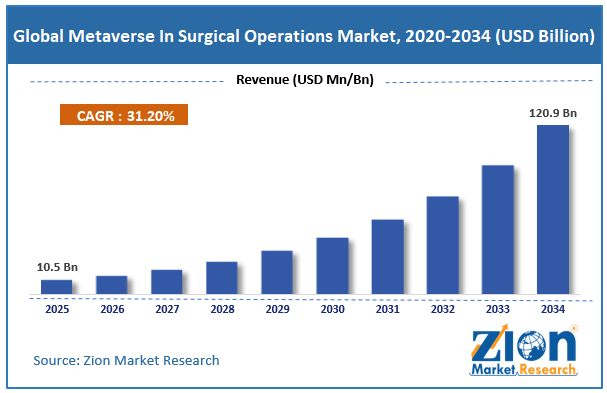
The global metaverse in surgical operations market size was valued at around USD 10.5 billion in 2025 and is projected to reach around USD 120.9 billion by 2034, with a compound annual growth rate (CAGR) of roughly 31.2% between 2026 and 2034.
Key Insights
- As per the analysis shared by our research analyst, the global metaverse in surgical operations market is estimated to grow annually at a CAGR of around 31.2% over the forecast period (2026-2034).
- In terms of revenue, the global metaverse in surgical operations market size was valued at around USD 10.5 billion in 2025 and is projected to reach USD 120.9 billion by 2034.
- Rising investment in digital healthcare is expected to propel the metaverse in surgical operations market over the projected period.
- Based on the component, the hardware segment dominates the market with a revenue share of 61.5% in 2025.
- Based on the application, the surgical training vehicle segment holds a majority of market share of 49.5% in 2025.
- Based on the technology, the Virtual Reality (VR) segment holds a majority of market share in 2025 of 53.5%.
- Based on the end-user, the hospitals and surgical centers segment holds a majority of market share in 2025 of 49.5%.
- Based on region, North America dominates the metaverse in surgical operations market with a revenue share of 42.7% in 2025.
Metaverse In Surgical Operations Market: Overview
The metaverse in surgical operations can be described as the use of immersive technologies such as virtual reality, augmented and mixed reality, three-dimensional visualization, digital twins, and real-time communication to develop an immersive experience in surgical planning, training, collaboration, and assistance. In surgical operations, the metaverse can serve as a tool, allowing surgeons to perform procedures in a virtual world. It can also be used to help doctors to operate on a three-dimensional representation of the patient's body before actually conducting the surgery. The metaverse can also enable remote collaboration among doctors, allowing for real-time exchange of digital data during surgery.
Moreover, the metaverse can be used to train future surgeons without the need for physical practice. It is expected that further development of the metaverse, alongside artificial intelligence, robotics, and haptic technology, will enable the creation of better surgical tools, the development of training programs for surgeons, remote collaboration, and a more personalized patient experience.
Impact of the USA-Israel War on Iran on the Metaverse In Surgical Operations Market
The U.S.-Israel war against Iran will have a detrimental effect on the metaverse in the surgical operations market in the short term, especially for Iran and the entire region of the Middle East, because the destruction of healthcare infrastructure, interruption of medical services, connection problems, and the economic crisis can prevent investments in advanced technologies like VR, AR, MR, and digital twin solutions. According to the WHO, by 2026, there had been 18 attacks on healthcare facilities in Iran.
On the other hand, this event can increase demand for remote cooperation in surgery, virtual learning, and simulation to provide access to specialists and training through surgical simulation. The rise in energy, transportation, and logistics costs can increase the cost of deploying metaverse technology.
Metaverse In Surgical Operations Market: Dynamics
Growth Drivers
How does the growing adoption of VR, AR, and MR technologies drive the metaverse in surgical operations market?
The increasing popularity of VR, AR, and MR technologies is contributing to the growth of the metaverse in the surgical operations market by enabling the creation of realistic, three-dimensional representations of human anatomy and surgical procedures for interaction with surgeons. VR, AR, and MR technologies help with surgical simulations and pre-operative planning, medical education and training, live visualization, and remote collaboration. As hospitals and medical facilities increasingly invest in immersive technology for healthcare to improve surgical accuracy and efficiency in training and decision-making, this could be a major contributor to market growth.
Restraints
Why do high implementation costs act as a major restraint on the growth of the metaverse in the surgical operations industry?
The high costs of implementation have been a barrier to the adoption of the metaverse in surgical operations due to the expense of implementing virtual reality (VR), augmented reality (AR), and mixed reality (MR) systems. Hospitals need to invest considerable funds in installing the required hardware, computers, software platforms, haptic systems, and high-speed connectivity to implement metaverse-based surgical systems.
Opportunities
How does the expansion of remote surgical collaboration offer a lucrative opportunity for the metaverse in surgical operations market?
The ability to expand surgical collaboration in remote locations provides significant growth opportunities for the metaverse in surgical operations market by enabling surgeons, specialists, and other medical personnel to work together in real time without being restricted by their geographic location. With AR, MR, VR, 3D visualization, and other technologies enabled by the metaverse, remote specialists can view surgical fields, interact with 3D patient anatomy, and provide surgeons with comments and instructions on conducting procedures.
For instance, an international case series in 2021 included 13 orthopedic surgeries across 13 countries, in which surgical teams used HoloLens mixed-reality headsets and remote-assist features to communicate in real time with other surgical teams. Another good example is a reconstructive metaverse in which surgeons conducted pre-surgery planning for four DIEP-flap procedures using patient-specific 3D models generated from CT angiography, thereby demonstrating that geographically distributed surgical teams could work together to assess patient anatomy. In February 2025, neurosurgeons from the UK and the US held a fully remote, multi-institution case discussion using 3D patient scans in an MR environment, demonstrating great potential for cross-border surgical collaboration and access to specialists.
Challenges
Lack of standardization poses a significant challenge to the growth of the metaverse in surgical operations industry
Standardization is another important issue that can be seen as a barrier to the development of the metaverse in surgical operations market, as virtual reality, augmented reality, and mixed reality systems may use incompatible hardware, software, data formats, and communication protocols. It can be problematic for hospitals to integrate metaverse technologies with electronic health record systems, medical imaging systems, surgical tools, and existing hospital IT infrastructure.
For instance, a 3D anatomical model developed on one metaverse platform may not be easily used or presented in another metaverse platform. The lack of data security, interoperability, and clinical guidelines can hinder collaboration between hospitals and companies that produce metaverse systems. Therefore, the absence of standards may negatively influence market growth.
Metaverse In Surgical Operations Market: Report Scope
| Report Attributes | Report Details |
|---|---|
| Report Name | Metaverse In Surgical Operations Market |
| Market Size in 2025 | USD 10.5 Billion |
| Market Forecast in 2034 | USD 120.9 Billion |
| Growth Rate | CAGR of 31.2% |
| Number of Pages | 228 |
| Key Companies Covered | Microsoft Corporation, Brainlab AG, Meta Platforms Inc., Siemens Healthineers AG, NVIDIA Corporation, Koninklijke Philips N.V., Medtronic Plc, Intuitive Surgical Inc., Stryker Corporation, EchoPixel Inc., Precision OS Technologies Inc., Augmedics Ltd, FundamentalVR Ltd, Osso VR Inc., Surgical Theater Inc., VirtaMed AG, CAE Inc., Laerdal Medical AS, Simulab Corporation, Mentice AB, 3D Systems Corporation, GigXR Inc., Virti Ltd, SimX Inc. AG, and others. |
| Segments Covered | By Component, By Application, By Technology, By End User, and By Region |
| Regions Covered | North America, Europe, Asia Pacific (APAC), Latin America, Middle East, and Africa (MEA) |
| Base Year | 2025 |
| Historical Year | 2020 - 2024 |
| Forecast Year | 2026 - 2034 |
| Customization Scope | Avail customized purchase options to meet your exact research needs. Request For Customization |
Metaverse In Surgical Operations Market: Segmentation
Component Insights
Why does the hardware segment hold a prominent position in the metaverse in surgical operations market?
The hardware segment dominates the metaverse in surgical operations market, accounting for 61.5% of revenue in 2025. The primary driver of market growth will be the increasing adoption of immersive visualization for training, preoperative planning, and use during surgery. VR headsets provide surgeons and trainee surgeons the opportunity to perform procedures in virtual environments. In contrast, AR/MR headsets enable surgeons to see the 3D structure of the body within the real surgical environment. With haptic devices and motion trackers, simulation becomes even more realistic by providing sensory and movement input.
For instance, studies have shown that Microsoft HoloLens is practical to use in sterile operating rooms for image-guided surgery through gesture and voice commands. With increasing investment by hospitals in immersive surgical platforms and smart operating rooms, demand for these devices is expected to grow.
Application Insights
How does the surgical training segment capture the largest share in the metaverse in surgical operations market?
The surgical training vehicle segment held a 49.5% share of the metaverse in surgical operations industry in 2025. This growth is mainly fueled by the increasing demand for practical surgical training, greater procedural precision, and safer training environments. VR, AR, and MR solutions enable surgeons and medical trainees to perform complex surgeries on the same 3D anatomical model repeatedly without putting patients at risk of harm during training.
Moreover, such technologies can be used to evaluate trainees' performance and to create various scenarios for surgical training. The rising number of medical training programs and development of immersive healthcare technology solutions will also stimulate the demand for virtual surgical training platforms.
Technology Insights
Does the Virtual Reality (VR) segment capture the largest market share in the metaverse in surgical operations market?
The Virtual Reality (VR) segment holds a majority of the metaverse in surgical operations market share in 2025 of 53.5%. The primary driver of this segment's growth will be the rising adoption of VR-based surgical simulation systems, which allow medical professionals to train for complex surgeries multiple times without putting patients at risk. These systems may offer realistic 3D anatomical environments, surgical training scenarios, and performance feedback.
In addition, VR technology is increasingly adopted in surgical planning and visualization, and research highlights its importance as a major application of the metaverse in surgery. With continued investments in immersive healthcare technologies and digital surgical training, demand for VR systems is expected to drive revenue growth in this segment.
End-User Insights
What factor drives the hospitals and surgical centers in the metaverse in surgical operations market?
The hospitals and surgical centers segment held a majority of metaverse in surgical operations market share in 2025 of 49.5%. The market growth will be catalyzed by the growing implementation of virtual reality (VR), augmented reality (AR), mixed reality (MR), 3D visualization, digital twin technology, and immersive surgical solutions for surgical training, preoperative planning, intraoperative assistance, and remote collaboration. Hospitals and surgical centers can leverage their modern infrastructure and professional surgical teams to improve surgical precision, planning, and efficiency in surgical training through these technologies. Researchers have also pinpointed various uses of the surgical metaverse during surgical procedures, including preoperative planning, intraoperative assistance, and postoperative care. With the healthcare industry investing more into digital transformation and connected operating rooms, demand from hospitals and surgical centers is predicted to continue driving revenue growth in the market.
Regional Insights
What factors drive the North America region in the metaverse in surgical operations market?
North America dominates the metaverse in surgical operations market with a revenue share of 42.7% in 2025. The growth will be fueled by the region's well-developed healthcare infrastructure, high healthcare spends, rapid digitalization, and adoption of immersive technologies for surgical training, planning, visualization, and collaboration. National healthcare spends in the U.S. grew by 7.2% to $5.3 trillion in 2024, accounting for 18% of GDP, while hospital spend increased by 8.9% to $1.63 trillion. The large and growing healthcare spending base provides hospitals with more opportunities to invest in innovative technologies such as VR, AR, MR, AI, and digital twins. Government data also show high levels of digital health readiness in North America. The U.S. HHS reported that 25% of Medicare fee-for-service beneficiaries received a telehealth service in 2024, underscoring the ongoing acceptance of digitally enabled healthcare delivery.
In Canada, 92% of healthcare providers accessed a digital health system in 2024, while 52% used digital health systems to electronically exchange patients' clinical information with providers outside their practice. Access to digital health for hospital-based providers was 94%. These government statistics show a solid digital foundation for integrating metaverse technologies into surgical workflows, including 3D surgical planning, immersive training, remote specialist collaboration, and intraoperative visualization, which will drive revenue growth in the North American market.
Metaverse In Surgical Operations Market: Competitive Analysis
The global metaverse in surgical operations market is dominated by players like:
- Microsoft Corporation
- Brainlab AG
- Meta Platforms Inc.
- Siemens Healthineers AG
- NVIDIA Corporation
- Koninklijke Philips N.V.
- Medtronic Plc
- Intuitive Surgical Inc.
- Stryker Corporation
- EchoPixel Inc.
- Precision OS Technologies Inc.
- Augmedics Ltd
- FundamentalVR Ltd
- Osso VR Inc.
- Surgical Theater Inc.
- VirtaMed AG
- CAE Inc.
- Laerdal Medical AS
- Simulab Corporation
- Mentice AB
- 3D Systems Corporation
- GigXR Inc.
- Virti Ltd
- SimX Inc. AG
The global metaverse in surgical operations market is segmented as follows:
By Component
- Hardware
- Service
- Software
By Application
- Surgical Training
- Preoperative Planning
- Telesurgery
- Others
By Technology
- Virtual Reality (VR)
- Mixed Reality (MR)
- Augmented Reality (AR)
By End User
- Hospitals and Surgical Centers
- Telemedicine Providers
- Medical Training Institutes
By Region
- North America
- The U.S.
- Canada
- Mexico
- Europe
- France
- The UK
- Spain
- Germany
- Italy
- Rest of Europe
- Asia Pacific
- China
- Japan
- India
- Australia
- South Korea
- Rest of Asia Pacific
- The Middle East & Africa
- Saudi Arabia
- UAE
- Egypt
- Kuwait
- South Africa
- Rest of the Middle East & Africa
- Latin America
- Brazil
- Argentina
- Rest of Latin America
Table Of Content
Methodology
FrequentlyAsked Questions
The metaverse in surgical operations can be described as the use of immersive technologies such as virtual reality, augmented and mixed reality, three-dimensional visualization, digital twins, and real-time communication to develop an immersive experience in surgical planning, training, collaboration, and assistance. In surgical operations, the metaverse can serve as a tool, allowing surgeons to perform procedures in a virtual world.
The key growth drivers for the Metaverse in Surgical Operations Market include the growing adoption of VR, AR, and MR technologies, increasing demand for advanced surgical training and simulation, and the need for improved preoperative planning and 3D visualization. The expansion of remote surgical collaboration is also creating opportunities by allowing specialists to support surgical teams across geographical locations.
What are the major challenges restraining the growth of the metaverse in surgical operations market?
The metaverse in surgical operations market faces several challenges, including high implementation and equipment costs, cybersecurity and patient-data privacy concerns, lack of standardization and interoperability, and limited healthcare infrastructure in some regions. Hospitals may also face difficulties integrating metaverse platforms with existing electronic health records, medical imaging systems, and surgical equipment.
Based on the application, the surgical training segment is expected to dominate the metaverse in surgical operations market growth during the projected period.
Emerging trends and innovations in the Metaverse in Surgical Operations Market include the integration of AI with VR/AR/MR, patient-specific digital twins, real-time 3D visualization, haptic feedback, and remote surgical collaboration. Digital twins are increasingly being explored for personalized surgical planning and real-time intraoperative guidance, while AI can support surgical navigation, data analysis, and predictive decision-making. The development of 5G/advanced connectivity is also enabling more responsive remote collaboration and telementoring.
According to the report, the global metaverse in surgical operations market size was worth around USD 10.5 billion in 2025 and is predicted to grow to around USD 120.9 billion by 2034.
The global metaverse in surgical operations market is expected to grow at a CAGR of 31.2% during the forecast period.
The global metaverse in surgical operations industry growth is expected to be led by North America over the forecast period.
The global metaverse in surgical operations market is dominated by players like Microsoft Corporation, Brainlab AG, Meta Platforms Inc., Siemens Healthineers AG, NVIDIA Corporation, Koninklijke Philips N.V., Medtronic Plc, Intuitive Surgical Inc., Stryker Corporation, EchoPixel Inc., Precision OS Technologies Inc., Augmedics Ltd, FundamentalVR Ltd, Osso VR Inc., Surgical Theater Inc., VirtaMed AG, CAE Inc., Laerdal Medical AS, Simulab Corporation, Mentice AB, 3D Systems Corporation, GigXR Inc., Virti Ltd, and SimX Inc., among others.
The metaverse in surgical operations market report covers the geographical market along with a comprehensive competitive landscape analysis. It also includes cash flow analysis, profit ratio analysis, market basket analysis, market attractiveness analysis, sentiment analysis, PESTLE analysis, trend analysis, SWOT analysis, trade area analysis, demand & supply analysis, Porter’s five forces analysis, and value chain analysis.

HappyClients

