Augmented Reality Gaming Market Size, Growth, Global Trends, Forecast 2034

Augmented Reality Gaming Market By Type (Mobile Devices, HMDs, Smart Glasses), By Component (Hardware, Software), By Genre (Adventure, Shooter, Puzzle, Sports and Fitness), By Business Segment (Free-to-play, Premium, Subscription), and By Region - Global and Regional Industry Overview, Market Intelligence, Comprehensive Analysis, Historical Data, and Forecasts 2025 - 2034
| Market Size in 2024 | Market Forecast in 2034 | CAGR (in %) | Base Year |
|---|---|---|---|
| USD 14.14 Billion | USD 69.39 Billion | 22% | 2024 |
Augmented Reality Gaming Industry Perspective:
What will be the size of the augmented reality gaming market from 2025 to 2034?
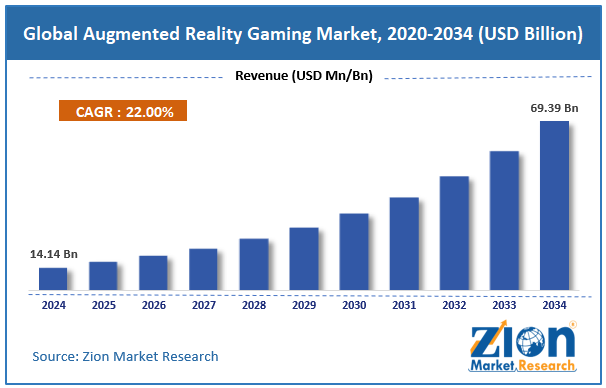
The global augmented reality gaming market size was around USD 14.14 billion in 2024 and is projected to reach USD 69.39 billion by 2034, with a compound annual growth rate (CAGR) of roughly 22% between 2025 and 2034.
Key Insights:
- As per the analysis shared by our research analyst, the global augmented reality gaming market is estimated to grow annually at a CAGR of around 22% over the forecast period (2025-2034)
- In terms of revenue, the global augmented reality gaming market size was valued at around USD 14.14 billion in 2024 and is projected to reach USD 69.39 billion by 2034.
- The augmented reality gaming market is projected to grow significantly, driven by improvements in AR hardware (headsets, smart glasses), increased investment from tech giants, and the expansion of app ecosystems and developer tools.
- Based on type, the mobile devices segment is expected to lead the market, while the HMDs segment is expected to grow considerably.
- By component, the hardware segment is the dominant, while the software segment is projected to record sizeable revenue over the forecast period.
- By genre, the adventure segment leads the market, followed by the shooter segment.
- Based on business segment, the free-to-play segment is expected to lead the market, followed by the premium segment.
- By region, North America is projected to dominate the global market during the forecast period, followed by the Asia Pacific.
Augmented Reality Gaming Market: Overview
Augmented reality gaming combines digital elements with the real world, allowing players to interact with virtual objects through devices such as AR headsets or smartphones. By overlaying game visuals, challenges, and sounds onto physical surroundings, AR games create interactive and immersive experiences that inspire real-world exploration and movement. The global augmented reality gaming market is poised for notable growth, driven by broader smartphone adoption, social gaming and community engagement, and technological advancements in AR software and hardware. Since most consumers already own smartphones with advanced cameras and powerful processors, AR games can be easily distributed and played without requiring costly dedicated hardware.
Moreover, AR games often incorporate social elements such as location-based challenges, shared goals, and cooperative play. This motivates community participation and virality, fueling world-of-mouth growth and user retention. Furthermore, in AR development platforms, spatial computing, wearable devices, and graphics processing have remarkably improved the accessibility and quality of AR games. Better sensors, real-time tracking technologies, and high-resolution displays create smooth interactive experiences.
Nevertheless, the global market faces limitations due to factors such as high development costs and complexity, device limitations and fragmentation, and privacy and security concerns. Designing compelling AR experiences needs specialized skills, testing, and tools, making development expensive and time-consuming for studios, mainly small developers. Only a few devices support advanced AR features, and disparities in hardware capabilities can limit the user base and gameplay consistency in platforms. Likewise, AR games often require camera access and location data, heightening user concerns about data privacy, intrusive tracking, and surveillance, which may hamper adoption.
Still, the global augmented reality gaming industry benefits from several favorable factors, including integration with wearable AR devices, cross-industry collaborations, and synergies with cloud gaming & edge computing. Next-generation AR glasses and headsets can unlock fresh forms of immersive gameplay beyond smartphones, offering hands-free, spatially aware experiences. Associations with entertainment, tourism, retail, and education sectors can expand AR gaming into experiential marketing, gamified learning adventures, and location-based events. Additionally, cloud-based processing and edge computing can support heavy AR graphics and multiplayer worlds, allowing complex gameplay on lightweight devices.
Augmented Reality Gaming Market Dynamics
Growth Drivers
How is high user engagement and monetization fueling the augmented reality gaming market?
AR games maintain high engagement through physical-world interaction, immersive challenges, and social events. Longer playtime and interactive experiences fuel monetization through in-app purchases and subscriptions. Real-time exploration adds stickiness to gameplay. Developers prioritize AR features to increase revenue and player loyalty. Higher engagement makes AR gaming more profitable than several older mobile games. This strong engagement trend continues to propel the industry growth.
How is the worldwide augmented reality gaming market driven by the rise of AR wearables?
AR-enabled wearables, comprising smart glasses and lightweight headsets, increase gaming experiences beyond smartphones. Hands-free, immersive gameplay enables more natural interaction with virtual objects. Low costs, enhanced comfort, and stylish designs are escalating consumer adoption. Developers can experiment with advanced mechanics and real-world integration. Wearables offer fresh avenues for long-term revenue and engagement. The rise of AR wearables is transforming the upcoming phase of the augmented reality gaming market.
Restraints
High development costs negatively impact the market progress
Developing high-quality AR games requires advanced hardware, skilled developers, and software, which increases production costs. Smaller studios may find it challenging to fund complex AR experiences. Expensive game development may hamper innovation and the number of novel releases. Significant prices may also translate into premium pricing for players. This financial barrier allows newbies to enter the industry. Overall, development costs are a major constraint on the growth of AR gaming.
Opportunities
How is the expansion into eSports and competitive gaming offering advantageous conditions for the augmented reality gaming market?
AR can deliver unique, competitive, and multiplayer experiences by assimilating real-world interactions with virtual gameplay. Players can compete in location-based, skill-based, or immersive challenges. This incorporation offers fresh monetization opportunities in the augmented reality gaming industry through tournaments, live events, and sponsorships. AR competitive gaming has the potential to appeal to global audiences and build fan bases. Developers can leverage the growing prominence of eSports to increase engagement and reach. The immersive nature of AR enables large-scale, interactive competitive experiences that older platforms cannot match.
Challenges
User safety and physical risks limit the market progress
AR games require players to connect with real-world environments while focusing on virtual elements, increasing the risk of injury and accidents. Players may cross streets unsafely, collide with obstacles, or become distracted during gameplay. Developers should implement safety measures, such as tutorials, alerts, geofencing, and real-time monitoring. Liability and legal concerns over public safety may impact adoption. Ensuring controlled, safe experiences is vital to maintaining user trust. Proper safety design is a vital factor in the success of AR gaming.
Augmented Reality Gaming Market: Report Scope
| Report Attributes | Report Details |
|---|---|
| Report Name | Augmented Reality Gaming Market |
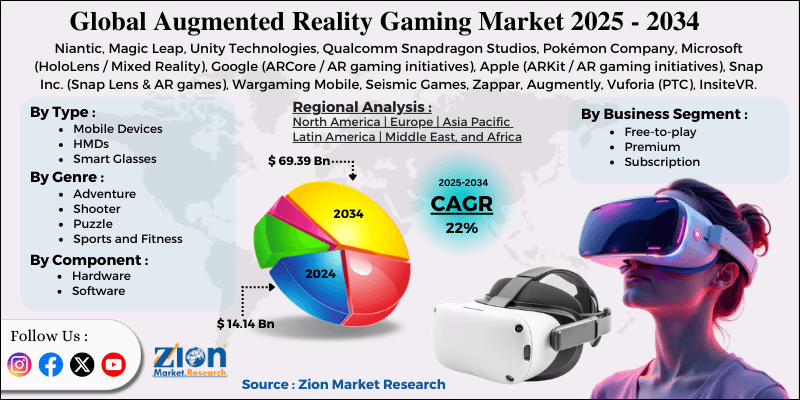
| Market Size in 2024 | USD 14.14 Billion |
| Market Forecast in 2034 | USD 69.39 Billion |
| Growth Rate | CAGR of 22% |
| Number of Pages | 215 |
| Key Companies Covered | Niantic, Magic Leap, Unity Technologies, Qualcomm Snapdragon Studios, Pokémon Company, Microsoft (HoloLens / Mixed Reality), Google (ARCore / AR gaming initiatives), Apple (ARKit / AR gaming initiatives), Snap Inc. (Snap Lens & AR games), Wargaming Mobile, Seismic Games, Zappar, Augmently, Vuforia (PTC), InsiteVR, and others. |
| Segments Covered | By Type, By Component, By Genre, By Business Segment, and By Region |
| Regions Covered | North America, Europe, Asia Pacific (APAC), Latin America, Middle East, and Africa (MEA) |
| Base Year | 2024 |
| Historical Year | 2019 to 2023 |
| Forecast Year | 2025 - 2034 |
| Customization Scope | Avail customized purchase options to meet your exact research needs. Request For Customization |
Augmented Reality Gaming Market: Segmentation
The global augmented reality gaming market is segmented based on type, component, genre, business segment, and region.
Based on type, the global augmented reality gaming industry is divided into mobile devices, HMDs, and smart glasses. The mobile devices segment holds a dominant share, accounting for nearly 65-70% of the market. This growth is attributed to the broader adoption of smartphones and the ease of access to AR games.
On the other hand, the HMDs segment holds leadership with nearly 25% market share, offering highly immersive AR experiences for dedicated gamers despite higher costs and low adoption.
Based on component, the global market is segmented into hardware and software. The hardware segment captures a 58-60% share of the market due to robust demand for AR-capable devices, including smart glasses, headsets, and sensors.
Conversely, the software segment ranks second with a 40-42% share, driven by AR game engines, interactive content, and development platforms that enable immersive gaming experiences.
Based on genre, the global augmented reality gaming market is segmented into adventure, shooter, puzzle, and sports and fitness. The adventure segment dominates the market with a 30-35% market share because of its exploratory gameplay and immersive storytelling that leverages real-world environments.
Nonetheless, the shooting segment holds second place with a 20-25% share, driven by demand for action-oriented, interactive experiences that blend virtual and real elements for greater engagement.
Based on business segment, the global market is segmented into free-to-play, premium, and subscription. The free-to-play segment accounts for 70-80% of the market due to its wide accessibility and revenue from in-app ads and purchases.
However, the premium segment holds the second-largest share, owing to one-time purchase games that appeal to players seeking complete experiences without micro-transactions.
Augmented Reality Gaming Market: Regional Analysis
Why does North America hold a dominant position in the global Augmented Reality Gaming Market?
North America is projected to maintain its dominant 15–16% CAGR in the global augmented reality gaming market, driven by innovation and technological infrastructure, high consumer adoption and spending power, and the presence of major gaming and tech companies. North America accounts for nearly 40% of the global AR gaming market, thanks to advanced digital infrastructure and the expansion of 5G networks. Cutting-edge AR software and hardware technologies improve immersive gameplay experiences. This strong technological ecosystem accelerates innovation and appeals to developers and consumers alike. Consumers in the region have high spending power and noticeable interest in immersive gaming experiences. Broader smartphone penetration and early adoption of AR headsets drive engagement. Strong demand translates into substantial revenue, strengthening the regional dominance. Canada and the U.S. host major gaming companies and technology giants, creating a vibrant ecosystem for development. Access to capital, talent, and partnerships backs continuous R&D and frequent game launches. This concentration of market players helps the region maintain a leading rank worldwide.
Asia Pacific maintains its position, with an 18-19% CAGR in the global augmented reality gaming industry, driven by rapid internet and smartphone adoption, a growing gaming culture, and expanding local development and investment. Asia Pacific has the world’s largest smartphone user base, supporting broader access to AR gaming. Improving mobile networks and fast internet allows smooth AR experiences. This large user base fuels robust industry growth and engagement.
Furthermore, a young, tech-savvy population with a strong interest in interactive and mobile gaming drives the adoption of AR. Local developers and players steadily embrace AR titles and social gameplay features. This cultural enthusiasm drives regional industry expansion. Additionally, regional game studios and technology companies are heavily investing in AR content and platforms. Strategic alliances and growing funding support the introduction of innovative AR games. This growing ecosystem improves the region's competitive ranking after North America.
Augmented Reality Gaming Market: Competitive Analysis
The leading players in the global augmented reality gaming market are:
- Niantic
- Magic Leap
- Unity Technologies
- Qualcomm Snapdragon Studios
- Pokémon Company
- Microsoft (HoloLens / Mixed Reality)
- Google (ARCore / AR gaming initiatives)
- Apple (ARKit / AR gaming initiatives)
- Snap Inc. (Snap Lens & AR games)
- Wargaming Mobile
- Seismic Games
- Zappar
- Augmently
- Vuforia (PTC)
- InsiteVR
Augmented Reality Gaming Market: Key Market Trends
Location-based & social AR gameplay:
Games that integrate real-world location with social features such as collaborative challenges and shared events are gaining significant popularity. These experiences encourage exploration, community engagement, and competitive play among friends and strangers equally.
AI-driven dynamic content & personalization:
Artificial intelligence is being used to create adaptive game environments, improve non-player character interactions, and generate personalized quests. This trend drives player engagement by modifying play styles and preferences.
The global augmented reality gaming market is segmented as follows:
By Type
- Mobile Devices
- HMDs
- Smart Glasses
By Component
- Hardware
- Software
By Genre
- Adventure
- Shooter
- Puzzle
- Sports and Fitness
By Business Segment
- Free-to-play
- Premium
- Subscription
By Region
- North America
- The U.S.
- Canada
- Mexico
- Europe
- France
- The UK
- Spain
- Germany
- Italy
- Rest of Europe
- Asia Pacific
- China
- Japan
- India
- Australia
- South Korea
- Rest of Asia Pacific
- The Middle East & Africa
- Saudi Arabia
- UAE
- Egypt
- Kuwait
- South Africa
- Rest of the Middle East & Africa
- Latin America
- Brazil
- Argentina
- Rest of Latin America
Table Of Content
Methodology
FrequentlyAsked Questions

HappyClients