
Global Medical Device Contract Manufacturing Market Size, Share, Trends, Growth 2032

Medical Device Contract Manufacturing Market By Device Type (In-vitro Diagnostic Medical Devices, Diagnostic Imaging & Medical Equipment, Drug Delivery Devices, Patient Monitoring Devices, Minimally Access Surgical Instruments, Therapeutic Patient Assistive Devices and Others), By Type of Manufacturing (Raw Materials, Electronics and Finished Goods), By Services (Prototype Development, Finished Device Manufacturing, Assembly & Packaging, Testing & Regulatory Support Services, Molding & Casting and Others), By Applications (Cardiovascular, Orthopedic, Neurovascular, Pulmonary, Oncology, Laparoscopy, Urology & Gynecology, Radiology and Others), And By Region - Global And Regional Industry Overview, Market Intelligence, Comprehensive Analysis, Historical Data, And Forecasts 2024 - 2032
| Market Size in 2023 | Market Forecast in 2032 | CAGR (in %) | Base Year |
|---|---|---|---|
| USD 71.24 Billion | USD 205.65 Billion | 12.50% | 2023 |
Medical Device Contract Manufacturing Industry Perspective
What will be the global medical device contract manufacturing market size during the forecast period?
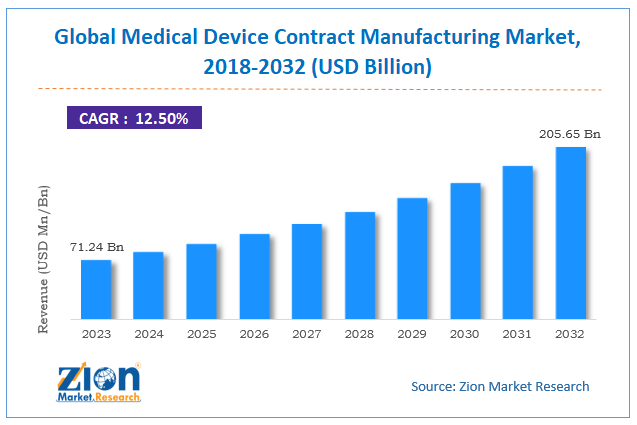
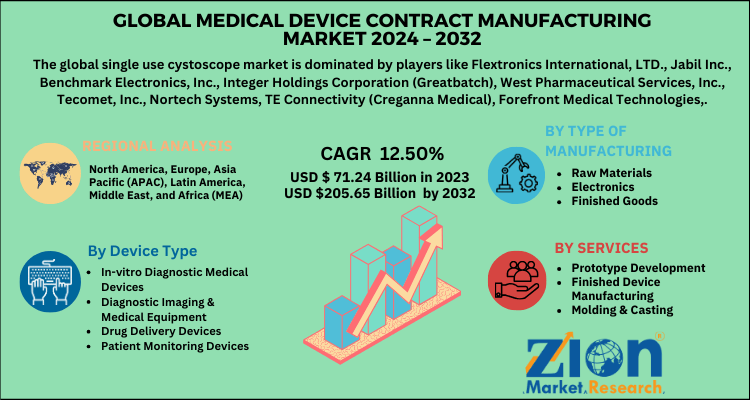
The global medical device contract manufacturing market size was worth around USD 71.24 billion in 2023 and is predicted to grow to around USD 205.65 billion by 2032 with a compound annual growth rate (CAGR) of roughly 12.50% between 2024 and 2032.
The report examines the primary drivers, challenges, and restraints shaping global demand for the medical device contract manufacturing market throughout the forecast period and identifies high-growth opportunities across the industry.
Key Insights
- As per the analysis shared by our research analyst, the global medical device contract manufacturing market is estimated to grow annually at a CAGR of around 12.50% over the forecast period (2024-2032).
- In terms of revenue, the global medical device contract manufacturing market size was valued at around USD 71.24 billion in 2023 and is projected to reach USD 205.65 billion by 2032.
- The market is driven by the growing preference of OEMs to outsource manufacturing activities to focus on research, development, and commercialization while benefiting from cost efficiencies and specialized expertise.
- Based on the device type segment, the in-vitro diagnostic medical devices segment dominated the market due to the rising prevalence of chronic and infectious diseases, increased demand for point-of-care testing, and high volume of diagnostic procedures requiring specialized production capabilities.
- Based on the type of manufacturing segment, the finished goods segment held the largest share owing to the comprehensive end-to-end production requirements of OEMs seeking fully assembled and ready-to-market devices with integrated quality assurance.
- Based on the services segment, the finished device manufacturing segment dominated because of the increasing complexity of medical devices and the need for scalable, compliant production lines that handle complete assembly and finalization.
- Based on the application segment, the cardiovascular segment led the market driven by the high incidence of heart-related conditions, continuous innovation in cardiac devices, and substantial outsourcing of sophisticated implantable and monitoring systems.
- Based on region, North America dominated the market with the largest share due to the presence of major OEMs, advanced healthcare infrastructure, high R&D spending, and a mature regulatory environment that supports sophisticated contract manufacturing activities.
Medical Device Contract Manufacturing Market: Overview
Medical device contract manufacturing refers to specialized services provided by third-party organizations that handle the design, development, production, assembly, testing, and packaging of medical devices on behalf of original equipment manufacturers (OEMs). These service providers leverage advanced facilities, regulatory expertise, and scalable production capabilities to deliver high-quality devices that comply with stringent global standards such as those from the FDA and ISO. The model allows OEMs to focus on core competencies like innovation and marketing while outsourcing complex manufacturing processes.
Medical Device Contract Manufacturing Market: Dynamics
Growth Drivers
What factors are primarily accelerating the expansion of the medical device contract manufacturing market?
The increasing complexity and cost of developing medical devices have prompted original equipment manufacturers to outsource production to specialized contract manufacturers. This shift allows companies to access advanced technologies, skilled labor, and regulatory compliance expertise without significant capital investment in facilities and equipment. Rising global healthcare expenditure, an aging population, and the growing prevalence of chronic diseases further boost demand for a wide range of medical devices, thereby expanding the need for efficient contract manufacturing services.
Technological advancements in manufacturing processes, including automation, precision engineering, and additive manufacturing, enhance production efficiency and quality. Contract manufacturers offer flexible capacity that helps OEMs respond quickly to market fluctuations and regulatory changes. Strategic partnerships and collaborations between device innovators and manufacturing specialists continue to strengthen the overall market ecosystem and support sustained growth.
Restraints
What challenges are limiting the growth of the medical device contract manufacturing market?
Stringent regulatory frameworks across different regions create significant barriers for contract manufacturers. Compliance with diverse standards such as FDA Quality System Regulation, EU MDR, and ISO 13485 requires substantial investment in quality systems, documentation, and audits. Any deviation can lead to product recalls, delays in market entry, or loss of contracts, increasing operational risks and costs for service providers.
Intellectual property protection remains a critical concern for OEMs when sharing proprietary designs and processes with third-party manufacturers. Supply chain vulnerabilities, including raw material shortages and geopolitical disruptions, can interrupt production schedules. High initial setup costs for specialized cleanrooms and advanced equipment further constrain the entry of smaller players and limit rapid capacity expansion in certain segments.
Opportunities
What emerging prospects are available in the medical device contract manufacturing market?
Emerging markets in Asia Pacific and Latin America present substantial growth opportunities due to expanding healthcare infrastructure, rising medical device consumption, and lower manufacturing costs. Governments in these regions are actively promoting local production through incentives and medical device parks, attracting both domestic and international contract manufacturers.
The shift toward personalized medicine, minimally invasive devices, and connected health solutions creates demand for specialized manufacturing capabilities. Contract manufacturers that invest in digital technologies, Industry 4.0 solutions, and end-to-end services from prototype to commercial production can capture higher-value contracts. Increasing focus on sustainable manufacturing practices and circular economy principles also opens new avenues for differentiation and long-term partnerships.
Challenges
What major obstacles must stakeholders overcome in the medical device contract manufacturing market?
Maintaining consistent product quality and sterility across high-volume production runs poses ongoing challenges, particularly for complex class II and class III devices. Rapid technological changes require continuous upskilling of the workforce and frequent upgrades of manufacturing equipment, adding to operational expenses.
Intense competition among contract manufacturers exerts pressure on pricing and margins. Balancing cost efficiency with the need for specialized expertise and regulatory readiness remains difficult. Additionally, managing multi-regional supply chains while ensuring full traceability and compliance with evolving data integrity requirements continues to test the operational resilience of market participants.
Medical Device Contract Manufacturing Market : Report Scope
| Report Attributes | Report Details |
|---|---|
| Report Name | Medical Device Contract Manufacturing Market |
| Market Size in 2023 | USD 71.24 Billion |
| Market Forecast in 2032 | USD 205.65 Billion |
| Growth Rate | CAGR of 12.50% |
| Number of Pages | 255 |
| Key Companies Covered | Flextronics International, LTD., Jabil Inc., Benchmark Electronics, Inc., Integer Holdings Corporation (Greatbatch), West Pharmaceutical Services, Inc., Tecomet, Inc., Nortech Systems, TE Connectivity (Creganna Medical), Forefront Medical Technologies, and Nordson Corporation |
| Segments Covered | By Device Type, By Type of Manufacturing, By Services, By Application, and By Region |
| Regions Covered | North America, Europe, Asia Pacific (APAC), Latin America, Middle East, and Africa (MEA) |
| Base Year | 2023 |
| Historical Year | 2018 - 2022 |
| Forecast Year | 2024 - 2032 |
| Customization Scope | Avail customized purchase options to meet your exact research needs. Request For Customization |
Medical Device Contract Manufacturing Market: Segmentation
The medical device contract manufacturing market is segmented by device type, type of manufacturing, services, application, and region. All the segments of medical device contract manufacturing market have been analyzed based on present and future trends and the market is estimated from 2024 to 2032.
Based on Device Type Segment, the medical device contract manufacturing market is divided into in-vitro diagnostic medical devices, diagnostic imaging & medical equipment, drug delivery devices, patient monitoring devices, minimally access surgical instruments, therapeutic patient assistive devices, and others. The in-vitro diagnostic medical devices segment is the most dominant due to the escalating global burden of chronic diseases, growing adoption of point-of-care testing, and continuous innovation in diagnostic platforms that require specialized manufacturing expertise. High test volumes and the need for precise, scalable production of reagents, instruments, and consumables drive substantial outsourcing. The second most dominant segment, diagnostic imaging & medical equipment, benefits from rising demand for advanced imaging systems and the technical complexity involved in producing high-precision components, which encourages OEMs to partner with experienced contract manufacturers for quality and cost efficiency.
Based on Type of Manufacturing Segment, the medical device contract manufacturing market is divided into raw materials, electronics, and finished goods. The finished goods segment dominates the market because OEMs increasingly prefer complete, ready-to-use devices that incorporate assembly, testing, and packaging under one roof, reducing coordination efforts and accelerating time-to-market. This comprehensive approach supports higher value contracts and stronger long-term partnerships. The electronics segment ranks as the second most dominant, driven by the growing integration of sensors, connectivity features, and smart technologies into modern medical devices that demand specialized electronic manufacturing capabilities and cleanroom environments.
Based on Services Segment, the medical device contract manufacturing market is divided into prototype development, finished device manufacturing, assembly & packaging, testing & regulatory support services, molding & casting, and others. Finished device manufacturing holds the leading position as it addresses the full production needs of OEMs seeking scalable, compliant manufacturing of complete devices. The ability to handle complex processes from component integration to final sterilization and packaging makes this service highly attractive. Assembly & packaging emerges as the second most dominant service due to the critical importance of maintaining sterility, ensuring proper labeling, and protecting product integrity throughout the supply chain, which drives consistent demand for specialized expertise in these areas.
Based on Application Segment, the medical device contract manufacturing market is divided into cardiovascular, orthopedic, neurovascular, pulmonary, oncology, laparoscopy, urology & gynecology, radiology, and others. The cardiovascular segment is the most dominant, supported by the high global prevalence of cardiovascular diseases, continuous introduction of innovative implantable and interventional devices, and the sophisticated manufacturing requirements of stents, pacemakers, and monitoring systems. Orthopedic applications form the second most dominant segment, propelled by an aging population, rising incidence of musculoskeletal disorders, and growing adoption of implants and surgical instruments that benefit from precision manufacturing and material expertise offered by contract partners.
Medical Device Contract Manufacturing Market: Regional Analysis
Why will North America continue to dominate the global market during the projection period?
North America maintains its leading position in the medical device contract manufacturing market owing to the concentration of major original equipment manufacturers, advanced healthcare infrastructure, and a robust regulatory framework that fosters innovation and quality. The United States, in particular, drives regional dominance through high R&D investments, a large base of medical technology companies, and the presence of leading contract manufacturers with extensive capabilities in complex device production. Strong collaboration between academia, industry, and regulatory bodies accelerates the development and commercialization of sophisticated devices, further reinforcing the region’s market leadership and influencing global standards and best practices.
Europe holds a significant share supported by well-established healthcare systems, stringent yet clear regulatory pathways under the Medical Device Regulation, and a strong focus on high-quality manufacturing. Countries such as Germany, the United Kingdom, and France host advanced production facilities and specialized expertise in precision engineering and diagnostics. Continuous investment in research and the presence of innovative device companies sustain steady demand for contract manufacturing services across the region.
Asia Pacific is emerging as the fastest-growing region, driven by expanding healthcare access, rising medical device consumption, and cost-competitive manufacturing environments. China, Japan, India, and South Korea are key contributors, with governments promoting local production capabilities and attracting foreign investment through dedicated medical device parks and favorable policies. The combination of skilled labor availability and increasing focus on quality standards positions the region for substantial expansion and greater participation in global supply chains.
Latin America benefits from improving healthcare infrastructure and growing awareness of advanced medical technologies, with Brazil and Mexico serving as primary hubs for manufacturing and distribution activities. The Middle East and Africa region shows gradual progress supported by increasing healthcare investments, particularly in the Gulf countries, and efforts to localize production of essential medical devices to enhance supply security and reduce import dependence.
Recent Developments
- In early 2025, Integer Holdings Corporation acquired specialized medical device coatings companies to strengthen its vertically integrated offerings and enhance coating technologies for complex devices.
- In 2025, Jabil continued expanding its healthcare manufacturing footprint with significant investments aimed at enhancing injection molding and assembly capacities for medical applications.
Medical Device Contract Manufacturing Market: Competitive Analysis
The global medical device contract manufacturing market is led by players like:
- Flextronics International, LTD
- Jabil Inc
- Benchmark Electronics, Inc
- Integer Holdings Corporation (Greatbatch)
- West Pharmaceutical Services, Inc
- Tecomet, Inc
- Nortech Systems
- TE Connectivity (Creganna Medical)
- Forefront Medical Technologies
- Nordson Corporation
Segment Coverage
The global medical device contract manufacturing market is segmented as follows:
By Device Type
- In-vitro Diagnostic Medical Devices
- Diagnostic Imaging & Medical Equipment
- Drug Delivery Devices
- Patient Monitoring Devices
- Minimally Access Surgical Instruments
- Therapeutic Patient Assistive Devices
- Others
By Type of Manufacturing
- Raw Materials
- Electronics
- Finished Goods
By Services
- Prototype Development
- Finished Device Manufacturing
- Assembly & Packaging
- Testing & Regulatory Support Services
- Molding & Casting
- Others
By Application
- Cardiovascular
- Orthopedic
- Neurovascular
- Pulmonary
- Oncology
- Laparoscopy
- Urology & Gynecology
- Radiology
- Others
By Region
- North America
- The U.S.
- Canada
- Mexico
- Europe
- France
- The UK
- Spain
- Germany
- Italy
- Rest of Europe
- Asia Pacific
- China
- Japan
- India
- Australia
- South Korea
- Rest of Asia Pacific
- The Middle East & Africa
- Saudi Arabia
- UAE
- Egypt
- Kuwait
- South Africa
- Rest of the Middle East & Africa
- Latin America
- Brazil
- Argentina
- Rest of Latin America
Table Of Content
Methodology
FrequentlyAsked Questions
Medical device contract manufacturing is a service offered by specialised firms that design, develop, manufacture, and assemble medical devices for original equipment manufacturers (OEMs). These contract manufacturers have the experience, facilities, and regulatory understanding needed to create medical devices that satisfy stringent industry requirements.
Several main variables influence the growth of the contract manufacturing industry for medical devices. These include technology developments, legislative changes, trends in the healthcare industry, and economic considerations.
The global medical device contract manufacturing market size was worth around USD 71.24 billion in 2023 and is predicted to grow to around USD 205.65 billion by 2032.
The global medical device contract manufacturing market a compound annual growth rate (CAGR) of roughly 12.50% between 2024 and 2032.
Which region will contribute notably towards the medical device contract manufacturing market value?
North America is expected to continue contributing the largest share to the medical device contract manufacturing market value, supported by advanced infrastructure, major OEM presence, and high innovation activity, while Asia Pacific is projected to register the fastest growth.
Flextronics International, LTD., Jabil Inc., Benchmark Electronics, Inc., Integer Holdings Corporation (Greatbatch), West Pharmaceutical Services, Inc., Tecomet, Inc., Nortech Systems, TE Connectivity (Creganna Medical), Forefront Medical Technologies, and Nordson Corporation.
The report provides comprehensive analysis of market size, growth drivers, restraints, opportunities, competitive landscape, detailed segmentation, regional insights, recent developments, and strategic recommendations to support informed decision-making for stakeholders.

HappyClients

