
Mechanical Control Cable Market Size, Growth, Global Trends, Forecast 2034

Mechanical Control Cable Market By Type (Pull-Pull and Push-Pull), By Platform (Land, Marine, and Aerial), By Material (Jacket Material and Wire Material), By End-Use Vertical (Defense, Commercial, and Non-Aero Military), and By Region - Global and Regional Industry Overview, Market Intelligence, Comprehensive Analysis, Historical Data, and Forecasts 2025 - 2034
| Market Size in 2024 | Market Forecast in 2034 | CAGR (in %) | Base Year |
|---|---|---|---|
| USD 4.17 Billion | USD 6.28 Billion | 4.59% | 2024 |
Mechanical Control Cable Industry Perspective:
What is the anticipated size of the global mechanical control cable market during the projection period
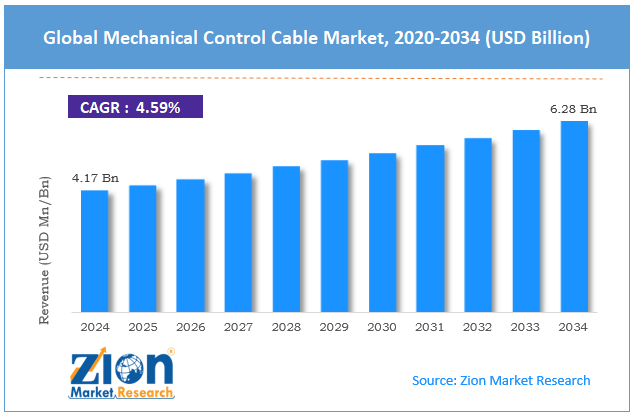
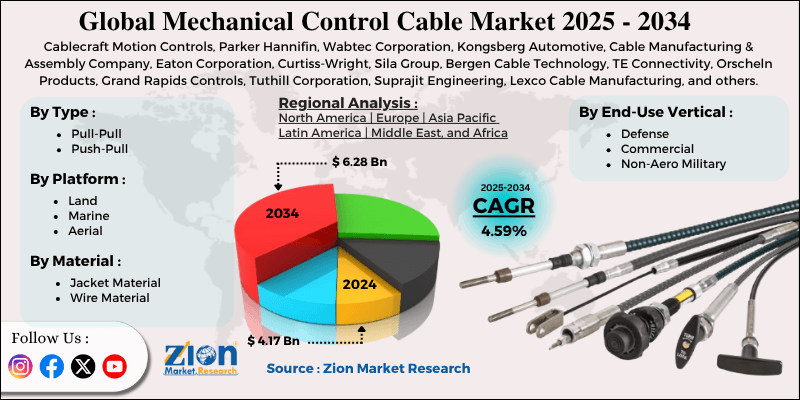
The global mechanical control cable market size was worth around USD 4.17 billion in 2024 and is predicted to grow to around USD 6.28 billion by 2034, with a compound annual growth rate (CAGR) of roughly 4.59% between 2025 and 2034.
Key Insights:
- As per the analysis shared by our research analyst, the global mechanical control cable market is estimated to grow annually at a CAGR of around 4.59% over the forecast period (2025-2034)
- In terms of revenue, the global mechanical control cable market size was valued at around USD 4.17 billion in 2024 and is projected to reach USD 6.28 billion by 2034.
- The mechanical control cable market is projected to grow at a significant rate due to the growing production volume of automotives.
- Based on the type, the push-pull segment is growing at a high rate and will continue to dominate the global market, as per industry projections
- Based on the platform, the land segment is anticipated to command the largest market share
- Based on the material, the wire material segment is expected to lead the market growth trends
- Based on the end-use vertical, the non-aero military segment is projected to influence revenue in the market
- Based on region, the Asia-Pacific is projected to dominate the global market during the forecast period
Mechanical Control Cable Market: Overview
Mechanical control cables are defined as flexible assemblies that transmit force or motion from a user input to a remote system. The most common applications of mechanical control cables are in automotive vehicles and industrial units. Mechanical control cables are multi-component systems with 3 main assemblies that are inner cables, outer housings, and end fittings & adjusters. Prominent types of mechanical control cables include bowden (pull-only) cables and pull-push (dual-action) cables. During the forecast period, demand for mechanical control cable is expected to grow due to rising automobile production, expansion of public transport systems, and introduction of novel industrial machinery. Additionally, strategic global partnerships may also help influence industry revenue in the long run. However, ongoing shifts to electric systems and supply chain disruptions may impact business growth trends during the forecast period.
Mechanical Control Cable Market: Dynamics
Growth Drivers
How will growing automotive production influence the mechanical cable control market?
The global mechanical control cable market is expected to benefit from the growing production volume of automotives. According to market research, automotive production grew by more than 4.9% in 2025 as compared to 2024. Increasing demand for lightweight vehicles and two-wheel automotives has played a crucial role in shaping the modern automotive industry. Mechanical control cables are an integral part of automobile vehicles as they are used in the clutch, brake, gear, and throttle systems. Furthermore, mechanical control cables are essential elements of bikes and motorcycles. During the forecast period, growth in the automotive industry will be facilitated by favorable government policies and evolving consumer demands.
Expansion of public transport systems and ride-sharing infrastructure to aid accelerated market revenue in the long run
The last few years have witnessed a rapid expansion of the public transport system, especially in road-based modes. The introduction of several new domestic routes connecting urban and rural parts of growing economies has helped fuel demand for mechanical control cables.
For instance, in March 2026, the European Union announced the adoption of the State aid Land and Multimodal Transport Guidelines (LMT Guidelines) and the State aid Transport Block Exemption Regulation (TBER) to promote the adoption of sustainable methods of transportation. In addition, the proliferation of ride-sharing services in urban and metropolitan cities worldwide will further work in favor of the global mechanical control cable market.
Restraints
Why will supply chain disruptions emerge as prominent restrictions against the mechanical control cable market growth?
The global mechanical control cable industry is expected to face constraints due to supply chain disruption risks. Mechanical control cable production relies heavily on a smooth supply of essential raw materials such as aluminum and steel. However, evolving geopolitics and rising trade differences worldwide have created barriers against the smooth supply of these primary materials, limiting final production and disrupting the overall supply chain.
Opportunities
Emergence of smart factories and industrial automation to generate growth opportunities for the market players
The global mechanical control cable market is anticipated to generate growth opportunities due to the rising development of smart factories. These units rely heavily on automation technologies and robotic solutions. In addition, ongoing automation of existing industrial facilities will further create growth momentum for mechanical control cables.
For instance, the new Earthmoving Machinery Manufacturing Smart Factory by Zoomlion was recently dismantled and built again. The new intelligent facility produces one excavator every 6 minutes. Growing global demand for commodities and rising competition will encourage accelerated industrial automation, promoting the use of control cables.
Why will the used cars industry and its application in the automotive aftermarket create growth opportunities for the mechanical control cable market?
The thriving used cars industry, along with the automotive aftermarkets, is a major growth driver for the mechanical control cable market. These industries encourage the repair and maintenance of existing worn-out cables, thus promoting safety. Additionally, regular replacement of worn-out vehicular parts helps enhance the product lifecycle. The surge in the number of people investing in used cars and in the automotive aftermarket will help drive revenue from mechanical control cables.
Challenges
Shift toward electric and hydraulic systems to challenge market expansion in the long run
The industrial economy worldwide is moving toward electric and hydraulic systems, thus challenging the global mechanical control cable market. Electric systems are more sustainable and eco-friendly. Additionally, they eliminate excessive reliance on sensitive and highly volatile raw materials such as steel and aluminum. The rapid shift toward electric and hydraulic systems will impact the expansion of mechanical control cables.
Mechanical Control Cable Market: Report Scope
| Report Attributes | Report Details |
|---|---|
| Report Name | Mechanical Control Cable Market |
| Market Size in 2024 | USD 4.17 Billion |
| Market Forecast in 2034 | USD 6.28 Bllion |
| Growth Rate | CAGR of 4.59% |
| Number of Pages | 224 |
| Key Companies Covered | Cablecraft Motion Controls, Parker Hannifin, Wabtec Corporation, Kongsberg Automotive, Cable Manufacturing & Assembly Company, Eaton Corporation, Curtiss-Wright, Sila Group, Bergen Cable Technology, TE Connectivity, Orscheln Products, Grand Rapids Controls, Tuthill Corporation, Suprajit Engineering, Lexco Cable Manufacturing, and others. |
| Segments Covered | By Type, By Platform, By Material, By End-Use Vertical, and By Region |
| Regions Covered | North America, Europe, Asia Pacific (APAC), Latin America, Middle East, and Africa (MEA) |
| Base Year | 2024 |
| Historical Year | 2019 to 2023 |
| Forecast Year | 2025 - 2034 |
| Customization Scope | Avail customized purchase options to meet your exact research needs. Request For Customization |
Mechanical Control Cable Market: Segmentation
The global mechanical control cable market is segmented based on type, platform, material, end-use vertical, and region.
Why will the push-pull segment lead the mechanical control cable industry revenue during the forecast period?
Based on type, the global market segments are pull-pull and push-pull. In 2024, the highest growth was listed in the push-pull segment. It accounted for 63.9% of global revenue and is projected to offer a CAGR of 7.1% during the forecast period. These cables are more versatile because they can transmit energy in both directions. Additionally, they are more reliable and simple to install, further elevating market growth trends.
Which will be the fastest-growing segment during the forecast period in the mechanical control cable market?
Based on the platform, the global mechanical control cable industry is divided into land, marine, and aerial. The highest growth rate in 2024 was listed in the land segment, contributing up to 71% of the global revenue. It will continue leading the market with a CAGR of 6.1% due to higher use of cables in prominent industries such as construction equipment and automotive.
Why will wire material continue to lead the mechanical control cable industry in the coming years?
Based on the material, the global market is divided into jacket material and wire material. In 2024, the global market was led by the wire material segment, accounting for 65.05% of the global revenue. The material is the core component of mechanical control cables, and it is responsible for critical functions such as durability and load transmission. The wire material segment will continue to deliver a CAGR of 6.12% in the coming years.
Why will the commercial segment continue to lead the mechanical control cable industry in the coming years?
Based on end-use verticals, the global market is divided into defense, commercial, and non-aero military. The commercial segment was the leading revenue generator in 2024, leading up to 70.05% of global revenue.
However, during the forecast period, the non-aero military segment is expected to emerge as the fastest-growing industry, with a CAGR of 7.12%, driven by surging investments in ground-based military equipment, amid rising geopolitical tensions worldwide.
Mechanical Control Cable Market: Regional Analysis
What is the projected CAGR for Asia-Pacific in the mechanical control cable market during the forecast period?
The global mechanical control cable market is expected to be led by Asia-Pacific during the forecast period. In 2024, the region accounted for 40% of global revenue and is anticipated to grow at a CAGR of 8.51% during the forecast period. The growth of the automotive industry in China, India, and Japan is the primary driver of the regional market. In addition, increasing integration of automation technologies across manufacturing facilities, along with easier access to essential raw materials and manual labor, will further help the region thrive.
Why will North America emerge as the second-highest region in the mechanical control cable market during the forecast period?
North America is projected to emerge as the second-highest revenue generator in the global mechanical control cable market during the forecast period with a CAGR of 6.57%. In 2024, it generated 34% of the global revenue, led by rising demand for mechanical control cables in the defense and automotive industries. Additionally, industrial automation and the expansion of the aerospace industry, along with rising demand for high-quality control cables, will further drive the region's growth.
Mechanical Control Cable Market: Competitive Analysis
The global mechanical control cable market is led by players like:
- Cablecraft Motion Controls
- Parker Hannifin
- Wabtec Corporation
- Kongsberg Automotive
- Cable Manufacturing & Assembly Company
- Eaton Corporation
- Curtiss-Wright
- Sila Group
- Bergen Cable Technology
- TE Connectivity
- Orscheln Products
- Grand Rapids Controls
- Tuthill Corporation
- Suprajit Engineering
- Lexco Cable Manufacturing
What are the latest key trends in the mechanical control cable market?
Smart cables
The ongoing integration of smart technologies in mechanical control cables is a promising market trend. It includes cables equipped with feedback systems and modern sensors, allowing predictive maintenance and real-time diagnostics.
Advanced materials
The growing use of advanced materials, such as composite and carbon-based solutions and thermoplastic elastomers (TPE), will further drive market growth. These materials are designed to reduce cable weight and improve its overall applications.
The global mechanical control cable market is segmented as follows:
By Type
- Pull-Pull
- Push-Pull
By Platform
- Land
- Marine
- Aerial
By Material
- Jacket Material
- Wire Material
By End-Use Vertical
- Defense
- Commercial
- Non-Aero Military
By Region
- North America
- The U.S.
- Canada
- Mexico
- Europe
- France
- The UK
- Spain
- Germany
- Italy
- Rest of Europe
- Asia Pacific
- China
- Japan
- India
- Australia
- South Korea
- Rest of Asia Pacific
- The Middle East & Africa
- Saudi Arabia
- UAE
- Egypt
- Kuwait
- South Africa
- Rest of the Middle East & Africa
- Latin America
- Brazil
- Argentina
- Rest of Latin America
Table Of Content
Methodology
FrequentlyAsked Questions
Mechanical control cables are defined as flexible assemblies that aid in the transmission of force or motion from a user input to a remote system.
The global mechanical control cable market is expected to benefit from the growing production volume of automotives.
According to study, the global mechanical control cable market size was worth around USD 4.17 billion in 2024 and is predicted to grow to around USD 6.28 billion by 2034.
The CAGR value of the mechanical control cable market is expected to be around 4.59% during 2025-2034.
The industrial economy worldwide is moving toward electric and hydraulic systems, thus challenging the global mechanical control cable market.
Smart cables and advanced materials are the emerging trends and innovations impacting the mechanical control cable market.
The global mechanical control cable market has performed well so far and will offer similar trends in the coming years.
The global mechanical control cable market is expected to be led by Asia-Pacific during the forecast period.
The global mechanical control cable market is led by players like Cablecraft Motion Controls, Parker Hannifin, Wabtec Corporation, Kongsberg Automotive, Cable Manufacturing & Assembly Company, Eaton Corporation, Curtiss-Wright, Sila Group, Bergen Cable Technology, TE Connectivity, Orscheln Products, Grand Rapids Controls, Tuthill Corporation, Suprajit Engineering, and Lexco Cable Manufacturing.
The report explores crucial aspects of the mechanical control cable market, including a detailed discussion of existing growth factors and restraints, while also browsing future growth opportunities and challenges that impact the market.

HappyClients

