
Lung Tumor Market Size, Trend, Growth, Industry Analysis Report 2034

Lung Tumor Market By Product (Targeted Therapies, Chemotherapy Drugs, Imaging Systems, Surgical Instruments, Biopsy Needles & Devices, Radiation Therapy Equipment, and Others), By Application (Treatment, Early Detection, Diagnosis, and Prognosis), By End-User Vertical (Imaging Centers, Cancer Centers, Hospitals & Clinics, and Research Institutions), and By Region - Global and Regional Industry Overview, Market Intelligence, Comprehensive Analysis, Historical Data, and Forecasts 2025 - 2034
| Market Size in 2024 | Market Forecast in 2034 | CAGR (in %) | Base Year |
|---|---|---|---|
| USD 5.82 Billion | USD 10.51 Billion | 6.67% | 2024 |
Lung Tumor Industry Perspective:
What is the anticipated size of the lung tumor market during the projection period?
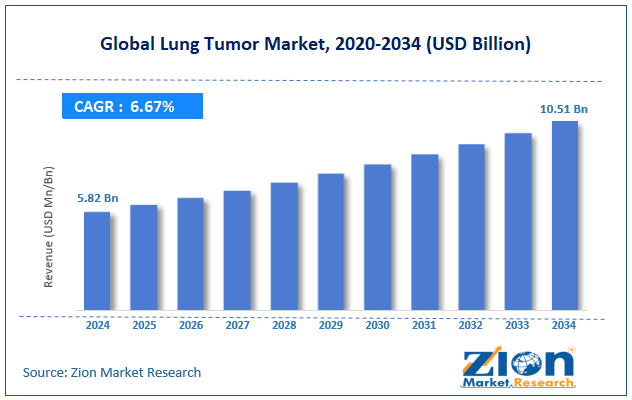
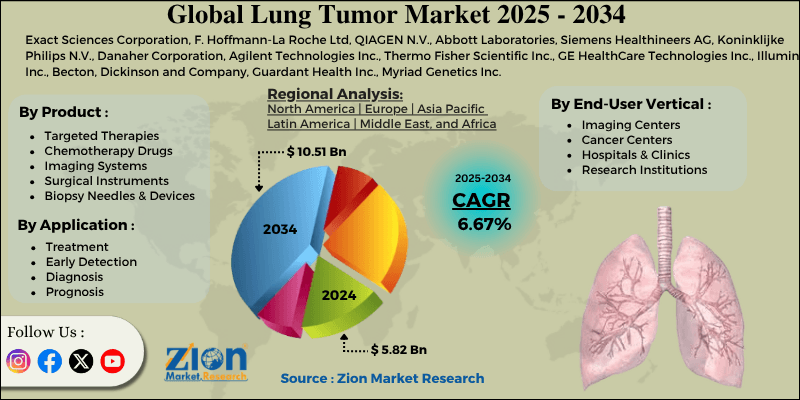
The global lung tumor market size was worth around USD 5.82 billion in 2024 and is predicted to grow to around USD 10.51 billion by 2034 with a compound annual growth rate (CAGR) of roughly 6.67% between 2025 and 2034.
Lung Tumor Market: Overview
Lung tumor refers to an abnormal growth or mass of cells in the lung airways or tissues. Lung tumor can spread from tumors in other parts of the body, or they can begin in the lungs themselves. In addition, primary lung tumors can be cancerous or noncancerous. Lung tumor treatment depends on the type of tumor. According to medical experts, noncancerous lung tumor can also lead to severe health problems if untreated. Common forms of noncancerous or benign tumors are hamartomas, myoblastomas, bronchial cystadenomas, and papillomas. During the forecast period, demand for lung tumor diagnosis and treatment is expected to grow due to the rising prevalence of lung cancer.
In addition, increased focus on early diagnosis and expansion of the healthcare industry will work in the favor of the regional players. However, the high cost of medical treatment, lack of effective medical infrastructure, and economic burdens may limit market expansion in the long run.
Key Insights:
- As per the analysis shared by our research analyst, the global lung tumor market is estimated to grow annually at a CAGR of around 6.67% over the forecast period (2025-2034)
- In terms of revenue, the global lung tumor market size was valued at around USD 5.82 billion in 2024 and is projected to reach USD 10.51 billion by 2034.
- The market is projected to grow at a significant rate due to the growing prevalence of lung cancer worldwide.
- Based on the product, the targeted therapies segment is growing at a high rate and will continue to dominate the global market, as per industry projections
- Based on the application, the early detection segment is anticipated to command the largest market share.
- Based on the end-user vertical, the imaging centers segment is expected to lead the market growth trends.
- Based on region, Europe is projected to dominate the global market during the forecast period.
Impact of the USA-Israel and Iran war on the Lung Tumor Market:
The ongoing war between the USA-Israel and Iran has affected global supply of medical products including diagnostic tools and medicines. Furthermore, it has also constrained medical tourism especially in Middle Eastern countries. In the coming year, the war is projected to influence greater reliance on domestic production and trade route diversification.
Lung Tumor Market: Dynamics
Growth Drivers
How will the growing prevalence of lung cancer influence lung tumor market growth?
The global lung tumor market is expected to be influenced by the growing prevalence of lung cancer worldwide. According to the Cleveland Clinic, lung cancer is the third most common type of cancer in the US. The primary cause of lung cancer is the uncontrollable and unchecked growth of harmful cells. Some of the prominent risk factors associated with lung cancer include exposure to secondhand smoke, family history of lung cancer, exposure to asbestos, alcohol, diesel, uranium, and coal products, and previous radiation treatments to the chest. Changing lifestyle of the general population and growing pollution level are expected to result in a higher number of lung cancer incidences globally, thus driving demand for effective diagnostic and treatment facilities. Immunotherapy, chemotherapy, surgery, targeted drugs, and radiation are the prominent treatments adopted against lung cancer.
Advancements toward early diagnosis to promote market growth in the coming years
Growing incidences of lung tumor have propelled demand for early diagnosis. As per market research, diagnosing lung tumor in early stages can improve survival rate and quality of life. In February 2025, scientists launched a new, affordable, fast response sensor for detecting lung cancer biomarkers. The new tool has paved the way for novel screening devices that can detect the disease before the symptoms appear. In August 2023, LUNGevity, a leading non-profit organization focused on lung cancer, launched the LUNGevity Early Lung Cancer Center (ELCC), aiming to accelerate the advancements of early detection and early treatment options, thus helping the global lung tumor market grow.
Restraints
Which factors will limit the expansion of the lung tumor market during the forecast period?
The global lung tumor industry is projected to be restricted due to the high cost of diagnosis and treatment. Advanced medical therapies such as immunotherapy are effective but expensive. The cost barriers limit technology adoption in emerging and low-income countries. Furthermore, lack of effective medical reimbursement, national health insurance initiatives, and other financial issues will affect market revenue in the coming years.
Opportunities
Shifting toward personalized medical care creates expansion possibilities for the market players
The global lung tumor market is anticipated to generate growth opportunities in the form of rising demand for personalized medical care. It is also known as precision medicine and is customized to meet the exact medical requirements of a patient. Shifting away from standard procedures, personalized medicines leverage the unique genetic profile of a patient along with other essential factors such as age and lifestyle to develop medical diagnostic and treatment plans. Precision medicine has shown exceptional end results, especially when dealing with aggressive diseases such as lung tumors.
How will advanced technologies shape the lung tumor market during the forecast period?
The ongoing efforts toward the use of next-generation technologies to enhance diagnostic procedures and medical care will promote market expansion trends. For instance, in March 2026, Caris Life Sciences®, a leading provider of Artificial Intelligence (AI) techBio solutions and precision medicine pioneer, announced the addition of two new Caris AI Insights™ signatures in the Caris Molecular Tumor Board Report. According to market reports, these signatures assess the risk of patients developing brain metastases in lung and breast cancer. The growing use of software applications for lung cancer detection will further encourage market expansion.
Challenges
Will the complex biology of lung tumor to challenge market expansion in the coming years?
The global lung tumor industry is expected to be challenged by the biological complexity of the tumors. According to market analysis, lung tumors are heterogeneous in terms of cell types, genetic mutations, and aggressiveness. Thus, standard treatments may not apply to all patients. The final treatment efficiency may also vary depending on the stage of detection and the patient’s overall immune strength during medical procedures.
Lung Tumor Market: Report Scope
| Report Attributes | Report Details |
|---|---|
| Report Name | Lung Tumor Market |
| Market Size in 2024 | USD 5.82 Billion |
| Market Forecast in 2034 | USD 10.51 Billion |
| Growth Rate | CAGR of 6.67% |
| Number of Pages | 227 |
| Key Companies Covered | Exact Sciences Corporation, F. Hoffmann-La Roche Ltd, QIAGEN N.V., Abbott Laboratories, Siemens Healthineers AG, Koninklijke Philips N.V., Danaher Corporation, Agilent Technologies Inc., Thermo Fisher Scientific Inc., GE HealthCare Technologies Inc., Illumina Inc., Becton, Dickinson and Company, Guardant Health Inc., Myriad Genetics Inc., Bio-Rad Laboratories Inc., and others. |
| Segments Covered | By Product, By Application, By End-User Vertical, and By Region |
| Regions Covered | North America, Europe, Asia Pacific (APAC), Latin America, Middle East, and Africa (MEA) |
| Base Year | 2024 |
| Historical Year | 2019 - 2023 |
| Forecast Year | 2025 - 2034 |
| Customization Scope | Avail customized purchase options to meet your exact research needs. Request For Customization |
Lung Tumor Market: Segmentation
The global lung tumor market is segmented based on product, application, end-user vertical, and region.
Why will the targeted therapies segment deliver a faster CAGR in the lung tumor industry revenue during the forecast period?
Based on product, the global market segments are targeted therapies, chemotherapy drugs, imaging systems, surgical instruments, biopsy needles & devices, traditional therapy equipment, and others. In 2024, the highest growth was listed in the targeted therapies segment. It accounted for 51% of the global revenue and will grow at a CAGR of 11.9% during the forecast period. Excellent results delivered by targeted therapies in managing lung tumor is a prominent segmental growth driver.
Which will be the fastest-growing application during the forecast period in the lung tumor market?
Based on application, the global lung tumor industry is divided into treatment, early detection, diagnosis, and prognosis. The highest growth rate in 2024 was listed in the treatment segment, contributing up to 66% of the total revenue. During the forecast period, early detection is projected to grow at a faster CAGR of 10.7%. It held control over 16% of the global revenue in 2024. Early detection helps improve survival rate thus driving market revenue.
Why will the imaging centers lead the lung tumor industry in the coming years?
Based on end-user verticals, the global market segments are imaging centers, cancer centers, hospitals & clinics, and research institutions. In 2024, the hospitals & clinics segment was the market leader, holding prominence over 54% of the total revenue. Imaging centers are anticipated to grow at a faster CAGR in the coming years, driven by technological advancements such as AI integration in imaging and processing equipment.
Lung Tumor Market: Regional Analysis
Why will Europe continue leading the lung tumor market?
The global lung tumor market is currently led by Europe. In 2024, it accounted for 45% of the global revenue. It will grow at a CAGR of 8.1% during the forecast period. Countries such as Spain and Germany are some of the world’s leading care providers for lung tumor. The presence of a robust healthcare infrastructure offering affordable and comprehensive care will aid regional expansion in the coming years. Furthermore, regional pharmaceutical giants such as Roche and Novartis, among others, are projected to lead growth in the European market.
How is Asia-Pacific expected to perform in the lung tumor market during the projection period?
Asia-Pacific is projected to emerge as the fastest-growing region with a CAGR of 25% during the forecast period. In 2024, it accounted for 13.51% of the global revenue. China, South Korea, and India are projected to emerge as influential regions. Rising prevalence of lung cancer, growing public awareness, and introduction of new national health programmes encouraging early detection and access to quality medical care will work in the favor of the regional market.
Lung Tumor Market: Competitive Analysis
The global lung tumor market is led by players like:
- Exact Sciences Corporation
- F. Hoffmann-La Roche Ltd
- QIAGEN N.V.
- Abbott Laboratories
- Siemens Healthineers AG
- Koninklijke Philips N.V.
- Danaher Corporation
- Agilent Technologies Inc.
- Thermo Fisher Scientific Inc.
- GE HealthCare Technologies Inc.
- Illumina Inc.
- Becton
- Dickinson and Company
- Guardant Health Inc.
- Myriad Genetics Inc.
- Bio-Rad Laboratories Inc.
Which are the latest key trends in the lung tumor market?
Increased demand for non-invasive diagnostic procedures
Growing work toward the development of non-invasive diagnostic procedures, such as liquid biopsies, is expected to reshape the lung tumor market. These techniques are designed to offer enhanced results in terms of mutation analysis and early detection.
Combination therapies
Combination therapies such as immunotherapy along with chemotherapy are emerging as prominent market trends. Combining two or more treatments can help deliver enhanced care even in the case of aggressive lung tumors.
The global lung tumor market is segmented as follows:
By Product
- Targeted Therapies
- Chemotherapy Drugs
- Imaging Systems
- Surgical Instruments
- Biopsy Needles & Devices
- Radiation Therapy Equipment
- Others
By Application
- Treatment
- Early Detection
- Diagnosis
- Prognosis
By End-User Vertical
- Imaging Centers
- Cancer Centers
- Hospitals & Clinics
- Research Institutions
By Region
- North America
- The U.S.
- Canada
- Mexico
- Europe
- France
- The UK
- Spain
- Germany
- Italy
- Rest of Europe
- Asia Pacific
- China
- Japan
- India
- Australia
- South Korea
- Rest of Asia Pacific
- The Middle East & Africa
- Saudi Arabia
- UAE
- Egypt
- Kuwait
- South Africa
- Rest of the Middle East & Africa
- Latin America
- Brazil
- Argentina
- Rest of Latin America
Table Of Content
Methodology
FrequentlyAsked Questions
Lung tumor refers to an abnormal growth or mass of cells in the lung airways or tissues. Lung tumor can spread from tumors in other parts of the body, or they can begin in the lungs themselves.
The global lung tumor market is expected to be influenced by the growing prevalence of lung cancer worldwide.
According to study, the global lung tumor market size was worth around USD 5.82 billion in 2024 and is predicted to grow to around USD 10.51 billion by 2034.
The CAGR value of lung tumor market is expected to be around 6.67% during 2025-2034.
The global lung tumor industry is expected to be challenged by the biological complexity of the tumors.
The lung tumor market is highly competitive with several biotechnology and pharmaceutical companies aiming to enhance access to targeted therapies and early detection.
The lung tumor market is expected to shift toward non-invasive diagnostic and treatment procedures during the forecast period.
Asia-Pacific is projected to emerge as the fastest-growing region with a CAGR of 25% during the forecast period.
The global lung tumor market is led by players like Exact Sciences Corporation, F. Hoffmann-La Roche Ltd, QIAGEN N.V., Abbott Laboratories, Siemens Healthineers AG, Koninklijke Philips N.V., Danaher Corporation, Agilent Technologies, Inc., Thermo Fisher Scientific Inc., GE HealthCare Technologies Inc., Illumina, Inc., Becton, Dickinson and Company, Guardant Health, Inc., Myriad Genetics, Inc. and Bio-Rad Laboratories, Inc.
The report explores crucial aspects of the lung tumor market including detailed discussion of existing growth factors and restraints while also browsing future growth opportunities and challenges that impact the market.

HappyClients

