
Lithium Battery Manufacturing Equipment Market Size, Share, Trends, Growth 2034

Lithium Battery Manufacturing Equipment Market By Equipment Type (Coating Equipment, Testing and Quality Control Equipment, Cell Formation Equipment, Assembly and Packaging Equipment, and Others), By Automation Level (Manual Equipment, Fully Automated Equipment, and Semi-Automated Equipment), By Application (Consumer Electronics, Industrial Energy Storage, Electric Vehicles (EVs), Renewable Energy Systems, and Others), and Region - Global and Regional Industry Overview, Market Intelligence, Comprehensive Analysis, Historical Data, and Forecasts 2026 - 2034
| Market Size in 2025 | Market Forecast in 2034 | CAGR (in %) | Base Year |
|---|---|---|---|
| USD 12.5 Billion | USD 49.4 Billion | 16.5% | 2025 |
Lithium Battery Manufacturing Equipment Industry Perspective:
What will be the size of the global lithium battery manufacturing equipment market during the forecast period?
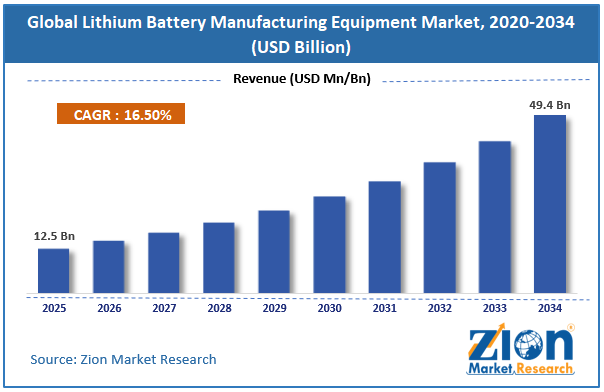
The global lithium battery manufacturing equipment market size was worth around USD 12.5 billion in 2025 and is predicted to grow to around USD 49.4 billion by 2034, with a compound annual growth rate (CAGR) of roughly 16.5% between 2026 and 2034.
 Request Free SampleRequest Free SampleRequest Free Sample
Key Insights
- As per the analysis shared by our research analyst, the global lithium battery manufacturing equipment market is estimated to grow annually at a CAGR of around 16.5% over the forecast period (2026-2034).
- In terms of revenue, the global lithium battery manufacturing equipment market size was valued at around USD 12.5 billion in 2025 and is projected to reach USD 49.4 billion by 2034.
- Growth of EVs is expected to propel the lithium battery manufacturing equipment market over the projected period.
- Based on the equipment type, the coating equipment segment dominates the market.
- Based on the automation level, the fully automated equipment segment holds a majority of market share in 2025.
- Based on the application, the Electric Vehicles (EVs) segment holds a majority of market share in 2025.
- Based on region, the Asia Pacific dominates the lithium battery manufacturing equipment market.
Lithium Battery Manufacturing Equipment Market: Overview
Lithium battery manufacturing equipment refers to the machinery used to produce lithium-ion and other lithium-based batteries. These lithium batteries are made through an entire process that requires machinery for mixing, coating, calendering, slitting, and winding or stacking, among other operations. Some of the important equipment includes mixers that are used in the preparation of electrode slurries, coating equipment for applying the active material on the current collectors, calendering equipment for controlling the density and thickness of electrodes, slitting equipment for cutting the electrode strips, and winding or stacking equipment that is used in the assembling of the cells. The lithium battery manufacturing equipment industry is driven by the growth of electric cars and energy storage applications.
Impact of the USA-Israel War on Iran on the Lithium Battery Manufacturing Equipment Market
The US-Israel conflict with Iran will likely have a dual, largely negative effect on the lithium battery manufacturing equipment market in the short term. Shipping and logistics issues have raised shipping and fuel costs and made it harder to ship certain raw materials and goods used in the battery industry. Commodities such as sulfur and sulfuric acid, which play a crucial role in the processing of many battery metals, have suffered greatly from supply chain disruptions and rising costs. The conflict could raise production costs for battery manufacturers, preventing them from purchasing new manufacturing equipment.
Lithium Battery Manufacturing Equipment Market: Dynamics
Growth Drivers
How does the expansion of battery gigafactories drive the lithium battery manufacturing equipment market?
An important factor contributing to growth in the lithium battery manufacturing equipment market is the development of gigafactories, as each requires advanced, automated equipment for processes such as electrode mixing, coating, calendering, slitting, stacking/winding, electrolyte filling, formation, testing, and packaging. Based on data from the International Energy Agency (IEA), global lithium-ion battery manufacturing capacity exceeded 4 TWh at the end of 2025, representing a 30% increase over 2024. Additionally, IEA estimates suggest committed battery projects could increase total capacity to 6.5 TWh in 2030, up from 3.3 TWh in 2024.
Moreover, the introduction of government-sponsored industrial policies further increases demand for such equipment. In the United States, battery manufacturing capacity has more than doubled since 2022, reaching over 200 GWh in 2024, with nearly 700 GWh under construction, partly due to federal tax incentives.
In the European Union, government programs, including the European Battery Alliance and Important Projects of Common European Interest, helped increase battery-cell manufacturing capacity from 1 GWh in 2017 to more than 200 GWh and spurred approximately USD 39 billion in investment in battery-factory construction by 2025. This means orders for fast-coating machines, automated assembly equipment, formation systems, inspection systems, and other specialized equipment. Thus, as governments promote domestic battery production and firms build gigafactories near EV and energy storage markets, expanding production capacity directly drives growth in the equipment market.
Restraints
Why does the high initial investment act as a major restraint on the growth of the lithium battery manufacturing equipment industry?
High investment costs pose a significant barrier to growth in the lithium battery manufacturing equipment industry, as it requires substantial capital for equipment, factory construction, dry rooms, utility installations, and automation systems. As CEEW notes, the cost of equipment for a 5 GWh lithium-ion battery production plant is around US$234 million, while the total investment, including equipment, plant, storage, and utility installations, is US$325–450 million. This may make it harder for smaller or newer battery makers to establish or expand production facilities, especially with limited financial resources.
Moreover, rapid changes in battery chemistry and technologies pose the risk of premature updates or replacements of expensive equipment before their full payback periods expire. As a result, manufacturers delay commissioning new lines, introduce phased capacity, or use low-cost equipment.
Opportunities
How does the growing product launch offer a lucrative opportunity for the lithium battery manufacturing equipment market?
The growing product launch offers a potential opportunity to the lithium battery manufacturing equipment market. For instance, in July 2025, Kalmar launched a second generation of Lithium-ion (Li-ion) batteries for its entire range of electric counterbalanced equipment: reachstackers, empty container handlers, and forklifts. New-generation batteries offer increased energy capacity, enhanced thermal resistance, and improved performance curves. The battery is already available in all markets in the version that complies with the European standard. Versions according to the standards in the USA and China will be released in 2026.
Building on the success of the first Li-ion solution, Kalmar has developed its Gen 2 battery to meet customers' growing need for more secure, efficient, and sustainable cargo-handling machines. The new battery technology uses innovative cell chemistry to extend battery life. Higher energy throughput than the previous generation delivers reliable, consistent performance, reducing battery replacement costs and simplifying shift planning, resulting in a lower total cost of ownership. By using the new-generation solution, Kalmar electric machines will achieve substantially increased battery capacity; for example, Kalmar electric reachstackers in heavy-duty applications will be able to operate for up to 10 hours. In addition to increased energy capacity, the Gen 2 battery also has improved thermal resistance.
Challenges
Fluctuating battery industry investments pose a significant challenge to the growth of the lithium battery manufacturing equipment industry
Ups and downs in battery-sector investment pose serious challenges for the lithium battery manufacturing equipment market, as equipment producers rely heavily on investment programs by battery producers that decide to build or expand factories and upgrade technology. If demand forecasts worsen, battery prices fall, and profitability declines, battery producers may delay plans to build a gigafactory, which would lower demand for production equipment. According to the IEA, by 2025 global lithium-ion battery manufacturing capacity exceeded 4 TWh, up 30% from 2024, while also noting that the global project pipeline is sufficient to meet 2030 demand, resulting in short-term overcapacity in some markets. These conditions could motivate manufacturers to utilize existing capacity rather than invest in new equipment.
Additionally, the IEA points out that several battery producers are experiencing narrowing margins and that weakening demand forecasts for EVs, along with changes in partnerships with automakers, make investments even harder to justify.
Lithium Battery Manufacturing Equipment Market: Report Scope
| Report Attributes | Report Details |
|---|---|
| Report Name | Lithium Battery Manufacturing Equipment Market |
| Market Size in 2025 | USD 12.5 Billion |
| Market Forecast in 2034 | USD 49.4 Billion |
| Growth Rate | CAGR of 16.5% |
| Number of Pages | 227 |
| Key Companies Covered | Hirano Tecseed, Hymson, Shenzhen Haoneng Technology, HNAC Technology Co. Ltd., Shenzhen Geesun, CIS CO. LTD., United Winners, SK Automation Technology, PNT, Han'S Laser, CHR, Golden Milky, Funeng Oriental Equipment Technology Co. Ltd., Koem, Putailai, Yinghe Technology, CKD, Lyric Robot, Manz, Sovema, Wuxi Lead, Toray, Wonik Pne, and others. |
| Segments Covered | By Equipment Type, By Automation Level, By Application, and By Region |
| Regions Covered | North America, Europe, Asia Pacific (APAC), Latin America, Middle East, and Africa (MEA) |
| Base Year | 2025 |
| Historical Year | 2020 - 2024 |
| Forecast Year | 2026 - 2034 |
| Customization Scope | Avail customized purchase options to meet your exact research needs. Request For Customization |
Lithium Battery Manufacturing Equipment Market: Segmentation
Equipment Type Insights
Why does the coating equipment segment hold a prominent position in the lithium battery manufacturing equipment market?
The coating equipment segment dominates the market. The growth is supported by the rapid expansion of lithium-ion battery production for electric vehicles, energy storage systems, and consumer electronics.
Automation Level Insights
How does the fully automated equipment segment capture the largest share in the lithium battery manufacturing equipment market?
The fully automated equipment segment holds a majority of market share in 2025. The main driver of revenue growth is the rapid expansion of lithium-ion battery production capacity, including units used for electric vehicles and energy storage systems. Automated systems combine robotics, machine vision, automated material handling, process control, and quality control technologies throughout the entire production process, including electrode manufacturing, cell assembly, and cell testing.
Application Insights
Does the Electric Vehicles (EVs) segment capture the largest share in the lithium battery manufacturing equipment market?
The Electric Vehicles (EVs) segment holds a majority of market share in 2025. The growing number of EVs increases the requirement for lithium-ion batteries, cells, modules, and packs. As more automobiles use electricity for transportation, capacity and investment in additional battery manufacturing lines are increasing. Demand is growing for machinery across the entire battery manufacturing process. The entire process includes slurry mixing, electrode coating, calendering, slitting, cell stacking or winding, electrolyte filling, battery formation, testing, and module pack assembly.
Regional Insights
What factors drive the Asia Pacific region in the lithium battery manufacturing equipment market?
The Asia Pacific dominates the lithium battery manufacturing equipment market. This growth is driven by the region’s supremacy in lithium-ion battery manufacturing, especially in China, South Korea, and Japan. The region already has an established battery-production ecosystem, including cell producers, equipment makers, raw material producers, and component makers, enabling battery producers to increase capacity and install new equipment more quickly. China is the main driver of regional demand, as it remains the world’s largest lithium-ion battery manufacturer.
According to International Energy Agency (IEA) statistics, in 2025 China produced more than 80% of the world's lithium-ion batteries, while Chinese, Korean, and Japanese companies supplied most of the world's battery cells. Thus, the expansion of EVs, energy storage systems, and battery gigafactories creates a need for equipment for electrode coating, mixing, calendering, slitting, stacking, winding, cell assembly, formation, testing, and automated inspection.
Lithium Battery Manufacturing Equipment Market: Competitive Analysis
The global lithium battery manufacturing equipment market is dominated by players like:
- Hirano Tecseed
- Hymson
- Shenzhen Haoneng Technology
- HNAC Technology Co. Ltd.
- Shenzhen Geesun
- CIS CO. LTD.
- United Winners
- SK Automation Technology
- PNT
- Han'S Laser
- CHR
- Golden Milky
- Funeng Oriental Equipment Technology Co. Ltd.
- Koem
- Putailai
- Yinghe Technology
- CKD
- Lyric Robot
- Manz
- Sovema
- Wuxi Lead
- Toray
- Wonik Pne
The global lithium battery manufacturing equipment market is segmented as follows:
By Equipment Type
- Coating Equipment
- Testing and Quality Control Equipment
- Cell Formation Equipment
- Assembly and Packaging Equipment
- Others
By Automation Level
- Manual Equipment
- Fully Automated Equipment
- Semi-Automated Equipment
By Application
- Consumer Electronics
- Industrial Energy Storage
- Electric Vehicles (EVs)
- Renewable Energy Systems
- Others
By Region
- North America
- The U.S.
- Canada
- Mexico
- Europe
- France
- The UK
- Spain
- Germany
- Italy
- Rest of Europe
- Asia Pacific
- China
- Japan
- India
- Australia
- South Korea
- Rest of Asia Pacific
- The Middle East & Africa
- Saudi Arabia
- UAE
- Egypt
- Kuwait
- South Africa
- Rest of the Middle East & Africa
- Latin America
- Brazil
- Argentina
- Rest of Latin America
Table Of Content
Methodology
FrequentlyAsked Questions
Lithium battery manufacturing equipment refers to the machinery used to produce lithium-ion and other lithium-based batteries. These lithium batteries are made through an entire process that requires machinery for mixing, coating, calendering, slitting, and winding or stacking, among other operations.
The key growth drivers for the lithium battery manufacturing equipment market include the rapid adoption of electric vehicles (EVs), expansion of battery gigafactories, increasing demand for battery energy storage systems, and the growing need for advanced, automated, and high-precision manufacturing processes.
The lithium battery manufacturing equipment market faces several challenges, including high initial investment, complex manufacturing processes, rapid technological changes, supply-chain disruptions, long equipment lead times, and shortages of skilled technical personnel. Battery manufacturing equipment requires highly precise and specialized systems, while the equipment supply chain remains geographically concentrated, with China, South Korea, and Japan playing dominant roles.
Based on the application, the Electric Vehicles (EVs) segment is expected to dominate the lithium battery manufacturing equipment market growth during the projected period.
The lithium battery manufacturing equipment market is being influenced by several emerging trends, including dry-electrode manufacturing, artificial intelligence (AI)-based quality inspection, advanced automation, laser-based processing, digitalization, and flexible production systems. Dry-electrode technology is gaining attention because it can eliminate solvent-intensive coating and drying processes, potentially reducing energy consumption, factory footprint, and production costs. This is encouraging equipment manufacturers to develop specialized powder-feeding, film-forming, calendering, and inline monitoring systems.
According to the report, the global lithium battery manufacturing equipment market size was worth around USD 12.5 billion in 2025 and is predicted to grow to around USD 49.4 billion by 2034.
The global lithium battery manufacturing equipment market is expected to grow at a CAGR of 16.5% during the forecast period.
The global lithium battery manufacturing equipment industry growth is expected to be led by the Asia Pacific over the forecast period.
The global lithium battery manufacturing equipment market is dominated by players like Hirano Tecseed, Hymson, Shenzhen Haoneng Technology, HNAC Technology Co., Ltd., Shenzhen Geesun, CIS CO., LTD., United Winners, SK Automation Technology, PNT, Han'S Laser, CHR, Golden Milky, Funeng Oriental Equipment Technology Co., Ltd., Koem, Putailai, Yinghe Technology, CKD, Lyric Robot, Manz, Sovema, Wuxi Lead, Toray, and Wonik Pne, among others.
The lithium battery manufacturing equipment market report covers the geographical market along with a comprehensive competitive landscape analysis. It also includes cash flow analysis, profit ratio analysis, market basket analysis, market attractiveness analysis, sentiment analysis, PESTLE analysis, trend analysis, SWOT analysis, trade area analysis, demand & supply analysis, Porter’s five forces analysis, and value chain analysis.

HappyClients

