
Life Saving Appliances Market Size, Share, Trends, Growth and Forecast 2034

Life Saving Appliances Market By Product Type (Life Jackets, Life Rafts, Lifebuoys, Emergency Breathing Systems, and Others), By End User (Maritime, Aviation, Oil & Gas, and Others), By Distribution Channel (Online Stores, Specialty Stores, and Others), and By Region - Global and Regional Industry Overview, Market Intelligence, Comprehensive Analysis, Historical Data, and Forecasts 2025 - 2034
| Market Size in 2024 | Market Forecast in 2034 | CAGR (in %) | Base Year |
|---|---|---|---|
| USD 4.2 Billion | USD 7.2 Billion | 5.5% | 2024 |
Life Saving Appliances Industry Perspective:
What will be the size of the global life saving appliances market during the forecast period?
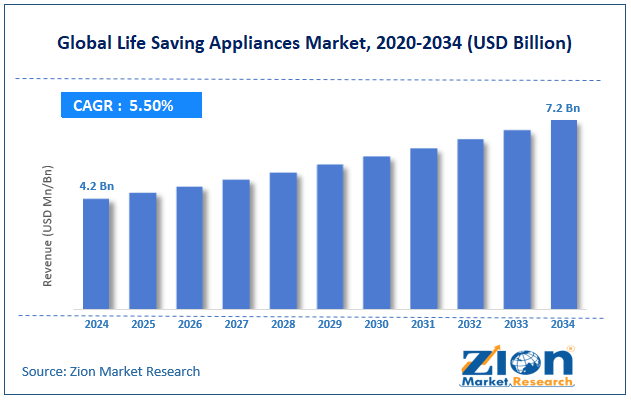
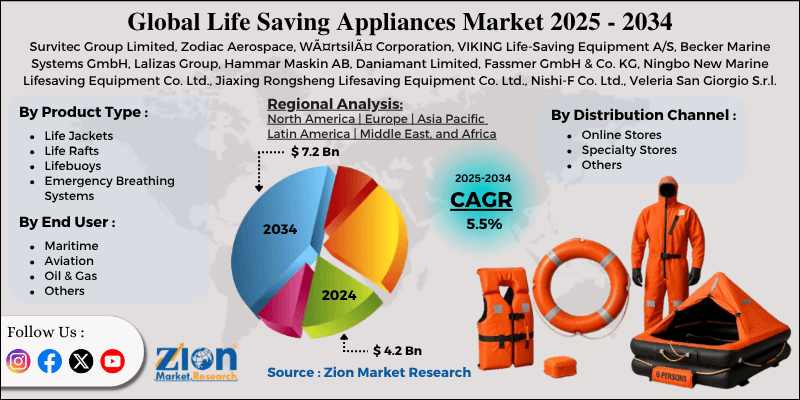
The global life saving appliances market size was worth around USD 4.2 billion in 2024 and is predicted to grow to around USD 7.2 billion by 2034, with a compound annual growth rate (CAGR) of roughly 5.5% between 2025 and 2034.
This report provides a comprehensive analysis of the growth drivers, restraints, and challenges shaping demand across the global life saving appliances market throughout the forecast period, while highlighting high-potential emerging opportunities within the industry.
Key Insights
- As per the analysis shared by our research analyst, the global life saving appliances market is estimated to grow annually at a CAGR of around 5.5% over the forecast period (2025-2034).
- In terms of revenue, the global life saving appliances market size was valued at around USD 4.2 billion in 2024 and is projected to reach USD 7.2 billion by 2034.
- Increasing maritime tourism is expected to propel the life saving appliances market over the projected period.
- Based on the product type, the life jackets segment captures the largest market share in 2024.
- Based on the end user, the maritime sector captures the largest revenue share in 2024.
- Based on the distribution channel, online stores are growing at a significant rate over the projected period.
- Based on region, Asia Pacific accounted for the highest market share in the life saving appliances market.
Life Saving Appliances Market: Overview
Life-Saving Appliances (LSA) consist of a variety of safety equipment and systems designed to save lives, primarily in maritime and other high-risk industries. Such appliances are vital to the survival of persons in times of shipwreck, fire aboard, a helicopter crash, or other incidents that occur at offshore production installations. Examples of such appliances are lifeboats, life rafts, life jackets, immersion suits, lifebuoys, and signaling devices, including distress flares. Many such appliances are subject to international safety conventions, such as SOLAS (the International Convention for the Safety of Life at Sea), which regulate their design, performance, and installation. In general, life-saving appliances are extremely important pieces of equipment used to reduce loss of life and serve as effective safety measures across the maritime industry.
Life Saving Appliances Market: Dynamics
Growth Drivers
Why does the growth in global maritime trade drive the life saving appliances market?
One of the most significant variables affecting the life saving appliances market is the growth of worldwide maritime trade. Currently, more than 80–90% of all worldwide trade flows are performed by sea. As a result, the fleet of cargo ships, tankers, and container vessels is continuously growing, significantly increasing demand for lifesaving appliances such as life rafts, lifeboats, life jackets, and other safety signaling devices. The increase in overall world trade leads to higher active fleets and a higher ship replacement rate, which strongly impacts the rates of life-saving appliances.
Furthermore, as maritime transportation becomes more complex and longer distances are commercially viable, the need to continually improve safety measures increases. Global trade markets are beginning to expand as developing countries (notably in the Asia-Pacific region) significantly raise their import/export rates, resulting in higher port activity, increased investment in shipbuilding, and growth in the vessel fleet. This expansion leads to higher demand for lifesaving appliances and increased market expansion for this segment of the industry.
Restraints
Do the high initial and maintenance costs impede the life saving appliances market?
The cost of purchase and operation is a major barrier to growth in the life saving appliances market, though the impact varies by region and operator size. Operators of ships, especially those in developing countries, are inclined to invest the maximum in purchasing the most important safety equipment due to regulatory requirements; hence, the cost of the investment is borne by the operator. Apart from the initial cost of purchasing the equipment, the operator must cover the long-term costs of maintenance, servicing, crew training, and certification renewals. These types of costs hinder market growth, especially for small shipping companies, fishing vessels, and businesses in developing countries.
For older vessels, upgrading to the latest safety equipment can be very costly due to the structural modifications required, which can deter market adoption. However, the high cost is not a restraint on the growth of the LSA market, given the mandatory requirements for ship and crew safety that cannot be compromised. Larger shipping companies and developed countries will be better able to absorb the costs, whereas other operators will prefer lower-cost safety options.
Opportunities
Why do the rising offshore oil & gas activities offer a lucrative opportunity for the life saving appliances market?
The growth of offshore oil & gas activities provides an attractive market opportunity for the life saving appliances market, mainly due to the increasing magnitude, complexity, and risk involved in offshore operations. Globally, demand for offshore developments is growing rapidly, with nearly 71% of the additional volumes of oil & gas projects commenced in 2024 attributable to offshore fields, underscoring the rising dependence on marine-based energy production. The increasing number of offshore platforms, drilling rigs, and support vessels, where it is obligatory to install safety equipment such as life rafts & life boats, immersion suits, emergency evacuation systems, and other equipment, would further support this growth in demand. Add to this the fact that offshore activities involve a large number of personnel operating in extreme conditions, often in remote, hard-to-access locations, making such equipment necessary.
For instance, data suggests that offshore energy sectors support in excess of 150,000 jobs today which is projected to increase to at least 225,000 by 2030, clearly indicating the increasing number of personnel exposed to high risk of fire, explosion or sinking at sea and the possibility of the well documented number of 32 fatalities occurring in the oil and gas sector in 2024 based on safety levels, would necessitate offshore safety laws and regulations such as offshore safety acts and International Maritime Safety Administrative regulations, in turn Mandating deployment of genuine LSAs. Further, offshore facilities are generally located far from the coast, where rescue time would far exceed the survival time of personnel in a life raft/ boat, thus driving demand for such appliances. All these factors indicate huge opportunities for the LSA market.
Challenges
Limited adoption in small vessels poses a significant challenge to the life saving appliances market
The low penetration of life-saving appliances in such small vessels is reportedly one of the major obstacles to their adoption, affecting market growth and demand (especially in developing nations and coastal countries). A large number of small fishing boats, inland water transport vessels, and unregistered maritime operators lack safety equipment on board – due to cost burdens, unavailability, and low awareness, as well as lax safety regulations and weak enforcement of safety norms. Unlike large ships, which are regulated by the International Convention for the Safety of Life at Sea (SOLAS), small vessels are often neglected and therefore not compliant with standard safety protocols.
Moreover, small ship owners and operators tend not to be financially strong and are therefore unable or unwilling to purchase any of the life-saving appliances which are certified under the abovementioned convention, such as life rafts, suits, and emergency signaling systems, as they also require space and installation considerations which are often too limited on the small ships. The lack of safety training in maritime nations across the Asia-Pacific and parts of Africa further diminishes the potential demand for lifesaving appliances, which in turn significantly narrows the possible customer base and sales for manufacturers. Although governments are mandating regulations for the use of lifesaving appliances on small ships, these regulations are not yet enforced and therefore hinder the development of demand accordingly.
Life Saving Appliances Market: Segmentation
Product Type Insights
Why do life jackets dominate the life saving appliances market?
The life jackets segment captures the largest market share in 2024. Heavy regulation regarding safety, booming maritime activity, and increased awareness about safety drive this growth. Regulatory authorities mandate that life jackets be provided to all on commercial ships, passenger vessels, offshore platforms, recreational boats, and other vessels, resulting in steady demand across all sectors. Moreover, the ongoing boom in global maritime trade and the rise in marine tourism, including water sports and cruises, have driven demand for personal flotation devices.
End User Insights
Is maritime growing at the highest rate in the life saving appliances market?
The maritime sector captures the largest revenue share in 2024. The growth of maritime tourism (ferry, cruise, and ocean travelers) and the development of new shipbuilding projects in emerging economies have increased demand for modern, high-volume, sophisticated safety equipment (for passenger and crew safety). Furthermore, increased flotilla renewal programs, the expansion of the cruise fleet, and the introduction of new ships in operated markets are expected to drive demand for advanced life-saving devices in the maritime segment of the LSA market. The increasing demand for safety equipment for long-distance, high-risk operations and the greater realization of maritime safety standards are expected to sustain strong revenue growth in this segment.
Distribution Channel Insights
Why are online stores growing at a significant rate in the life saving appliances market?
The online stores are growing at a significant rate over the projected period. The rapid growth of e-commerce and the continued digital proliferation of the maritime and recreational industries have led to significant demand for life-saving products such as life jackets, life rings, emergency flares, and safety kits. Buyers can conveniently access all product specifications, certifications, and pricing from their office or home. This is particularly advantageous for operators of small vessels, individual boating customers, and water sports enthusiasts who may not have easy access to a dedicated marine products trade.
Life Saving Appliances Market: Report Scope
| Report Attributes | Report Details |
|---|---|
| Report Name | Life Saving Appliances Market |
| Market Size in 2024 | USD 4.2 Billion |
| Market Forecast in 2034 | USD 7.2 Billion |
| Growth Rate | CAGR of 5.5% |
| Number of Pages | 227 |
| Key Companies Covered | Survitec Group Limited, Zodiac Aerospace, Wärtsilä Corporation, VIKING Life-Saving Equipment A/S, Becker Marine Systems GmbH, Lalizas Group, Hammar Maskin AB, Daniamant Limited, Fassmer GmbH & Co. KG, Ningbo New Marine Lifesaving Equipment Co. Ltd., Jiaxing Rongsheng Lifesaving Equipment Co. Ltd., Nishi-F Co. Ltd., Veleria San Giorgio S.r.l., Shanghai Youlong Rubber Products Co. Ltd., Jiangsu Huayan Marine Equipment Co. Ltd., Jiangyin Neptune Marine Appliance Co. Ltd., Galvanisers India, Jiangsu Jiaoyan Marine Equipment Co. Ltd., Hatecke GmbH, Palfingermarine, and others. |
| Segments Covered | By Product Type, By End User, By Distribution Channel, and By Region |
| Regions Covered | North America, Europe, Asia Pacific (APAC), Latin America, Middle East, and Africa (MEA) |
| Base Year | 2024 |
| Historical Year | 2019 to 2023 |
| Forecast Year | 2025 - 2034 |
| Customization Scope | Avail customized purchase options to meet your exact research needs. Request For Customization |
Life Saving Appliances Market: Regional Analysis
Why does the Asia Pacific lead the Life Saving Appliances market?
The Asia Pacific accounted for the highest market share in the life saving appliances market in 2024. The region is experiencing considerable growth in maritime trade, offshore energy exploration, and shipbuilding. The growth of the shipping and shipbuilding industries in China, India, South Korea, and Japan is driving steady increases in the number of cargo ships, container ships, and other commercial vessels. It has increased the number of vessels carrying sensitive safety appliances such as life-saving appliances (LSA).
The region accounts for a large share of the world's seaborne trade, and strong growth in the shipping industry has driven rising demand for safety equipment, including lifeboats, life rafts, and life jackets. The growth of the offshore oil & gas industry and investments in ports, shipbuilding, and coastal infrastructure are further complementing the Asia Pacific LSA market. With increasing awareness of safety practices and regulations, declining manufacturing costs, and growing water sports activity, revenue growth in the Asia Pacific LSA market is expected to be significant.
Life Saving Appliances Market: Competitive Analysis
The global life saving appliances market is dominated by players like:
- Survitec Group Limited
- Zodiac Aerospace
- Wärtsilä Corporation
- VIKING Life-Saving Equipment A/S
- Becker Marine Systems GmbH
- Lalizas Group
- Hammar Maskin AB
- Daniamant Limited
- Fassmer GmbH & Co. KG
- Ningbo New Marine Lifesaving Equipment Co. Ltd.
- Jiaxing Rongsheng Lifesaving Equipment Co. Ltd.
- Nishi-F Co. Ltd.
- Veleria San Giorgio S.r.l.
- Shanghai Youlong Rubber Products Co. Ltd.
- Jiangsu Huayan Marine Equipment Co. Ltd.
- Jiangyin Neptune Marine Appliance Co. Ltd.
- Galvanisers India
- Jiangsu Jiaoyan Marine Equipment Co. Ltd.
- Hatecke GmbH
- Palfingermarine
The global life saving appliances market is segmented as follows:
By Product Type
- Life Jackets
- Life Rafts
- Lifebuoys
- Emergency Breathing Systems
- Others
By End User
- Maritime
- Aviation
- Oil & Gas
- Others
By Distribution Channel
- Online Stores
- Specialty Stores
- Others
By Region
- North America
- The U.S.
- Canada
- Mexico
- Europe
- France
- The UK
- Spain
- Germany
- Italy
- Rest of Europe
- Asia Pacific
- China
- Japan
- India
- Australia
- South Korea
- Rest of Asia Pacific
- The Middle East & Africa
- Saudi Arabia
- UAE
- Egypt
- Kuwait
- South Africa
- Rest of the Middle East & Africa
- Latin America
- Brazil
- Argentina
- Rest of Latin America
Table Of Content
Methodology
FrequentlyAsked Questions
Life-Saving Appliances (LSA) consist of a variety of safety equipment and systems designed to save lives, primarily in maritime and other high-risk industries. Such appliances are vital to the survival of persons in times of shipwreck, fire aboard, helicopter crash, or other incidents at offshore production installations.
The life saving appliances market is primarily driven by stringent international safety regulations that mandate the use of certified safety equipment on vessels, along with the rapid growth in global maritime trade, which increases the number of ships requiring such appliances.
The life saving appliances market faces several key challenges that restrain its growth, including the high initial cost and ongoing maintenance expenses associated with safety equipment, which can be burdensome for small operators. Additionally, complex regulatory and certification processes increase compliance costs and delay product adoption.
Based on the end user, the maritime segment is expected to dominate the life saving appliances market growth during the projected period.
One of the most prominent trends is the integration of smart technologies and IoT, where devices such as life jackets and lifebuoys are equipped with GPS, sensors, and real-time communication systems to enable faster tracking and rescue operations.
According to the report, the global life saving appliances market size was worth around USD 4.2 billion in 2024 and is predicted to grow to around USD 7.2 billion by 2034.
The global life saving appliances market is expected to grow at a CAGR of 5.5% during the forecast period.
The global life saving appliances industry growth is expected to be led by the Asia Pacific over the forecast period.
The global life saving appliances market is dominated by players like Survitec Group Limited, Zodiac Aerospace, Wärtsilä Corporation, VIKING Life-Saving Equipment A/S, Becker Marine Systems GmbH, Lalizas Group, Hammar Maskin AB, Daniamant Limited, Fassmer GmbH & Co. KG, Ningbo New Marine Lifesaving Equipment Co., Ltd., Jiaxing Rongsheng Lifesaving Equipment Co., Ltd., Nishi-F Co., Ltd., Veleria San Giorgio S.r.l., Shanghai Youlong Rubber Products Co., Ltd., Jiangsu Huayan Marine Equipment Co., Ltd., Jiangyin Neptune Marine Appliance Co., Ltd., Galvanisers India, Jiangsu Jiaoyan Marine Equipment Co., Ltd., Hatecke GmbH, and Palfingermarine among others.
The life saving appliances market report covers the geographical market along with a comprehensive competitive landscape analysis. It also includes cash flow analysis, profit ratio analysis, market basket analysis, market attractiveness analysis, sentiment analysis, PESTLE analysis, trend analysis, SWOT analysis, trade area analysis, demand & supply analysis, Porter’s five forces analysis, and value chain analysis.

HappyClients

