
Left Ventricular Assist Devices Market Size, Share, Trends, Growth and Forecast 2034

Left Ventricular Assist Devices Market By Product Type (Pulsatile Flow Devices, Continuous Flow Devices, Implantable Devices, External Devices), By Application (Bridge to Transplant, Destination Therapy, Bridge to Recovery, Bridge to Candidacy), By End-User (Hospitals, Cardiac Care Centers, Ambulatory Surgical Centers, Specialty Cardiac Clinics), By Distribution Channel (Direct Institutional Sales, Medical Device Distributors, Online Procurement Platforms, Government and Institutional Tender Procurement), and By Region – Global and Regional Industry Overview, Market Intelligence, Comprehensive Analysis, Historical Data, and Forecasts 2026 - 2034-
| Market Size in 2025 | Market Forecast in 2034 | CAGR (in %) | Base Year |
|---|---|---|---|
| USD 1.45 Billion | USD 2.8 Billion | 7.59% | 2025 |
Left Ventricular Assist Devices Industry Perspective:
What will be the size of the left ventricular assist devices market during the forecast period?
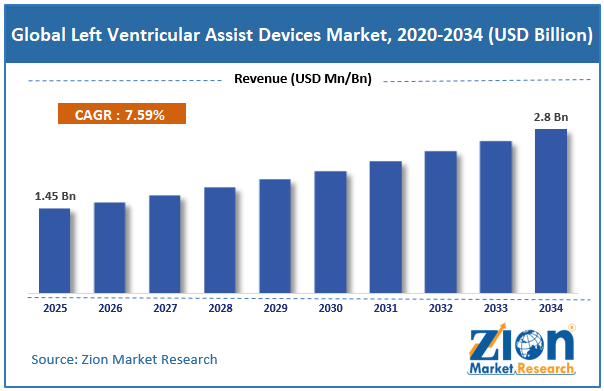
The global left ventricular assist devices market size was approximately USD 1.45 billion in 2025 and is projected to reach USD 2.8 billion by 2034, growing at a compound annual growth rate of approximately 7.59% between 2026 and 2034.
Key Insights
- According to our research team's analysis, the global left ventricular assist devices market is expected to grow at a compound annual growth rate of approximately 7.59% over the forecast period from 2026 to 2034.
- In terms of revenue, the global left ventricular assist devices market was valued at approximately USD 1.45 billion in 2025 and is projected to reach USD 2.8 billion by 2034.
- The left ventricular assist devices market is expected to grow steadily due to rising cases of heart failure, increasing preference for destination therapy, and continuous advancements in device technology.
- Based on product type, continuous flow devices hold the largest market share, as hospitals increasingly prefer their improved durability and reliability, while implantable devices are growing the fastest due to rising demand for long-term patient mobility and comfort.
- Based on application, destination therapy leads the market as more patients rely on long-term device use instead of transplant, while bridge-to-candidacy applications are growing steadily as more patients require support while awaiting transplant eligibility evaluation.
- Based on end users, hospitals hold the largest market share due to the widespread use of left ventricular assist devices across countless cardiac care operations, while cardiac care centers are growing rapidly as specialized heart failure treatment expands worldwide.
- Based on distribution channel, direct institutional sales lead the market because large hospitals prefer working directly with device manufacturers, while medical device distributors are expanding steadily to serve smaller clinics and specialized buyers.
- Based on region, North America leads the global left ventricular assist devices market due to strong healthcare infrastructure and high rates of heart failure diagnosis, followed by Europe, where advanced cardiac care systems and expanding treatment facilities are driving further growth.
Left Ventricular Assist Devices Market: Overview
A left ventricular assist device (LVAD) is a surgically implanted mechanical heart pump that helps the heart's left ventricle pump oxygen-rich blood to the rest of the body when it becomes too weak to function effectively. It is mainly used for patients with advanced heart failure and works alongside the natural heart instead of replacing it completely. LVADs improve blood circulation, reduce symptoms such as fatigue and shortness of breath, and help patients live longer with a better quality of life. These devices are widely used in hospitals, cardiac care centers, and specialty heart clinics as an important treatment for severe heart failure. Advances in battery technology, portable controllers, and device design are making LVADs easier for patients to manage at home after surgery.
The growing number of people with heart failure, rising cases of cardiovascular diseases, an aging population, and the shortage of donor hearts for transplantation are increasing the demand for these devices. Healthcare providers are increasingly using LVADs as both a bridge to heart transplantation and a long-term treatment option for patients who are not eligible for a transplant. Continuous improvements in remote monitoring, device durability, and patient care programs are further enhancing treatment outcomes and supporting wider adoption.
The left ventricular assist devices industry is expanding steadily as hospitals, cardiac specialists, and patients seek dependable and effective solutions to manage advanced heart failure and improve long-term survival outcomes.
Impact of the USA-Israel War on Iran on the Left Ventricular Assist Devices Market
Rising tensions between the United States, Israel, and Iran may temporarily disrupt the supply of medical-grade components, specialized manufacturing materials, and shipping routes for finished left ventricular assist devices. However, the demand for these devices remains strong because heart failure treatment and cardiac care must continue regardless of global events. As manufacturers continue to strengthen supply chains and diversify sourcing, the left ventricular assist devices market is expected to grow despite short-term disruptions.
Left Ventricular Assist Devices Market: Technology Roadmap 2026–2034
What is the projected development roadmap of the left ventricular assist devices market over the forecast period?
The left ventricular assist devices market is advancing through smaller device designs, improved battery efficiency, reduced complication rates, and the growing use of wireless power transfer methods to support better patient outcomes. The market is expected to grow at a compound annual growth rate of approximately 7.59% during the forecast period, driven by rising heart failure cases, growing preference for long-term device therapy, and continuous innovation in device design.
The following roadmap outlines key development phases expected through 2034.
2026–2028: Reliability and Patient Comfort Phase
- Improved pump durability and fewer device-related complications are expected to help hospitals provide safer and more reliable long-term heart failure treatment.
- Smaller and lighter left ventricular assist devices are expected to make daily movement more comfortable, allowing patients to carry out routine activities with greater ease.
- Expanding hospital partnerships and distribution networks are expected to improve access to advanced LVAD technology, especially for regional and smaller cardiac care centers.
2029–2032: Wireless Power and Remote Monitoring Phase
- Wireless power technology is expected to reduce infection risks by minimizing the need for external cables connected to the device.
- Remote monitoring systems are expected to help doctors check patient health and device performance from a distance, reducing the need for frequent hospital visits while improving follow-up care.
- Smart device systems with better control features are expected to provide more personalized and dependable treatment for patients with different stages of heart failure.
2033–2034: Advanced Integration and Miniaturization Phase
- Smaller and more advanced pump designs are expected to simplify implantation procedures and support faster recovery after surgery.
- Next-generation left ventricular assist devices with longer battery life and improved energy efficiency are expected to enhance patient comfort and support long-term use.
- Better data connectivity and AI-powered monitoring tools are expected to identify potential device problems earlier, helping doctors respond quickly and improve patient outcomes.
Left Ventricular Assist Devices Market: Dynamics
Growth Drivers
How is the rising prevalence of heart failure driving the left ventricular assist devices market?
The left ventricular assist devices market is growing as healthcare providers seek effective solutions for managing advanced heart failure. Left ventricular assist devices help the weakened heart pump blood throughout the body, improving survival rates and supporting patients while they wait for a heart transplant or receive long-term treatment. These devices reduce hospital readmissions, improve mobility, and enhance the quality of life for patients with severe heart conditions. The rising number of cardiovascular disease cases, growing elderly population, and increasing shortage of donor hearts are driving demand for mechanical circulatory support.
Hospitals and cardiac care centers are expanding the use of LVADs to improve patient outcomes and provide advanced heart failure treatment. Manufacturers are developing smaller, safer, and more durable devices with better battery life and improved remote monitoring features. Increasing awareness of heart failure treatment options and improving access to advanced healthcare services are also supporting market growth. These advantages are encouraging wider adoption of LVADs and driving the steady expansion of the left ventricular assist devices market across healthcare systems worldwide.
The growing demand for long-term heart failure management and improved patient survival drives the left ventricular assist devices market.
The left ventricular assist devices market is growing as hospitals and cardiac specialists look for reliable and effective solutions to treat patients with advanced heart failure. Left ventricular assist devices improve blood circulation, support the heart's pumping function, extend patient survival, and enhance overall quality of life. The increasing demand for destination therapy, bridge-to-transplant treatment, and bridge-to-recovery therapy is driving the adoption of these devices across healthcare facilities. LVADs provide both short-term and long-term heart support, helping reduce dependence on immediate heart transplantation and improving treatment outcomes. They are widely used in hospitals, cardiac care centers, specialty heart clinics, and advanced healthcare facilities for managing severe heart conditions.
Manufacturers are developing smaller, safer, and more durable devices with improved battery performance, remote monitoring capabilities, and lower complication rates. These advancements are helping reduce long-term healthcare costs while making treatment more effective and accessible. Growing awareness of advanced heart failure management, increasing investments in cardiac care, and continuous improvements in medical technology are creating new growth opportunities and supporting the steady expansion.
Restraints
How are device costs and surgical complexity affecting the left ventricular assist devices market?
The left ventricular assist devices industry faces several challenges that may limit its growth. One of the biggest barriers is the high cost of LVAD devices and the complex surgical procedures required for implantation, making treatment less affordable for many patients and healthcare providers. Implantation also requires highly skilled cardiac surgeons, specialized hospitals, and long-term follow-up care, which are not available in every region. Limited reimbursement coverage and changing healthcare funding policies can further reduce patient access to these advanced devices.
In addition, there is a shortage of trained specialists experienced in implanting and managing LVADs. The risk of complications such as infections, bleeding, and blood clots also remains a concern for both patients and healthcare providers. Manufacturers must continuously invest in research and development to improve device safety, durability, and performance. Despite these challenges, rising demand for advanced heart failure treatment continues to support the long-term growth of the left ventricular assist devices market.
Opportunities
How are emerging technologies and expanding cardiac care infrastructure creating opportunities in the left ventricular assist devices market?
The left ventricular assist devices industry offers significant growth opportunities as healthcare systems continue to expand advanced cardiac care services and invest in innovative heart failure treatments. Rising demand for mechanical circulatory support across North America, Europe, Asia Pacific, and Latin America is creating new opportunities for LVAD manufacturers. More hospitals are establishing destination therapy and bridge-to-transplant programs, increasing the need for durable and high-performance left ventricular assist devices. Growing investments in specialized cardiac centers, advanced surgical facilities, and healthcare infrastructure are further supporting market expansion. The increasing elderly population and rising prevalence of advanced heart failure are driving demand for long-term treatment solutions.
Governments are also improving access to advanced cardiac care through favorable healthcare policies, expanded insurance coverage, and higher investments in modern medical technologies. Manufacturers are also introducing smaller, safer, and more efficient devices with improved battery life, enhanced durability, and remote monitoring capabilities. These advancements are making LVAD therapy more accessible and easier to manage for both patients and healthcare providers. As demand for effective long-term heart failure treatment continues to rise, the market is expected to witness steady global growth.
Challenges
What challenges does the left ventricular assist devices market face in achieving broad adoption and delivering long-term value?
The left ventricular assist devices market faces several challenges that may affect its growth. One of the main challenges is managing device-related complications, as patient health conditions, surgical outcomes, and post-operative care can influence treatment success. Manufacturers also rely on specialized components and precision engineering, making production vulnerable to supply chain disruptions and rising material costs. Many hospitals cannot afford the significant investment required to establish dedicated LVAD programs and specialized cardiac care facilities.
In addition, strict regulatory approval processes and extensive clinical testing increase development costs and delay product launches. Intense competition among manufacturers creates pricing pressure while maintaining high standards of safety and performance. Continuous advancements in medical technology also require ongoing investment in research, product innovation, and clinical training for healthcare professionals. Growing focus on improving heart failure management and expanding access to advanced cardiac therapies is expected to strengthen the long-term outlook of the left ventricular assist devices market.
Left Ventricular Assist Devices Market: Report Scope
| Report Attributes | Report Details |
|---|---|
| Report Name | Left Ventricular Assist Devices Market |
| Market Size in 2025 | USD 1.45 Billion |
| Market Forecast in 2034 | USD 2.8 Billion |
| Growth Rate | CAGR of 7.59% |
| Number of Pages | 229 |
| Key Companies Covered | Abbott Laboratories, Medtronic, Berlin Heart, Jarvik Heart, ReliantHeart, CH Biomedical, EVAHEART, SynCardia Systems, Fineheart, Carmat, and others. |
| Segments Covered | By Product Type, By Application, By End-User, By Distribution Channel, and By Region |
| Regions Covered | North America, Europe, Asia Pacific (APAC), Latin America, Middle East, and Africa (MEA) |
| Base Year | 2025 |
| Historical Year | 2020 to 2024 |
| Forecast Year | 2026 - 2034 |
| Customization Scope | Avail customized purchase options to meet your exact research needs. Request For Customization |
Left Ventricular Assist Devices Market: Segmentation
The global left ventricular assist devices market is segmented by product type, application, end-user, distribution channel, and region.
How do continuous flow devices maintain their leading position in the left ventricular assist devices market?
Based on product type, the global left ventricular assist devices market is divided into pulsatile flow devices, continuous flow devices, implantable devices, and external devices. Continuous flow devices lead with about a 42% share because they offer patients improved durability, quieter operation, and longer device lifespan compared to other forms. The implantable devices segment holds around 25% of the market share. It is growing rapidly due to increasing demand for improved patient mobility and comfort during long-term treatment.
What is driving the dominance of destination therapy in the left ventricular assist devices market?
Based on application, the market is categorized into bridge to transplant, destination therapy, bridge to recovery, and bridge to candidacy. Destination therapy accounts for about 39% of market share, as more patients rely on long-term device use instead of waiting for transplant availability. The bridge to candidacy segment holds around 20% share. It is growing steadily as more patients require temporary support while undergoing transplant eligibility evaluation.
Why do hospitals account for the largest share of the left ventricular assist devices market?
Based on end-user, the left ventricular assist devices market is segregated into hospitals, cardiac care centers, ambulatory surgical centers, and specialty cardiac clinics. Hospitals hold around a 49% share because left ventricular assist devices are used extensively in countless cardiac care operations worldwide. The cardiac care centers segment accounts for about 23% of the market share. It is growing rapidly due to expanding specialized heart failure treatment facilities across regions.
Which factors are driving the growth of direct institutional sales in the left ventricular assist devices market?
Based on distribution channel, the left ventricular assist devices industry is classified into direct institutional sales, medical device distributors, online procurement platforms, and government and institutional tender procurement. Direct institutional sales account for about 47% of market share because large hospitals prefer purchasing directly from device manufacturers. The medical device distributors segment holds around 26% of the market share. It continues expanding by serving smaller clinics and specialized cardiac care providers across various regions.
Left Ventricular Assist Devices Market: Regional Analysis
How is the advanced healthcare infrastructure strengthening the North America left ventricular assist devices market?
The North America left ventricular assist devices market is expected to grow at a CAGR of 7.9% during the forecast period, driven by advanced healthcare infrastructure, rising cases of advanced heart failure, and increasing investments in innovative cardiac care technologies. The United States holds the largest market share due to the presence of leading LVAD manufacturers, a strong network of specialized cardiac centers, and growing demand for advanced heart failure treatment. Hospitals across the country are increasingly adopting left ventricular assist devices to improve patient survival, support bridge-to-transplant and destination therapy programs, and reduce dependence on the limited supply of donor hearts. Canada is also contributing to market growth through expanding access to specialized cardiac care, increasing healthcare investments, and government initiatives that support advanced medical technologies.
The region benefits from well-established hospitals, experienced cardiac surgeons, and continuous innovation in mechanical circulatory support systems. Growing adoption of remote patient monitoring, improved post-operative care, and next-generation LVAD technologies is further strengthening market demand. Rising awareness of advanced heart failure management, favorable reimbursement policies, and ongoing research in cardiovascular treatment are expected to reinforce North America's leading position in the left ventricular assist devices market throughout the forecast period.
Why is the expanding cardiac care network accelerating the left ventricular assist devices market in Europe?
The European left ventricular assist devices market is expected to grow at a CAGR of 7.2% during the forecast period, driven by expanding cardiac care services, the rising prevalence of advanced heart failure, and increasing investments in modern cardiovascular treatment technologies. Germany holds the largest market share due to its advanced healthcare infrastructure, highly skilled cardiac surgeons, and strong adoption of innovative mechanical circulatory support devices. The United Kingdom is another major contributor, supported by expanding cardiac care facilities, growing investments in hospital infrastructure, and increasing demand for advanced heart failure treatment. Several European countries are adopting next-generation left ventricular assist devices to improve patient survival, reduce complications, and provide effective long-term cardiac support. Governments across the region are strengthening healthcare systems through investments in advanced medical technologies, specialized cardiac centers, and favorable healthcare initiatives.
Rising awareness of heart failure management, increasing adoption of destination therapy and bridge-to-transplant procedures, and growing demand for minimally invasive cardiac treatment are further boosting market growth. Continuous advancements in LVAD technology, remote patient monitoring, and post-operative care are improving clinical outcomes and reinforcing the long-term growth of the Europe left ventricular assist devices market.
Recent Market Developments
- In March 2026, Abbott highlighted long-term clinical evidence for its HeartMate 3™ Left Ventricular Assist Device, demonstrating sustained improvements in patient survival, reduced complications, and enhanced quality of life for patients with advanced heart failure requiring long-term mechanical circulatory support.
Left Ventricular Assist Devices Market: Competitive Analysis
The leading players in the global left ventricular assist devices market are Abbott Laboratories, Medtronic, Berlin Heart, Jarvik Heart, ReliantHeart, CH Biomedical, EVAHEART, SynCardia Systems, Fineheart, and Carmat.
The global left ventricular assist devices market is segmented as follows:
By Product Type
- Pulsatile Flow Devices
- Continuous Flow Devices
- Implantable Devices
- External Devices
By Application
- Bridge to Transplant
- Destination Therapy
- Bridge to Recovery
- Bridge to Candidacy
By End-User
- Hospitals
- Cardiac Care Centers
- Ambulatory Surgical Centers
- Specialty Cardiac Clinics
By Distribution Channel
- Direct Institutional Sales
- Medical Device Distributors
- Online Procurement Platforms
- Government and Institutional Tender Procurement
By Region
- North America
- The U.S.
- Canada
- Mexico
- Europe
- France
- The UK
- Spain
- Germany
- Italy
- Rest of Europe
- Asia Pacific
- China
- Japan
- India
- Australia
- South Korea
- Rest of Asia Pacific
- The Middle East & Africa
- Saudi Arabia
- UAE
- Egypt
- Kuwait
- South Africa
- Rest of the Middle East & Africa
- Latin America
- Brazil
- Argentina
- Rest of Latin America
Table Of Content
Methodology
FrequentlyAsked Questions
A left ventricular assist device (LVAD) is a surgically implanted mechanical heart pump that helps the heart's left ventricle pump oxygen-rich blood to the rest of the body when it becomes too weak to function effectively. It is mainly used for patients with advanced heart failure and works alongside the natural heart instead of replacing it completely.
What key factors will influence the left ventricular assist devices market growth from 2026 to 2034?
The global left ventricular assist devices market is expected to grow, driven by rising cases of heart failure worldwide, increasing preference for destination therapy, growing shortage of donor hearts, and continuous improvements in device technology.
According to research, the global left ventricular assist devices market was valued at approximately USD 1.45 billion in 2025 and is projected to reach approximately USD 2.8 billion by 2034.
The compound annual growth rate of the left ventricular assist devices market is expected to be approximately 7.59% from 2026 to 2034.
North America is expected to lead the global left ventricular assist devices market throughout the forecast period, driven by advanced healthcare infrastructure, high heart failure diagnosis rates, and rising demand for long-term cardiac support solutions.
The major players in the global left ventricular assist devices market include Abbott Laboratories, Medtronic, Berlin Heart, Jarvik Heart, ReliantHeart, CH Biomedical, EVAHEART, SynCardia Systems, Fineheart, and Carmat.
The report examines key aspects of the left ventricular assist devices market, including growth drivers, adoption barriers, emerging opportunities, competitive dynamics, detailed regional performance, and a forward-looking outlook across all major product types, applications, end-user segments, and geographic regions through 2034.
The left ventricular assist devices market is restrained by the high cost of devices and implantation procedures, limited availability of skilled cardiac surgeons, strict regulatory approval requirements, and the risk of complications such as infection, bleeding, and blood clots, which can affect wider adoption.
The left ventricular assist devices market offers strong growth opportunities in destination therapy, bridge-to-transplant, and bridge-to-recovery applications for patients with advanced heart failure. Expanding use in specialized cardiac centers, rising adoption of long-term mechanical circulatory support, and increasing demand for home-based patient monitoring are further driving market growth.
The left ventricular assist devices market value chain includes research and product development, component sourcing, device design and manufacturing, clinical testing, regulatory approvals, distribution, hospital procurement, surgical implantation, post-operative monitoring, long-term patient management, and follow-up support services.

HappyClients

