
Leather Tanning Market Size, Share, Trends, Growth and Forecast 2034

Leather Tanning Market By Product Type (Vegetable Tanned Leather, Aldehyde Tanned Leather, Chrome Tanned Leather, and Synthetic Tanned Leather), By Application (Footwear, Clothing, Furniture, Automotive Interiors, and Accessories), By Industry Vertical (Fashion and Apparel, Automotive, Furniture, Industrial, and Consumer Goods), and By Region - Global and Regional Industry Overview, Market Intelligence, Comprehensive Analysis, Historical Data, and Forecasts 2025 - 2034
| Market Size in 2024 | Market Forecast in 2034 | CAGR (in %) | Base Year |
|---|---|---|---|
| USD 7.8 Billion | USD 12.8 Billion | 5.1% | 2024 |
Leather Tanning Industry Perspective:
What will be the size of the global leather tanning market during the forecast period?
This paragraph is unique.
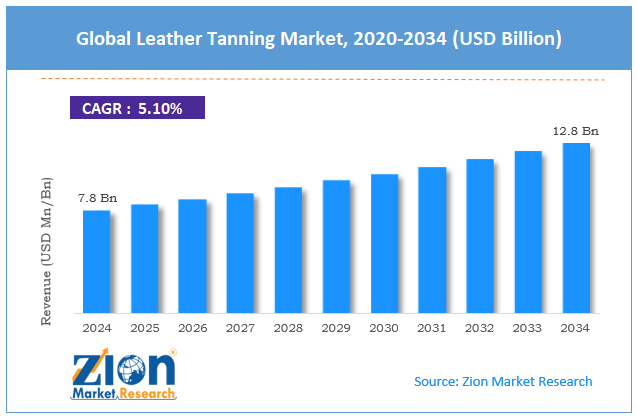
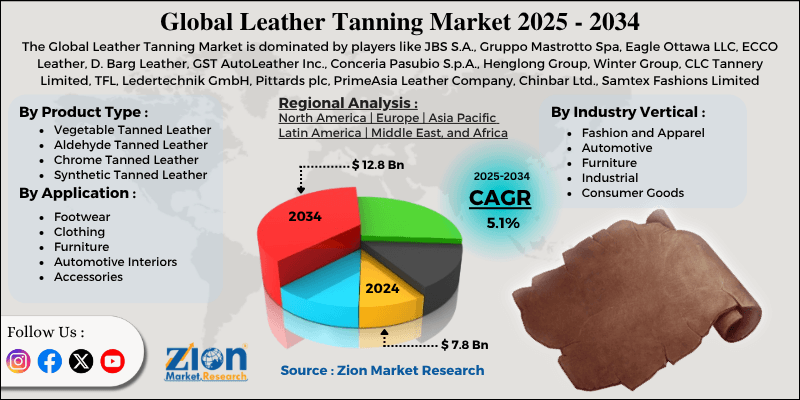
The global leather tanning market size was worth around USD 7.8 billion in 2024 and is predicted to grow to around USD 12.8 billion by 2034, with a compound annual growth rate (CAGR) of roughly 5.1% between 2025 and 2034.
Key Insights
- As per the analysis shared by our research analyst, the global leather tanning market is estimated to grow annually at a CAGR of around 5.1% over the forecast period (2025-2034).
- In terms of revenue, the global leather tanning market size was valued at around USD 7.8 billion in 2024 and is projected to reach USD 12.8 billion by 2034.
- Growth in furniture & interior applications is expected to propel the leather tanning market over the projected period.
- Based on the product type, the vegetable tanned leather segment captures the largest market share in 2025.
- Based on the application, the footwear segment is expected to dominate the market over the projected period.
- Based on the industry vertical, the fashion and apparel segment is growing at a substantial rate during the projected period.
- Based on region, North America dominates the market with the largest market share in 2024.
Leather Tanning Market: Overview
Leather tanning is the industrial process by which raw hides and skins are chemically treated and mechanically processed into durable, non-putrescible leather. Raw hide, in its native state, is prone to deterioration and requires stabilization through tanning (the curing of the protein structure within the leather, mainly collagen) to protect it from moisture and microorganisms. The process is complex, often involving soaking, liming, deliming, pickling, tanning, and finishing. Different tanning techniques yield different properties in the finished leather; the most common are chrome tanning (fast and soft) and vegetable tanning, which uses natural tannins and is more environmentally friendly. Leather is part of the value-added chain of industries, as it provides the main raw material for footwear, car interiors, apparel, furniture, and accessories, all of which are moving towards greener, pollutant-free systems.
Leather Tanning Market: Dynamics
Growth Drivers
Why does the rising demand from the footwear industry drive the leather tanning market?
The leather tanning industry is stimulated by increasing demand from the footwear industry, the world’s largest consumer of leather, as leather must be tanned to convert it from its raw state. As footwear production increases due to factors such as population booms, urbanization, the influence of fashion trends, and increased disposable income, the need for greater quantities of tanned leather in key areas, such as linings, uppers, and insoles, on finished shoes increases. This is a linear effect, whereby every new pair of shoes on the market requires entirely new quantities of processed and tanned leather to be fashioned to meet consumer standards for the finished product. Combined with the fact that bags, wallets, and belts also require large volumes of tanned leather, the worldwide footwear industry has a ripple effect on the tanning industry, which in turn has a boomerang effect on the tanning chemicals industry.
Restraints
Stringent environmental regulations hamper the leather tanning market
The leather tanning market faces restrictions due to stringent environmental regulations, which inhibit market growth by imposing substantial compliance requirements and increasing operational costs for manufacturers. Leather tanning, especially chrome tanning, is a highly contaminating process, as it results in the formation of toxic effluents, sludge, and heavy metals that can pollute water bodies and soil if not properly treated.
Therefore, the government and various regulatory authorities have implemented stringent environmental regulations governing effluent disposal, chemical use, and waste disposal, necessitating excessive expenditure by tanneries on treatment plants, disposal systems, and cleaner production techniques. These restrictions can prove to be a constraint by imposing an additional economic burden on producers, affecting their profits or leading to plant closures in case of penalties.
Opportunities
Does a shift towards bio-based leather offer a potential opportunity for the leather tanning market?
The shift toward bio-based, sustainable Leather is a major opportunity for growth in the leather tanning market. Due to increasing environmental pollution and health and safety concerns, consumers are shifting toward bio-based and natural leather tanning products that are less hazardous. This has compelled manufacturers to shift toward bio-based leather tanning chemicals, using techniques such as vegetable tanning. The bio-based tanning chemicals include plant-derived tannins, fats and oils, amino acids, cysteines, and green solvents. This trend in bio-based leather is benefiting existing players by providing opportunities to develop innovative, sustainable products and to promote the use of bio-based, greener tanning materials.
Moreover, the growing popularity of sustainable and ethical products among consumers is providing companies with opportunities to use sustainable leathers and to develop innovative products, thereby adding value to the market. The bio-based and greener tanning solutions are thus aiding market growth, not replacing the traditional ones. For instance, in April 2024, Bridge of Weir, supplier of premium automotive leather to the world‘s most prestigious automotive brands, including Aston Martin, McLaren, Jaguar Land Rover, and Polestar, recently introduced two groundbreaking tanning innovations- BioTAN and FreeTAN – an achievement in the advancement of next-generation, bio-based, biodegradable leather.
Challenges
Why does the environmental & health concerns pose a significant challenge to the leather tanning market?
Environmental and health concerns are among the major constraints on the growth of the leather tanning market, as the process requires hazardous chemicals, such as chromium salts, sulfides, and acids, that can generate toxic effluents and solid waste. If left untreated, these contaminants can pollute water bodies, soil, and air, causing environmental damage. Workers in tanneries also face health risks from handling chemicals that can cause skin, eye, and nasal, throat, and lung irritation, as well as other hazards from long-term exposure.
Due to these factors, many governments and regulatory agencies enforce stringent environmental and occupational safety regulations and standards, and require tanneries to make major investments in the construction of effluent treatment systems and the use of environmentally safer chemicals and other measures. Such factors entail higher operational costs, making it difficult for small- and medium-scale companies to survive and posing the risk of shutdowns if the standards are not followed. Consumer attitudes toward eco-friendly, ethically produced leather products are also forcing companies to comply with environmental standards that may impose a burden on their financial and technological resources. This factor acts as a restraint on market growth.
Leather Tanning Market: Report Scope
| Report Attributes | Report Details |
|---|---|
| Report Name | Leather Tanning Market |
| Market Size in 2024 | USD 7.8 Billion |
| Market Forecast in 2034 | USD 12.8 Bllion |
| Growth Rate | CAGR of 5.1% |
| Number of Pages | 226 |
| Key Companies Covered | JBS S.A., Gruppo Mastrotto Spa, Eagle Ottawa LLC, ECCO Leather, D. Barg Leather, GST AutoLeather Inc., Conceria Pasubio S.p.A., Henglong Group, Winter Group, CLC Tannery Limited, TFL, Ledertechnik GmbH, Pittards plc, PrimeAsia Leather Company, Chinbar Ltd., Samtex Fashions Limited, and others. |
| Segments Covered | By Product Type, By Application, By Industry Vertical, and By Region |
| Regions Covered | North America, Europe, Asia Pacific (APAC), Latin America, Middle East, and Africa (MEA) |
| Base Year | 2024 |
| Historical Year | 2019 to 2023 |
| Forecast Year | 2025 - 2034 |
| Customization Scope | Avail customized purchase options to meet your exact research needs. Request For Customization |
Leather Tanning Market: Segmentation
Product Type Insights
Why does the vegetable tanned leather dominate the leather tanning market?
The vegetable tanned leather segment captures the largest market share in 2025. Growth comes from a high degree of conformity with shifting environmental, regulatory, and consumer needs for sustainable, environmentally friendly characteristics in these products. Unlike chrome tanned product, vegetable tanned products are made from the natural tannins extracted from plant raw material, including tree bark and leaves, which are easier to absorb during the tanning process, thus making them more biodegradable and less damaging to the environment. It makes it easier for manufacturers to comply with strict environmental regulations and avoid the costs of implementing an expensive waste treatment system.
Moreover, the natural, non-aggressive visual appearance and long life that are inherent in a light-colored, resistant, and natural attachment make it highly valued in high-end fashion products such as luxury shoes, belts, bags, and craftwork. Consumer awareness of sustainability and ethical sourcing is rising as more brands advocate such materials.
Application Insights
Is the footwear growing at the highest rate in the leather tanning market?
The footwear segment is expected to dominate the market over the projected period. This is mainly due to its high consumption and ever-increasing world demand. Footwear is the major end-use application of leather, and with a rapidly growing population, urbanization, fashion trends, and rising disposable incomes, shoe production in both developing and developed countries is on the increase. There is also an increasing demand for sports footwear, casual shoes, and high-end leather shoes.
As footwear production increases, so does the demand for processed leather for various needs, such as flexibility, strength, and aesthetic appeal, and these needs are fulfilled through tannage. Due to the continuous increase in footwear production, demand for tanning chemicals and processes is also on the rise.
Industry Vertical Insights
Do fashion and apparel account for a substantial share of the leather tanning market?
The fashion and apparel segment is growing at a substantial rate during the projected period. Leather is used for a wide range of fashion items, including jackets, handbags, belts, wallets, and other accessories. The demand in the fashion segment is influenced by changing fashion trends, rising disposable incomes, and consumer demand for higher-quality, more durable materials. Leather remains a fashionable material in the fashion industry because it offers many desirable characteristics, including visual appeal, flexibility, and durability.
Global fashion brands regularly release new collections, which means there will always be a need for high-quality, well-finished leather throughout the tanning process, although the footwear segment still accounts for the majority of the overall market share. It is, however, the premium designer footwear segment that drives the demand from the fashion and apparel segment for the bulk of today's tanning chemicals and technologies.
Regional Insights
Why does North America lead the leather tanning market?
North America dominates the leather tanning market with the largest market share in 2024. Factors driving the North American leather tanning market include its advanced manufacturing infrastructure, stringent quality control standards, and high demand for luxury leather goods. Research and development in this region are primarily focused on sustainable tanning techniques, owing to the region's very strong luxury industry. The US Leather Tanning Market is indeed a key player, driven by high-end brands, demand from the automotive industry, and the increasing inclination towards sustainable tanneries. The US also leads in innovations such as bio- and chrome-free tanneries to meet its sustainability goals. With a robust supply chain and growing consumer affinity for high-end leather products, North America is expected to remain a dominant player in the global market.
Leather Tanning Market: Competitive Analysis
The global leather tanning market is dominated by players like:
- JBS S.A.
- Gruppo Mastrotto Spa
- Eagle Ottawa LLC
- ECCO Leather
- D. Barg Leather
- GST AutoLeather Inc.
- Conceria Pasubio S.p.A.
- Henglong Group
- Winter Group
- CLC Tannery Limited
- TFL
- Ledertechnik GmbH
- Pittards plc
- PrimeAsia Leather Company
- Chinbar Ltd.
- Samtex Fashions Limited
The global leather tanning market is segmented as follows:
By Product Type
- Vegetable Tanned Leather
- Aldehyde Tanned Leather
- Chrome Tanned Leather
- Synthetic Tanned Leather
By Application
- Footwear
- Clothing
- Furniture
- Automotive Interiors
- Accessories
By Industry Vertical
- Fashion and Apparel
- Automotive
- Furniture
- Industrial
- Consumer Goods
By Region
- North America
- The U.S.
- Canada
- Mexico
- Europe
- France
- The UK
- Spain
- Germany
- Italy
- Rest of Europe
- Asia Pacific
- China
- Japan
- India
- Australia
- South Korea
- Rest of Asia Pacific
- The Middle East & Africa
- Saudi Arabia
- UAE
- Egypt
- Kuwait
- South Africa
- Rest of the Middle East & Africa
- Latin America
- Brazil
- Argentina
- Rest of Latin America
Table Of Content
Methodology
FrequentlyAsked Questions
Leather tanning is the industrial process by which raw hides and skins are chemically treated and mechanically processed into durable, non-putrescible leather. Raw hide, in its native state, is prone to deterioration and requires stabilization through tanning (the curing of the protein structure within the leather, mainly collagen) to protect it from moisture and microorganisms.
Key growth drivers for the leather tanning market include rising demand from the footwear industry, increasing use of leather in automotive interiors, and growth in fashion & luxury goods. Additionally, expansion in emerging economies, advancements in tanning technologies, and the shift toward eco-friendly and sustainable leather processing are further supporting market growth.
- Major challenges restraining the growth of the leather tanning market include stringent environmental regulations, health and pollution concerns from chemical-intensive processes, and high operational and compliance costs. Additionally, competition from synthetic and vegan leather alternatives, fluctuating supply of raw material (hide), and increasing pressure for sustainable, eco-friendly production further limit market expansion.
Based on the product type, the vegetable tanned leather segment is expected to dominate the leather tanning market growth during the projected period.
One of the most significant trends is the shift toward eco-friendly tanning methods, including vegetable tanning, enzymatic processes, and chrome-free systems, which reduce environmental impact while maintaining leather quality.
According to the report, the global leather tanning market size was worth around USD 7.8 billion in 2024 and is predicted to grow to around USD 12.8 billion by 2034.
The global leather tanning market is expected to grow at a CAGR of 5.1% during the forecast period.
The global leather tanning industry growth is expected to be led by North America over the forecast period.
he global leather tanning market is dominated by players like JBS S.A., Gruppo Mastrotto Spa, Eagle Ottawa LLC, ECCO Leather, D. Barg Leather, GST AutoLeather, Inc., Conceria Pasubio S.p.A., Henglong Group, Winter Group, CLC Tannery Limited, TFL, Ledertechnik GmbH, Pittards plc, PrimeAsia Leather Company, Chinbar Ltd., and Samtex Fashions Limited, among others.
The leather tanning market report covers the geographical market along with a comprehensive competitive landscape analysis. It also includes cash flow analysis, profit ratio analysis, market basket analysis, market attractiveness analysis, sentiment analysis, PESTLE analysis, trend analysis, SWOT analysis, trade area analysis, demand & supply analysis, Porter’s five forces analysis, and value chain analysis.

HappyClients

