
Global Leather Car Seat Market Size, Share and Forecast Report 2034

Leather Car Seat Market By Type (Genuine Leather Seats and Synthetic Leather Seats), By Application (Passenger Vehicle and Commercial Vehicle), By Distribution Channel (OEM and Aftermarket), and By Region - Global and Regional Industry Overview, Market Intelligence, Comprehensive Analysis, Historical Data, and Forecasts 2025 - 2034
| Market Size in 2024 | Market Forecast in 2034 | CAGR (in %) | Base Year |
|---|---|---|---|
| USD 27.9 Billion | USD 47.2 Billion | 5.4% | 2024 |
Leather Car Seat Industry Perspective:
What will be the size of the global leather car seat market during the forecast period?
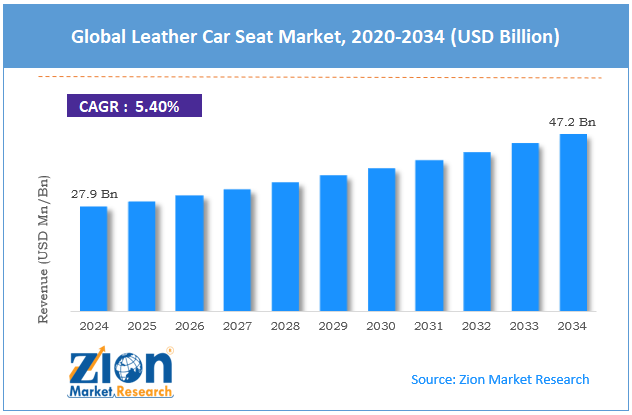
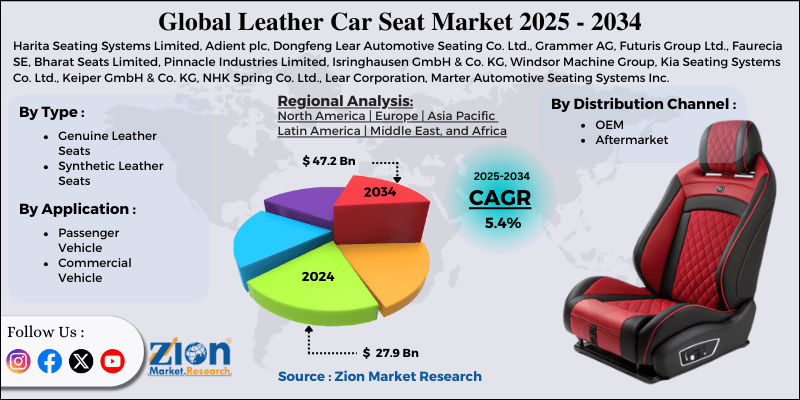
The global leather car seat market size was worth around USD 27.9 billion in 2024 and is predicted to grow to around USD 47.2 billion by 2034, with a compound annual growth rate (CAGR) of roughly 5.4% between 2025 and 2034.
This report provides a comprehensive analysis of the growth drivers, restraints, and challenges shaping demand across the global leather car seat market throughout the forecast period, while highlighting high-potential emerging opportunities within the industry.
Key Insights
- As per the analysis shared by our research analyst, the global leather car seat market is estimated to grow annually at a CAGR of around 5.4% over the forecast period (2025-2034).
- In terms of revenue, the global leather car seat market size was valued at around USD 27.9 billion in 2024 and is projected to reach USD 47.2 billion by 2034.
- The rising production of passenger vehicle acting as a significant driver for the global leather car seat market.
- Based on the type, the synthetic leather seats segment is expected to dominate the market in 2024.
- Based on the application, the passenger vehicle segment is expected to dominate the market over the projected period.
- Based on the distribution channel, the OEM segment held the largest revenue share in 2024 and is expected to continue the same pattern during the projected period.
- Based on region, Asia Pacific is expected to dominate the market over the analysis period.
Leather Car Seat Market: Overview
Leather car seats are seats in cars that are covered in real leather or high-quality synthetic leather to make them more comfortable, last longer, and look better. These seats are common in high-end, luxury, and premium passenger automobiles, but more and more mid-range manufacturers are offering them as optional upgrades. Leather car seats are popular because they look good, feel good, last a long time, and are easy to clean. They also often have high-tech amenities, such as seating that can be heated, cooled, and adjusted with power. Different methods are employed to treat and finish leather for car seats, depending on how it will be used. This ensures that the leather meets all automotive safety, wear-resistance, and comfort standards for all kinds of weather. The leather car seat industry is largely driven by growing demand for high-end, luxury car interiors.
Leather seating is directly linked to comfort, durability, and looks. The demand for car interior parts, such as leather seats, is closely linked to the rise in global car production, especially in developing countries. People are buying more expensive cars or adding features like leather upholstery because they have more money to spend, and their living standards are rising. Also, the leather car seat market faces a range of challenges that could prevent it from growing, even as demand for high-end interiors continues to expand. One of the biggest problems is the high, volatile cost of raw materials. This is because real leather depends on the supply of animal hides and on changing livestock prices, which drive up production costs and finished-vehicle prices.
Leather Car Seat Market: Dynamics
Growth Drivers
Does increasing vehicle production drive the growth of the leather car seat market?
The leather car seat market is growing as more cars are manufactured worldwide. As more cars are produced, demand for interior parts, including high-quality seating materials, increases. More cars are being made in developing countries, and global manufacturers are adding more capacity. This means there are more passenger cars on the road with leather seats as standard or optional features. As manufacturers introduce new models in the mid-range and premium segments to enhance the interior and make their brands stand out, leather seats are becoming more popular. Also, the rise in the manufacture of SUVs and high-end cars, which have historically chosen leather upholstery, strengthens the connection between global automotive output and market growth.
For instance, according to UNCTAD, China became the world leader in electric vehicle manufacturing, accounting for 58% of global electric vehicle production in 2023. The electric vehicle industry, which China controls, has become essential for developing future transportation systems and addressing climate change.
Restraints
Why are volatile raw material costs acting as a major restraining factor to the leather car seat industry expansion?
The leather vehicle seat sector is limited by the high cost of raw materials. This is because making real leather depends a lot on the availability and price of animal hides, which vary with changes in livestock supply, the meat industry, and worldwide trade. The cost of processing leather fluctuates with the quality and price of hides, making it challenging for seat makers to predict how much it will cost to make their products. These adjustments typically compel automakers and suppliers to change their pricing plans or pay extra costs, which lower profit margins and make it harder for people to buy leather seats, especially in car segments where price is important.
Opportunities
How do increasing disposable incomes and changing consumer lifestyles create opportunities for the leather car seat market?
The leather car seat industry is growing because people have more money to spend, and their lives are changing. This means they can buy cars with better comfort and premium interior elements. As living standards rise, especially in developing countries, buyers are placing more value on looks, luxury, and the overall driving experience than on basic functionality. People's tastes in cars have changed, and there is now greater demand for higher-end cars and extra features like leather seats, which are seen as signs of prestige, comfort, and elegance. To accommodate evolving customer needs, manufacturers are offering leather car seats across a wider range of models.
Challenges
Competition from high-grade synthetics and alternatives poses a significant threat to the industry's growth
The leather vehicle seat market faces risk. This is because high-quality synthetics and other materials now closely match real leather in appearance, durability, and comfort. Automakers and consumers prefer these alternatives for their lower cost, lighter weight, easier maintenance, and better resistance to heat, moisture, and wear. Ecological and ethical concerns also matter more, making vegan and sustainable materials popular, especially among electric and mass-market car makers. As a result, increased use of high-quality synthetics reduces dependence on real leather and limits its use in more vehicles.
Leather Car Seat Market: Report Scope
| Report Attributes | Report Details |
|---|---|
| Report Name | Leather Car Seat Market |
| Market Size in 2024 | USD 27.9 Billion |
| Market Forecast in 2034 | USD 47.2 Billion |
| Growth Rate | CAGR of 5.4% |
| Number of Pages | 214 |
| Key Companies Covered | Harita Seating Systems Limited, Adient plc, Dongfeng Lear Automotive Seating Co. Ltd., Grammer AG, Futuris Group Ltd., Faurecia SE, Bharat Seats Limited, Pinnacle Industries Limited, Isringhausen GmbH & Co. KG, Windsor Machine Group, Kia Seating Systems Co. Ltd., Keiper GmbH & Co. KG, NHK Spring Co. Ltd., Lear Corporation, Marter Automotive Seating Systems Inc., Recaro Automotive Seating GmbH, TS Tech Co. Ltd., Magna International Inc., Toyota Boshoku Corporation, and others. |
| Segments Covered | By Type, By Application, By Distribution Channel, and By Region |
| Regions Covered | North America, Europe, Asia Pacific (APAC), Latin America, Middle East, and Africa (MEA) |
| Base Year | 2024 |
| Historical Year | 2019 to 2023 |
| Forecast Year | 2025 - 2034 |
| Customization Scope | Avail customized purchase options to meet your exact research needs. Request For Customization |
Leather Car Seat Market: Segmentation
Type Insights
The synthetic leather seats segment is expected to dominate the market in 2024. The surge is due to cost-effectiveness, sustainability trends, and changes in the automotive strategy. PU and PVC are examples of synthetic leather materials that appear and feel like real leather but cost a lot less. This makes them more popular in mid-range and mass-market cars. OEMs are switching to vegan and eco-friendly interior options, especially in electric and hybrid vehicles, because more people are worried about the environment and animal rights.
Application Insights
The passenger vehicle segment is expected to dominate the market over the projected period. The main reason for this change is that people want more comfort, nicer interiors, and a better driving experience. More SUVs, sedans, and crossovers are being made and sold, increasing the number of cars with leather seats. This is happening because leather seats are standard on higher trim levels or optional on mid-range models. More discretionary spending and urban lifestyles, especially in developing countries, are leading people to prefer cars with high-end interior features. Leather seats are a key value differentiator in these cars.
Distribution Channel Insights
The OEM segment held the largest revenue share in 2024 and is expected to maintain that pattern over the projected period. OEM-installed leather seats are better than aftermarket installations because they have better quality control, design consistency, and compliance with safety and regulatory rules. OEM adoption is supported by growing demand for personalized, technology-integrated interiors, such as heated, ventilated, and power-adjustable seats. This will lead to long-term revenue growth in the leather car seat market.
Leather Car Seat Market: Regional Insights
What are the major factors that cause the Asia Pacific to be in a leading position in the leather car seat market?
The Asia Pacific dominates the market over the analysis period. The rapid expansion of the automotive sector and the rising buying power of consumers in major countries such as China, India, Japan, and Southeast Asia are driving growth in the region. Demand for leather and synthetic leather seating is rising as more SUVs and premium mid-size cars are produced and sold. People are prioritizing comfort, style, and high-end interior elements as their discretionary income rises, cities grow, and their lives change. This is why leather seats are so popular.
Factory-installed leather seats are also becoming more popular as major car manufacturers set up shop in the area and local production capacity grows. The Asia Pacific leather car seat industry is booming because more people are buying electric and hybrid cars, which often feature high-quality interiors, and because more people are accepting cheaper synthetic leather replacements.
Leather Car Seat Market: Competitive Analysis
The global leather car seat market is dominated by players like:
- Harita Seating Systems Limited
- Adient plc
- Dongfeng Lear Automotive Seating Co. Ltd.
- Grammer AG
- Futuris Group Ltd.
- Faurecia SE
- Bharat Seats Limited
- Pinnacle Industries Limited
- Isringhausen GmbH & Co. KG
- Windsor Machine Group
- Kia Seating Systems Co. Ltd.
- Keiper GmbH & Co. KG
- NHK Spring Co. Ltd.
- Lear Corporation
- Marter Automotive Seating Systems Inc.
- Recaro Automotive Seating GmbH
- TS Tech Co. Ltd.
- Magna International Inc.
- Toyota Boshoku Corporation
The global leather car seat market is segmented as follows:
By Type
- Genuine Leather Seats
- Synthetic Leather Seats
By Application
- Passenger Vehicle
- Commercial Vehicle
By Distribution Channel
- OEM
- Aftermarket
By Region
- North America
- The U.S.
- Canada
- Mexico
- Europe
- France
- The UK
- Spain
- Germany
- Italy
- Rest of Europe
- Asia Pacific
- China
- Japan
- India
- Australia
- South Korea
- Rest of Asia Pacific
- The Middle East & Africa
- Saudi Arabia
- UAE
- Egypt
- Kuwait
- South Africa
- Rest of the Middle East & Africa
- Latin America
- Brazil
- Argentina
- Rest of Latin America
Table Of Content
Methodology
FrequentlyAsked Questions
Leather car seats are seats in cars that are covered in real leather or high-quality synthetic leather to make them more comfortable, last longer, and look better. These seats are common in high-end, luxury, and premium passenger automobiles, but more and more mid-range manufacturers are offering them as optional upgrades. Leather car seats are popular because they look good, feel good, last a long time, and are easy to clean.
The leather car seat industry is largely driven by growing demand for high-end, luxury car interiors. Leather seating is directly linked to comfort, durability, and looks. The demand for car interior parts, such as leather seats, is closely linked to the rise in global car production, especially in developing countries. People are buying more expensive cars or adding features like leather upholstery because they have more money to spend, and their living standards are rising.
The leather car seat market faces a range of challenges that could prevent it from growing, even as demand for high-end interiors expands. One of the biggest problems is the high, volatile cost of raw materials. This is because real leather depends on the supply of animal hides and on changing livestock prices, which drive up production costs and finished-vehicle prices.
Based on the application, the passenger vehicle segment is expected to dominate the leather car seat market growth during the projected period.
Innovations in material science and manufacturing processes are improving durability, stain resistance, and maintenance ease, while enabling lightweight and performance-oriented leather solutions that support overall vehicle efficiency. Together, these trends are reshaping how leather seats are designed, produced, and marketed in modern vehicles.
According to the report, the global leather car seat market size was worth around USD 27.9 billion in 2024 and is predicted to grow to around USD 47.2 billion by 2034.
The global leather car seat market is expected to grow at a CAGR of 5.4% during the forecast period.
The global leather car seat industry growth is expected to be led by the Asia Pacific over the forecast period.
The global leather car seat market is dominated by players like Harita Seating Systems Limited, Adient plc, Dongfeng Lear Automotive Seating Co., Ltd., Grammer AG, Futuris Group Ltd., Faurecia SE, Bharat Seats Limited, Pinnacle Industries Limited, Isringhausen GmbH & Co. KG, Windsor Machine Group, Kia Seating Systems Co., Ltd., Keiper GmbH & Co. KG, NHK Spring Co., Ltd., Lear Corporation, Marter Automotive Seating Systems Inc., Recaro Automotive Seating GmbH, TS Tech Co., Ltd., Magna International Inc., and Toyota Boshoku Corporation, among others.
The leather car seat market report covers the geographical market along with a comprehensive competitive landscape analysis. It also includes cash flow analysis, profit ratio analysis, market basket analysis, market attractiveness analysis, sentiment analysis, PESTLE analysis, trend analysis, SWOT analysis, trade area analysis, demand & supply analysis, Porter’s five forces analysis, and value chain analysis.

HappyClients

