
Koi Market Size, Share, Trends, Growth and Forecast 2034

Koi Market By Product Type (Kohaku, Showa Sanke, Taisho Sanke, and Others), By Application (Commercial and Retail), and By Region - Global and Regional Industry Overview, Market Intelligence, Comprehensive Analysis, Historical Data, and Forecasts 2025 - 2034
| Market Size in 2024 | Market Forecast in 2034 | CAGR (in %) | Base Year |
|---|---|---|---|
| USD 2.2 Billion | USD 6.1 Billion | 10.8% | 2024 |
Koi Industry Perspective:
What will be the size of the global koi market during the forecast period?
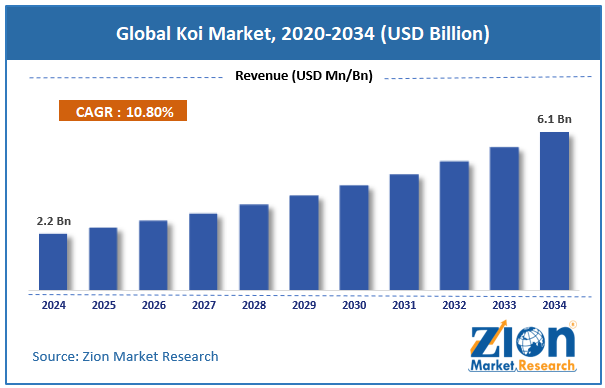
The global koi market size was worth around USD 2.2 billion in 2024 and is predicted to grow to around USD 6.1 billion by 2034, with a compound annual growth rate (CAGR) of roughly 10.8% between 2025 and 2034.
Key Insights
- As per the analysis shared by our research analyst, the global koi market is estimated to grow annually at a CAGR of around 10.8% over the forecast period (2025-2034).
- In terms of revenue, the global koi market size was valued at around USD 2.2 billion in 2024 and is projected to reach USD 6.1 billion by 2034.
- Increasing disposable income is expected to propel the koi market over the projected period.
- Based on the product type, the Showa Sanke segment captures the largest market share in 2025.
- Based on the application, the retail segment is expected to dominate the market over the projected period.
- Based on region, the Asia Pacific dominates the market with the largest market share in 2024 of 45%.
Koi Market: Overview
Koi are a very common and colorful group of the Amur carp (Cyprinus rubrofuscus) species. This same species is kept and bred as ornamental fish in garden water features or outdoor ponds, which also contributes to the growth of the koi market. In many East Asian societies, choosing goldfish is not only for their aesthetic appeal; they are also used as luck charms and symbols of wealth. Moreover, each color of the koi has a symbolic meaning: gold symbolizes success and wealth, and blue, red, and grey symbolize hope. The growth of the aquaculture sector, increasing awareness of ornamental fish, technological developments in breeding, and the cultural importance and symbolism attached to the koi fish can be attributed to the global koi market's growth.
Koi Market: Dynamics
Growth Drivers
Why does the rising popularity of koi as an ornamental pet drive the koi market?
Koi fish are increasingly seen as popular ornamental pets, a major factor impacting the koi market. Koi fish have high symbolic significance in Japan, the United States, and the United Kingdom (generally seen as the countries with the greatest demand), sending cultural messages of luck, prosperity, and longevity. For instance, the Japanese celebrate the “Children’s Day” festival, where koi fish are both showcased and symbolize strength and tenacity. As a result, they are in demand for their ability to maintain their luxurious appearance in garden ponds or pools, and their popularity in the market is rising.
Restraints
High maintenance and care requirements hamper the koi market
A key difficulty in the koi market is the high maintenance and care required to keep Koi healthy and in optimal condition. As koi are sensitive to water quality, environmental conditions, and temperature fluctuations, careful pond management and constant observation are necessary to avoid problems. In terms of ease of purchase, water quality needs to be carefully maintained through time-consuming, costly measures, such as advanced filtration and water treatment systems, as well as frequent testing. This may be a disincentive to consumers and hobbyists who are not familiar with the care required for koi maintenance, and may deter entry into the market. The expenses of veterinary care may also be significant for potential owners of highly skilled or rare Koi. API, for instance, produces water-testing kits that measure pH and ammonia levels, ensuring the environment is suitable for the fish.
Opportunities
Does the expansion of online sales platforms offer a potential opportunity for the koi market?
There has been a significant growth in their sales and purchase sites over the years. Major breeders and distributors of koi have readily adopted IT for distribution. This has been a boon to customers, as they now have easy access to a wide range of koi through various websites. This has further increased koi sales, and demand for them is growing globally. Thus, the growth in online sales presents an opportunity for industry growth.
Challenges
Does the vulnerability to disease and predators pose a significant challenge to the koi market?
Koi are at risk from a range of factors, including disease and predators. Disease outbreaks, e.g., Koi herpesvirus (KHV), and bacterial infections can spread rapidly and wipe out hundreds or even thousands of koi within days, spelling disaster not only for individual breeders but also for koi keepers and endangering a vast number of the koi population. Breeding and koi ownership can also pose significant financial risks; treating and preventing disease can be costly in both time and money, and the non-negligible risk of losing a particularly expensive koi fish can be devastating.
Outdoor ponds are also at risk from predators, e.g., herons, cats, raccoons, and other animals, and sharp fences, netting, and pond covers must be installed to prevent harm or death to the koi. The extra expense of security measures for outdoor ponds adds to the cost of ownership. As a result of all these factors, the financial and emotional resources required to keep them may deter most potential new owners.
Koi Market: Report Scope
| Report Attributes | Report Details |
|---|---|
| Report Name | Koi Market |
| Market Size in 2024 | USD 2.2 Billion |
| Market Forecast in 2034 | USD 6.1 Bllion |
| Growth Rate | CAGR of 10.8% |
| Number of Pages | 225 |
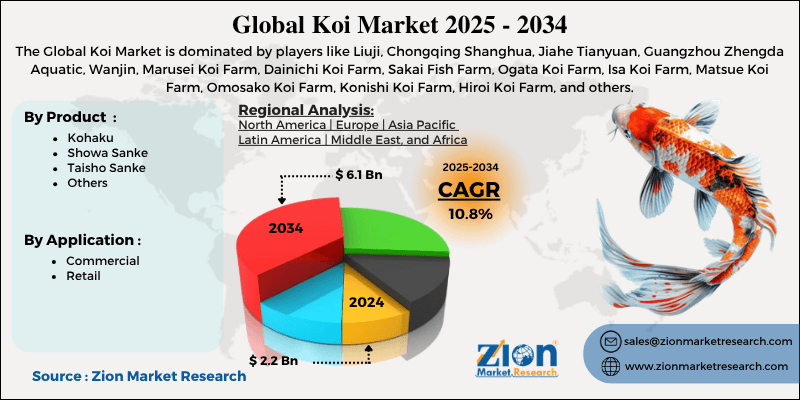
| Key Companies Covered | Liuji, Chongqing Shanghua, Jiahe Tianyuan, Guangzhou Zhengda Aquatic, Wanjin, Marusei Koi Farm, Dainichi Koi Farm, Sakai Fish Farm, Ogata Koi Farm, Isa Koi Farm, Matsue Koi Farm, Omosako Koi Farm, Konishi Koi Farm, Hiroi Koi Farm, and others. |
| Segments Covered | By Product Type, By Application, and By Region |
| Regions Covered | North America, Europe, Asia Pacific (APAC), Latin America, Middle East, and Africa (MEA) |
| Base Year | 2024 |
| Historical Year | 2019 to 2023 |
| Forecast Year | 2025 - 2034 |
| Customization Scope | Avail customized purchase options to meet your exact research needs. Request For Customization |
Koi Market: Segmentation
Product Type Insights
Why does the Showa Sanke dominate the Koi market?
The Showa Sanke segment captures the largest share in the koi industry in 2025. Segment growth is driven by rising demand for high-value ornamental fish among affluent private collectors and enthusiasts. Showa (Sanke) - a triple-color (Black, Red, and white) pattern in Sanke (hero Showa is one of the most popular in the ornamental fish world for their enormous body potential, vibrant tri-color patterns, and constantly changing markings, which increase their appeal.
A growing number of enthusiasts' entries into popular nationwide shows, expos, international competitions, and auctions have elevated the prices of these types. Increased online aquarium trading websites and strategic breeders, which have increased accessibility to buy these highly valued Showa types, are also boosting sales worldwide. The segment also benefited from increasing interest in luxury landscaping, Zen gardens with water lilies and Japanese rock gardens, water features, and water lawns in private houses and commercial establishments (Asia-Pacific, Europe, and North America).
Application Insights
Is the retail market growing at the highest rate in the koi market?
The retail segment is expected to dominate the koi market over the projected period. The consumer boom in ornamental aquaculture, as well as the trend toward water gardening at residences worldwide, are the factors behind this growth. The growing number of retail outlets (both land-based and E-commerce), such as pet specialty stores, garden centers, other specialty retailers, and aquarium stores, has been instrumental in widening retailers' customer base and reaching first-time aquarists. Retailers also see an increasing budget for ornamental water gardening, for which the fish are just an ornament.
The availability of a variety of breeds within a price range helps vendors move an equivalent number of fish by attracting both low- and high-budget customers and helps drive sales. E-commerce has also had a major impact by enabling direct-to-home purchases and increasing the impact of digital marketing. Additional revenue streams can be generated by selling related products, such as pond equipment, feed, and maintenance services.
Regional Insights
Why does the Asia Pacific lead the koi market?
The Asia Pacific dominates the koi market with the largest share in 2024 of 45%. This market is primarily dominated by Japan, where the art of koi breeding originated, where Koi is part of the core culture and tradition, and the market is perceived to be thriving. The production of high-quality, premium koi varieties such as Kohaku, Sanke, Showa, etc. has also been dominated by Japan. The growing demand for koi in China, South Korea, and Southeast Asian countries is also driving market expansion in the region. Increased disposable income levels, coupled with demand for ornamental fish in water bodies (both commercial and domestic), are certain factors fueling growth in the Asia-Pacific region. Increased awareness of breeding techniques and easier access to online sales have been positive factors in the growth of the global market.
Koi Market: Competitive Analysis
The global koi market is dominated by players like:
- Liuji
- Chongqing Shanghua
- Jiahe Tianyuan
- Guangzhou Zhengda Aquatic
- Wanjin
- Marusei Koi Farm
- Dainichi Koi Farm
- Sakai Fish Farm
- Ogata Koi Farm
- Isa Koi Farm
- Matsue Koi Farm
- Omosako Koi Farm
- Konishi Koi Farm
- Hiroi Koi Farm
The global koi market is segmented as follows:
By Product Type
- Kohaku
- Showa Sanke
- Taisho Sanke
- Others
By Application
- Commercial
- Retail
By Region
- North America
- The U.S.
- Canada
- Mexico
- Europe
- France
- The UK
- Spain
- Germany
- Italy
- Rest of Europe
- Asia Pacific
- China
- Japan
- India
- Australia
- South Korea
- Rest of Asia Pacific
- The Middle East & Africa
- Saudi Arabia
- UAE
- Egypt
- Kuwait
- South Africa
- Rest of the Middle East & Africa
- Latin America
- Brazil
- Argentina
- Rest of Latin America
Table Of Content
Methodology
FrequentlyAsked Questions

HappyClients

