
Iodinated Contrast Media Market Size, Share, Value and Forecast 2034

Iodinated Contrast Media Market By Product Type (Non-Ionic Contrast Media, Ionic Contrast Media), By Application (Computed Tomography, Angiography, Urography, Other Diagnostic Imaging), By End-User (Hospitals, Diagnostic Imaging Centers, Ambulatory Care Centers, Research and Academic Institutions), By Distribution Channel (Direct Sales, Distributors and Wholesalers, Online Procurement Platforms, Government and Institutional Tender Procurement), and By Region - Global and Regional Industry Overview, Market Intelligence, Comprehensive Analysis, Historical Data, and Forecasts 2026 - 2034
| Market Size in 2025 | Market Forecast in 2034 | CAGR (in %) | Base Year |
|---|---|---|---|
| USD 5.98 Billion | USD 8.96 Billion | 4.51% | 2025 |
Iodinated Contrast Media Industry Perspective:
What will be the size of the iodinated contrast media market during the forecast period?
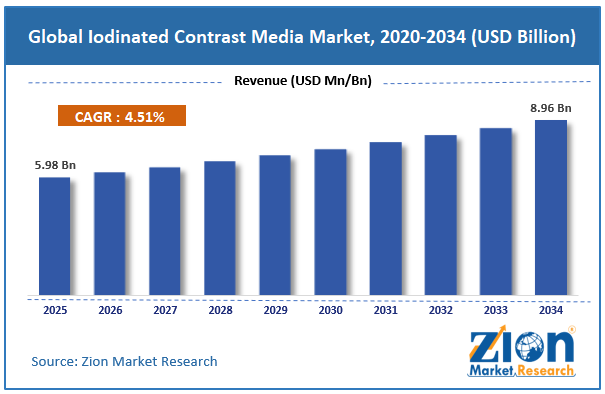
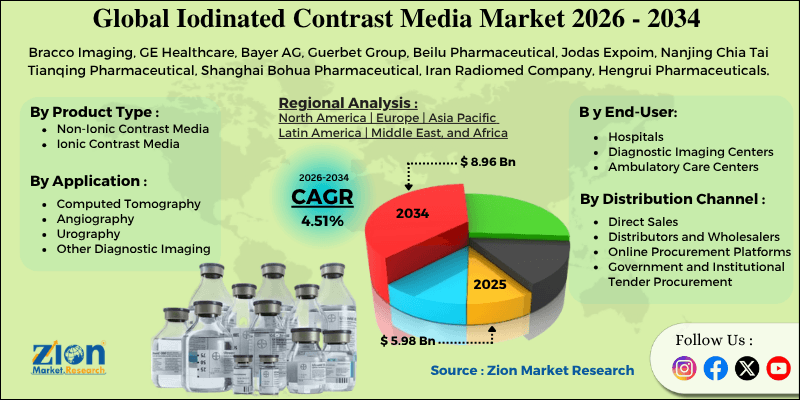
The global iodinated contrast media market size was approximately USD 5.98 billion in 2025 and is projected to reach USD 8.96 billion by 2034, growing at a compound annual growth rate of approximately 4.51% between 2026 and 2034.
 Request Free SampleRequest Free Sample
Key Insights
- According to our research team's analysis, the global iodinated contrast media market is expected to grow at a compound annual growth rate of approximately 4.51% over the forecast period from 2026 to 2034.
- In terms of revenue, the global iodinated contrast media market was valued at approximately USD 5.98 billion in 2025 and is projected to reach USD 8.96 billion by 2034.
- The iodinated contrast media market is expected to grow steadily due to rising volumes of imaging procedures, increasing prevalence of chronic diseases, expanding diagnostic infrastructure, and ongoing improvements in contrast agent safety profiles.
- Based on product type, non-ionic contrast media hold the largest market share, as it causes fewer side effects and are preferred for most imaging procedures. In contrast, ionic contrast media continue to serve specific diagnostic needs in select clinical settings.
- Based on application, computed tomography leads the market, as it is the most commonly used imaging technique requiring contrast enhancement, while angiography is growing steadily with rising cases of cardiovascular disease.
- Based on end-user, hospitals hold the largest market share due to high patient volumes and advanced imaging equipment, while diagnostic imaging centers are growing rapidly as standalone imaging services expand worldwide.
- Based on distribution channel, direct sales lead the market, as manufacturers prefer working closely with large hospital networks, while distributors and wholesalers are expanding their reach into regional and smaller healthcare markets.
- Based on region, North America leads the global iodinated contrast media market due to advanced diagnostic infrastructure and high imaging volumes, followed by Europe, where growing healthcare investment and rising rates of chronic disease are driving further growth.
Iodinated Contrast Media Market: Overview
Iodinated contrast media are special medical liquids used during imaging scans to make organs, blood vessels, and body tissues appear clearer, helping doctors diagnose diseases more accurately. These contrast agents are injected into the body before scans such as CT scans and angiography. The iodine in the liquid absorbs X-rays, creating a clear difference between normal and abnormal tissues. This allows doctors to easily detect problems such as tumors, blocked arteries, internal bleeding, infections, and other serious health conditions. Without contrast media, many soft tissues can look similar on medical images, making diagnosis more difficult. These agents are widely used in hospitals, diagnostic imaging centers, and research institutions as part of everyday healthcare. The growing number of people affected by cancer, cardiovascular diseases, and other chronic illnesses has increased the demand for advanced imaging procedures.
At the same time, healthcare providers are focusing on faster and more accurate diagnoses to improve patient outcomes. Manufacturers are also developing safer iodinated contrast media with lower risks of side effects and better patient comfort. These improvements, along with increasing access to medical imaging worldwide, continue to support the growth of the iodinated contrast media market.
The iodinated contrast media industry is expanding steadily as hospitals and diagnostic centers around the world lean more heavily on advanced imaging to diagnose diseases early and plan treatments more precisely.
Impact of the USA-Israel War on Iran on the Iodinated Contrast Media Market
Ongoing tensions between the United States, Israel, and Iran could lead to temporary disruptions in raw material sourcing and short-term increases in production costs for iodinated contrast media manufacturers. Hospitals and diagnostic centers continue to depend heavily on these agents because imaging procedures cannot be delayed for patients needing urgent diagnosis. As global healthcare systems continue to prioritize early disease detection, the market is expected to remain resilient and continue to expand despite these temporary geopolitical pressures.
Iodinated Contrast Media Market: Technology Roadmap 2025–2034
What is the projected development roadmap of the iodinated contrast media market over the forecast period?
The iodinated contrast media market is progressing through improved agent formulations, safer delivery methods, artificial intelligence-assisted imaging protocols, and the development of next-generation low-risk contrast solutions. The market is expected to grow at a compound annual growth rate of approximately 4.51% during the forecast period, driven by rising imaging demand, growing focus on patient safety, and continuous innovation in diagnostic technology.
The following roadmap outlines key development phases expected through 2034.
2025–2027: Safety Enhancement and Accessibility Phase
- Lower osmolality contrast agents are expected to see wider adoption as hospitals prioritize reducing allergic reactions and kidney-related complications in patients.
- Improved packaging and prefilled injection systems are expected to make contrast administration faster, safer, and more convenient for healthcare staff.
- Expanding manufacturing capacity in emerging markets is expected to improve availability and reduce supply shortages across regions.
2028–2031: Smart Imaging and Personalized Dosing Phase
- Artificial intelligence-powered dose-calculation tools are expected to help radiologists determine the appropriate contrast amount based on individual patient characteristics.
- Real-time monitoring systems are expected to help detect adverse reactions earlier, improving patient safety during imaging procedures.
- Combination imaging techniques using contrast agents alongside advanced software are expected to improve diagnostic accuracy for complex conditions.
2032–2034: Advanced Formulation and Sustainability Phase
- Next-generation contrast agents with even lower toxicity are expected to expand safe usage among patients with kidney or thyroid conditions while improving overall patient safety during imaging procedures.
- Environmentally friendly manufacturing processes are expected to reduce the ecological footprint of contrast media production.
- Stronger quality control and traceability systems are expected to improve safety standards across the global supply chain while ensuring consistent product quality, regulatory compliance, and greater transparency throughout manufacturing and distribution.
Iodinated Contrast Media Market: Dynamics
Growth Drivers
The iodinated contrast media market is growing, driven by rising volumes of imaging procedures and the prevalence of chronic diseases.
The iodinated contrast media market is growing as more people need medical imaging tests to detect and monitor diseases. These special contrast agents help doctors obtain clearer images during CT scans and angiography, making it easier to detect health problems at an early stage. The rising number of people with cancer, heart disease, brain disorders, and other chronic illnesses is increasing the demand for these imaging procedures. Aging populations are also contributing to this growth, as older adults often require regular diagnostic scans. Many governments are investing in better healthcare facilities and expanding imaging services in rural and underserved areas, allowing more patients to access advanced diagnosis. Hospitals and diagnostic centers are also upgrading to modern imaging equipment that works best with high-quality contrast media to produce sharper and more detailed images.
At the same time, growing public awareness about the importance of early disease detection is encouraging more people to undergo preventive health screenings, supporting the continued growth of the iodinated contrast media market worldwide.
How is the growing focus on patient safety and reduced adverse reactions driving the iodinated contrast media market?
The iodinated contrast media market is also growing as healthcare providers focus more on improving patient safety during imaging procedures. Manufacturers are developing newer contrast agents that are safer, more stable, and less likely to cause side effects. These improved formulations help lower the risk of allergic reactions and reduce the chances of kidney-related complications, especially in patients with existing health conditions. Before administering contrast media, hospitals now carefully review a patient's medical history, kidney function, and risk of allergies to ensure the procedure is as safe as possible. This extra screening helps doctors choose the right contrast agent for each patient and avoid unnecessary complications.
As a result, patients feel more confident about undergoing important imaging tests. Doctors and radiologists are also becoming more aware of the importance of using the correct dose and following proper injection methods, which further improves patient safety. At the same time, researchers continue to develop advanced contrast media with improved performance and lower risk. These improvements are helping increase the use of iodinated contrast media while supporting the overall growth of the global market.
Restraints
How are safety concerns and high production costs affecting the iodinated contrast media market?
The iodinated contrast media industry also faces several challenges that may limit its growth. One of the biggest concerns is that some patients may experience allergic reactions or kidney-related side effects after receiving contrast media. Because of this, doctors are often more careful when treating people with kidney disease, allergies, or other existing medical conditions. Another challenge is the high cost of producing these contrast agents. Their manufacturing requires advanced technology, strict quality checks, and high-quality raw materials, making production expensive for many companies.
In addition, new contrast media must pass detailed regulatory reviews before they can be sold, and this approval process can take a long time. Hospitals and healthcare providers in developing countries may also have limited budgets, making it difficult to afford newer and more advanced contrast agents. As a result, many continue to use older, lower-cost products instead. These challenges can slow the adoption of safer and more advanced iodinated contrast media. However, ongoing research and manufacturing improvements are expected to help overcome some of these barriers in the coming years.
Opportunities
Emerging markets, safer formulations, and technological innovation are driving opportunities in the iodinated contrast media market.
The iodinated contrast media market offers strong growth opportunities as more countries invest in better healthcare and advanced diagnostic imaging services. Many developing regions across Asia Pacific, Latin America, the Middle East, and Africa are building new hospitals, diagnostic centers, and imaging facilities, increasing the demand for contrast media. Manufacturers also have an opportunity to develop safer contrast agents with lower toxicity and fewer side effects, helping healthcare providers improve patient safety and treatment outcomes. Another promising area is the use of artificial intelligence with medical imaging. AI-powered software can help doctors analyze scans more accurately, improve diagnosis, and recommend the right amount of contrast media for each patient. Hospitals are also looking for reliable manufacturers that can provide a steady supply of high-quality contrast agents and prevent shortages during periods of high demand.
In addition, governments are increasing investments in healthcare infrastructure and expanding radiology services to improve access to early disease detection. Partnerships between pharmaceutical companies and medical imaging technology providers are also encouraging innovation and the development of better imaging solutions. These trends are expected to create new business opportunities and support the long-term growth of the global iodinated contrast media market.
Challenges
What challenges does the iodinated contrast media market face in ensuring safety and meeting rising global demand?
The iodinated contrast media market faces several challenges that may affect its future growth. One of the biggest concerns is reducing the risk of side effects, which requires careful patient screening and continued research to make contrast agents safer. Another challenge is maintaining a steady supply of the raw materials needed to manufacture these products, especially during global disruptions that can affect production and delivery. Manufacturers must also meet different regulatory requirements in each country, making it more difficult and time-consuming to launch new products worldwide. Healthcare professionals need regular training to ensure that contrast media are used safely, at the correct dose, and with proper injection techniques. This requires additional time and investment from hospitals and healthcare systems.
At the same time, increasing competition among pharmaceutical companies is creating pressure to offer better products at competitive prices. To stay ahead, manufacturers must continue investing in research, product improvements, and safer formulations while meeting the changing needs of healthcare providers and patients.
 Request Free SampleRequest Free Sample
Iodinated Contrast Media Market: Report Scope
| Report Attributes | Report Details |
|---|---|
| Report Name | Iodinated Contrast Media Market |
| Market Size in 2025 | USD 5.98 Billion |
| Market Forecast in 2034 | USD 8.96 Billion |
| Growth Rate | CAGR of 4.51% |
| Number of Pages | 227 |
| Key Companies Covered | Bracco Imaging, GE Healthcare, Bayer AG, Guerbet Group, Beilu Pharmaceutical, Jodas Expoim, Nanjing Chia Tai Tianqing Pharmaceutical, Shanghai Bohua Pharmaceutical, Iran Radiomed Company, Hengrui Pharmaceuticals, and others. |
| Segments Covered | By Product Type, By Application, By End-User, By Distribution Channel, and By Region |
| Regions Covered | North America, Europe, Asia Pacific (APAC), Latin America, Middle East, and Africa (MEA) |
| Base Year | 2025 |
| Historical Year | 2020 - 2024 |
| Forecast Year | 2026 - 2034 |
| Customization Scope | Avail customized purchase options to meet your exact research needs. Request For Customization |
Iodinated Contrast Media Market: Segmentation
The global iodinated contrast media market is segmented by product type, application, end-user, distribution channel, and region.
What makes non-ionic contrast media the dominant product type in the iodinated contrast media market?
Based on product type, the global iodinated contrast media market is classified into non-ionic and ionic contrast media. Non-ionic contrast media lead with about 55% share because it causes fewer side effects and are better tolerated by patients undergoing frequent imaging procedures. The ionic contrast media segment holds around 27% share. It continues to serve specific diagnostic requirements where its unique properties remain clinically useful.
How does computed tomography maintain its leading position in the iodinated contrast media market?
Based on application, the iodinated contrast media industry is divided into computed tomography, angiography, urography, and other diagnostic imaging. Computed tomography accounts for about 52% of the market share, as it is widely used in hospitals to detect tumors, internal injuries, and organ abnormalities. The angiography segment holds around 29% share. It is growing steadily as cardiovascular disease cases rise and demand for detailed vascular imaging increases.
What makes hospitals the dominant end-user group in the iodinated contrast media market?
Based on end-user, the market is classified into hospitals, diagnostic imaging centers, ambulatory care centers, and research and academic institutions. Hospitals hold around a 60% share because they handle the highest volume of imaging procedures and maintain advanced radiology departments. The diagnostic imaging centers segment accounts for about 23% of the market share. It is growing rapidly as standalone imaging facilities expand access to affordable scanning services.
How do direct sales lead the distribution landscape of the iodinated contrast media market?
Based on distribution channel, the iodinated contrast media market is segregated into direct sales, distributors and wholesalers, online procurement platforms, and government and institutional tender procurement. Direct sales account for about 45% of market share because manufacturers prefer to build long-term relationships directly with large hospital networks. The distributors and wholesalers segment holds around 31% share. It continues expanding by supplying contrast media products to regional hospitals and smaller diagnostic centers.
Iodinated Contrast Media Market: Regional Analysis
How is North America shaping global demand for iodinated contrast media solutions?
North America is the largest iodinated contrast media market and is expected to grow at a CAGR of around 5.4% during the forecast period. The region leads the market because it performs a large number of medical imaging procedures every year and has a well-developed healthcare system with advanced imaging technology. The United States holds the biggest market share due to the widespread use of CT scans and angiography, high healthcare spending, and regular investments in modern diagnostic equipment.
Many hospitals and imaging centers are upgrading their radiology departments to provide faster, more accurate diagnoses and meet the growing demand for imaging services. Canada is also supporting market growth by investing in new medical imaging systems and expanding access to diagnostic services across the country. Mexico is becoming an important market as private hospitals and healthcare providers continue to improve their imaging facilities and offer more advanced diagnostic procedures. The region also benefits from the presence of leading pharmaceutical companies, strong hospital networks, supportive reimbursement policies, and growing awareness about the importance of early disease detection. These factors continue to strengthen North America's position as the leading market for iodinated contrast media.
How does Europe maintain strong momentum in the iodinated contrast media market?
Europe is the second-largest iodinated contrast media market and is expected to grow at a CAGR of around 6.2% during the forecast period. The region is growing because hospitals and diagnostic centers are using more advanced imaging tests to detect diseases earlier and plan better treatments. Countries such as Germany, the United Kingdom, France, the Netherlands, and the Nordic countries are investing heavily in modern radiology equipment and expanding diagnostic imaging services. Germany and the United Kingdom hold the largest market shares due to their strong healthcare systems, high number of imaging procedures, and continuous government support for healthcare innovation. Many European countries are also working together to improve imaging standards and make patient care more consistent across the region.
In addition, leading pharmaceutical companies are developing safer and more effective contrast agents with fewer side effects. Ongoing research, better imaging technology, and a growing focus on accurate and early diagnosis are increasing the use of iodinated contrast media across Europe. These factors are expected to support the steady growth of the regional market in the coming years.
Recent Market Developments
- In February 2026, Bracco Imaging announced that the U.S. FDA expanded the approval of Vueway (gadopiclenol) to include use in neonates and infants, broadening access to advanced diagnostic imaging for pediatric patients.
- In February 2026, Bayer AG received approval from India's CDSCO for Ultravist (iopromide Injection) as the first iodinated contrast agent approved for Contrast-Enhanced Mammography (CEM), expanding breast cancer imaging options and strengthening its iodinated contrast media portfolio.
Iodinated Contrast Media Market: Competitive Analysis
The leading players in the global iodinated contrast media market are:
- Bracco Imaging
- GE Healthcare
- Bayer AG
- Guerbet Group
- Beilu Pharmaceutical
- Jodas Expoim
- Nanjing Chia Tai Tianqing Pharmaceutical
- Shanghai Bohua Pharmaceutical
- Iran Radiomed Company
- Hengrui Pharmaceuticals
The global iodinated contrast media market is segmented as follows:
By Product Type
- Non-Ionic Contrast Media
- Ionic Contrast Media
By Application
- Computed Tomography
- Angiography
- Urography
- Other Diagnostic Imaging
By End-User
- Hospitals
- Diagnostic Imaging Centers
- Ambulatory Care Centers
- Research and Academic Institutions
By Distribution Channel
- Direct Sales
- Distributors and Wholesalers
- Online Procurement Platforms
- Government and Institutional Tender Procurement
By Region
- North America
- The U.S.
- Canada
- Mexico
- Europe
- France
- The UK
- Spain
- Germany
- Italy
- Rest of Europe
- Asia Pacific
- China
- Japan
- India
- Australia
- South Korea
- Rest of Asia Pacific
- The Middle East & Africa
- Saudi Arabia
- UAE
- Egypt
- Kuwait
- South Africa
- Rest of the Middle East & Africa
- Latin America
- Brazil
- Argentina
- Rest of Latin America
Table Of Content
Methodology
FrequentlyAsked Questions
Iodinated contrast media are special medical liquids used during imaging scans to make organs, blood vessels, and body tissues appear clearer, helping doctors diagnose diseases more accurately. These contrast agents are injected into the body before scans such as CT scans and angiography.
The global iodinated contrast media market is expected to grow, driven by rising volumes of imaging procedures worldwide, increasing prevalence of chronic and cardiovascular diseases, growing investment in diagnostic imaging infrastructure, expanding hospital and diagnostic center networks, and continuous development of safer, lower-toxicity contrast agent formulations.
According to research, the global iodinated contrast media market was valued at approximately USD 5.98 billion in 2025 and is projected to reach approximately USD 8.96 billion by 2034.
The compound annual growth rate of the iodinated contrast media market is expected to be approximately 4.51% from 2026 to 2034.
North America is expected to lead the global iodinated contrast media market throughout the forecast period, driven by high imaging procedure volumes, strong healthcare investment, and advanced radiology infrastructure across hospitals and diagnostic centers.
The major players in the global iodinated contrast media market include Bracco Imaging, GE Healthcare, Bayer AG, Guerbet Group, Beilu Pharmaceutical, Jodas Expoim, Nanjing Chia Tai Tianqing Pharmaceutical, Shanghai Bohua Pharmaceutical, Iran Radiomed Company, and Hengrui Pharmaceuticals.
The report examines key aspects of the iodinated contrast media market, including growth drivers, adoption barriers, emerging opportunities, competitive dynamics, detailed regional performance, and a forward-looking outlook across all major product types, applications, end-user segments, and geographic regions through 2034.
The iodinated contrast media market will be driven by healthcare spending, aging populations, and investments in diagnostic infrastructure. At the same time, inflation, raw material costs, and supply chain stability will influence market growth, demand, and overall profitability.
The iodinated contrast media market offers investment opportunities in the development of safer contrast agents, manufacturing expansion, and AI-enabled imaging technologies. Partnerships between pharmaceutical companies, imaging equipment manufacturers, hospitals, and research institutions can accelerate innovation, improve supply security, and expand global market reach.
The iodinated contrast media market value chain includes raw material sourcing, formulation, manufacturing, quality testing, regulatory approval, packaging, distribution, and supply to hospitals and diagnostic centers. It concludes with product administration during imaging procedures, followed by post-market safety monitoring and continuous product improvement.

HappyClients

