
Global Industrial IoT Market Size, Share, Trends, Growth and Forecast 2034

Industrial IoT Market By Component (Solution (Analytics, Data Management, Security Solutions, Remote Monitoring, and Others), Services (Managed and Professional), By Platform (Device Management, Application Management, and Connectivity Management), By End-Use (Agriculture, Logistics & Transport, Energy & Power, Manufacturing, Healthcare, Oil & Gas, and Others), By Connectivity (Wireless and Wired), By Deployment (Cloud-Based and On-Premises), and By Region - Global and Regional Industry Overview, Market Intelligence, Comprehensive Analysis, Historical Data, and Forecasts 2026 - 2034
| Market Size in 2025 | Market Forecast in 2034 | CAGR (in %) | Base Year |
|---|---|---|---|
| USD 325.7 Billion | USD 944.8 Billion | 12.56% | 2025 |
Industrial IoT Industry Perspective:
What is the anticipated size of the industrial IoT market during the projection period?
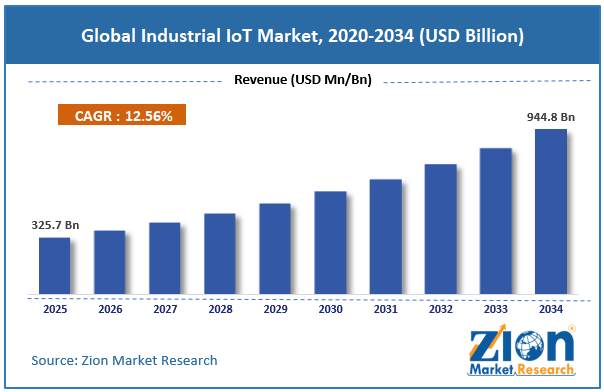
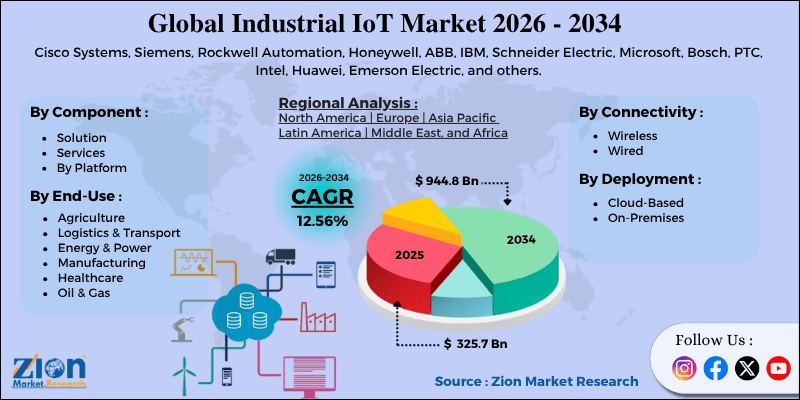
The global industrial IoT market size was worth around USD 325.7 billion in 2025 and is predicted to grow to around USD 944.8 billion by 2034, with a compound annual growth rate (CAGR) of roughly 12.56% between 2026 and 2034.
Key Insights:
- As per the analysis shared by our research analyst, the global industrial IoT market is estimated to grow annually at a CAGR of around 12.56% over the forecast period (2026-2034)
- In terms of revenue, the global industrial IoT market size was valued at around USD 325.7 billion in 2025 and is projected to reach USD 944.8 billion, by 2034.
- The industrial IoT market is projected to grow at a significant rate due to the development of smart factories & warehouses, expansion of 5G and 6G networks, and automation in manufacturing.
- Based on the component, the solution segment was the leading revenue generator in 2025. During the forecast period, the services segment is anticipated to deliver the fastest CAGR.
- Based on the end-use, the manufacturing segment is anticipated to command the largest market share.
- Based on connectivity, the wireless segment was the highest revenue generator in 2025, and similar trends can be expected in the future.
- Based on deployment, cloud-based industrial IoT systems contributed up to 71% of the global revenue. They are projected to deliver a CAGR of 14.1% during the forecast period.
- Based on region, Asia-Pacific is projected to dominate the global market during the forecast period.
Industrial IoT Market: Overview
Industrial Internet of Things (IIOT) is an advanced ecosystem of applications, sensors, devices, and networking equipment that work in tandem to obtain, monitor, and analyze data for industrial processes. Industrial IoT is similar to traditional IoT systems, with the primary difference being that the former is specially designed for industrial applications. Data thus obtained and analyzed using industrial IoT is leveraged to optimize business procedures, reduce cost, and enhance safety. Major elements of IIoT are superior cybersecurity, centralized connectivity, deployment & monitoring, and next-generation networking equipment. During the forecast period, the global industrial IoT market is expected to benefit from the development of smart factories & warehouses, expansion of 5G and 6G networks, and automation in manufacturing. However, ongoing use of legacy systems, cybersecurity risks, and high investment costs may limit market adoption in the coming years.
Impact of the USA-Israel and Iran war on the Industrial IoT Market:
The USA-Israel and Iran war is expected to affect transportation costs and availability of essential raw materials such as chips, integrated circuits, and advanced semiconductors required to facilitate smooth deployment of industrial IoT. The war may influence the emergence of new trade routes, strategic partnerships, and domestic chip production during the forecast period.
Industrial IoT Market: Dynamics
Growth Drivers
How will smart factories and warehouses drive demand in the industrial IoT market?
The global industrial IoT market will be driven by the growing development of smart factories and warehouses. According to market analysis, intelligent industrial facilities are equipped with machines and systems that are interconnected using industrial IoT solutions. For instance, self-monitoring machines are prime examples of intelligent solutions found in smart factories. In July 2026, Wistron Corp., a Taiwan-based electronics company, announced the launch of its first U.S.-based smart manufacturing facility in Texas. The premises of the smart factory will be used to produce next-generation Artificial Intelligence (AI) systems. China is reported to be spending on developing more than 43,000 smart factories as AI integration becomes more widespread across industries in the region.
Development in networking technologies to encourage market growth during the forecast period
Advancements in networking systems such as 5G and 6G connectivity will amplify market growth trends in the coming years. These developments are directed toward making networking systems more reliable, safer, and efficient. Better networking systems will facilitate faster communication and connection between devices. In March 2026, Semtech Corporation launched the FX86E, a 5G RedCap modem designed for industrial IoT applications. The company is a leading provider of cloud connectivity service solutions, and the modem delivers plug-and-play connectivity across 5G RedCap, 4G/LTE, and public and private networks. Such advancements are projected to propel revenue in the global industrial IoT market.
Restraints
Why will legacy systems limit expansion of the industrial IoT market during the forecast period?
The global industrial IoT industry is expected to be restricted due to the ongoing use of older, legacy systems. A large number of organizations continue to rely on conventional industrial technologies. Modern solutions such as industrial IoT require organizational preparedness to invest in new infrastructure and adopt changes. However, end users may find next-generation technologies overwhelming, limiting the market adoption rate.
Opportunities
Will advancements in edge computing and decentralized neural inference generate growth opportunities for the industrial IoT industry?
The global industrial IoT market players are rapidly investing in edge computing and decentralized neural inference solutions. These technologies enable data collection and analysis closer to the source instead of relying on centralized cloud systems. Real-time automation, faster decision-making, and improved reliability are some of the leading benefits offered by decentralized structures. In July 2026, Quectel Wireless Solutions, a market leader in end-to-end IoT solutions, launched the FCM665D. It is a high-performance Bluetooth and Wi-Fi 6 module equipped with edge computing capabilities. This wireless communication chip can be used in industrial monitoring systems, smart factory equipment, and energy storage systems. In June 2026, Tensordyne, an Artificial Intelligence (AI) systems company, launched Tensordyne Napier (TDN). This breakthrough AI system offers a balance between cost-efficiency and inference speed.
Challenges
What are the leading challenges in the industrial IoT market?
The global industrial IoT industry is projected to be challenged by high investment costs and cybersecurity risks. IIoT is expensive to deploy. The final cost depends on the system's use and scale of deployment. Moreover, industrial IoT technologies are vulnerable to cyberattacks, thus compromising the integrity and safety of crucial industrial information.
Industrial IoT Market: Report Scope
| Report Attributes | Report Details |
|---|---|
| Report Name | Industrial IoT Market |
| Market Size in 2025 | USD 325.7 Billion |
| Market Forecast in 2034 | USD 944.8 Billion |
| Growth Rate | CAGR of 12.56% |
| Number of Pages | 229 |
| Key Companies Covered | Cisco Systems, Siemens, Rockwell Automation, Honeywell, ABB, IBM, Schneider Electric, Microsoft, Bosch, PTC, Intel, Huawei, Emerson Electric, and others. |
| Segments Covered | By Component, By End-Use, By Connectivity, By Deployment, and By Region |
| Regions Covered | North America, Europe, Asia Pacific (APAC), Latin America, Middle East, and Africa (MEA) |
| Base Year | 2025 |
| Historical Year | 2020 - 2024 |
| Forecast Year | 2026 - 2034 |
| Customization Scope | Avail customized purchase options to meet your exact research needs. Request For Customization |
Industrial IoT Market: Segmentation
The global industrial IoT market is segmented based on component, end-use, connectivity, deployment, and region.
Why will the solution segment lead the industrial IoT industry revenue during the forecast period?
Based on component, the global market segments are solution, services, and platform. The solution segment is further divided into analytics, data management, security solutions, remote monitoring, and others. The services segment is fragmented into managed and professional services. The platform segment is divided into device management, application management, and connectivity management. In 2025, the highest growth was listed in the solution segment. It accounted for more than 40% of the global revenue. During the forecast period, the services segment is anticipated to deliver the fastest CAGR due to the emergence of the software-as-a-service (SaaS) sector and demand for experts that can guide companies during technological transformation.
Which will be the fastest-growing end-use during the forecast period in the industrial IoT market?
Based on end-use, the global market divisions are agriculture, logistics & transport, energy & power, manufacturing, healthcare, oil & gas, and others. Manufacturing emerged as the highest revenue generator in 2025. During the forecast period, it will continue leading the market with significant CAGR, due to increasing use of automation technologies in the manufacturing sector.
Which factors drive demand in the wireless segment in the industrial IoT industry?
Based on connectivity, the global market is fragmented into wireless and wired. In 2025, the largest market share was held by the wireless segment. It is projected to continue dominating market growth trends. Wireless systems are more cost-effective and reliable. Advancements in wireless technologies will prove beneficial to the industry players.
What will be the influence of the cloud-based segment on the industrial IoT market?
Based on deployment, the global market is fragmented into cloud-based and on-premises. In 2025, cloud-based industrial IoT systems contributed up to 71% of the global revenue. They are projected to deliver a CAGR of 14.1% during the forecast period. Cloud-based systems are easy to deploy and maintain. Scalability is an added advantage. Developments in cloud-based systems will encourage higher segmental adoption during the forecast period.
Industrial IoT Market: Regional Analysis
Why will North America lead the industrial IoT market in the coming years?
The global industrial IoT market is currently led by North America. In 2025, it accounted for 39% of the global revenue and is expected to grow at a CAGR of 11.27% during the forecast period. North America enjoys the benefits of early adoption of Industry 4.0 trends. In addition, the presence of leading industrial IIoT providers, along with widespread adoption of cloud systems across North American industrial facilities, will drive revenue growth in the region.
Why will Asia-Pacific generate the fastest CAGR in the industrial IoT market during the forecast period?
Asia-Pacific is expected to emerge as the fastest-growing region in the industrial IoT industry with a CAGR of 13.9% during the forecast period. In 2025, it accounted for 32% of the global revenue. Countries such as China, India, Japan, and South Korea will lead the regional growth trends. Industrial automation, construction of new-generation smart factories, and favorable government policies will propel regional growth during the forecast period.
Industrial IoT Market: Competitive Analysis
The global industrial IoT market is led by players like:
- Cisco Systems
- Siemens
- Rockwell Automation
- Honeywell
- ABB
- IBM
- Schneider Electric
- Microsoft
- Bosch
- PTC
- Intel
- Huawei
- Emerson Electric
What are the latest key trends in the industrial IoT market?
Application of digital twins
Digital twins have become an integral part of industrial IIoT systems. The technology has enabled reduced downtime and optimization of maintenance schedules. Advancements in digital twins technology will enable accelerated market growth in the coming years.
Enhanced cybersecurity
As more industries become automated, demand for superior cybersecurity technologies will be on the rise. This will include investments in systems such as AI-driven threat detection & prevention and zero-trust security.
The global industrial IoT market is segmented as follows:
By Component
- Solution
- Analytics
- Data Management
- Security Solutions
- Remote Monitoring
- Others
- Services
- Managed
- Professional
- By Platform
- Device Management
- Application Management
- Connectivity Management
By End-Use
- Agriculture
- Logistics & Transport
- Energy & Power
- Manufacturing
- Healthcare
- Oil & Gas
- Others
By Connectivity
- Wireless
- Wired
By Deployment
- Cloud-Based
- On-Premises
By Region
- North America
- The U.S.
- Canada
- Mexico
- Europe
- France
- The UK
- Spain
- Germany
- Italy
- Rest of Europe
- Asia Pacific
- China
- Japan
- India
- Australia
- South Korea
- Rest of Asia Pacific
- The Middle East & Africa
- Saudi Arabia
- UAE
- Egypt
- Kuwait
- South Africa
- Rest of the Middle East & Africa
- Latin America
- Brazil
- Argentina
- Rest of Latin America
Table Of Content
Methodology
FrequentlyAsked Questions
Industrial Internet of Things (IIOT) is an advanced ecosystem of applications, sensors, devices, and networking equipment that work in tandem to obtain, monitor, and analyze data for industrial processes.
The global industrial IoT market will be driven by the growing development of smart factories and warehouses.
According to study, the global industrial IoT market size was worth around USD 325.7 billion in 2025 and is predicted to grow to around USD 944.8 billion by 2034.
The CAGR value of the industrial IoT market is expected to be around 12.56% during 2026-2034.
The global industrial IoT industry is projected to be challenged by high investment costs and cybersecurity risks.
Application of digital twins and enhanced cybersecurity are the emerging trends and innovations impacting the industrial IoT market.
The global industrial IoT market has performed well so far and will offer similar trends in the coming years.
Asia-Pacific will contribute notably towards the industrial IoT market value.
The global industrial IoT market is led by players like Cisco Systems, Siemens, Rockwell Automation, Honeywell, ABB, IBM, Schneider Electric, Microsoft, Bosch, PTC, Intel, Huawei, Emerson Electric, and others.
The report explores crucial aspects of the industrial IoT market, including a detailed discussion of existing growth factors and restraints, while also browsing future growth opportunities and challenges that impact the market.

HappyClients

