Hydrophobic Coatings Market Size, Trend, Growth, Industry Analysis 2034
Hydrophobic Coatings Market By Property (Anti-Fouling, Anti-Microbial, Anti-Corrosion, Anti-Icing, Self-Cleaning, and Others), By Application (Optical, Medical, Construction, Automotive, Aerospace, and Others), and By Region - Global and Regional Industry Overview, Market Intelligence, Comprehensive Analysis, Historical Data, and Forecasts 2026 - 2034
| Market Size in 2025 | Market Forecast in 2034 | CAGR (in %) | Base Year |
|---|---|---|---|
| USD 2.80 Billion | USD 4.20 Billion | 4.60% | 2025 |
Hydrophobic Coatings Industry Perspective:
What is the anticipated size of the hydrophobic coatings market during the projection period?
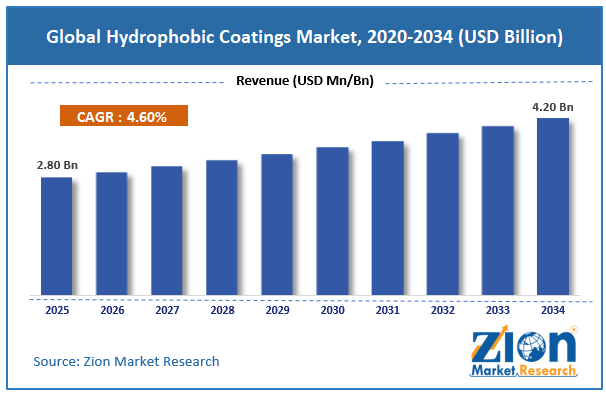
The global hydrophobic coatings market size was worth around USD 2.80 billion in 2025 and is predicted to grow to around USD 4.20 billion by 2034, with a compound annual growth rate (CAGR) of roughly 4.60% between 2026 and 2034.
Key Insights:
- As per the analysis shared by our research analyst, the global hydrophobic coatings market is estimated to grow annually at a CAGR of around 4.60% over the forecast period (2026-2034)
- In terms of revenue, the global hydrophobic coatings market size was valued at around USD 2.80 billion in 2025 and is projected to reach USD 4.20 billion, by 2034.
- The hydrophobic coatings market is projected to grow at a significant rate due to the rising applications in the automotive sector, development of eco-friendly formulas, and expansion of renewable energy systems.
- Based on the property, the anti-corrosion segment is growing at a high rate and will continue to dominate the global market as per industry projections.
- Based on the application, the automotive segment is anticipated to command the largest market share.
- Based on region, Asia-Pacific is projected to dominate the global market during the forecast period.
Hydrophobic Coatings Market: Overview
Hydrophobic coatings are specialized nanotechnological solutions that repel water. When applied to a surface, they help shed water, making cleaning easier and improving surface protection. Upon application, hydrophobic coatings create an invisible barrier that reduces surface energy. According to market analysis, lower surface energy creates a high contact angle between the surface and the water droplets. As the contact angle increases, water droplets become more round, making it harder for water to soak into the surface. Hydrophobic coatings also improve surface durability and corrosion resistance properties. During the forecast period, demand for hydrophobic coatings is projected to grow due to rising applications in the automotive sector, development of eco-friendly formulas, and expansion of renewable energy systems. However, high production costs, environmental concerns, a lack of skilled labor, and competition from alternatives may affect market revenue in the long run.
Impact of the USA-Israel and Iran war on the Hydrophobic Coatings Market:
The USA-Israel and Iran war has affected production costs, logistics expenses, and trading partnerships for hydrophobic coatings producers. The war has intensified pressure on coatings producers to maintain profit margins while navigating delayed shipments and shifting global demand. In the long term, this conflict will encourage higher reliance on domestic production and development of a more resilient supply chain network.
Hydrophobic Coatings Market: Drivers
Growth Drivers
How will automotive applications drive demand in the hydrophobic coatings market?
The global hydrophobic coatings market is expected to be driven by the rising applications in the automotive sector. Water-repelling coatings are used on various automobile components, including windows, mirrors, and windshields. Furthermore, exterior surfaces of modern vehicles are also coated with hydrophobic or superhydrophobic coatings to enhance vehicle lifespan and impart corrosion-resistance properties. The rapid expansion of electric and hybrid vehicles, which are rich in electronic components, has further intensified demand for hydrophobic coatings. In July 2025, IGL Coatings, a leading provider of ceramic coatings, announced the relaunch of its EZ and Shield product line. The company also introduced a new range of Window Coatings developed using Graphene Infinite technology with applications in the automotive sector.
Expansion of solar energy systems to propel market growth in the coming years
Hydrophobic coatings are widely used across solar energy systems. They coat photovoltaic (PV) panels to improve the surface’s ability to absorb sunlight. In addition, hydrophobic coatings enhance the durability of solar panels by preventing water droplets from penetrating the systems. These coatings create easy-to-clean, low-maintenance surfaces, enabling wider use in solar energy installations. The global hydrophobic coatings market will continue to benefit as residential, commercial, and industrial solar panel installations grow significantly.
Restraints
What are the leading restraints in the hydrophobic coatings industry during the projection period?
The global hydrophobic coatings industry will be restricted due to the high cost of investment. Advanced hydrophobic coatings are developed using nanotechnology. This sophisticated engineering solution requires skilled expertise and cutting-edge systems. Price-sensitive regions may register limited adoption. Furthermore, the ongoing introduction of new, high-performance traditional coating solutions may further limit industry revenue in the coming years.
Opportunities
Why are hydrophobic coatings market players shifting toward eco-friendly formulas?
The global hydrophobic coatings market is expected to grow as companies launch environmentally friendly formulas. Stricter environmental regulations have driven demand for low-Volatile Organic Compound (VOC), per- and polyfluoroalkyl substance (PFAS)-free, and bio-based coating systems. A recent study published in the Journal of Coatings Technology and Research confirmed that researchers developed a scalable, fluorine-free hydrophobic coating for solar panels. This sustainable coating offers self-cleaning, increased energy harvesting, and thermal insulation.
Advancements in nanotechnology to encourage improved market growth during the forecast period
Advancements in nanotechnology are expected to drive further sales for hydrophobic coatings. Manufacturers can develop high-performance, multifunctional hydrophobic coatings with advanced nanocomposites such as titanium dioxide (TiO₂), nano-silica (SiO₂), graphene, and other nanocomposite materials. These nanomaterials can expand overall applications across industries, enhance Ultraviolet (UV) protection, and improve the thermal stability of hydrophobic coatings.
Challenges
Regulatory concerns and limited performance challenge hydrophobic coatings industry growth
The global hydrophobic coatings industry is expected to face challenges from strict regulatory frameworks, especially around PFAS-related chemistries and fluorinated compounds. Moreover, limited performance in harsh environments, complex application processes, and the growing availability of alternative solutions will limit further industry expansion.
Hydrophobic Coatings Market: Report Scope
| Report Attributes | Report Details |
|---|---|
| Report Name | Hydrophobic Coatings Market |
| Market Size in 2025 | USD 2.80 Billion |
| Market Forecast in 2034 | USD 4.20 Billion |
| Growth Rate | CAGR of 4.60% |
| Number of Pages | 227 |
| Key Companies Covered | Sherwin-Williams, Kansai Paint, PPG Industries, Hempel, RPM International, Evonik Industries, Wacker Chemie, Jotun, AkzoNobel, Covestro, Nippon Paint Holdings, 3M, Dow, BASF, Axalta Coating Systems, and others. |
| Segments Covered | By Property, By Application, and By Region |
| Regions Covered | North America, Europe, Asia Pacific (APAC), Latin America, Middle East, and Africa (MEA) |
| Base Year | 2025 |
| Historical Year | 2020 - 2024 |
| Forecast Year | 2026 - 2034 |
| Customization Scope | Avail customized purchase options to meet your exact research needs. Request For Customization |
Hydrophobic Coatings Market: Segmentation
The global hydrophobic coatings market is segmented based on property, application, and region.
Why will the anti-corrosion segment lead the hydrophobic coatings industry revenue during the forecast period?
Based on property, the global market segments are anti-fouling, antimicrobial, anti-corrosion, anti-icing, self-cleaning, and others. In 2025, the anti-corrosion segment showed the highest growth. It accounted for 25.07% of the global revenue. It will continue dominating the market due to rising investments in solar energy installation across offshore and onshore sites. Additionally, rising demand for durability-enhancing coatings in automotive and construction applications will further support the segment's growth.
Which will be the fastest-growing application during the forecast period in the hydrophobic coatings market?
Based on application, the global market divisions are optical, medical, construction, automotive, aerospace, and others. In 2025, the automotive segment held the highest market share. It contributed 33% of global revenue and is expected to follow similar trends in the future. Rapid expansion of electric vehicles, advancements in automotive infotainment systems, and the introduction of high-performance hydrophobic coatings for modern vehicles will encourage segmental growth.
Hydrophobic Coatings Market: Regional Analysis
Why will Asia-Pacific lead the hydrophobic coatings market during the forecast period?
The global hydrophobic coatings market is expected to be dominated by Asia-Pacific during the forecast period. In 2025, it accounted for 48% of the global revenue and is projected to grow at a CAGR of 6.55% during the forecast period. The presence of the world’s leading chemicals & materials industry, along with high-end end-user applications, will drive regional dominance. China and India are anticipated to lead growth in Asia-Pacific, driven by expansion of the automotive sector and applications in consumer electronics.
How is North America expected to perform in the hydrophobic coatings market during the projection period?
North America is anticipated to deliver a strong CAGR of 4.5% in the global hydrophobic coatings market during the forecast period. It dominated around 41% of the total market share. North America is a mature market for hydrophobic coatings. Rising installation of solar energy panels at residential and industrial scales, demand for eco-friendly formulas, and use in the healthcare sector are the main regional growth drivers. The rising do-it-yourself (DIY) trend will increase residential demand for hydrophobic coatings.
Hydrophobic Coatings Market: Competitive Analysis
The global hydrophobic coatings market is led by players like:
- Sherwin-Williams
- Kansai Paint
- PPG Industries
- Hempel
- RPM International
- Evonik Industries
- Wacker Chemie
- Jotun
- AkzoNobel
- Covestro
- Nippon Paint Holdings
- 3M
- Dow
- BASF
- Axalta Coating Systems
What are the latest key trends in the hydrophobic coatings market?
Demand for multifunctional coatings
Consumers are actively seeking multifunctional coatings that offer several advantages such as antimicrobial, anti-fouling, and self-healing properties. Multifunctional hydrophobic coatings will expand applications across emerging industries.
Applications in the healthcare industry
Hydrophobic coatings are being increasingly used in the healthcare industry. Water-repellent coatings are applied to surgical instruments, medical devices, and diagnostic equipment to reduce biofilm formation and contamination.
Use in the building & construction industry
The building & construction industry is a growing end-user for hydrophobic coatings. Common applications include glass windows and facades, concrete and cement structures, roofs and tiles, and building facades and walls.
The global hydrophobic coatings market is segmented as follows:
By Property
- Anti-Fouling
- Anti-Microbial
- Anti-Corrosion
- Anti-Icing
- Self-Cleaning
- Others
By Application
- Optical
- Medical
- Construction
- Automotive
- Aerospace
- Others
By Region
- North America
- The U.S.
- Canada
- Mexico
- Europe
- France
- The UK
- Spain
- Germany
- Italy
- Rest of Europe
- Asia Pacific
- China
- Japan
- India
- Australia
- South Korea
- Rest of Asia Pacific
- The Middle East & Africa
- Saudi Arabia
- UAE
- Egypt
- Kuwait
- South Africa
- Rest of the Middle East & Africa
- Latin America
- Brazil
- Argentina
- Rest of Latin America
Table Of Content
Methodology
FrequentlyAsked Questions
Hydrophobic coatings are specialized nanotechnological solutions that repel water. When applied to a surface, they help shed water, making cleaning easier and protecting the surface.
The global hydrophobic coatings market is expected to be driven by the rising applications in the automotive sector.
According to study, the global hydrophobic coatings market size was worth around USD 2.80 billion in 2025 and is predicted to grow to around USD 4.20 billion by 2034.
The CAGR value of the hydrophobic coatings market is expected to be around 4.60% during 2026-2034.
The global hydrophobic coatings industry is anticipated to be challenged by strict regulatory frameworks, especially against PFAS-related chemistries and fluorinated compounds.
Demand for multifunctional coatings and applications in the healthcare industry are emerging trends and innovations impacting the hydrophobic coatings market.
The global hydrophobic coatings market has performed well so far and will offer similar trends in the coming years.
Asia-Pacific will contribute notably to the hydrophobic coatings market value.
The global hydrophobic coatings market is led by players like Sherwin-Williams, Kansai Paint, PPG Industries, Hempel, RPM International, Evonik Industries, Wacker Chemie, Jotun, AkzoNobel, Covestro, Nippon Paint Holdings, 3M, Dow, BASF, and Axalta Coating Systems.
The report explores crucial aspects of the hydrophobic coatings market, including a detailed discussion of existing growth factors and restraints, while also browsing future growth opportunities and challenges that impact the market.

HappyClients