
Global Hemophilia Market Size, Share, Trends, Growth and Forecast 2032

Hemophilia Market - By Disease Type (Hemophilia A, Hemophilia B, and Others), By Therapy (Gene Therapy, Replacement Therapy, and Others), By Product Type (Plasma-Derived Coagulation Factor Concentrates, Recombinant Coagulation Factor Concentrates, and Others), And By Region - Global Industry Perspective, Comprehensive Analysis, and Forecast, 2024-2032
| Market Size in 2023 | Market Forecast in 2032 | CAGR (in %) | Base Year |
|---|---|---|---|
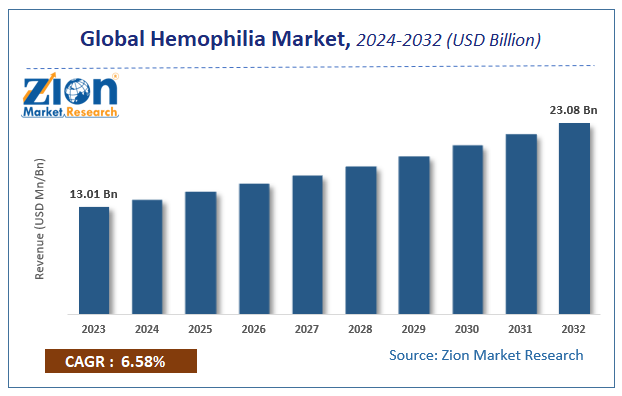
| USD 13.01 Billion | USD 23.08 Billion | 6.58% | 2023 |
What is the market size of the hemophilia industry?
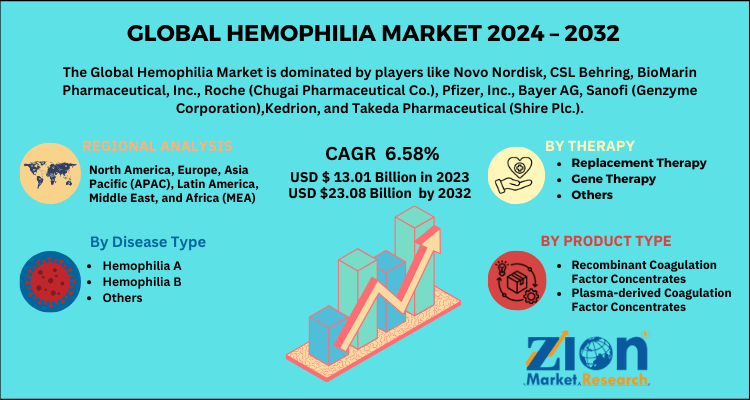
Zion Market Research has published a report on the global Hemophilia Market, estimating its value at USD 13.01 Billion in 2023, with projections indicating that it will reach USD 23.08 Billion by 2032. The market is expected to expand at a compound annual growth rate (CAGR) of 6.58% over the forecast period 2024-2032.
The report explores the factors fueling market growth, the hitches that could hamper this expansion, and the opportunities that may arise in the Hemophilia industry. Additionally, it offers a detailed analysis of how these elements will affect market demand dynamics and market performance throughout the forecast period. The report offers historical data from 2018 to 2022 along with a forecast from 2024 to 2032 based on value (USD Billion).
Hemophilia Market: Overview
Hemophilia is a most common as well as serious genetic hemorrhagic disease. There are two kinds of hemophilia, namely, hemophilia A and hemophilia B. Moreover, they are caused due to factors VIII protein deficiency as well IX protein deficiency and is impacted due to continuous & excessive bleeding post minor trauma. Reportedly, acquired hemophilia can be present in an individual right from childbirth and can be cured after apt treatment. According to NCBI, hemophilia was the word first introduced by Johann Schonlein in his dissertation at Zurich University. For the record, Dr. Nasse first published genetic description of hemophilia in Nasse’s law stating the transmission of hemophilia from unaffected mothers to the sons.
Furthermore, hemophilia has been treated with prophylactic therapy with the latter helping in prevention of bleeding as well as reducing complications resulting due to hemophilia. With onset of gene therapy and with other treatments imitating sustained coagulation factor replacement, the hemophilia market is likely to gain traction over the years ahead.
Hemophilia Market:? Growth Drivers
Focus on new drug development along with favorable government policies for curbing the disease is likely to prompt the expansion of hemophilia market over the forecast timespan. In addition to this, rise in the awareness about rare disease such as hemophilia and growing efforts made by both private & public healthcare research organizations to produce drugs for effectively treating the disorder will impel the business growth. Apparently, huge allocation of funds by giant pharma firms in research & development to find new ways of treating the genetic disease will proliferate the expansion of the hemophilia industry over the forecast timespan.
Furthermore, enhanced distribution networking facility of the mammoth players in the pharmaceutical industry will culminate into huge market demand over the forecasting timeframe. As per Centers for Disease Control and Prevention (CDC), nearly four hundred babies are born with hemophilia in the U.S. each year and this will boost the demand for hemophilia treatment in the country, thereby driving the market trends.
Hemophilia Market: Report Scope
| Report Attributes | Report Details |
|---|---|
| Report Name | Hemophilia Market |
| Market Size in 2023 | USD 13.01 Billion |
| Market Forecast in 2032 | USD 23.08 Billion |
| Growth Rate | CAGR of 6.58% |
| Number of Pages | 110 |
| Key Companies Covered | Novo Nordisk; CSL Behring; BioMarin Pharmaceutical, Inc.; Roche (Chugai Pharmaceutical Co.); Pfizer, Inc.; Bayer AG; Sanofi (Genzyme Corporation);Kedrion; and Takeda Pharmaceutical (Shire Plc.). |
| Segments Covered | By Disease Type, By Therapy, By Product Type And By Region |
| Regions Covered | North America, Europe, Asia Pacific (APAC), Latin America, Middle East, and Africa (MEA) |
| Base Year | 2023 |
| Historical Year | 2018 - 2022 |
| Forecast Year | 2024 - 2032 |
| Customization Scope | Avail customized purchase options to meet your exact research needs. Request For Customization |
Hemophilia Market: Regional Insights
North America To Form Strong Base For Market Growth By 2032
The regional market dominance during the estimated timeframe can be attributed to increase in the number of hemophilia cases in the countries like the U.S. In addition to this, rise in the use of prophylaxis therapy for hemophilia in the region will promulgate the business growth in the sub-continent over the forecast timespan. Presence of behemoth pharmaceutical firms as well as healthcare service providers in the countries such as Canada and the U.S. are expected to boost the regional market trends.
Hemophilia Market: Competitive Space
Key participants profiled in the study are -
- Novo Nordisk
- CSL Behring
- BioMarin Pharmaceutical, Inc.
- Roche (Chugai Pharmaceutical Co.)
- Pfizer, Inc.
- Bayer AG
- Sanofi (Genzyme Corporation);Kedrion
- Takeda Pharmaceutical (Shire Plc.).
The global hemophilia market is segmented as follows:
By disease type:
- Hemophilia A
- Hemophilia B
- Others
By therapy:
- Replacement Therapy
- Gene Therapy
- Others (Immune Tolerance Induction Therapy etc.)
By product type:
- Recombinant Coagulation Factor Concentrates
- Plasma-derived Coagulation Factor Concentrates
- Others (Desmopressin etc.)
By Region
- North America
- The U.S.
- Canada
- Mexico
- Europe
- France
- The UK
- Spain
- Germany
- Italy
- Rest of Europe
- Asia Pacific
- China
- Japan
- India
- Australia
- South Korea
- Rest of Asia Pacific
- The Middle East & Africa
- Saudi Arabia
- UAE
- Egypt
- Kuwait
- South Africa
- Rest of the Middle East & Africa
- Latin America
- Brazil
- Argentina
- Rest of Latin America
Table Of Content
Methodology
FrequentlyAsked Questions
Hemophilia is a genetic disorder that affects blood clotting. It causes excessive bleeding from minor injuries
The global Hemophilia market is expected to be driven by the rising diagnosis rates, advancements in clotting factor therapies, and gene therapy development. Improved treatment accessibility supports expansion..
According to study, the global Hemophilia market size was worth around USD 13.01 Billion in 2023 and is predicted to grow to around USD 23.08 Billion By 2032.
The global Hemophilia market is expected to grow at a Compound Annual Growth Rate (CAGR) of around CAGR 6.58% during the forecast period from 2024-2032.
The global Hemophilia industry is projected to be challenged by Challenges include high treatment costs, limited access in developing regions, and lifelong therapy dependence.
The Opportunities include gene therapy advancements, extended half-life treatments, improved diagnosis, and orphan drug incentives will offer significant growth opportunities in the Hemophilia market.
Long-acting factor therapies; gene therapy breakthroughs; personalized prophylaxis and home-based treatment models are the emerging trends and innovations impacting the Hemophilia market.
The global Hemophilia market is expected to be led by North America during the forecast period.
Some of the prominent players operating in the global Hemophilia market are; Novo Nordisk; CSL Behring; BioMarin Pharmaceutical, Inc.; Roche (Chugai Pharmaceutical Co.); Pfizer, Inc.; Bayer AG; Sanofi (Genzyme Corporation);Kedrion; and Takeda Pharmaceutical (Shire Plc.). and others.
The report explores crucial aspects of the Hemophilia market, including a detailed discussion of existing growth factors and restraints, while also browsing future growth opportunities and challenges that impact the market.

HappyClients

