
ealthcare Customer Data Platform Market Size, Share and Forecast 2034

Healthcare Customer Data Platform Market By Component (Software and Services), By Deployment Mode (On-premise and Cloud-based), By Organization Size (Large Enterprises and Small & Medium-sized Enterprises), By Application (Personalized Recommendations, Marketing Data Segmentation, Predictive Analytics, Security Management, Customer Retention and Engagement and Others) and By Region - Global and Regional Industry Overview, Market Intelligence, Comprehensive Analysis, Historical Data, and Forecasts 2025 - 2034
| Market Size in 2024 | Market Forecast in 2034 | CAGR (in %) | Base Year |
|---|---|---|---|
| USD 7.5 Billion | USD 61.9Billion | 23.5% | 2024 |
Healthcare Customer Data Platform Industry Perspective:
What will be the size of the global healthcare customer data platform market during the forecast period?
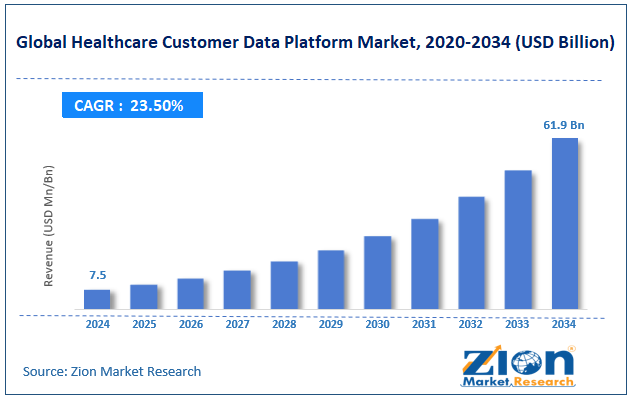
The global healthcare customer data platform market size was worth around USD 7.5 billion in 2024 and is predicted to grow to around USD 61.9 billion by 2034 with a compound annual growth rate (CAGR) of roughly 23.5% between 2025 and 2034.
Healthcare Customer Data Platform Market: Overview
A Healthcare Customer Data Platform (Healthcare CDP) is a software application that aggregates, integrates, and organizes information from all patient touchpoints within healthcare organizations into a single, enriched patient profile. Healthcare CDPs integrate data from many sources (EMR/EHRs, telemedicine platforms, health mobile applications, patient portal solutions, wearables, billing systems, pharmacies, CRM systems) into one complete view of the patient, using the data to facilitate attentive patient engagement, personalized communication, community management and education, targeted efforts and care coordination, and optimal decision making. Healthcare CDPs can also serve as a platform for more advanced analysis, artificial intelligence, marketing automation, and omnichannel communication to enforce health data privacy rules (HIPAA, GDPR). Healthcare CDPs are being implemented by many healthcare organizations, clinics, facilities, government bodies, and departments to deliver a superior patient experience, streamline administration, implement value-based care approaches, and strengthen patient relationships.
Key Insights
- As per the analysis shared by our research analyst, the global healthcare customer data platform market is estimated to grow annually at a CAGR of around 23.5% over the forecast period (2025-2034).
- In terms of revenue, the global healthcare customer data platform market size was valued at around USD 7.5 billion in 2024 and is projected to reach USD 61.9 billion by 2034.
- Increasing healthcare IT investments are expected to propel the healthcare customer data platform market over the projected period.
- Based on the component, the software protein segment accounted for the largest revenue share in 2024 of 78%.
- Based on the deployment mode, the cloud-based segment accounted for the largest revenue share in 2024 of over 70%.
- Based on the organization size, the large enterprises segment held the largest market share in 2024 of 65%.
- Based on the application, the predictive analytics segment held the largest market share in 2024 in 25%.
- Based on region, North America led the healthcare customer data platform market in 2024 of 50%.
Impact of the USA-Israel War on Iran on the Healthcare Customer Data Platform Market
The USA-Israel war between the two nations with respect to Iran will have an indirect effect on the market of Healthcare CDP due to the increase in cybersecurity threats that have been observed in the global healthcare industry. As such, cyber-attacks targeting healthcare providers, health tech companies, and even hospital systems have become more common, creating a need to enhance the safety of patient data, privacy, and digital infrastructure in the field. Nonetheless, geopolitical tensions have increased the need for a cloud-based healthcare platform and for better cybersecurity integration within healthcare data.
Healthcare Customer Data Platform Market: Dynamics
Growth Drivers
Why does the rising demand for personalized patient engagement drive the healthcare customer data platform market?
The increasing need for personalized patient engagement has been a key factor driving the adoption of Healthcare Customer Data Platforms (CDPs) as healthcare providers focus on offering personalized services, improving patient satisfaction, and boosting clinical outcomes. The purpose of healthcare CDPs is to enable organizations to collect and integrate data on their patients from various sources, such as electronic health records (EHRs), telemedicine portals, mobile health applications, wearables, pharmacies, and patient portals. By analyzing the collected information, healthcare organizations will gain deeper insights into their patients' behavior, preferences, medical history, and communication patterns. This way, healthcare organizations will be able to offer personalized services to their patients through appointment and medication reminders, well-being suggestions, preventive care programs, health education materials, and more, using various communication tools. Personalization will boost adherence to treatment plans, patient participation in preventive care, the development of strong, long-term relationships between patients and healthcare providers, and prevent hospital readmissions.
Moreover, there is a need to meet patients' expectations for the retail and banking sectors' customer experience in healthcare organizations, which will boost the adoption of CDPs.
Restraints
Data privacy and security concerns hamper the growth of the healthcare customer data platform industry
Privacy and security issues act as a barrier to the expansion of the healthcare customer data platform market, due to the massive amount of sensitive customer data these platforms maintain, including medical records, payment and insurance information, and personal health data. Cyberattacks, ransomware, and data breaches have made health care institutions apprehensive about the safety and privacy of the data they maintain. There are stringent data protection regulations, such as HIPAA and GDPR, that require the adoption of cybersecurity technologies, data protection systems, and consent management solutions. These factors make organizations reluctant to use the healthcare customer data platform due to the high costs and complexities involved.
Opportunities
Why does the increasing launch of innovative solution offer a lucrative opportunity for the healthcare customer data platform market?
The launch of innovative solution is expected to offer a lucrative opportunity to the healthcare customer data platform market over the projected period. For instance, in January 2026, Oracle introduced the Oracle Life Sciences AI Data Platform, a generative AI-backed solution designed to enable pharmaceutical, medical device, research, and life science companies to fast-track R&D, clinical trials, post-market safety, and commercialization efforts. By unlocking large-scale insights, this platform creates an environment for AI-driven research by integrating vast, diverse datasets, including customer and third-party data and more than 129 million de-identified longitudinal records from Oracle Health Real-World Data.
Challenges
Why does the shortage of skilled healthcare IT professionals pose a significant challenge to the healthcare customer data platform market?
A major constraint that affects the success and growth of the healthcare customer data platform (CDP) market is the inadequacy of technical experts in healthcare IT because the implementation and management of healthcare CDPs requires highly specialized knowledge in fields such as healthcare informatics, cloud computing, cybersecurity, artificial intelligence, data analytics, and other relevant aspects. The integration of data from various sources, such as EHRs, telemedicine software, billing systems, wearables, and others, necessitates specialized skills in managing a healthcare data platform. Healthcare organizations have insufficiently trained staff to facilitate data integration, ensure data collected is accurate, manage cybersecurity issues, and comply with various regulations, including HIPAA and GDPR. Technical incompetence leads to increased operational costs, poor efficiency, and low ROI. Such constraints are especially problematic for small and medium-sized healthcare organizations that adopt healthcare CDPs.
Healthcare Customer Data Platform Market: Report Scope
| Report Attributes | Report Details |
|---|---|
| Report Name | Healthcare Customer Data Platform Market |
| Market Size in 2024 | USD 7.5 Billion |
| Market Forecast in 2034 | USD 61.9 Billion |
| Growth Rate | CAGR of 23.5% |
| Number of Pages | 226 |
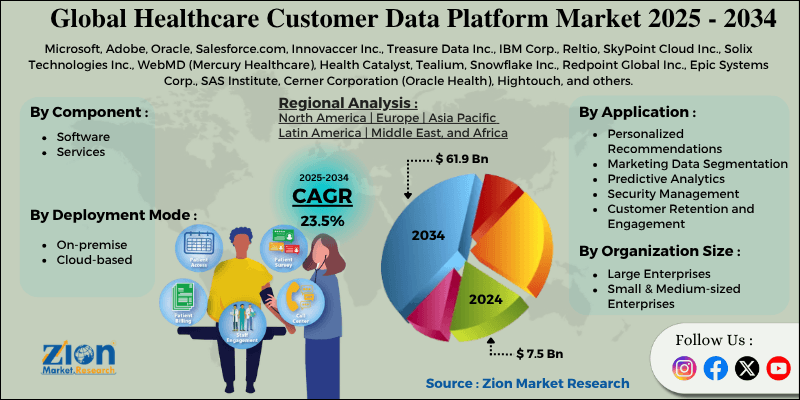
| Key Companies Covered | Microsoft, Adobe, Oracle, Salesforce.com, Innovaccer Inc., Treasure Data Inc., IBM Corp., Reltio, SkyPoint Cloud Inc., Solix Technologies Inc., WebMD (Mercury Healthcare), Health Catalyst, Tealium, Snowflake Inc., Redpoint Global Inc., Epic Systems Corp., SAS Institute, Cerner Corporation (Oracle Health), Hightouch, and others. |
| Segments Covered | By Component, By Deployment Mode, By Organization Size, By Application, and By Region |
| Regions Covered | North America, Europe, Asia Pacific (APAC), Latin America, Middle East, and Africa (MEA) |
| Base Year | 2024 |
| Historical Year | 2019 - 2023 |
| Forecast Year | 2025 - 2034 |
| Customization Scope | Avail customized purchase options to meet your exact research needs. Request For Customization |
Healthcare Customer Data Platform Market: Segmentation
Component Insights
Why does the software dominate the healthcare customer data platform market?
The software protein segment accounted for the largest revenue share in 2024 of 78%. This is due to increased use of healthcare technology, patient engagement through applications, and software in healthcare management. Hospitals and other healthcare facilities are investing significant resources in CDP software to integrate data from EHRs, telemedicine, wearables, mHealth apps, billing software, and CRMs into a single platform. Increasing demand for customized patient communication, predictive analytics, automation, and insights has led to greater adoption of software solutions by hospitals, clinics, insurance companies, and pharmaceutical firms.
Deployment Mode Insights
How does the cloud-based segment capture the largest market share in the healthcare customer data platform market?
The cloud-based segment accounted for the largest revenue share in 2024 of over 70%. This acceleration is being fueled by the rising demand for cost-effective health care solutions that can manage vast amounts of data while providing scalability, flexibility, and low implementation costs. Several organizations in the healthcare vertical, such as healthcare providers, insurance firms, and life sciences companies, have started leveraging cloud CDP solutions to store, analyze, and unify data from EHRs, telehealth solutions, mobile health applications, wearables, and patient engagement software.
Organization Size Insights
Does the large enterprises segment capture the largest market share in the healthcare customer data platform market?
The large enterprises segment held the largest market share in 2024 of 65%. Growth in the segment is supported by rising demand for superior data management, personalized patient engagement approaches, and extensive digital transformation efforts. Hospitals, healthcare groups, insurance firms, pharmaceutical firms, and life sciences companies collect vast amounts of patient/consumer data across different departments/locations, making centralized data systems crucial. The adoption of healthcare CDPs facilitates the consolidation of patient information collected from electronic health records, telemedicine applications, billing solutions, fitness trackers, and customer relationship management software.
Application Insights
Why does the predictive analytics segment capture the largest market share in the healthcare customer data platform market?
The predictive analytics segment held the largest market share in 2024 in 25%. Predictive modeling converts large amounts of data in the customer data platform into useful insights, which businesses use to inform their marketing decisions. Predictive analytics enables companies to understand trends from analyzed customer data. As such, businesses are better placed to predict what happens next in customer interactions.
Regional Insights
Why does North America lead the healthcare customer data platform market?
North America led the healthcare customer data platform market in 2024 of 50%. Advances in healthcare infrastructure, growing use of digital health applications, and increased funding to improve healthcare IT infrastructure are expected to propel the market growth in the region. Healthcare service providers, health insurers, pharmaceutical and life science companies in North America have begun adopting customer data platforms to incorporate customer data into clinical decision-making. Digital health tools such as electronic health records, telemetry, health wearables, and cloud-based healthcare platforms have generated massive amounts of patient data, necessitating data integration and analysis.
Additionally, the government's outlook on healthcare digitization, policies on patient data, and the introduction of artificial intelligence and analytics in the healthcare sector are projected to drive the healthcare customer data platforms market.
Healthcare Customer Data Platform Market: Competitive Analysis
The global healthcare customer data platform market is dominated by players like:
- Microsoft
- Adobe
- Oracle
- Salesforce.com
- Innovaccer Inc.
- Treasure Data Inc.
- IBM Corp.
- Reltio
- SkyPoint Cloud Inc.
- Solix Technologies Inc.
- WebMD (Mercury Healthcare)
- Health Catalyst
- Tealium
- Snowflake Inc.
- Redpoint Global Inc.
- Epic Systems Corp.
- SAS Institute
- Cerner Corporation (Oracle Health)
- Hightouch
The global healthcare customer data platform market is segmented as follows:
By Component
- Software
- Services
By Deployment Mode
- On-premise
- Cloud-based
By Organization Size
- Large Enterprises
- Small & Medium-sized Enterprises
By Application
- Personalized Recommendations
- Marketing Data Segmentation
- Predictive Analytics
- Security Management
- Customer Retention and Engagement
- Others
By Region
- North America
- The U.S.
- Canada
- Mexico
- Europe
- France
- The UK
- Spain
- Germany
- Italy
- Rest of Europe
- Asia Pacific
- China
- Japan
- India
- Australia
- South Korea
- Rest of Asia Pacific
- The Middle East & Africa
- Saudi Arabia
- UAE
- Egypt
- Kuwait
- South Africa
- Rest of the Middle East & Africa
- Latin America
- Brazil
- Argentina
- Rest of Latin America
Table Of Content
Methodology
FrequentlyAsked Questions
A Healthcare Customer Data Platform (Healthcare CDP) is a software application that aggregates, integrates, and organizes information from all patient touchpoints within healthcare organizations into a single, enriched patient profile.
Key growth drivers for the healthcare customer data platform market include rising demand for personalized patient engagement, increasing adoption of digital healthcare technologies, growing use of AI-driven analytics, expansion of telehealth services, and the need for unified patient data management.
Major challenges restraining the growth of the healthcare customer data platform market include data privacy and cybersecurity concerns, complex integration with legacy healthcare systems, high implementation and maintenance costs, shortage of skilled healthcare IT professionals, regulatory compliance complexities, and interoperability limitations across healthcare platforms.
Based on the application, the predictive analytics segment is expected to dominate the healthcare customer data platform market growth during the projected period.
What are the emerging trends and innovations impacting the healthcare customer data platform market?
Emerging trends and innovations impacting the healthcare customer data platform market include the integration of artificial intelligence and machine learning for predictive analytics, increasing adoption of cloud-based CDP solutions, expansion of omnichannel patient engagement strategies, growing use of real-time data analytics, interoperability advancements, and the incorporation of wearable device and telehealth data into unified patient profiles. Additionally, healthcare organizations are increasingly adopting automation, personalized communication tools, and value-based care models to enhance patient experience and operational efficiency.
According to the report, the global healthcare customer data platform market size was worth around USD 7.5 billion in 2024 and is predicted to grow to around USD 61.9 billion by 2034.
The global healthcare customer data platform market is expected to grow at a CAGR of 23.5% during the forecast period.
The global healthcare customer data platform industry growth is expected to be led by North America over the forecast period.
The global healthcare customer data platform market is dominated by players like Microsoft, Adobe, Oracle, Salesforce.com, Innovaccer Inc., Treasure Data Inc., IBM Corp., Reltio, SkyPoint Cloud Inc., Solix Technologies Inc., WebMD (Mercury Healthcare), Health Catalyst, Tealium, Snowflake Inc., Redpoint Global Inc., Epic Systems Corp., SAS Institute, Cerner Corporation (Oracle Health) and Hightouch among others.
The market report covers the geographical market along with a comprehensive competitive landscape analysis. It also includes cash flow analysis, profit ratio analysis, market basket analysis, market attractiveness analysis, sentiment analysis, PESTLE analysis, trend analysis, SWOT analysis, trade area analysis, demand & supply analysis, Porter’s five forces analysis, and value chain analysis.

HappyClients

