
Global Halal Food Market Size, Share, Growth Analysis Report - Forecast 2034

Halal Food Market By Product Type (Meat & Poultry, Dairy Products, Fruits & Vegetables, Cereals & Grains, Beverages, Confectionery & Bakery Products, and Others), By Distribution Channel (Supermarkets/Hypermarkets, Online Stores, Convenience Stores, Specialty Stores, and Others), By End-user (Household, Foodservice Industry (Restaurants, Hotels & Catering), and Food Processing Industry), and By Region: Global and Regional Industry Overview, Market Intelligence, Comprehensive Analysis, Historical Data, and Forecasts 2025 - 2034
| Market Size in 2024 | Market Forecast in 2034 | CAGR (in %) | Base Year |
|---|---|---|---|
| USD 3.21 Billion | USD 16.84 Billion | 18.04% | 2024 |
Halal Food Industry Perspective:
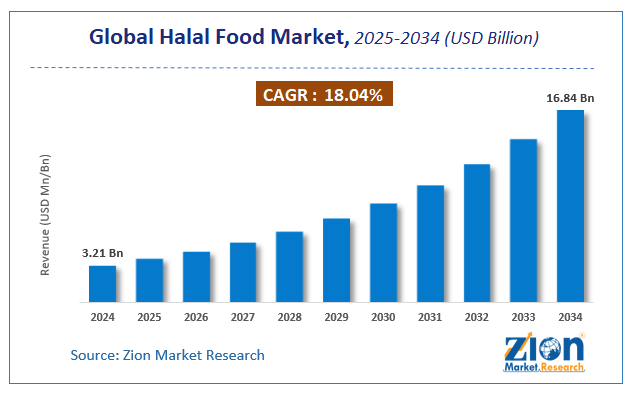
The global halal food market size was worth around USD 3.21 billion in 2024 and is predicted to grow to around USD 16.84 billion by 2034 with a compound annual growth rate (CAGR) of roughly 18.04% between 2025 and 2034. The report analyzes the global halal food market's drivers, restraints/challenges, and the effect they have on the demand during the projection period. In addition, the report explores emerging opportunities in the halal food industry.
Halal Food Market: Overview
Halal food refers to the type of edible items that are permitted and lawful as per guidelines laid down by Islamic dietary law. The word ‘halal’ is derived from Arabic literature and it means ‘allowed’ or ‘permissible’. The guidelines specify the type of food and drinks that the Muslim population can consume. For instance, there are 5 major criteria that have to be met in order for the food to be classified as halal. When consuming any item containing meat, it must be derived from an animal slaughtered according to Islamic law. This involves invoking the name of Allah and cutting the animal’s throat using a sharp knife, which indicates humane and swift death.
Key Insights
- As per the analysis shared by our research analyst, the global halal food market is estimated to grow annually at a CAGR of around 18.04% over the forecast period (2025-2034).
- Regarding revenue, the global halal food market size was valued at around USD 3.21 billion in 2024 and is projected to reach USD 16.84 billion by 2034.
- The halal food market is projected to grow at a significant rate due to the growing Muslim population, rising demand for certified food products, and increased global trade in halal goods.
- Based on Product Type, the Meat & Poultry segment is expected to lead the global market.
- On the basis of Distribution Channel, the Supermarkets/Hypermarkets segment is growing at a high rate and will continue to dominate the global market.
- Based on the End-user, the Household segment is projected to swipe the largest market share.
- Based on region, the Asia Pacific is predicted to dominate the global market during the forecast period.
Halal Food Market: Growth Drivers
Rise in Muslim population to drive market growth
The global halal food market is expected to grow owing to the increasing Muslim population globally. As per an estimate by Times Prayer, more than 2.01 billion Muslim people are living worldwide. The largest concentration of this population is currently in the Asia-Pacific and the Middle East. Although not every Islam-following person needs to follow strict dietary norms, the majority of people in the Islamic faith follow guidelines, especially in countries with a Muslim majority. The difference in certain aspects of lifestyle depends on the chosen and accepted interpretation of the Islamic Holy book, the Quran. In addition to this, there are many people born into families with different faiths who are now undertaking Islamic laws as a way of living.
Halal Food Market: Restraints
Certification challenges to restrict market expansion
One of the key challenges faced by the halal food industry players is in terms of halal certification. The process is known to be time-consuming and extremely complex. The entire procedure requires manufacturers to observe rigorous auditing & inspection and the protocol may vary between certifying bodies or nations, which further adds to the already strenuous process of certification. Small or mid-sized companies may not have the necessary resources to undertake such extensive certification programs.
Halal Food Market: Opportunities
Untapped commercialization tactics to provide growth opportunities
The global halal food market can be considered to be in an emerging state and there is a vast scope of expansion that is yet to be tapped, especially in terms of commercialized and branded halal food. There are several countries with a large Muslim population that do not have significant awareness or understanding of commercialized halal food since they currently rely only on products made at home or by local food producers. Moreover, companies may benefit by investing in product diversification and innovation.
Halal Food Market: Challenges
Lack of standardization to challenge the market expansion
The halal food industry may face challenges owing to the lack of standardization in terms of halal certification standards and rules. This affects sectoral harmonization and makes it difficult for operating businesses to operate across markets with different requirements. Furthermore, the changing consumer preference pattern is also likely to impede further expansion as consumers have varying needs, such as organic, gluten-free, or vegan halal products.
Halal Food Market: Segmentation
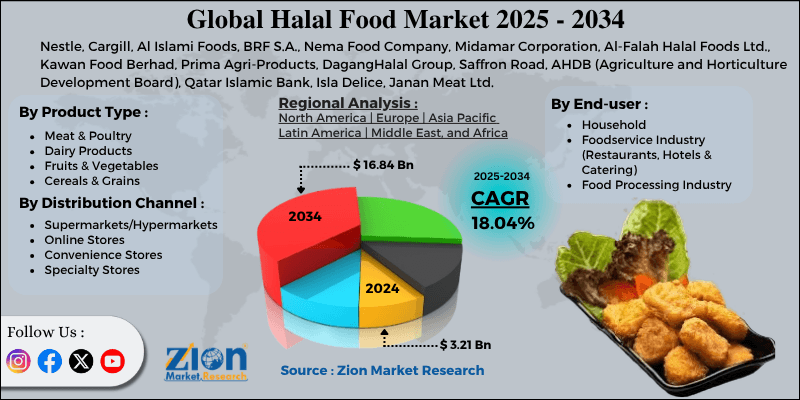
The global halal food market is segmented based on product type, distribution channel, end-user, and region.
Based on product type, the global halal food industry divisions are meat & poultry, dairy products, fruits & vegetables, cereals & grains, beverages, confectionery & bakery products, and others. The highest CAGR was witnessed in the meat & poultry products segment in 2024, since meat tends to hold a significant place in halal diets. Consumption of such products is widespread in the Muslim community. It is derived from animals that have been slaughtered under Islamic conditions and includes products such as poultry, beef, lamb, and goat. The consumption is mainly associated with religious and cultural celebrations and is considered a fundamental part of meals in many households. Halal grain products include rice, wheat, barley, oats, and bread, although they are commonly eaten in other religions as well. A research report claims that nearly 48% of the population in Africa and the Middle East follows a halal diet.
Based on distribution channel, the global industry segments are supermarkets & hypermarkets, online stores, convenience stores, specialty stores, and others. In 2024, supermarkets & hypermarkets were the leading segment and they contributed to nearly 46.12% of the market share. The increasing presence and preference of supermarkets & hypermarkets is the main driving force. As the global inflation rate is on the rise, consumers tend to prefer purchasing from supermarkets since they get access to a wider range of options along with other monetary benefits such as discounted prices, incentives, and multiple offers on newer products. Moreover, several new companies choose to first launch their products in supermarkets due to the higher footfall of consumers, which translates to better marketing or advertising cost-efficiency. However, in countries with limited supermarkets, specialty stores remain the dominant option segment.
By End-user, the global halal food market is split into household, foodservice industry (restaurants, hotels, catering), and the food processing industry. Households are the most dominant segment, followed by the Food Service Industry as the second most dominant. Households dominate as primary consumers seeking daily compliant staples for family meals, fostering steady repeat demand that stabilizes revenue streams and incentivizes product innovation tailored to home cooking, ultimately strengthening the market by embedding halal preferences into routine consumption patterns across generations.
Halal Food Market: Report Scope
| Report Attributes | Report Details |
|---|---|
| Report Name | Halal Food Market |
| Market Size in 2024 | USD 3.21 Billion |
| Market Forecast in 2034 | USD 16.84 Billion |
| Growth Rate | CAGR of 18.04% |
| Number of Pages | 220 |
| Key Companies Covered | Nestle, Cargill, Al Islami Foods, BRF S.A., Nema Food Company, Midamar Corporation, Al-Falah Halal Foods Ltd., Kawan Food Berhad, Prima Agri-Products, DagangHalal Group, Saffron Road, AHDB (Agriculture and Horticulture Development Board), Qatar Islamic Bank, Isla Delice, Janan Meat Ltd., Emirates Modern Poultry Co. (Al Rawdah), K&N's Foods, Halal Industry Development Corporation (HDC), Tayyibat Poultry, Brunei Halal, Carrefour SA, Asia Halal Meat, Euro Foods Group, Pick'n Pay Stores Ltd., and Halal Development Council Pakistan., and Others. |
| Segments Covered | By Product Type, By Distribution Channel, By End-user, and By Region |
| Regions Covered | North America, Europe, Asia Pacific (APAC), Latin America, The Middle East and Africa (MEA) |
| Base Year | 2024 |
| Historical Year | 2020 to 2023 |
| Forecast Year | 2025 - 2034 |
| Customization Scope | Avail customized purchase options to meet your exact research needs. Request For Customization |
Recent Developments
- In February 2025, Unilever opened a dedicated Halal Research Center in Indonesia aimed at becoming a global innovation hub for halal-certified foods, strengthening its position in key Muslim-majority markets through localized R&D and faster product development.
- In September 2024, Midamar Corporation secured an exclusive U.S. distribution agreement with Ziyad Brothers Importing to expand the availability of premium halal meat products across American grocery chains and online platforms.
- In April 2025, Midamar launched a new range of halal-certified sliced deli meats, including roast beef and pastrami, targeting retail and foodservice channels in the United States to meet growing demand for convenient options.
- In June 2024, Saffron Road, under American Halal Company, introduced four new gluten-free frozen meals, such as Korean Fire-Roasted Chicken and Vegetable Bibimbap, all fully halal-certified to appeal to diverse consumer preferences.
- In August 2025, Malaysia and Bangladesh signed a strategic collaboration to enhance halal product trade, production standards, and market access between the two nations.
- In May 2023, the Financial Express published an article describing ‘organic halal’ as the next business brand for countries such as Bangladesh. As per the article, organic halal can be the answer to the threat posed by the adulterated meat industry, as it deals with animals that have been raised in a clean and natural environment. They are free of unnecessary chemical injections and antibiotics
- In December 2022, The Halal Guys, one of the world’s largest halal restaurants, launched a new range of chicken shawarma. The spicy variant was made available only for a limited duration and offered two versions, namely Chicken Shawarma Platter and Chicken Shawarma Sandwich. The former was available for USD 11.29, and the latter was priced at USD 9.29
Halal Food Market: Regional Analysis
- Asia Pacific to dominate the global market
Asia Pacific leads the halal food landscape due to its unparalleled concentration of Muslim consumers who prioritize daily adherence to dietary laws, supported by proactive government policies that integrate halal standards into national economic strategies. Indonesia stands as the dominant country with the world's largest Muslim population, backed by a comprehensive national halal assurance system that mandates certification for all food products, fostering a vibrant ecosystem of local producers, exporters, and certification bodies that drive innovation in processed and ready-to-eat items. Malaysia complements this dominance through its globally recognized JAKIM certification, which serves as a benchmark for international trade and attracts foreign investment in halal hubs, while Pakistan and India contribute through massive domestic demand and growing export capabilities in the meat and dairy sectors. The region's rapid urbanization, expanding middle class, and integration of e-commerce platforms further amplify accessibility, creating a self-reinforcing cycle of production, certification, and consumption that solidifies the Asia Pacific's leadership.
North America exhibits strong growth momentum fueled by its diverse and expanding Muslim communities that seek authentic yet convenient halal options integrated into mainstream retail environments. The United States dominates as the key country, where major supermarket chains and online platforms actively stock certified products to cater to both religious and health-conscious shoppers, supported by established certification organizations that ensure compliance with rigorous standards. Canada follows closely with its multicultural policies that encourage halal offerings in public institutions and foodservice, promoting cross-cultural acceptance. The region's advanced cold-chain logistics and focus on transparency through digital labeling enhance consumer trust, while collaborations between global brands and local distributors expand the availability of premium halal items beyond traditional ethnic stores.
Halal Food Market: Competitive Analysis
The report provides a company market share analysis to give a broader overview of the key market players. In addition, the report also covers key strategic developments of the market, including acquisitions & mergers, new product launches, agreements, partnerships, collaborations & joint ventures, research & development, and regional expansion of major participants involved in the halal food market on a global and regional basis.
The global halal food market is dominated by players like:
- Nestle
- Cargill
- Al Islami Foods
- BRF S.A.
- Nema Food Company
- Midamar Corporation
- Al-Falah Halal Foods Ltd.
- Kawan Food Berhad
- Prima Agri-Products
- DagangHalal Group
- Saffron Road
- AHDB (Agriculture and Horticulture Development Board)
- Qatar Islamic Bank
- Isla Delice
- Janan Meat Ltd.
- Emirates Modern Poultry Co. (Al Rawdah)
- K&N's Foods
- Halal Industry Development Corporation (HDC)
- Tayyibat Poultry
- Brunei Halal
- Carrefour SA
- Asia Halal Meat
- Euro Foods Group
- Pick'n Pay Stores Ltd.
- and Halal Development Council Pakistan.
The global halal food market is segmented as follows;
By Product Type
- Meat & Poultry
- Dairy Products
- Fruits & Vegetables
- Cereals & Grains
- Beverages
- Confectionery & Bakery Products
- Others
By Distribution Channel
- Supermarkets/Hypermarkets
- Online Stores
- Convenience Stores
- Specialty Stores
- Others
By End-user
- Household
- Foodservice Industry (Restaurants, Hotels & Catering)
- Food Processing Industry
By Region
- North America
- The U.S.
- Canada
- Mexico
- Europe
- France
- The UK
- Spain
- Germany
- Italy
- Rest of Europe
- Asia Pacific
- China
- Japan
- India
- Australia
- South Korea
- Rest of Asia Pacific
- The Middle East & Africa
- Saudi Arabia
- UAE
- Egypt
- Kuwait
- South Africa
- Rest of the Middle East & Africa
- Latin America
- Brazil
- Argentina
- Rest of Latin America
Table Of Content
Methodology
FrequentlyAsked Questions
Halal food refers to the type of edible items that are permitted and lawful as per guidelines laid down by Islamic dietary law.
The global halal food market is expected to grow due to growing Muslim population, rising demand for certified food products, and increased global trade in halal goods.
According to a study, the global halal food market size was worth around USD 3.21 Billion in 2024 and is expected to reach USD 16.84 Billion by 2034.
The global halal food market is expected to grow at a CAGR of 18.04% during the forecast period.
The global halal food market is expected to be dominated by Asia-Pacific during the forecast period.
Leading players in the global halal food market include Nestle, Cargill, Al Islami Foods, BRF S.A., Nema Food Company, Midamar Corporation, Al-Falah Halal Foods Ltd., Kawan Food Berhad, Prima Agri-Products, DagangHalal Group, Saffron Road, AHDB (Agriculture and Horticulture Development Board), Qatar Islamic Bank, Isla Delice, Janan Meat Ltd., Emirates Modern Poultry Co. (Al Rawdah), K&N's Foods, Halal Industry Development Corporation (HDC), Tayyibat Poultry, Brunei Halal, Carrefour SA, Asia Halal Meat, Euro Foods Group, Pick n Pay Stores Ltd., and Halal Development Council Pakistan., among others.
The report explores crucial aspects of the halal food market, including a detailed discussion of existing growth factors and restraints, while also examining future growth opportunities and challenges that impact the market.

HappyClients