

Global Halal Food Market To Grow At A CAGR Of 18.04% During The Forecast Period
30-Jun-2025 | Zion Market Research
The global halal food market size was valued at around USD 3.21 billion in 2024 and is projected to reach USD 16.84 billion by the end of 2034 with a compound annual growth rate (CAGR) of approximately 18.04% from 2025 to 2034. The Halal Food Market is driven by the rising global Muslim population, increasing consumer awareness of halal certification, and growing demand for ethical, hygienic, and clean-label food products.
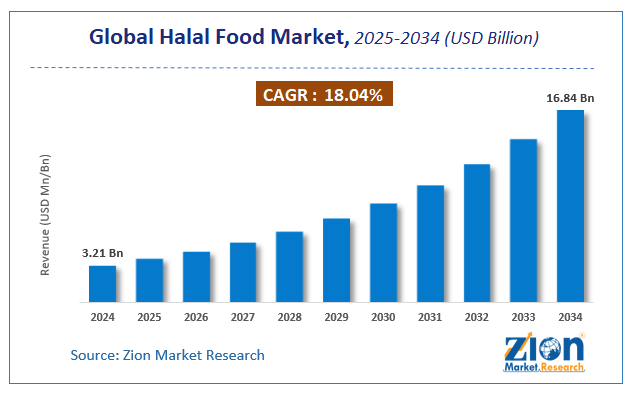
The halal food market encompasses all food and beverage products that strictly adhere to Islamic dietary laws as prescribed in the Sharia, ensuring they are permissible (halal) and free from any haram (prohibited) elements such as pork, alcohol, blood, or non-Islamically slaughtered animals. This market includes a broad spectrum of items from fresh meat and poultry processed according to specific humane slaughter methods (zabiha), to dairy, bakery items, beverages, processed foods, cereals, and even fruits and vegetables that meet certification standards for cross-contamination avoidance. Halal food appeals not only to the global Muslim community but also increasingly to non-Muslim consumers seeking high-quality, ethically sourced, transparent, and hygienic products that emphasize animal welfare, cleanliness, and the absence of harmful additives. It operates across supply chains involving rigorous certification, traceability, and compliance with international standards, serving both retail and foodservice channels while promoting cultural inclusivity and health-conscious choices in a globalized food industry.
This review is based on a report by Zion Market Research, titled "Halal Food Market By Product Type (Meat & Poultry, Dairy Products, Fruits & Vegetables, Cereals & Grains, Beverages, Confectionery & Bakery Products, and Others), By Distribution Channel (Supermarkets/Hypermarkets, Online Stores, Convenience Stores, Specialty Stores, and Others), By End-user (Household, Foodservice Industry (Restaurants, Hotels & Catering), and Food Processing Industry), and By Region: Global and Regional Industry Overview, Market Intelligence, Comprehensive Analysis, Historical Data, and Forecasts 2025 - 2034"- Report at https://www.zionmarketresearch.com/report/halal-food-market
Growth Drivers
- Rising Global Muslim Population
The expanding Muslim demographic, projected to reach over 2.2 billion by 2034, creates sustained demand for compliant food products across everyday consumption and festive occasions. This demographic shift influences manufacturers to scale up halal-certified production lines, integrating advanced traceability technologies to meet volume requirements while maintaining religious authenticity. This population growth, particularly in emerging economies with young consumers, encourages innovation in convenient halal formats such as ready-to-eat meals and snacks, further embedding halal standards into mainstream supply chains and boosting overall market penetration through cultural normalization.
- Increasing Awareness of Halal Certification and Ethical Benefits
Heightened consumer education via social media, certification bodies, and health campaigns highlights halal as synonymous with purity, animal welfare, and food safety, attracting both Muslim and non-Muslim buyers seeking clean-label options. Brands invest heavily in transparent labeling and third-party audits to build trust and differentiate in competitive retail environments. This awareness drives premiumization, where consumers willingly pay more for verified halal items perceived as superior in quality and ethics, compelling global food giants to expand certification portfolios and collaborate with local authorities for region-specific compliance.
Restraints
- High Costs and Complexity of Halal Certification
Obtaining and maintaining halal certification involves expensive audits, specialized training, segregated production facilities, and ongoing compliance monitoring, which disproportionately burdens small and medium enterprises. These costs often translate into higher retail prices, limiting accessibility in price-sensitive markets and slowing broader adoption. Additionally, varying certification standards across countries create administrative hurdles for exporters, leading to supply chain inefficiencies and potential market fragmentation that discourages new entrants from fully committing to halal production.
- Supply Chain Integrity and Traceability Challenges
Ensuring end-to-end halal compliance from farm to fork requires robust monitoring against cross-contamination risks, especially in globalized sourcing networks involving non-Muslim suppliers. Logistical complexities in transportation and storage further elevate the risk of inadvertent violations, eroding consumer confidence. These challenges are compounded by the limited availability of certified raw materials in certain regions, causing production delays and increased dependency on imports that inflate costs and expose the market to geopolitical and trade disruptions.
Opportunities
- Expansion into Non-Muslim and Health-Conscious Markets
Growing interest among non-Muslim consumers in ethical, organic-like, and allergen-free foods positions halal as a premium lifestyle choice, opening doors for crossover products in Western retail and e-commerce platforms. Strategic marketing emphasizing shared values like sustainability can capture a significant share of secular demographics. This opportunity encourages partnerships between halal producers and mainstream brands to co-develop innovative offerings, such as plant-based halal alternatives, thereby diversifying revenue streams beyond traditional religious segments.
- Digital Transformation and E-commerce Growth
The surge in online grocery platforms and halal-specific apps enables direct access to certified products for diaspora communities and remote consumers, bypassing traditional retail limitations. Blockchain-enabled traceability solutions enhance transparency, fostering loyalty and repeat purchases. Emerging markets in Africa and Southeast Asia benefit from mobile commerce integration, allowing small producers to reach global buyers efficiently while supporting local halal ecosystems through digital certification tools.
Challenges
- Lack of Unified Global Halal Standards
Divergent interpretations and certification requirements across countries complicate international trade, forcing companies to obtain multiple accreditations and increasing operational complexity. This fragmentation hinders seamless market access and raises compliance costs for multinational players. Without harmonization, disputes over authenticity can damage brand reputation, while smaller exporters face barriers in entering lucrative markets, ultimately slowing the pace of global standardization efforts.
- Intense Competition from Conventional and Alternative Food Options
Conventional foods often undercut halal products on price due to economies of scale, while the rising popularity of vegetarian, vegan, and kosher alternatives diverts health-focused consumers. Maintaining competitive pricing without compromising certification integrity remains a persistent hurdle. Rapid innovation in plant-based and lab-grown proteins further challenges traditional halal meat segments, requiring continuous R&D investment to adapt offerings and retain market relevance amid evolving dietary preferences.
The Halal Food market is segmented by product type, distribution channel, end user, and region.
Based on Product Type Segment, the Halal Food market is divided into meat & poultry, dairy products, fruits & vegetables, cereals & grains, beverages, confectionery & bakery products, and others. Meat & Poultry is the most dominant segment, followed by Dairy Products as the second most dominant. Meat & Poultry leads the market due to its foundational role in Muslim dietary practices requiring specific slaughter methods, driving consistent demand and encouraging technological advancements in processing and packaging that enhance shelf life and global distribution, thereby propelling overall industry growth through high-volume consumption and export opportunities.
Based on Distribution Channel Segment, the Halal Food market is divided into supermarkets/hypermarkets, online stores, convenience stores, specialty stores, and others. Supermarkets & Hypermarkets are the most dominant segment, followed by Online Retail as the second most dominant. Supermarkets & Hypermarkets dominate because they offer extensive product variety, competitive pricing, and physical accessibility in urban centers, enabling mass-market penetration and impulse purchases that accelerate adoption rates and support economies of scale in halal supply chains to drive broader market expansion.
Based on the end user segment, the Halal Food market is divided into household, foodservice industry (restaurants, hotels & catering), and food processing industry. Households are the most dominant segment, followed by the Food Service Industry.
The global halal food market is led by Asia-Pacific due to the presence of a large Muslim populations across Asian countries. Some of the nations consist of a Muslim-majority, while some are registering a growth rate of the Islamic population. Moreover, increasing awareness rate about religious beliefs, an increase in international trade of halal products, and a rising level of consumption have contributed to the regional CAGR. The Middle East is another significant contributor to the halal food sector due to the presence of large Islamic nations. Moreover, cuisines such as Arabic, Turkish, and Iranian, originating from these countries, have gained an international following. This could be further strengthened by rising tourism in Middle East nations. In North America, the United States, and Canada have witnessed the growth of the halal food market driven by the increasing Muslim population and the demand for halal products among diverse communities.
Recent Developments:
- In February 2025, Unilever opened a dedicated Halal Research Center in Indonesia aimed at becoming a global innovation hub for halal-certified foods, strengthening its position in key Muslim-majority markets through localized R&D and faster product development.
- In September 2024, Midamar Corporation secured an exclusive U.S. distribution agreement with Ziyad Brothers Importing to expand the availability of premium halal meat products across American grocery chains and online platforms.
Halal Food Market: Competitive Analysis
The global halal food market is led by players like:
- Nestle
- Cargill
- Al Islami Foods
- BRF S.A.
- Nema Food Company
- Midamar Corporation
- Al-Falah Halal Foods Ltd.
- Kawan Food Berhad
- Prima Agri-Products
- DagangHalal Group
- Saffron Road
- AHDB (Agriculture and Horticulture Development Board)
- Qatar Islamic Bank
- Isla Delice
- Janan Meat Ltd.
- Emirates Modern Poultry Co. (Al Rawdah)
- K&N's Foods
- Halal Industry Development Corporation (HDC)
- Tayyibat Poultry
- Brunei Halal
- Carrefour SA
- Asia Halal Meat
- Euro Foods Group
- Pick n Pay Stores Ltd.
- Halal Development Council Pakistan
The global halal food market is segmented as follows:
By Product Type
- Meat & Poultry
- Dairy Products
- Fruits & Vegetables
- Cereals & Grains
- Beverages
- Confectionery & Bakery Products
- Others
By Distribution Channel
- Supermarkets/Hypermarkets
- Online Stores
- Convenience Stores
- Specialty Stores
- Others
By End-user
- Household
- Foodservice Industry (Restaurants, Hotels & Catering)
- Food Processing Industry
By Region
- North America
- The U.S.
- Canada
- Europe
- France
- The UK
- Spain
- Germany
- Italy
- Rest of Europe
- Asia Pacific
- China
- Japan
- India
- South Korea
- Southeast Asia
- Rest of Asia Pacific
- Latin America
- Brazil
- Mexico
- Rest of Latin America
- Middle East & Africa
- GCC
- South Africa
- Rest of Middle East & Africa
About Us:
Zion Market Research is an obligated company. We create futuristic, cutting-edge, informative reports ranging from industry reports, the company reports to country reports. We provide our clients not only with market statistics unveiled by avowed private publishers and public organizations but also with vogue and newest industry reports along with pre-eminent and niche company profiles. Our database of market research reports comprises a wide variety of reports from cardinal industries. Our database is been updated constantly in order to fulfill our clients with prompt and direct online access to our database. Keeping in mind the client’s needs, we have included expert insights on global industries, products, and market trends in this database. Last but not the least, we make it our duty to ensure the success of clients connected to us—after all—if you do well, a little of the light shines on us.
Contact Us:
Zion Market Research
244 Fifth Avenue, Suite N202
New York, 10001, United States
Tel: +49-322 210 92714
USA/Canada Toll-Free No.1-855-465-4651
Email: sales@zionmarketresearch.com
Website: https://www.zionmarketresearch.com