
Firefighting Foam Market Market Size, Share, Value and Forecast 2034

Firefighting Foam Market By Foam Type (Aqueous Film-Forming Foam (AFFF), Alcohol-Resistant Aqueous Film-Forming Foam (AR-AFFF), Protein Foam, Synthetic Foam, and Fluorine-free Foam (F3)), By Application (Municipal, Industrial, and Aviation), By End-Use (Industrial Facilities, Oil & Gas Refineries, Fire Departments, and Chemical Plants), and By Region - Global and Regional Industry Overview, Market Intelligence, Comprehensive Analysis, Historical Data, and Forecasts 2026 - 2034
| Market Size in 2025 | Market Forecast in 2034 | CAGR (in %) | Base Year |
|---|---|---|---|
| USD 1,011.91 Million | USD 1,362.07 Million | 3.35% | 2025 |
Firefighting Foam Industry Perspective:
What is the anticipated size of the firefighting foam market during the projection period?
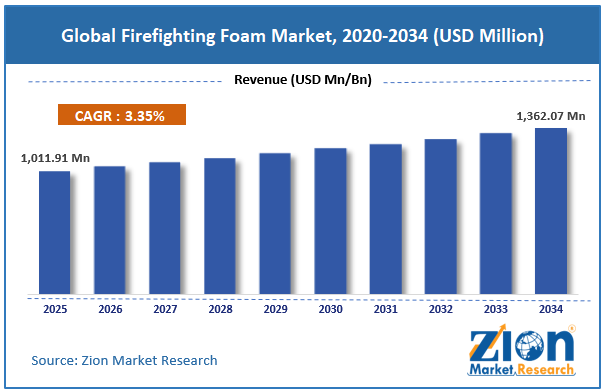
The global firefighting foam market size was worth around USD 1,011.91 million in 2025 and is predicted to grow to around USD 1,362.07 million by 2034 with a compound annual growth rate (CAGR) of roughly 3.35% between 2026 and 2034.
Key Insights:
- As per the analysis shared by our research analyst, the global firefighting foam market is estimated to grow annually at a CAGR of around 3.35% over the forecast period (2026-2034)
- In terms of revenue, the global firefighting foam market size was valued at around USD 1,011.91 million in 2025 and is projected to reach USD 1,362.07 million, by 2034.
- The firefighting foam market is projected to grow at a significant rate due to the increasing rate of natural disasters such as forest fires, higher focus on occupation safety, and the introduction of sustainable variants.
- Based on the foam type, the fluorine-free foam (F3) segment is anticipated to generate the highest CAGR of 6.67% due to the growing shift toward eco-friendly alternatives
- Based on the application, the industrial segment is anticipated to command the largest market share.
- Based on the end-use, the oil & gas refineries segment is expected to lead the market growth trends.
- Based on region, Asia-Pacific is projected to dominate the global market during the forecast period.
Firefighting Foam Market: Overview
Firefighting foam is an extinguishing agent. It extinguishes and controls Class B fires caused by combustible and flammable liquids. Fighting foam is produced by mixing water and foam concentrate in an appropriate ratio. Specialized discharge equipment then introduces air into the mixture. When applied correctly, it forms a stable blanket of foam across the burning surface. The foam suppresses flammable vapor release, thus separating fuel and oxygen and providing a cooling effect. Firefighting foams have extensive applications across high-risk industries such as oil & gas and chemical manufacturing facilities. During the forecast period, demand for firefighting foam is expected to be driven by an increasing rate of natural disasters such as forest fires, a greater focus on occupational safety, and the introduction of sustainable variants. However, environmental concerns associated with traditionally used firefighting foam, competition from alternative solutions, and supply chain disruptions may limit market growth in the coming years.
Impact of the USA-Israel and Iran war on the Firefighting Foam Market:
The USA-Israel and Iran war is expected to increase demand for firefighting foam due to the growing risk of explosions, especially around critical infrastructure and oil refineries in the Middle East. Countries are expected to invest in upgrading national security and safety solutions such as fire-management tools. However, the war has also increased firefighting foam production costs and disrupted the raw material supply chain. During the forecast period, this conflict may encourage domestic production, development of new supply chain networks, and global partnerships.
Firefighting Foam Market: Dynamics
Growth Drivers
How will growing incidences of natural calamities influence demand for the firefighting foam market?
The global firefighting foam market is expected to be driven by the rising frequency and intensity of natural calamities. In recent years, major economies have reported more severe wildfires, explosions, hurricanes, and other large-scale incidents. Firefighting systems are an integral component of national fire protection infrastructure. Additionally, the surge in these incidents has increased demand for emergency preparedness. In September 2026, the US Geological Survey awarded USD 1 million in federal grants to 16 tribal, local, and state governments to improve public safety across the country. In August 2026, China’s Ministry of Finance and Ministry of Emergency Management granted USD 26.52 million to disaster-hit areas in the region.
Expansion of high-hazard industries to promote market revenue in the long run
Fire-prone industries such as oil & gas and chemical manufacturing are rapidly expanding worldwide. According to the US Energy Information Administration (EIA), the country’s crude oil production reached a record average of 13.8 million barrels per day in 2026. It is expected to reach new heights in 2027. Similar reports are emerging from other parts of the world as countries seek ways to secure energy. Additionally, growing end applications have further intensified investments in high-hazard sectors, fueling demand in the global firefighting foam market. Oil & gas and chemical manufacturing facilities must be equipped with high-performance firefighting solutions at all times. As these sectors expand, market players can expect more demand.
Restraints
Which environmental concerns will limit expansion of the firefighting foam industry?
The global firefighting foam industry is projected to be restricted due to growing environmental concerns associated with foam discharge. When applied, firefighting foam can enter surrounding water and soil, causing contamination. Conventionally used foams, such as per- and polyfluoroalkyl substances (PFAS)-containing aqueous film-forming foams (AFFF), contain high-risk, toxic substances. These elements can enter groundwater and soil, putting the lives of animals and humans at risk.
Opportunities
How will eco-friendly solutions shape the firefighting foam market during the forecast period?
The global firefighting foam market is projected to grow as companies invest in environmentally friendly, sustainable solutions. These products will help companies comply with evolving government regulations worldwide. In August 2025, the United Nations Environment Program (UNEP) and the International Civil Aviation Organization (ICAO) announced the launch of the Fortifying Infrastructure for Responsible Extinguishment (FIRE) project. This joint venture aims to replace toxic fluorinated firefighting foams with safer alternatives across major airports in South Africa, Nigeria, Egypt, Ethiopia, and Kenya. In April 2026, Jactone Products Ltd, a UK-based fire safety equipment, fire protection products, and safety signage provider, launched a new eco-plus fluorine-free extinguisher to control class A and class B fires.
Replacement of aging infrastructure to revamp market growth trends in the future
Countries worldwide are upgrading fire safety infrastructure to replace aging systems with more efficient, effective alternatives. Advanced firefighting foam solutions are expected to replace legacy systems, opening new growth doors for the leading players. During the forecast period, eco-friendly and fluorine-free foams are expected to register higher demand.
Challenges
Regulatory hurdles and alternative safety technologies to challenge the firefighting foam industry
The global firefighting foam industry will be challenged by strict regulatory hurdles concerning foam formulations and their application. Additionally, competition from more efficient and cost-effective alternative safety technologies, high initial investment costs, and volatile raw material prices may create additional barriers to industry growth.
Firefighting Foam Market: Report Scope
| Report Attributes | Report Details |
|---|---|
| Report Name | Firefighting Foam Market |
| Market Size in 2025 | USD 1,011.91 Million |
| Market Forecast in 2034 | USD 1,362.07 Million |
| Growth Rate | CAGR of 3.35% |
| Number of Pages | 228 |
| Key Companies Covered | Angus Fire, Johnson Controls, ICL Group, Perimeter Solutions, DIC Corporation, Viking Group, Dafo Fomtec AB, Buckeye Fire Equipment, Kidde-Fenwal, Dr. Sthamer, SFFECO Global, National Foam, BIOEX, and others. |
| Segments Covered | By Foam Type, By Application, By End-Use, and By Region |
| Regions Covered | North America, Europe, Asia Pacific (APAC), Latin America, Middle East, and Africa (MEA) |
| Base Year | 2025 |
| Historical Year | 2020 - 2024 |
| Forecast Year | 2026 - 2034 |
| Customization Scope | Avail customized purchase options to meet your exact research needs. Request For Customization |
Firefighting Foam Market: Segmentation
The global firefighting foam market is segmented based on foam type, application, end-use, and region.
Why will the foam type segment lead the firefighting foam industry revenue during the forecast period?
By foam type, the global market segments are aqueous film-forming foam (AFFF), alcohol-resistant aqueous film-forming foam (AR-AFFF), protein foam, synthetic foam, and fluorine-free foam (F3). In 2025, the highest growth was listed in the aqueous film-forming foam (AFFF) segment. It accounted for 42% of the total market share. During the forecast period, the fluorine-free foam (F3) segment is anticipated to generate the highest CAGR of 6.67% due to the growing shift toward eco-friendly alternatives.
Which will be the fastest-growing application during the forecast period in the firefighting foam market?
Based on application, the global firefighting foam industry is fragmented into municipal, industrial, and aviation. In 2025, industrial applications were the leading revenue generator. It contributed 45.01% of the total revenue and will continue growing at a CAGR of 6.12% during the forecast period. Rapid expansion of industrial facilities and stricter occupational safety laws will encourage segmental demand.
Which factors drive demand in the oil & gas refineries segment in the firefighting foam industry?
Based on end-use, the global market segments are industrial facilities, oil & gas refineries, fire departments, and chemical plants. Oil & gas refineries held the largest market share in 2025. They accounted for 49.2% of the final revenue and will grow at a CAGR of 5.15% during the forecast period. Growing investments in the oil industry, rising geopolitical concerns, and attacks on critical oil infrastructure will promote segmental dominance.
Firefighting Foam Market: Regional Analysis
Why will Asia-Pacific lead the firefighting foam market in the coming years?
The global firefighting foam market is currently led by Asia-Pacific. In 2025, it accounted for 33% of the global revenue and will grow at a strong CAGR of 6.17% during the forecast period. Rapid industrialization, increasing investments in oil refineries, and expansion of chemical manufacturing facilities will drive regional demand for firefighting foam. Moreover, infrastructure development projects and stricter safety laws will fuel growth across Asia-Pacific.
How is North America expected to perform in the firefighting foam market during the forecast period?
North America is expected to emerge as a strong player in the firefighting foam market with a CAGR of 24% during the forecast period. In 2025, it accounted for 5.07% of the global revenue. Replacement of existing fire safety infrastructure, rising investments in next-generation foam materials, and the presence of large oil & gas refineries will promote regional growth trends. Additionally, North America has a robust existing base for firefighting systems, which will enable easier deployment of new solutions.
Firefighting Foam Market: Competitive Analysis
The global firefighting foam market is led by players like:
- Angus Fire
- Johnson Controls
- ICL Group
- Perimeter Solutions
- DIC Corporation
- Viking Group
- Dafo Fomtec AB
- Buckeye Fire Equipment
- Kidde-Fenwal
- Dr. Sthamer
- SFFECO Global
- National Foam
- BIOEX
What are the latest key trends in the firefighting foam market?
High-performance F3 formulations
Market players are developing high-performance F3 formulations that deliver strong results. This includes a focus on burnback resistance, improved fire knockdown, and cold-weather performance to meet evolving end requirements.
Integration with automated systems
Firefighting foam systems can integrate with automation technologies for better, more timely results. Automatic fire detection tools, remote operation, and automated foam proportioning can open new growth avenues for market leaders.
The global firefighting foam market is segmented as follows:
By Foam Type
- Aqueous Film-Forming Foam (AFFF)
- Alcohol-Resistant Aqueous Film-Forming Foam (AR-AFFF)
- Protein Foam
- Synthetic Foam
- Fluorine-free Foam (F3)
By Application
- Municipal
- Industrial
- Aviation
By End-Use
- Industrial Facilities
- Oil & Gas Refineries
- Fire Departments
- Chemical Plants
By Region
- North America
- The U.S.
- Canada
- Mexico
- Europe
- France
- The UK
- Spain
- Germany
- Italy
- Rest of Europe
- Asia Pacific
- China
- Japan
- India
- Australia
- South Korea
- Rest of Asia Pacific
- The Middle East & Africa
- Saudi Arabia
- UAE
- Egypt
- Kuwait
- South Africa
- Rest of the Middle East & Africa
- Latin America
- Brazil
- Argentina
- Rest of Latin America
Table Of Content
Methodology
FrequentlyAsked Questions
Firefighting foam is an extinguishing agent. It is used to extinguish and control Class B fires caused by combustible and flammable liquids.
The global firefighting foam market is expected to be driven by the rising frequency and intensity of natural calamities.
According to study, the global firefighting foam market size was worth around USD 1,011.91 million in 2025 and is predicted to grow to around USD 1,362.07 million by 2034.
The CAGR value of the firefighting foam market is expected to be around 3.35% during 2026-2034.
The global firefighting foam industry will be challenged by strict regulatory hurdles concerning foam formulations and their application.
High-performance F3 formulations and integration with automated systems are the emerging trends and innovations impacting the firefighting foam market.
The global firefighting foam market has performed well so far and will offer similar trends in the coming years.
Asia-Pacific will contribute notably towards the firefighting foam market value.
The global firefighting foam market is led by players like Angus Fire, Johnson Controls, ICL Group, Perimeter Solutions, DIC Corporation, Viking Group, Dafo Fomtec AB, Buckeye Fire Equipment, Kidde-Fenwal, Dr. Sthamer, SFFECO Global, National Foam, BIOEX, Chemguard, and Kerr Fire.
The report explores crucial aspects of the firefighting foam market, including a detailed discussion of existing growth factors and restraints, while also browsing future growth opportunities and challenges that impact the market.

HappyClients

