
Exterior Architectural Coatings Market Size, Share, Trends, Growth and Forecast 2034

Exterior Architectural Coatings Market By Product Type (Paints, Primers, Stains and Varnishes, Specialty Coatings), By Resin Type (Acrylic, Alkyd, Epoxy, Polyurethane, Others), By Application Surface (Walls and Facades, Wood Surfaces, Metal Surfaces, Concrete and Masonry), By End-User (Residential, Commercial, Industrial, Institutional), By Distribution Channel (Specialty Stores, Home Improvement Retailers, Online Retail, Direct Sales), and By Region - Global and Regional Industry Overview, Market Intelligence, Comprehensive Analysis, Historical Data, and Forecasts 2025 - 2034
| Market Size in 2024 | Market Forecast in 2034 | CAGR (in %) | Base Year |
|---|---|---|---|
| USD 81.74 Billion | USD 129.84 Billion | 5.28% | 2024 |
Exterior Architectural Coatings Industry Perspective:
What will be the size of the exterior architectural coatings market during the forecast period?
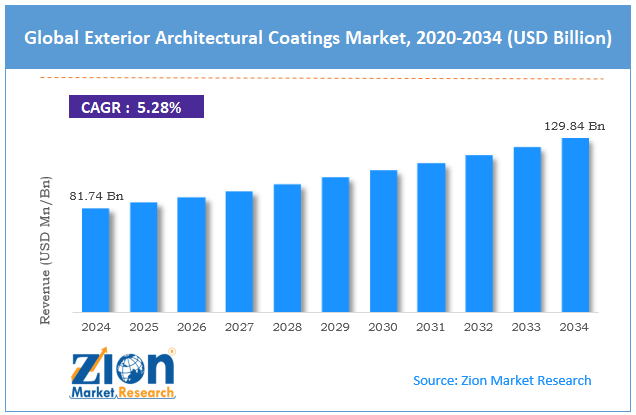
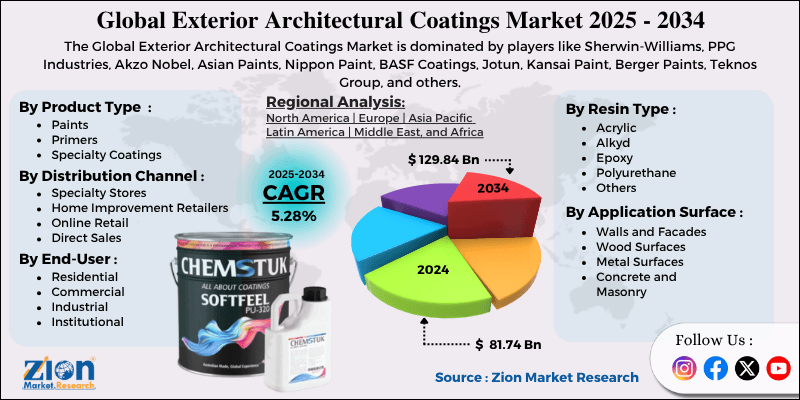
The global exterior architectural coatings market size was worth approximately USD 81.74 billion in 2024 and is projected to grow to around USD 129.84 billion by 2034, with a compound annual growth rate (CAGR) of roughly 5.28% between 2025 and 2034.
Key Insights
- As per the analysis shared by our research analyst, the global exterior architectural coatings market is estimated to grow annually at a CAGR of around 5.28% over the forecast period (2025–2034).
- In terms of revenue, the global exterior architectural coatings market size was valued at approximately USD 81.74 billion in 2024 and is projected to reach USD 129.84 billion by 2034.
- The exterior architectural coatings market is projected to grow significantly due to rising global construction and renovation activity, increasing demand for high-performance, weather-resistant coating formulations, growing regulatory pressure to reduce volatile organic compound emissions from paint products, and rising consumer and contractor preference for low-maintenance, long-lasting exterior coatings.
- Based on product type, the paints segment is expected to lead the exterior architectural coatings market, while the specialty coatings segment is anticipated to grow significantly.
- Based on resin type, the acrylic segment is expected to lead the exterior architectural coatings market, while the polyurethane segment is anticipated to grow rapidly.
- Based on end-user, the residential segment is expected to lead the exterior architectural coatings market, while the commercial segment is anticipated to grow rapidly.
- Based on the application surface, the walls and facades segment is the dominant category, while the wood surfaces segment maintains a stable, consistent market share.
- Based on distribution channel, the offline segment is expected to lead the exterior architectural coatings market, while the online segment is anticipated to grow steadily.
- Based on region, the Asia Pacific is projected to dominate the global exterior architectural coatings market during the estimated period, followed by North America.
Exterior Architectural Coatings Market: Overview
Exterior architectural coatings are paints and protective layers applied to the outer surfaces of buildings to enhance protection and appearance. These coatings have two main roles. First, they protect surfaces from weather conditions such as rain, sunlight, wind, humidity, and extreme temperatures, as well as from mold and mildew. Second, they give buildings color, finish, and an attractive look. Without these coatings, materials such as wood, concrete, brick, and metal can quickly deteriorate when exposed to outdoor conditions. Regular painting is not just for beautification; it is also an important part of building maintenance that helps extend the life of homes, offices, factories, and public buildings. The exterior architectural coatings market includes various product types. Standard exterior paints are the most common and include water-based and oil-based paints. The market also includes primers that prepare surfaces, wood stains and varnishes, elastomeric coatings that seal small cracks, and special coatings that offer features such as heat resistance and weather protection. The demand for these coatings is growing due to rising construction activity, urban development, and the need to maintain and repaint existing buildings regularly.
The rising demand for longer-lasting, weather-resistant, and environmentally friendly exterior coating formulations, combined with sustained global construction activity and growing urbanization in developing regions, is expected to drive steady growth in the exterior architectural coatings market throughout the forecast period.
Exterior Architectural Coatings Market: Technology Roadmap 2025–2034
What is the projected development roadmap of the exterior architectural coatings market over the forecast period?
Advances in polymer chemistry are transforming the exterior architectural coatings market through the development of low- and zero-volatile organic compound formulations, smart and functional coating technologies, sustainable raw material sourcing, and digital color-matching tools. The market is expected to grow at a CAGR of around 5.28% over the forecast period, driven by growing demand across the residential, commercial, and infrastructure segments globally.
The following roadmap outlines key development phases expected through 2034.
2025–2027: Low Emission and High Durability Formulation Phase
- Digital tinting systems will expand across retail networks to improve color accuracy and reduce paint waste at scale.
- Paint manufacturers will increasingly reduce VOC content to meet stricter environmental regulations.
- Self-cleaning coatings will see wider adoption over time, reducing maintenance needs.
2028–2031: Smart Functional Coatings Phase
- Digital tools will be integrated to help architects select and track coating performance more efficiently.
- Cool roof and wall coatings will gain strong adoption as they reduce energy use in buildings across hot regions.
- Anti-microbial coatings will become standard in humid environments to prevent surface damage.
2032–2034: Sustainable and Circular Coatings Phase
- Paint recycling programs will expand significantly to support circular economy goals.
- Bio-based coatings will become commercially viable and widely adopted as sustainable alternatives to traditional products.
- Nano-based coatings will be increasingly developed to deliver higher durability with lower material usage.
Exterior Architectural Coatings Market: Dynamics
Growth Drivers
How is rapid global urbanization and construction activity driving growth in the exterior architectural coatings market?
The exterior architectural coatings industry is experiencing strong growth driven by rapid urbanization and expanding construction activity worldwide. As more people move from rural areas to cities, especially in Asia, Africa, Latin America, and the Middle East, there is a growing need for new housing, commercial buildings, schools, hospitals, and transport infrastructure. Every new structure requires exterior coatings for protection and finishing, which is steadily increasing market demand. Countries such as China, India, Indonesia, Vietnam, and Nigeria are seeing fast-paced construction, with new urban areas developing quickly.
In addition to new buildings, existing structures also need repainting every few years to maintain durability and appearance. This creates stable, recurring demand for coating products. Government infrastructure projects such as bridges, public housing, and institutions further support market expansion. Overall, continuous urban growth and regular maintenance needs are creating long-term opportunities for the exterior architectural coatings market.
The rising demand for durable, premium, and weather-resistant coatings is driving the market.
The exterior architectural coatings market is benefiting from growing awareness about the long-term value of high-quality exterior paints. Homeowners and building managers are increasingly choosing better-quality coatings because they last longer, resist fading, and provide stronger protection against moisture and weather damage. This helps reduce the need for frequent repainting, saving both time and money over the years. Professional contractors also prefer premium products as they deliver smoother finishes, require fewer repairs, and improve customer satisfaction. In response, paint manufacturers are developing advanced coatings with better durability, improved color retention, stronger weather resistance, and easier application. These premium, professional-grade products are becoming increasingly popular, especially in developed markets.
As more consumers shift from basic paints to high-performance solutions, the overall market value is increasing. This positive trend is supporting steady growth in the exterior architectural coatings market, even as unit sales grow at a moderate pace.
Restraints
How do volatile raw material prices and environmental regulations on solvents create challenges for the exterior architectural coatings market?
The exterior architectural coatings market relies on key raw materials such as titanium dioxide, acrylic resins, and additives, which are often subject to price changes driven by supply conditions, energy costs, and global logistics. These fluctuations can make it challenging for manufacturers to maintain stable pricing and plan production efficiently. Titanium dioxide, a key ingredient in most exterior paints, is especially known for its price volatility, which directly impacts overall product costs.
At the same time, strict environmental regulations are encouraging companies to reduce harmful emissions by developing low-VOC coatings. While this requires additional research and investment, it is also driving innovation in the industry. Manufacturers are continuously improving formulations to maintain performance while meeting environmental standards. These developments are helping the market move toward safer, more sustainable, and high-quality coating solutions, creating long-term growth opportunities despite short-term cost challenges.
Opportunities
Growing demand for energy-efficient cool coatings and thermally reflective exterior finishes is creating significant new opportunities in the exterior architectural coatings market.
The exterior architectural coatings industry is growing as building owners seek ways to reduce heating and energy costs. With rising global temperatures, especially in warm and hot regions, demand for coatings that help keep buildings cooler is increasing. Cool exterior wall and roof coatings are formulated with special materials that reflect more sunlight than regular paints. This reduces the amount of heat absorbed by building surfaces, helping maintain lower indoor temperatures.
As a result, buildings require less air conditioning, leading to lower electricity bills and improved energy efficiency. These coatings are becoming more popular in both residential and commercial buildings. Many governments and cities are also supporting this trend by introducing building codes and incentive programs that promote the use of heat-reflective coatings. This encourages wider adoption across different regions. Increasing awareness about energy savings and sustainable construction is further driving demand. Overall, the market is well-positioned to benefit from this shift toward energy-efficient, climate-friendly building solutions.
Challenges
How do application quality challenges and a shortage of skilled painters create operational difficulties in the exterior architectural coatings market?
The exterior architectural coatings market depends not only on product quality but also on proper application for long-lasting performance. Even the best exterior coatings can fail if surfaces are not properly prepared or the wrong application methods are used. Factors such as surface cleaning, correct product selection, and suitable weather conditions during painting play a key role in achieving good results. In many regions, a shortage of skilled, trained painting professionals creates challenges for the market. Poor application can lead to issues such as peeling, cracking, fading, and premature damage, affecting both customer satisfaction and brand reputation.
As coating systems become more advanced, they often require multiple layers and proper timing during application, making the process more complex. This increases the need for trained applicators. Paint companies and industry groups are working to improve skills through training programs, but the gap still exists. Addressing this challenge is important to ensure better performance and long-term growth in the exterior architectural coatings market.
Exterior Architectural Coatings Market: Report Scope
| Report Attributes | Report Details |
|---|---|
| Report Name | Exterior Architectural Coatings Market |
| Market Size in 2024 | USD 81.74 Billion |
| Market Forecast in 2034 | USD 129.84 Billion |
| Growth Rate | CAGR of 5.28% |
| Number of Pages | 227 |
| Key Companies Covered | Sherwin-Williams, PPG Industries, Akzo Nobel, Asian Paints, Nippon Paint, BASF Coatings, Jotun, Kansai Paint, Berger Paints, Teknos Group, and others. |
| Segments Covered | By Product Type, By Resin Type, By Application Surface, By End-User, By Distribution Channel, and By Region |
| Regions Covered | North America, Europe, Asia Pacific (APAC), Latin America, Middle East, and Africa (MEA) |
| Base Year | 2024 |
| Historical Year | 2019 to 2023 |
| Forecast Year | 2025 - 2034 |
| Customization Scope | Avail customized purchase options to meet your exact research needs. Request For Customization |
Exterior Architectural Coatings Market: Segmentation
The global exterior architectural coatings market is segmented based on product type, resin type, application surface, end-user, distribution channel, and region.
What drives the strong demand for paints in the exterior architectural coatings market?
Based on product type, the global exterior architectural coatings market is segmented into paints, primers, stains and varnishes, and specialty coatings. The paints segment accounted for approximately 55% of the global market share and is expected to lead the market during the forecast period. This is because paints are used on almost all buildings for protection and appearance. The primers segment is the second-largest category with around 20% market share, as it is essential for surface preparation and better paint performance.
Why is acrylic the most widely used resin in the exterior architectural coatings market?
Based on resin type, the exterior architectural coatings market is classified into acrylic, alkyd, epoxy, polyurethane, and other resin types. The acrylic segment accounts for nearly 48% of the market. It leads due to its strong balance of durability, weather resistance, fast drying time, and lower environmental impact compared to many alternatives. Acrylic coatings are also compatible with water-based formulations, making them widely accepted across global markets. The alkyd segment holds around 18% share, supported by its good adhesion and traditional use in solvent-based coatings, especially in applications requiring a strong finish and surface bonding.
What makes walls and facades the largest application area in the exterior architectural coatings market?
Based on application surface, the exterior architectural coatings market is divided into walls and facades, wood surfaces, metal surfaces, and others. The walls and facades segment accounts for approximately 52% of the global market share. It dominates because it covers the largest visible and exposed area of any building, requiring regular coating for both protection and appearance. Wood surfaces account for around 23% of the market share, primarily used in residential buildings, decorative structures, and outdoor elements that require consistent protection and maintenance.
Why does the residential segment generate the highest demand in the exterior architectural coatings market?
Based on end-user, the market is segmented into residential, commercial, industrial, and institutional. The residential segment accounts for around 46% of the total market share. It is driven by the large number of houses worldwide and the regular need to repaint to maintain appearance and structural integrity. The commercial segment holds around 28% share, driven by demand from offices, shopping centers, hotels, and other commercial buildings that require periodic maintenance and aesthetic improvements to attract customers and maintain property value.
What makes offline channels the primary sales route in the exterior architectural coatings market?
Based on distribution channel, the exterior architectural coatings industry is classified into offline and online channels. The offline segment accounts for nearly 78% of the global market share. It leads because most customers prefer to visit physical stores such as paint shops, hardware stores, and dealer outlets where they can see product options, compare finishes, and get expert advice before purchasing. Professional contractors also rely heavily on these stores for bulk buying and technical support. The online segment holds around 22% share and is growing steadily due to rising digital adoption, convenience, broader product availability, and the ease of comparing prices and features.
Exterior Architectural Coatings Market: Regional Analysis
What factors enable the Asia Pacific to dominate the global exterior architectural coatings market during the forecast period?
Asia Pacific is expected to account for about 44.5% of global demand and remain the leading region in the exterior architectural coatings market. The region's dominance is driven by some of the world's fastest rates of urbanization and construction activity. China alone accounts for a very large share of global paint and coatings consumption, with millions of new residential and commercial buildings being constructed and painted every year. India is the second-largest and one of the fastest-growing markets in the region, supported by government housing programs, rapid urban expansion, and a growing middle-class population investing in home improvement and maintenance. Southeast Asia, including Vietnam, Indonesia, Thailand, and the Philippines, is also seeing strong construction growth, boosting demand for exterior coatings. In addition, many older buildings across the region require regular repainting, creating a steady and recurring demand.
The hot, humid climate in many Asia-Pacific countries also increases the need for high-quality coatings that resist moisture, prevent mold growth, and protect surfaces from strong sunlight. Government infrastructure projects such as roads, bridges, and public buildings further support market growth. Overall, continuous development, climate conditions, and rising living standards are helping the Asia Pacific maintain its leading position in the exterior architectural coatings market.
Why is North America expected to be the second leading region in the global exterior architectural coatings market?
North America is expected to account for about 22.8% of the global exterior architectural coatings market. North America remains a key region due to strong renovation activity, high consumer spending on home improvement, and a well-established construction industry. The United States is the largest individual market in the region, supported by a mature and active residential remodeling and repainting market, strong commercial construction activity, and high consumer spending on home improvement.
Many homeowners regularly invest in repainting to maintain the appearance and durability of their properties. Professional painting contractors in the United States also purchase large volumes of premium exterior coatings to deliver long-lasting, high-quality results. The renovation and maintenance segment plays a major role in driving demand, as many homes and buildings in the region are older and require periodic repainting. This creates a stable and recurring market for coating products. Canada also contributes significantly through steady residential construction in cities like Toronto and Vancouver, as well as the regular maintenance of existing buildings.
In addition, extreme weather conditions, such as cold winters and strong sunlight, increase the need for durable, weather-resistant coatings. Overall, strong housing demand, regular maintenance needs, and high product quality standards support steady growth in the North America exterior architectural coatings market.
Recent Market Developments
- In November 2025, AkzoNobel announced a strategic merger with Axalta Coating Systems to create a global coatings leader, strengthening innovation and scale in architectural and exterior coatings solutions.
Exterior Architectural Coatings Market: Competitive Analysis
The leading players in the global exterior architectural coatings market are:
- Sherwin-Williams
- PPG Industries
- Akzo Nobel
- Asian Paints
- Nippon Paint
- BASF Coatings
- Jotun
- Kansai Paint
- Berger Paints
- Teknos Group
The global exterior architectural coatings market is segmented as follows:
By Product Type
- Paints
- Primers
- Stains and Varnishes
- Specialty Coatings
By Resin Type
- Acrylic
- Alkyd
- Epoxy
- Polyurethane
- Others
By Application Surface
- Walls and Facades
- Wood Surfaces
- Metal Surfaces
- Concrete and Masonry
By End-User
- Residential
- Commercial
- Industrial
- Institutional
By Distribution Channel
- Specialty Stores
- Home Improvement Retailers
- Online Retail
- Direct Sales
By Region
- North America
- The U.S.
- Canada
- Mexico
- Europe
- France
- The UK
- Spain
- Germany
- Italy
- Rest of Europe
- Asia Pacific
- China
- Japan
- India
- Australia
- South Korea
- Rest of Asia Pacific
- The Middle East & Africa
- Saudi Arabia
- UAE
- Egypt
- Kuwait
- South Africa
- Rest of the Middle East & Africa
- Latin America
- Brazil
- Argentina
- Rest of Latin America
Table Of Content
Methodology
FrequentlyAsked Questions
The exterior architectural coatings include all paint products, primers, stains, varnishes, and specialty coating systems applied to the exterior surfaces of residential, commercial, industrial, and institutional buildings for weather protection, surface preservation, and aesthetic enhancement.
What key factors will influence the exterior architectural coatings market growth from 2025 to 2034?
The global exterior architectural coatings market is projected to grow due to rapid urbanization and new construction activity in developing regions, rising demand for premium long-lasting coating formulations, growing regulatory requirements for low-volatile organic compound products, and increasing consumer interest in energy-efficient cool wall and roof coatings.
According to a study, the global exterior architectural coatings market size was worth around USD 81.74 billion in 2024 and is predicted to grow to around USD 129.84 billion by 2034.
The CAGR value of the exterior architectural coatings market is expected to be around 5.28% during 2025–2034.
Asia Pacific is expected to lead the global exterior architectural coatings market during the forecast period.
The major players profiled in the global exterior architectural coatings market include Sherwin-Williams, PPG Industries, Akzo Nobel, Asian Paints, Nippon Paint, BASF Coatings, Jotun, Kansai Paint, Berger Paints, and Teknos Group.
The report examines key aspects of the exterior architectural coatings market, including a detailed analysis of current growth drivers and constraints, as well as future growth opportunities and challenges.
Leading players are focusing on product innovation, sustainable coating development, strategic partnerships, expansion of manufacturing capacity, and digital tools for color matching and sales, along with strengthening distribution networks and investing in emerging markets to increase their global presence.
The offline distribution channel holds the largest market share in the exterior architectural coatings market, driven by strong dealer networks, hardware stores, and contractor purchases, where customers prefer in-person guidance, product inspection, and the convenience of bulk buying.
Strict environmental regulations on VOC emissions, growing demand for eco-friendly coatings, and government policies promoting sustainable construction are key factors, pushing manufacturers to develop low-emission, water-based, and bio-based coating solutions while increasing compliance costs and innovation efforts.

HappyClients

