
Epoxidized Soybean Oil Market Size, Share, Trends, Growth and Forecast 2032

Epoxidized Soybean Oil Market By Raw Material (Hydrogen Peroxide, Formic Acid, Soybean Oil, And Acetic Acid), By Application (Surfactants, UV Cure, Pigment Dispersion Agent, Lubricants, Plasticizers, Agricultural Chemicals, Cutting Oils, Coatings, Flavor & Fragrances, Fuel Additive, And Functional Fluids), and By End-User (Food & Beverage, Pharmaceutical & Healthcare, Adhesives & Sealants, And Pharmaceutical & Healthcare): Global Industry Perspective, Comprehensive Analysis And Forecast, 2024 - 2032
| Market Size in 2023 | Market Forecast in 2032 | CAGR (in %) | Base Year |
|---|---|---|---|
| USD 452.99 Million | USD 1050.78 Million | 9.8% | 2023 |
Epoxidized Soybean Oil Market Insights
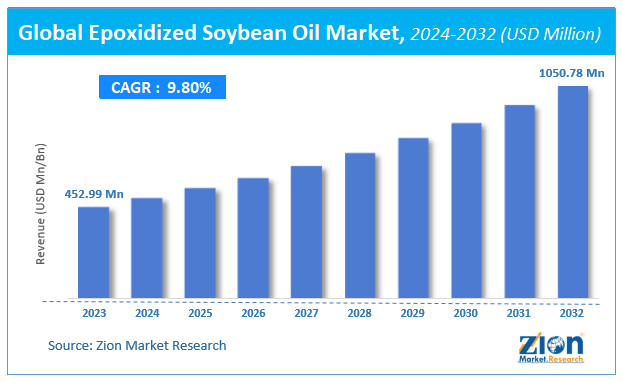
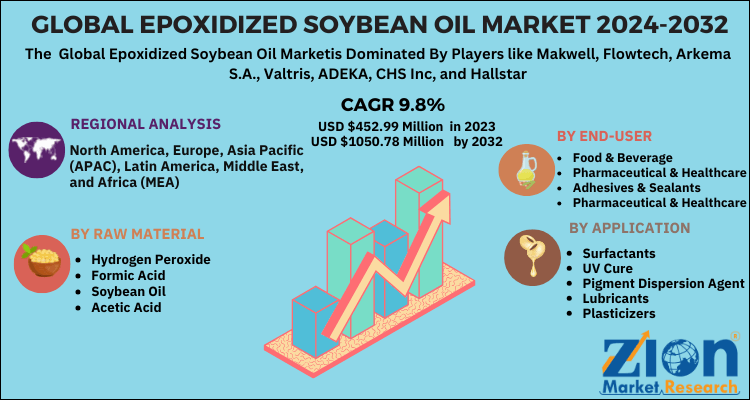
Zion Market Research has published a report on the global Epoxidized Soybean Oil Market, estimating its value at USD 452.99 Million in 2023, with projections indicating that it will reach USD 1050.78 Million by 2032. The market is expected to expand at a compound annual growth rate (CAGR) of 9.8% over the forecast period 2024-2032.
Key Insights
- As per the analysis shared by our research analyst, the global epoxidized soybean oil market is projected to grow annually at a CAGR of around 9.8% over the forecast period (2024-2032).
- In terms of revenue, the global epoxidized soybean oil market size was valued at around USD 452.99 Million in 2023 and is projected to reach USD 1050.78 Million by 2032.
- The market is driven by the escalating preference for eco-friendly and bio-based chemical additives across the global plastic and polymer industries.
- Raw material wise, the epoxidized soybean oil market is sectored into hydrogen peroxide, formic acid, soybean oil, and acetic acid.
- Application wise, the market is divided into surfactants, UV cure, pigment dispersion agent, lubricants, plasticizers, agricultural chemicals, cutting oils, coatings, flavor & fragrances, fuel additive, and functional fluids.
- Depending upon the end-user, the epoxidized soybean oil market is classified into food & beverage, automotive, adhesives & sealants, and pharmaceutical & healthcare.
- Asia Pacific dominated the global epoxidized soybean oil market with a share of 42% in 2023 owing to rapid industrialization, massive plastics manufacturing hubs in China and India, and rising environmental consciousness in the region.
Global Epoxidized Soybean Oil Industry: Overview
The epoxidized soybean oil (ESBO) market comprises a specialized segment of the chemical industry focused on the production and distribution of a non-toxic, bio-derived functional additive obtained through the oxidation of soybean oil with hydrogen peroxide and organic acids. As a vegetable-oil-based derivative, ESBO serves as a critical secondary plasticizer and stabilizer for polyvinyl chloride (PVC) and other polymers, providing essential heat and light resistance while maintaining the flexibility of the material. The market is defined by its transition toward "green" chemistry, moving away from synthetic, petroleum-derived additives toward renewable resources. ESBO is widely recognized for its high compatibility with polymer resins and its low volatility, making it an indispensable component in materials that require high safety standards, such as food-grade films and medical tubing.
The industry is further characterized by its versatile role as a chemical intermediate in the formulation of coatings, lubricants, and fuel additives. Because ESBO is biodegradable and generally recognized as safe (GRAS) for indirect food contact, it has become a cornerstone in the global effort to reduce the carbon footprint of the plastics industry. The market ecosystem involves agricultural suppliers, chemical processors, and downstream manufacturers who integrate ESBO into a vast array of end-use products. As environmental regulations become increasingly stringent regarding the use of hazardous substances, the market for epoxidized soybean oil continues to expand as a primary solution for sustainable industrial manufacturing.
Epoxidized Soybean Oil Market: Dynamics
Growth Factors
Rising Global Demand for Phthalate-Free and Non-Toxic Plasticizers
The primary driver for the epoxidized soybean oil market is the global shift away from traditional phthalate plasticizers, which have been linked to adverse health effects and environmental persistence. Regulatory bodies such as REACH in Europe and the FDA in the United States have implemented strict guidelines limiting the use of certain phthalates in sensitive applications like children's toys, medical devices, and food packaging. ESBO, being a bio-based and non-toxic alternative, offers excellent stabilization properties and compatibility with PVC, making it the ideal replacement for manufacturers striving to meet these safety standards.
Moreover, the inherent chemical properties of ESBO, such as its ability to act as an acid scavenger during PVC degradation, provide a dual-function benefit of plasticization and stabilization. This efficiency reduces the need for multiple additives, lowering overall production costs while enhancing the longevity and heat resistance of the final plastic product. As the global plastic industry moves toward more sustainable and health-conscious formulations, the adoption of ESBO is expected to surge across various manufacturing sectors.
Restraints
Volatility in Raw Material Prices and Supply Chain Fluctuations
A significant restraint for the ESBO market is the direct dependence on the agricultural sector for soybean oil. The price of soybean oil is subject to extreme volatility caused by weather conditions, crop yields, and shifts in international trade policies. Since raw material costs constitute a major portion of the final product price, any spike in soybean prices can lead to higher costs for ESBO manufacturers, potentially making it less competitive against cheaper, albeit less eco-friendly, synthetic alternatives.
Furthermore, the competition for soybean oil between the food industry, biodiesel production, and chemical manufacturing can lead to supply shortages. In regions where food security is a priority, the diversion of edible oils for industrial use can face public and regulatory scrutiny. This competition for feedstock can limit the consistent availability of raw materials, creating a bottleneck for the large-scale production of epoxidized soybean oil and hindering steady market growth.
Opportunities
Expansion into UV-Cured Coatings and Bio-Lubricant Applications
The development of UV-cured technology presents a significant opportunity for the ESBO market. Epoxidized soybean oil is increasingly being used as a reactive diluent in UV-curable coatings and inks because of its low viscosity and ability to cross-link effectively under ultraviolet light. This application is gaining traction in the electronics and high-end packaging industries, where fast curing times and low volatile organic compound (VOC) emissions are highly valued. As industries transition toward energy-efficient coating processes, ESBO is poised to play a vital role.
Additionally, the rising interest in biodegradable lubricants for automotive and industrial machinery offers new growth avenues. ESBO’s high flash point and excellent lubricity make it a viable base for bio-lubricants that are less harmful to the environment in case of leaks or spills. With the global automotive sector focusing on reducing environmental impact, the integration of ESBO into specialized lubricants and fuel additives represents a high-potential market expansion area.
Challenges
Technical Limitations in High-Temperature Processing
A major technical challenge for ESBO is its performance limitations under extreme high-temperature processing conditions compared to some high-performance synthetic plasticizers. While ESBO is an excellent secondary stabilizer, using it as a primary plasticizer in very high concentrations can lead to issues such as "spewing" or migration of the oil to the surface of the plastic over time. This can affect the aesthetic and functional quality of the final product, necessitating careful formulation and the use of co-plasticizers.
Furthermore, the industry faces the challenge of standardizing epoxidation levels across different manufacturers. Variations in the oxirane oxygen content can lead to inconsistent performance in downstream polymer applications. Achieving high-purity, consistent-quality ESBO at a price point comparable to traditional chemicals remains a persistent challenge for the industry, especially when targeting high-performance engineering plastics that require rigorous technical specifications.
Global Epoxidized Soybean Oil Industry: Segmentation
The epoxidized soybean oil industry can be classified based on raw material, end-user, and application.
Raw material wise, the epoxidized soybean oil market is sectored into hydrogen peroxide, formic acid, soybean oil, and acetic acid.
Application wise, the market is divided into surfactants, UV cure, pigment dispersion agent, lubricants, plasticizers, agricultural chemicals, cutting oils, coatings, flavor & fragrances, fuel additive, and functional fluids.
Depending upon the end-user, the epoxidized soybean oil market is classified into food & beverage, automotive, adhesives & sealants, and pharmaceutical & healthcare.
Epoxidized Soybean Oil Market: Report Scope
| Report Attributes | Report Details |
|---|---|
| Report Name | Epoxidized Soybean Oil Market |
| Market Size in 2023 | USD 452.99 Million |
| Market Forecast in 2032 | USD 1050.78 Million |
| Growth Rate | CAGR of 9.8% |
| Number of Pages | 110 |
| Key Companies Covered | Makwell, Flowtech, Arkema S.A., Valtris, ADEKA, CHS Inc, and Hallstar |
| Segments Covered | By Raw Material, By End-User, By Application And By Region |
| Regions Covered | North America, Europe, Asia Pacific (APAC), Latin America, Middle East, and Africa (MEA) |
| Base Year | 2023 |
| Historical Year | 2018 - 2022 |
| Forecast Year | 2024 - 2032 |
| Customization Scope | Avail customized purchase options to meet your exact research needs. Request For Customization |
Global Epoxidized Soybean Oil Market: Regional Analysis
Based on the region, the epoxidized soybean oil market can be divided into five main regions: Latin America, North America, Asia Pacific, Europe, and the Middle East and Africa. Asia Pacific market is touted to register a massive growth over the years ahead, subject to myriad use of stabilizers as a result of its cost efficiency. Additionally, easy raw material sourcing and accessibility of manpower for producing epoxidized soybean oil at reasonable rates will propel the scope of the business.
Moreover, the European market growth majorly dependent on the product demands across major the European countries such as; France, Germany, and the UK can contribute opulently towards market earnings during the future years. Apart from this, the thriving food & beverages sector will account for the major gains for the regional market. Stringent laws formulated by the EU pertaining to the use of phthalate plasticizers in packaging industry may kindle market demand in the European zone.
Burgeoning need for non-phthalate compounds in end-user sectors including coatings, construction, and agriculture will reinforce epoxidized soybean oil market evolution in countries such as Brazil. This will multiply the epoxidized soybean oil market size in Latin America.
Recent Developments
- In 2023, a leading chemical manufacturer announced the launch of a high-purity ESBO grade specifically designed for medical-grade PVC, offering enhanced migration resistance and superior clarity for hospital applications.
- In 2024, advancements in "in-situ" epoxidation technology were commercialized, allowing for a more energy-efficient production process that reduces the carbon footprint of ESBO manufacturing by nearly 15%.
- A major strategic partnership was formed in 2025 between an agricultural giant and a specialty chemical firm to ensure a steady supply of sustainably sourced, non-GMO soybean oil dedicated to industrial ESBO production.
Global Epoxidized Soybean OilIndustry: Competitive Players
Some of the key players in the epoxidized soybean oil market include -
- Makwell
- Flowtech
- Arkema S.A.
- Valtris
- ADEKA
- CHS Inc
- Hallstar.
This report segments the global epoxidized soybean oil industry market as follows:
Global Epoxidized Soybean Oil Industry Market: Raw Material Segment Analysis
- Hydrogen Peroxide
- Formic Acid
- Soybean Oil
- Acetic Acid
Global Epoxidized Soybean Oil Industry Market: Application Segment Analysis
- Surfactants
- UV Cure
- Pigment Dispersion Agent
- Lubricants
- Plasticizers
- Agricultural Chemicals
- Cutting Oils
- Coatings
- Flavor & Fragrances
- Fuel Additive
- Functional Fluids
Global Epoxidized Soybean Oil Industry Market: End-User Segment Analysis
- Food & Beverage
- Pharmaceutical & Healthcare
- Adhesives & Sealants
- Pharmaceutical & Healthcare
Global Epoxidized Soybean Oil Industry Market: Regional Segment Analysis
- North America
- The U.S.
- Canada
- Europe
- France
- The UK
- Spain
- Germany
- Italy
- Rest of Europe
- Asia Pacific
- China
- Japan
- India
- South Korea
- Southeast Asia
- Rest of Asia Pacific
- Latin America
- Brazil
- Mexico
- Rest of Latin America
- Middle East & Africa
- GCC
- South Africa
- Rest of Middle East & Africa
Table Of Content
Methodology
FrequentlyAsked Questions

HappyClients

