
Electric Hoist Market Size, Share, Growth, Opportunities 2034

Electric Hoist Market By Type (Wire Rope Hoists, Pneumatic Hoists, Chain Hoists, Winches, and Electric Cranes), By Control Type (Remote Control, Manual Control, and Wired Control), By Load Capacity (Up to 1 Ton, 1 to 5 Tons, 5 to 10 Tons, 10 to 20 Tons, and Above 20 Tons), By Lifting Height (Up to 10 Meters, 10 to 20 Meters, 20 to 30 Meters, and Above 30 Meters), By Application (Construction, Shipping and Logistics, Manufacturing, Mining and Aerospace), and By Region - Global and Regional Industry Overview, Market Intelligence, Comprehensive Analysis, Historical Data, and Forecasts 2026 - 2034
| Market Size in 2025 | Market Forecast in 2034 | CAGR (in %) | Base Year |
|---|---|---|---|
| USD 5.9 Billion | USD 8.3 Billion | 3.8% | 2025 |
Electric Hoist Industry Perspective:
What will be the size of the global electric hoist market during the forecast period?
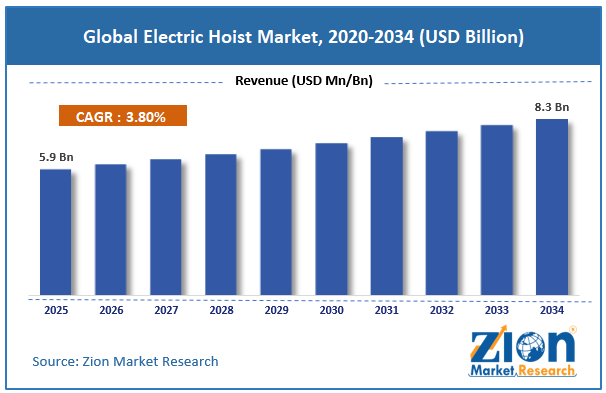
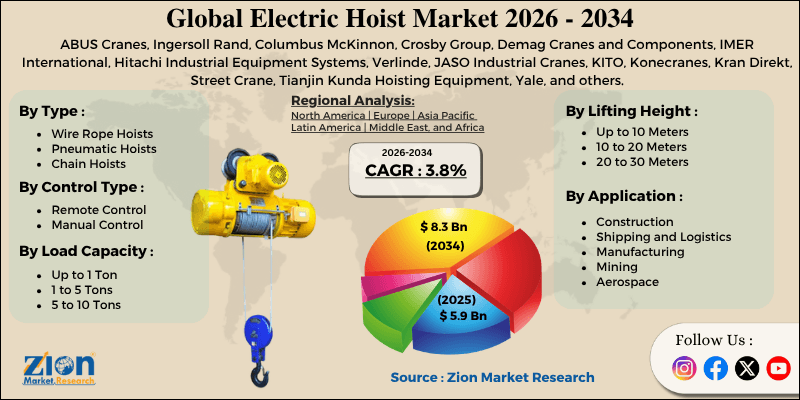
The global electric hoist market size was worth around USD 5.9 billion in 2025 and is predicted to grow to around USD 8.3 billion by 2034, with a compound annual growth rate (CAGR) of roughly 3.8% between 2026 and 2034.
Electric Hoist Market: Overview
An electric hoist is a lifting apparatus controlled electronically to lift, lower, and move heavy loads, with an electric motor controlling the chain or wire rope winding system. Electric hoists have become very common in industries such as manufacturing, construction, warehouse operations, mining, the automotive industry, shipbuilding, and logistics. It is used to improve material-handling processes in these industries. Electric hoists are commonly installed on stationary structures or on cranes such as overhead, gantry, jib, and monorail cranes, facilitating the easy positioning of the load with minimal effort. Electric hoists have now become advanced tools with additional features such as variable-speed control, overload protection, remote control, automatic braking, and IoT-based status monitoring to ensure reliability and reduce downtime.
Key Insights
- As per the analysis shared by our research analyst, the global electric hoist market is estimated to grow annually at a CAGR of around 3.8% over the forecast period (2026-2034).
- In terms of revenue, the global electric hoist market size was valued at around USD 5.9 billion in 2025 and is projected to reach USD 8.3 billion by 2034.
- Growth of warehousing, logistics, and e-commerce is expected to propel the electric hoist market over the projected period.
- Based on the type, the wire rope hoists segment holds a significant market share in 2025.
- Based on the control type, the remote control segment held the largest revenue share in 2025 and is expected to continue the same pattern over the projected period.
- Based on the load capacity, the category of 1 to 5 tons is anticipated to hold a major proportion of the revenue generated in the electric hoist industry.
- Based on the lifting height, the 10 to 20 meter height lift segment is anticipated to experience strong growth in terms of revenue generation in the electric hoist industry.
- Based on the application, construction would be responsible for the majority of revenue generation in the electric hoist market.
- Based on region, the Asia-Pacific region holds a prominent market share of approximately 43% in 2025.
Impact of the USA-Israel War on Iran on the Electric Hoist Market
The war between the USA and Iran, with Israel, is expected to cause some moderate negative effects on the electric hoist market in the short run, but may bring some selective long-term opportunities in the defense, infrastructure rebuilding, and energy sectors. As the war has disrupted shipping lanes across the Strait of Hormuz, created additional risks in the region, and raised oil prices and energy costs, the costs of production, logistics, and raw materials for industrial goods, including electric hoists, will increase. With such an array of materials as steel, copper, aluminum, electric engines, electronic control devices, and semiconductors being used in the manufacture of electric hoists, the cost increase might negatively affect profit margins and order placements.
Electric Hoist Market: Dynamics
Growth Drivers
How does the growing industrial automation and smart manufacturing drive the electric hoist market?
The rapid integration of industrial automation and intelligent manufacturing is a major driver of the electric hoist market, as many companies implement automated material-handling systems to increase efficiency, precision, and safety at worksites. Electric hoists are becoming an integral part of overhead cranes, automated assembly lines, robots, and IIoT solutions, enabling efficient load lifting, device operation monitoring, preventive maintenance, and reduced downtime. In connection with the transition of manufacturing towards Industry 4.0 technologies, various sectors, including automotive, aerospace, metalworking, warehousing, and heavy engineering, have begun implementing electric hoists equipped with variable-frequency drives, remote controls, and intelligent load-monitoring systems.
According to data provided by IFR, the number of industrial robots installed worldwide was estimated at 541,302 in 2023, while the global stock of industrial robots exceeded 4.28 million units. In addition, UNIDO claims that, due to the digitalization of factories, global manufacturing capacity continues to increase, and thus, there is a growing need for automated lifting devices. Therefore, the adoption of electric hoists will continue to rise steadily as factories modernize to increase efficiency and reduce labor costs.
Restraints
Why do the high initial investment and installation costs act as a major restraint to the growth of the electric hoist industry?
The high investment cost of installing electric hoists poses a significant challenge to their widespread use, particularly among SMEs. Apart from the cost of buying the hoist machine, there are other costs associated with establishing the necessary infrastructure for the hoist (such as the crane system, monorail, beams, cables, controls, installation, and testing of the hoist), which are highly capital-intensive. This significantly increases the cost of owning electric hoists. These costs delay the implementation of modernization programs, particularly for manufacturing companies without sufficient capital. According to data from the World Bank, SMEs account for more than half of the labor force in developing countries.
Still, financing constraints prevent them from investing in new equipment and technology that would improve the efficiency of production processes. Moreover, according to the International Finance Corporation (IFC), the total financing gap for SMEs worldwide is about $4.5 trillion.
Opportunities
Do the increasing innovative product launches offer a lucrative opportunity for the electric hoist market?
Innovation in product introduction is one of the factors that could lead to the substantial expansion of the electric hoist market. Companies are regularly releasing new models of electric hoists that feature state-of-the-art capabilities such as IoT-based condition monitoring, variable-frequency drives, wireless remote control, intelligent overload protection, energy-efficient motors, and predictive maintenance. Such functionalities increase lift precision, enhance safety in the working environment, reduce maintenance expenses, and minimize downtime. Electric hoists become more appealing to a wide range of industries due to their numerous benefits: manufacturing, logistics, warehouse, construction, mining, and automotive sectors benefit from them. The growing popularity of Industry 4.0 and smart factories is driving demand for intelligent hoisting devices.
For instance, in February 2025, the Konecranes D-series electric chain hoist became available from Konecranes to help customers meet their need for high-performance lifting machinery in demanding industry sectors. With its robust design, safety features, and compact size, the Konecranes D-series hoist is designed to prioritize safety and efficiency in industrial processes.
Challenges
Availability of low-cost alternatives poses a significant challenge to the industry's growth
The presence of numerous affordable substitutes is one of the main inhibitors to the development of the electric hoist market. The majority of consumers, including small-scale factories, construction companies, repair shops, and warehouses, opt for chain hoists, lever hoists, hydraulic lifting devices, and pneumatic hoists, which are less expensive, easier to install, and require lower maintenance due to their simplicity. This type of equipment provides all the necessary features to carry out light lifting jobs, thus making electric hoists unnecessary.
Furthermore, electric hoists entail additional expenditures for infrastructure, such as electrical connections, installation of additional lifting structures, and equipment maintenance. If a company has a small amount of lifting work or a tight budget, buying an electric hoist can be complicated, as it is not justifiable to spend extra money on it when there are sufficient alternatives for carrying out lifting operations.
Electric Hoist Market: Report Scope
| Report Attributes | Report Details |
|---|---|
| Report Name | Electric Hoist Market |
| Market Size in 2025 | USD 5.9 Billion |
| Market Forecast in 2034 | USD 8.3 Billion |
| Growth Rate | CAGR of 3.8% |
| Number of Pages | 228 |
| Key Companies Covered | ABUS Cranes, Ingersoll Rand, Columbus McKinnon, Crosby Group, Demag Cranes and Components, IMER International, Hitachi Industrial Equipment Systems, Verlinde, JASO Industrial Cranes, KITO, Konecranes, Kran Direkt, Street Crane, Tianjin Kunda Hoisting Equipment, Yale, and others. |
| Segments Covered | By Type, By Control Type, By Load Capacity, By Lifting Height, By Application, and By Region |
| Regions Covered | North America, Europe, Asia Pacific (APAC), Latin America, Middle East, and Africa (MEA) |
| Base Year | 2025 |
| Historical Year | 2020 - 2024 |
| Forecast Year | 2026 - 2034 |
| Customization Scope | Avail customized purchase options to meet your exact research needs. Request For Customization |
Electric Hoist Market: Segmentation
Type Insights
Why does the wire rope hoists segment hold a prominent position in the electric hoist market?
The wire rope hoists segment holds a significant share of the electric hoist market in 2025. This increase is attributed to the higher load capacity, faster lifting speed, larger lifting height, and high durability of the hoists in harsh industrial settings. Wire rope hoists are widely used in factories, steel mills, shipbuilding yards, mines, power stations, automobile manufacturing units, warehouses, and large construction sites where heavy loads require precise handling. The continuous operating capability and technological advancements, such as remote diagnostics, overload protection, predictive maintenance, and variable-frequency drives, make these hoists the best-suited option for industrial lifting applications. With the rising adoption of automation in factories and the upgrade of material handling systems, the demand for wire rope hoists will continue to grow in the coming years.
Another factor contributing to segment growth is product innovation. For instance, Demag introduced its latest DHR rope hoist at the LogiMAT 2024 event, which combines the best aspects of its earlier DMR and DVR product lines into one compact, modular solution with smart monitoring and diagnostics, and enhanced safety. Further, in March 2025, Demag added new foot hoist and double rail crab versions to the DHR lineup.
Control Type Insights
Does the remote control segment capture the largest share in the electric hoist market?
The remote control segment held the largest revenue share of the electric hoist industry in 2025 and is expected to continue the same pattern over the projected period. The growth is fueled by the increasing demand for lifting processes that are not only safe and efficient but also highly automated. Wireless remote-controlled electric hoists enable operators to control lifting equipment from a safe distance, greatly improving visibility and safety and thereby increasing efficiency. With wireless remote-controlled electric hoists, there is no requirement for the operator to be near the load being lifted.
Load Capacity Insights
What factor drives the 1 to 5 Tons segment in the electric hoist market?
The 1 to 5 tons category is anticipated to account for a major share of revenue in the electric hoist industry due to its extensive use across industries such as manufacturing, warehousing, construction, automotive, logistics, food processing, and general industries. Electric hoists operating in this capacity range represent an ideal combination of lifting capacity and operational efficiency at a relatively lower cost. Electric hoists in this capacity range can lift equipment, raw materials, finished goods, and parts on the assembly line.
Lifting Height Insights
Does the 10 to 20 m segment account for a significant share of revenue in the electric hoist market?
The 10 to 20 meter height lift segment is anticipated to experience strong growth in terms of revenue generation in the electric hoist industry due to the widespread application of this lift height in various industries, including manufacturing facilities, warehouses, logistics facilities, construction projects, automobile facilities, metal fabrication facilities, and power generation facilities. This lift height offers an optimal balance between efficiency and operational flexibility when handling heavy loads in medium/large industrial structures. It is widely favored for overhead crane systems, gantry crane systems, and monorails with moderate height lifting capabilities.
Application Insights
Why is the construction segment growing at the highest rate in the electric hoist market?
Construction would be responsible for the majority of revenue generation in the electric hoist market, driven by growing investment in residential, commercial, industrial, and infrastructure construction projects worldwide. Electric hoists are widely used in the construction sector to lift and position heavy items, including steel beams, concrete components, machinery, scaffolding, and pre-fab building sections. These devices are essential in the modern construction process owing to their effectiveness in making lifting easier and safer.
Regional Insights
What factors drive the Asia-Pacific region in the electric hoist market?
The Asia-Pacific region holds a prominent share of the electric hoist market of approximately 43% in 2025. The reason for the expansion in the region is attributed to rapid industrialization and growth in the manufacturing industry, extensive infrastructure development, and the increasing use of industrial automation technologies in China, India, Japan, South Korea, and Southeast Asia. The region comprises various sectors, including automotive, electronics, steel, shipbuilding, mining, logistics, and heavy engineering, where there is extensive use of electric hoists. The demand for the product will be further fueled by rising investments in smart factories, warehouse automation, port development, renewable energy, and construction.
Furthermore, government policies will help the market grow. According to the National Bureau of Statistics of China, value-added industrial production grew by 5.8% in 2024, while manufacturing output increased by 6.1%. In addition, China has been the world's largest manufacturing nation for the past 15 years.
Electric Hoist Market: Competitive Analysis
The global electric hoist market is dominated by players like:
- ABUS Cranes
- Ingersoll Rand
- Columbus McKinnon
- Crosby Group
- Demag Cranes and Components
- IMER International
- Hitachi Industrial Equipment Systems
- Verlinde
- JASO Industrial Cranes
- KITO
- Konecranes
- Kran Direkt
- Street Crane
- Tianjin Kunda Hoisting Equipment
- Yale
The global electric hoist market is segmented as follows:
By Type
- Wire Rope Hoists
- Pneumatic Hoists
- Chain Hoists
- Winches
- Electric Cranes
By Control Type
- Remote Control
- Manual Control
- Wired Control
By Load Capacity
- Up to 1 Ton
- 1 to 5 Tons
- 5 to 10 Tons
- 10 to 20 Tons
- Above 20 Tons
By Lifting Height
- Up to 10 Meters
- 10 to 20 Meters
- 20 to 30 Meters
- Above 30 Meters
By Application
- Construction
- Shipping and Logistics
- Manufacturing
- Mining
- Aerospace
By Region
- North America
- The U.S.
- Canada
- Mexico
- Europe
- France
- The UK
- Spain
- Germany
- Italy
- Rest of Europe
- Asia Pacific
- China
- Japan
- India
- Australia
- South Korea
- Rest of Asia Pacific
- The Middle East & Africa
- Saudi Arabia
- UAE
- Egypt
- Kuwait
- South Africa
- Rest of the Middle East & Africa
- Latin America
- Brazil
- Argentina
- Rest of Latin America
Table Of Content
Methodology
FrequentlyAsked Questions
An electric hoist is defined as a lifting apparatus controlled electronically to lift, lower, and move heavy loads, with an electric motor controlling the chain or wire rope winding system. An electric hoist has become very common in industries such as manufacturing, construction, warehouse operations, mining, the automotive industry, shipbuilding, and logistics, and is used to improve material-handling processes.
The growth of the electric hoist market is primarily driven by increasing industrial automation and smart manufacturing, rapid expansion of construction and infrastructure projects, and the growing need for efficient material handling solutions across manufacturing, warehousing, logistics, mining, and energy industries. Rising adoption of Industry 4.0 technologies, stringent workplace safety regulations, and increasing investments in automated warehouses and production facilities are accelerating demand for advanced electric hoists with IoT-enabled monitoring, wireless controls, and energy-efficient motors.
The electric hoist market faces several challenges, including high initial investment and installation costs, which can discourage adoption among small and medium-sized enterprises. The availability of lower-cost alternatives such as manual chain hoists and hydraulic lifting equipment also limits market penetration in price-sensitive industries.
Based on the type, the wire rope hoists segment is expected to dominate the electric hoist market growth during the projected period.
The electric hoist market is being transformed by advancements in Industry 4.0, IoT-enabled condition monitoring, predictive maintenance, and smart material handling systems. Manufacturers are introducing electric hoists with wireless remote controls, variable frequency drives (VFDs), energy-efficient motors, anti-sway technology, and advanced overload protection to improve safety, precision, and operational efficiency. The integration of electric hoists with automated cranes, warehouse management systems, and digital monitoring platforms is enabling real-time performance tracking and reducing downtime.
According to the report, the global electric hoist market size was worth around USD 5.9 billion in 2025 and is predicted to grow to around USD 8.3 billion by 2034.
The global electric hoist market is expected to grow at a CAGR of 3.8% during the forecast period.
The global electric hoist industry growth is expected to be led by the Asia Pacific over the forecast period.
The global electric hoist market is dominated by players like ABUS Cranes, Ingersoll Rand, Columbus McKinnon, Crosby Group, Demag Cranes and Components, IMER International, Hitachi Industrial Equipment Systems, Verlinde, JASO Industrial Cranes, KITO, Konecranes, Kran Direkt, Street Crane, Tianjin Kunda Hoisting Equipment, and Yale, among others.
The electric hoist market report covers the geographical market along with a comprehensive competitive landscape analysis. It also includes cash flow analysis, profit ratio analysis, market basket analysis, market attractiveness analysis, sentiment analysis, PESTLE analysis, trend analysis, SWOT analysis, trade area analysis, demand & supply analysis, Porter’s five forces analysis, and value chain analysis.

HappyClients

