
Global Electric Bikes Market Size, Share, Growth, Trends, and Forecasts 2034

Electric Bikes Market By Propulsion Type (Pedal Assist and Throttle), By Battery Type (Lead Acid, Nickel Metal Hydride, Lithium-ion, and Others), By Application (City/Urban, Cargo/Luggage, and Mountain/Trekking), By Motor Type (Hub Motor and Mid-drive Motor), By Component (Battery, Motor Controller, Electric Motors, Frame with Forks, and Others), By Battery Capacity (Below 250W, 251W to 450W, 451W to 650 W, and Above 650W), and By Region - Global and Regional Industry Overview, Market Intelligence, Comprehensive Analysis, Historical Data, and Forecasts 2026 - 2034
| Market Size in 2025 | Market Forecast in 2034 | CAGR (in %) | Base Year |
|---|---|---|---|
| USD 58 Billion | USD 196 Billion | 14.5% | 2025 |
Electric Bikes Market: Industry Perspective
What will be the size of the global electric bikes market during the forecast period?
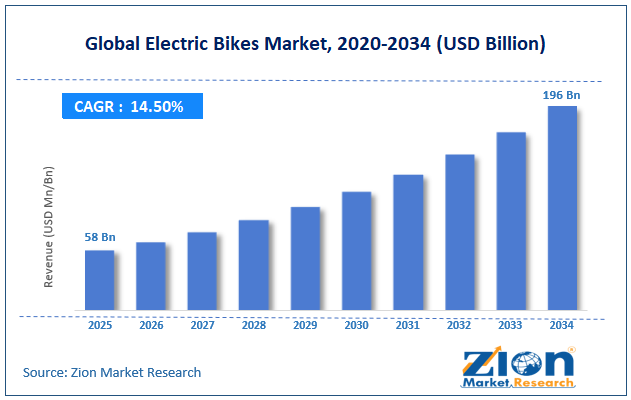
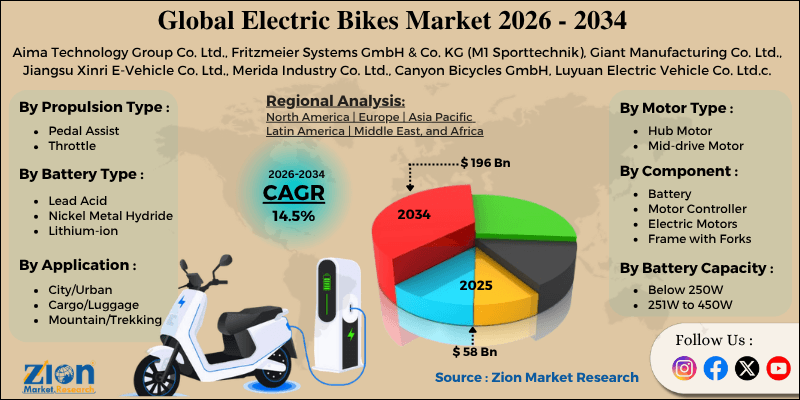
The global electric bikes market size was worth around USD 58 billion in 2025 and is predicted to grow to around USD 196 billion by 2034, with a compound annual growth rate (CAGR) of roughly 14.5% between 2026 and 2034.
Key Insights
- As per the analysis shared by our research analyst, the global electric bikes market is estimated to grow annually at a CAGR of around 14.5% over the forecast period (2026-2034).
- In terms of revenue, the global electric bikes market size was valued at around USD 58 billion in 2025 and is projected to reach USD 196 billion by 2034.
- Rising urbanization and increasing traffic congestion are expected to propel the electric bikes market over the projected period.
- Based on the propulsion type, the pedal assist segment held the largest revenue share in 2025 of 79%.
- Based on the battery type, the lithium-ion segment held the largest market share in 2025 of 72%.
- Based on the application, the city/urban segment held a prominent revenue share in 2025 of 80%.
- Based on the motor type, the hub motor segment is growing at a significant rate, capture major market share of 55% in 2025.
- Based on the component, the battery segment is anticipated to deliver substantial revenue in the electric bikes market.
- Based on the battery capacity, the 451 W to 650 W power segment is expected to register strong revenue growth.
- Based on region, the Asia Pacific dominates the electric bikes market with a revenue share of 56% in 2025.
Electric Bikes Market: Overview
Electric bikes (e-bikes) are bicycles with an integrated motor, battery, and controller that provide either pedal-assisted or throttle-assisted pedaling to reduce the effort needed to ride. They offer the combined benefits of human-powered bicycles with the addition of electric power, providing a means of transportation that allows the rider to cover more ground with less effort than would otherwise be possible. E-bikes in general have proved to be a very popular alternative to standard forms of transportation due to their utility, cost-effectiveness, and decreased environmental impact when compared to modes of transport such as cars. Most e-bikes allow for pedal-assisted, throttle-assisted, or a combination of the two, depending on the specific model and local laws, with a wide range of power output and speed capabilities depending on the class of the bike.
Impact of the USA-Israel War on Iran on the Electric Bikes Market
The current conflict between the USA, Israel, and Iran is likely to affect supplies of battery cells, electronics, and semiconductors needed to produce electric bikes. Increased tension in the region affects energy and transportation costs, as well as the prices of various goods, including lithium, aluminum, and other materials used to produce electric bikes. Consequently, the production of such vehicles may be temporarily hampered, which may affect profits and pricing. However, the conflict will have little effect on the demand for electric bikes.
Electric Bikes Market: Dynamics
Growth Drivers
How does the growing demand for sustainable and eco-friendly transportation drive the electric bikes market?
Growing demand for sustainable and eco-friendly transportation is one of the key factors driving the electric bikes market. Governments globally are taking initiatives to promote the usage of e-bikes by providing subsidies and tax incentives to buyers and offering relaxed registration and licensing procedures. Moreover, the development of bicycle-friendly policies by governments and private bodies offering shared e-bike services and funding sustainable transport projects are some other factors anticipated to drive the market growth. Governments in various countries are formulating policies to reduce carbon emissions from fossil fuel-powered vehicles and have imposed stringent emission norms while setting a target to achieve net-zero emissions by 2050. Hence, people are opting for alternative modes of transportation such as e-bikes over traditional gasoline-powered two-wheelers and four-wheelers.
Restraints
Why do the high initial purchase cost and battery replacement expenses act as a major restraint to the electric bikes industry's growth?
High initial purchase and battery replacement costs are major restraints on electric bike market growth. Electric bikes are significantly costlier than traditional bikes owing to the high cost of lithium-ion batteries, electric motor, controller, and other hardware. Further, the battery capacity of these bikes depreciates with time, and it has to be replaced after every few years, which makes up a significant fraction of the total purchase cost of electric bikes. As a result, the overall cost of ownership is quite high, which discourages many people from buying electric bikes.
Opportunities
How do rising innovative product launches offer a lucrative opportunity for the electric bikes market?
Growing innovative product launches are creating significant opportunities for the electric bikes market by attracting new consumer groups and improving the overall appeal of the e-bikes category. Manufacturers are introducing new products with long-range batteries, fast charging, lightweight designs, connectivity, enhanced safety features, and durability to cater to different customer needs. The developments are increasing the potential of the e-bike segment and helping it gain traction around the globe, replacing the need for regular two-wheelers and even fuel-run bikes in the near future.
The electric bike concept introduced by Ampere, Xyber, at the Bharat Mobility Global Expo 2025, is a classic example of an innovative design set to disrupt the current e-bike scenario with its 200 km range and fast-charging support on both AC and DC. The 2025 e-bike product launches would create new opportunities for the market, and consumers would see unique features to choose from.
Challenges
Limited charging infrastructure, battery-related concerns, and regulatory challenges pose a significant threat to the growth of the electric bikes industry
Limited charging infrastructure, battery-related issues, and regulatory challenges are some of the factors that can hinder the growth of electric bikes. For instance, large-scale public charging stations are limited, which reduces the appeal of electric bikes for long-distance commercial use and limits demand.
Moreover, battery-related issues, such as limited battery life, charging time for specific models, expensive battery replacement, fire safety, and battery recycling, affect the demand and adoption rates for electric bikes. In addition, regulations related to motor size, speed limits, licensing, and helmet usage are major factors that might impede the growth of the global electric bike market size.
Electric Bikes Market: Report Scope
| Report Attributes | Report Details |
|---|---|
| Report Name | Electric Bikes Market |
| Market Size in 2025 | USD 58 Billion |
| Market Forecast in 2034 | USD 196 Billion |
| Growth Rate | CAGR of 14.5% |
| Number of Pages | 230 |
| Key Companies Covered | Aima Technology Group Co. Ltd., Fritzmeier Systems GmbH & Co. KG (M1 Sporttechnik), Giant Manufacturing Co. Ltd., Jiangsu Xinri E-Vehicle Co. Ltd., Merida Industry Co. Ltd., Canyon Bicycles GmbH, Luyuan Electric Vehicle Co. Ltd., Myvelo Co. Ltd., Rad Power Bikes Inc., Pon Holdings B.V., Riese & Müller GmbH, Specialized Bicycle Components Inc., Dongguan Tailing Electric Vehicle Co. Ltd, Samchuly Bicycle, Yamaha Motor Co. Ltd., Yadea Group Holdings Ltd., Tianjin Fuji-Ta Bicycle Co. Ltd., VanMoof BV, Trek Bicycle Corporation, and others. |
| Segments Covered | By Propulsion Type, By Battery Type, By Application, By Motor Type, By Component, By Battery Capacity, and By Region |
| Regions Covered | North America, Europe, Asia Pacific (APAC), Latin America, Middle East, and Africa (MEA) |
| Base Year | 2025 |
| Historical Year | 2020 to 2024 |
| Forecast Year | 2026 - 2034 |
| Customization Scope | Avail customized purchase options to meet your exact research needs. Request For Customization |
Electric Bikes Market: Segmentation
Propulsion Type Insights
Why does the pedal assist segment hold a prominent position in the electric bikes market?
The pedal assist segment held the largest revenue share of the electric bike market in 2025, at 79%. The growth is attributed to its ability to provide electric motor assistance only when the rider is pedaling, allowing for an efficient and natural riding experience. Pedal assist on e-bikes reduces rider fatigue and makes hilly terrain easier to navigate, making it easier for riders to commute longer distances. This makes the electric bikes appealing to urbanites as well as sporty riders who like to keep fit.
Battery Type
How does the lithium-ion segment capture the largest share in the electric bikes market?
The lithium-ion segment holds a majority share of the electric bike industry in 2025 of 72%. The growth trends are attributed to their high energy density, low weight, long life cycle, and fast charging nature compared to lead-acid and nickel batteries. Lithium-ion batteries allow e-bikes to have a far greater range than lead-acid batteries and reduce the overall weight of the vehicle, thereby increasing its performance, portability, and comfort. As a result, lithium-ion batteries have gained popularity among commuter, mountain, cargo, and high-end electric bikes and are now considered the best battery technology.
Application Insights
Does the city/urban segment capture the largest share in the electric bikes market?
The city/urban segment held a prominent revenue share of the electric bike market in 2025, at 80%. The growth is attributed to rising urbanization, traffic congestion, and the need for energy-efficient and cost-effective transportation. The electric bike is convenient for short and medium-to-long-distance commutes while also helping avoid traffic and save money on gas. The development of an economical, compact, and quick vehicle that can form a viable alternative to cars, scooters, and buses is advantageous.
Motor Type Insights
Why does the hub motor segment capture the largest share in the electric bikes market?
The hub motor segment is growing at a significant rate and captured a major market share of 55% in 2025. The growth is explained by their simple design, cost-effectiveness, and low maintenance. They are usually located in the front or rear wheel housing and do not require complicated mechanisms to provide excellent, reliable torque. Moreover, their powerful and smooth performance makes them more convenient for ordinary and commuting bicycles and promotes the tendency to choose them over other types.
Component Insights
What factor causes the battery segment at the top position in the electric bike market?
The battery segment is anticipated to deliver substantial revenue in the electric bikes market due to its significance as the prime functionality provider in electric bikes. Demand for batteries is rising as consumers are now leaning toward longer-range, faster-charging, and lighter electric bikes. Moreover, the segment is witnessing high adoption rates due to the use of lithium batteries in e-bikes. Rising global demand for electric bikes for short- and long-distance commuting, commercial use, mountain biking, and leisure activities is driving the battery segment.
Battery Capacity Insights
How does the 451w to 650 W segment capture the largest share in the electric bikes market?
The 451 W to 650 W power segment is expected to register strong revenue growth due to its power and range while remaining highly efficient. E-bikes in this power segment deliver higher torque to climb steep hills, carry heavy luggage, and reach higher speeds while remaining energy-efficient. As such, it is a powerful option for commuting, carrying goods, recreation, and light off-road cycling, where riders want better performance than lower-power options can provide.
Regional Insights
What factors drive the Asia Pacific region in the electric bikes market?
The Asia Pacific dominates the electric bikes market with a revenue share of 56% in 2025. The growth is attributed to rapid urbanization, rising disposable incomes, and the need for affordable and sustainable transportation. Demand for electric bikes is growing in countries such as China, India, Japan, South Korea, and Vietnam. It is expected to continue rising due to high local adoption rates among people seeking to reduce fuel costs and ease traffic congestion. The region is also experiencing a high rate of bicycle usage, expanding logistics and last-mile delivery chains, and growing environmental concerns that are driving the demand for electric bikes.
Electric Bikes Market: Competitive Analysis
The global electric bikes market is dominated by players like:
- Aima Technology Group Co. Ltd.
- Fritzmeier Systems GmbH & Co. KG (M1 Sporttechnik)
- Giant Manufacturing Co. Ltd.
- Jiangsu Xinri E-Vehicle Co. Ltd.
- Merida Industry Co. Ltd.
- Canyon Bicycles GmbH
- Luyuan Electric Vehicle Co. Ltd.
- Myvelo Co. Ltd.
- Rad Power Bikes Inc.
- Pon Holdings B.V.
- Riese & Müller GmbH
- Specialized Bicycle Components Inc.
- Dongguan Tailing Electric Vehicle Co. Ltd
- Samchuly Bicycle
- Yamaha Motor Co. Ltd.
- Yadea Group Holdings Ltd.
- Tianjin Fuji-Ta Bicycle Co. Ltd.
- VanMoof BV
- Trek Bicycle Corporation
The global electric bikes market is segmented as follows:
By Propulsion Type
- Pedal Assist
- Throttle
By Battery Type
- Lead Acid
- Nickel Metal Hydride
- Lithium-ion
- Others
By Application
- City/Urban
- Cargo/Luggage
- Mountain/Trekking
By Motor Type
- Hub Motor
- Mid-drive Motor
By Component
- Battery
- Motor Controller
- Electric Motors
- Frame with Forks
- Others
By Battery Capacity
- Below 250W
- 251W to 450W
- 451W to 650 W
- Above 650W
By Region
- North America
- The U.S.
- Canada
- Mexico
- Europe
- France
- The UK
- Spain
- Germany
- Italy
- Rest of Europe
- Asia Pacific
- China
- Japan
- India
- Australia
- South Korea
- Rest of Asia Pacific
- The Middle East & Africa
- Saudi Arabia
- UAE
- Egypt
- Kuwait
- South Africa
- Rest of the Middle East & Africa
- Latin America
- Brazil
- Argentina
- Rest of Latin America
Table Of Content
Methodology
FrequentlyAsked Questions
Electric bikes (e-bikes) are bicycles with an integrated motor, battery, and controller that provide either pedal-assisted or throttle-assisted pedaling to reduce the effort needed to ride. They offer the combined benefits of human-powered bicycles with the addition of electric power, providing a means of transportation that allows the rider to cover more ground with less effort than would otherwise be possible.
The key growth drivers for the electric bikes market include the rising demand for sustainable and eco-friendly transportation, increasing urbanization and traffic congestion, and growing consumer preference for cost-effective mobility solutions. Government support through subsidies, tax incentives, and investments in cycling infrastructure is accelerating e-bike adoption worldwide.
The major challenges restraining the growth of the electric bikes market include high initial purchase costs, expensive battery replacement, and limited charging infrastructure in many regions. Concerns regarding battery lifespan, charging time, safety, and recycling also affect consumer adoption.
Based on the application, the city/urban segment is expected to dominate the electric bikes market growth during the projected period.
Emerging trends and innovations in the electric bikes market include the development of longer-range lithium-ion batteries, fast-charging technology, lightweight frame materials, and more efficient motors that enhance performance and rider experience. Manufacturers are increasingly integrating smart features such as GPS navigation, smartphone connectivity, anti-theft systems, IoT-enabled diagnostics, and AI-powered battery management. The growing popularity of cargo e-bikes, connected mobility solutions, battery-swapping technologies, and sustainable manufacturing practices is also shaping the market, while continuous new product launches are expanding applications in urban commuting, recreation, and last-mile delivery.
According to the report, the global electric bikes market size was worth around USD 58 billion in 2025 and is predicted to grow to around USD 196 billion by 2034.
The global electric bikes market is expected to grow at a CAGR of 14.5% during the forecast period.
The global electric bikes industry growth is expected to be led by the Asia Pacific over the forecast period.
The global electric bikes market is dominated by players like Aima Technology Group Co., Ltd., Fritzmeier Systems GmbH & Co. KG (M1 Sporttechnik), Giant Manufacturing Co., Ltd., Jiangsu Xinri E-Vehicle Co., Ltd., Merida Industry Co., Ltd., Canyon Bicycles GmbH, Luyuan Electric Vehicle Co., Ltd., Myvelo Co., Ltd., Rad Power Bikes Inc., Pon Holdings B.V., Riese & Müller GmbH, Specialized Bicycle Components, Inc., Dongguan Tailing Electric Vehicle Co., Ltd, Samchuly Bicycle, Yamaha Motor Co., Ltd., Yadea Group Holdings Ltd., Tianjin Fuji-Ta Bicycle Co., Ltd., VanMoof BV, and Trek Bicycle Corporation, among others.
The electric bike market report covers the geographical market along with a comprehensive competitive landscape analysis. It also includes cash flow analysis, profit ratio analysis, market basket analysis, market attractiveness analysis, sentiment analysis, PESTLE analysis, trend analysis, SWOT analysis, trade area analysis, demand & supply analysis, Porter’s five forces analysis, and value chain analysis.

HappyClients

