
Global Data Resiliency Market Size, Share, Analysis, Trends, Growth, 2032

Data Resiliency Market By Component (Solutions and Services), By Deployment (On-premises and Cloud), By Organization Size (Large Enterprises and Small & Medium Enterprises), By Vertical (BFSI, IT & Telecommunication, Retail & Consumer Goods, Government, Public Sector, Healthcare, Media & Entertainment, Manufacturing, and Others), and By Region - Global and Regional Industry Overview, Market Intelligence, Comprehensive Analysis, Historical Data, and Forecasts 2024 - 2032
| Market Size in 2023 | Market Forecast in 2032 | CAGR (in %) | Base Year |
|---|---|---|---|
| USD 26.58 Billion | USD 102.91 Billion | 16.23% | 2023 |
Data Resiliency Industry Perspective
What will be the global data resiliency market size during the forecast period?
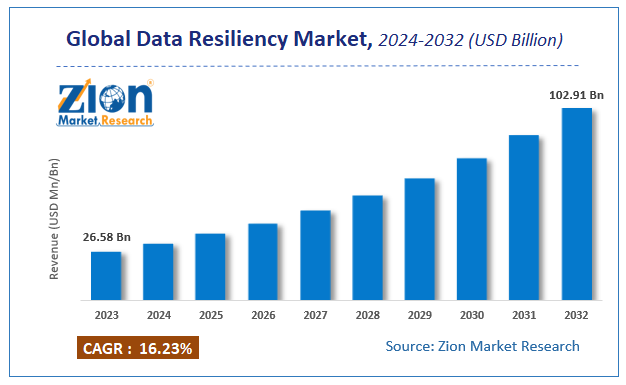
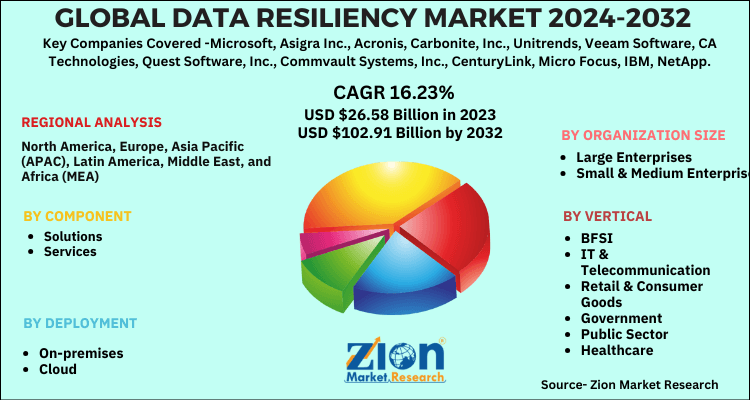
Zion Market Research has published a report on the global data resiliency market size estimating its value at USD 26.58 billion in 2023, with projections indicating that it will reach USD 102.91 billion by 2032. The market is expected to expand at a compound annual growth rate (CAGR) of 16.23% over the forecast period 2024-2032.
This report provides a comprehensive analysis of the growth drivers, restraints, and challenges shaping demand across the global data resiliency market throughout the forecast period, while highlighting high-potential emerging opportunities within the industry.
Key Insights
- As per the analysis shared by our research analyst, the global data resiliency market is estimated to grow at a CAGR of approximately 16.23% during the forecast period from 2024 to 2032.
- In terms of revenue, the global data resiliency market size was valued at around USD 26.58 billion in 2023 and is projected to reach USD 102.91 billion by 2032.
- The market is driven by rising data generation from multiple sources, increasing cyberattacks, growing needs for business continuity, and wider adoption of cloud-based recovery solutions.
- Based on the component, the solutions segment dominates the market as organizations prioritize integrated data backup and recovery, archiving, e-discovery, and disaster recovery platforms that ensure rapid restoration and operational continuity.
- Based on the deployment, the cloud segment is gaining strong traction due to its scalability, flexibility, and cost efficiency, while on-premises continues to hold significant presence among enterprises requiring strict data control.
- Based on organization size, the large enterprise segment leads adoption because of its complex IT environments, higher data volumes, and greater investment capacity in comprehensive resilience frameworks.
- Based on the vertical, the BFSI segment dominates owing to stringent regulatory requirements, the critical nature of financial data, and elevated risks from cyber threats that necessitate robust backup and recovery capabilities.
- Regionally, North America holds the leading regional position due to advanced IT infrastructure, early technology adoption, strong presence of key vendors, and high awareness of data protection needs.
Data Resiliency Market: Overview
Data resilience means the access to data required in the manufacturing environment. As per IBM, there are various techniques addressing data resilience needs, that are either disk replication or software replication. Firms are implementing data resilience services to resolve complexities for ensuring efficient cost optimization of their business processes. Apart from this, blockchain services are predicted to generate huge growth avenues for the market players in the foreseeable future.
Moreover, data resiliency can be achieved through the use of redundant parts, systems, and sub-systems. Data resilience helps in providing security to account numbers, debit cards or credit cards, and transaction passwords. The players in the data resiliency business assist BFSI firms in providing backup and recovering data to maintain continuity in business.
Data Resiliency Market: Growth Factors
Why is the demand for data resiliency solutions accelerating across industries?
Each firm witnesses huge data growth and as this data is produced through various sources, it needs to be monitored effectively and is required to be secured. This is likely to steer the market trends. In addition to this, a prominent surge in acceptance of cloud-based data recovery services as a result of their secure, scalable, and flexible features will embellish the business landscape over the forecasting timeline. Apparently, large-scale acceptance of data quality management services is likely to augment the expansion of the data resiliency industry over the forthcoming years.
Rising cyberattacks, particularly ransomware incidents, further intensify demand. Companies across BFSI, healthcare, and manufacturing sectors are prioritizing solutions that deliver immutable backups, rapid recovery points, and continuous data protection. The growing preference for cloud-based recovery services, valued for their scalability, flexibility, and reduced capital expenditure, is reinforcing this upward trajectory and enabling both large and mid-sized organizations to strengthen their resilience posture.
Data Resiliency Market: Restraints
What factors are limiting broader adoption of data resiliency technologies?
Despite clear benefits, several barriers continue to constrain market expansion. The high cost of building and maintaining fully redundant infrastructures remains a significant obstacle, especially for organizations operating under tight IT budgets. Implementing end-to-end resiliency often requires substantial investment in software licenses, storage capacity, networking, and skilled personnel, which can delay or reduce the scope of deployments.
In addition, the inherent complexity of hybrid and multi-cloud environments creates operational challenges. Managing consistent policies, ensuring data consistency across platforms, and orchestrating recovery across disparate systems demand advanced expertise that many organizations still lack. Limited awareness of modern resiliency solutions among small and medium-sized enterprises further restricts market penetration in this important customer segment.
Data Resiliency Market: Report Scope
| Report Attributes | Report Details |
|---|---|
| Report Name | Data Resiliency Market |
| Market Size in 2023 | USD 26.58 Billion |
| Market Forecast in 2032 | USD 102.91 Billion |
| Growth Rate | CAGR of 16.23% |
| Number of Pages | 255 |
| Key Companies Covered | Microsoft, Asigra Inc., Acronis, Carbonite, Inc., Unitrends, Veeam Software, CA Technologies, Quest Software, Inc., Commvault Systems, Inc., CenturyLink, Micro Focus, IBM, NetApp, Veritas Technologies LLC, and VMware |
| Segments Covered | By Component, By Deployment, By Organization Size, By Vertical, And By Region |
| Regions Covered | North America, Europe, Asia Pacific (APAC), Latin America, Middle East, and Africa (MEA) |
| Base Year | 2023 |
| Historical Year | 2018 - 2022 |
| Forecast Year | 2024 - 2032 |
| Customization Scope | Avail customized purchase options to meet your exact research needs. Request For Customization |
Data Resiliency Market: Segmentation
The data resiliency market is segmented by component, deployment, organization size, vertical, and region. All the segments of the data resiliency market have been analyzed based on present and future trends and the market is estimated from 2024 to 2032.
Based on Component, the data resiliency market is divided into solutions and services. The solutions segment currently represents the dominant portion of the market as enterprises prioritize comprehensive platforms that integrate data backup and recovery, data archiving and e-discovery, and disaster recovery capabilities. These solutions deliver the core functionality required to protect critical information assets, enable rapid restoration after incidents, and support long-term retention and legal discovery needs. Their dominance stems from the fundamental requirement of every organization to maintain recoverable copies of data and the continuous innovation in features such as immutability, automation, and orchestration. Services, encompassing professional services and managed services, form the second major category and are growing steadily as organizations seek expert implementation, ongoing support, and outsourced management of complex resiliency environments. The combination of robust solutions and complementary services is essential for driving overall market expansion, as technology alone is insufficient without proper deployment and continuous optimization.
Based on Deployment, the data resiliency market is divided into on-premises and cloud. Cloud deployment is experiencing the strongest growth momentum because of its inherent scalability, pay-as-you-go economics, rapid provisioning, and ability to support geographically distributed recovery. Organizations increasingly favor cloud-based models to reduce capital expenditure and gain flexibility in protecting workloads that already reside in public or hybrid clouds. On-premises deployment remains significant, particularly among large enterprises and regulated industries that require full control over data location, latency, and security boundaries. The coexistence of both models is shaping market evolution, with many buyers adopting hybrid approaches that leverage the strengths of each to achieve optimal resilience and cost efficiency.
Based on Organization Size, the data resiliency market is divided into large enterprises and small & medium enterprises. The large enterprises segment dominates current spending due to their extensive data volumes, complex multi-site and multi-cloud infrastructures, and greater financial capacity to invest in sophisticated protection frameworks. These organizations typically require enterprise-grade solutions with advanced orchestration, reporting, and compliance features, thereby driving substantial revenue for vendors. Small and medium enterprises represent a rapidly expanding opportunity as cloud-based and managed resiliency offerings lower the barriers to entry. The increasing availability of simplified, subscription-based solutions is enabling smaller organizations to achieve higher levels of protection previously accessible only to larger firms, contributing meaningfully to overall market growth.
Based on Vertical, the data resiliency market is divided into BFSI, IT & telecommunications, retail & consumer goods, government, public sector, healthcare, media & entertainment, manufacturing, and others. BFSI segment stands as the leading vertical because of the highly sensitive nature of financial data, stringent regulatory mandates, and elevated exposure to cyber threats. Financial institutions invest heavily in continuous data protection, rapid recovery capabilities, and immutable backups to ensure uninterrupted services and regulatory compliance. IT & telecommunications form another major vertical, driven by the need to safeguard network operations, customer data, and service continuity. Healthcare is also advancing quickly as patient data protection and operational uptime become critical priorities. Collectively, these verticals illustrate how sector-specific risk profiles and compliance pressures are accelerating the adoption of data resiliency solutions across the global economy.
Data Resiliency Market: Regional Insights
Why will North America continue to dominate the global market during the projection period?
North America maintains its leading position in the global data resiliency market through a combination of mature technology infrastructure, early adoption of advanced protection solutions, and the strong presence of major vendors. The United States, in particular, drives regional performance with widespread enterprise deployment of sophisticated backup, disaster recovery, and cyber-resilience platforms. High awareness of ransomware risks, stringent regulatory frameworks, and substantial IT budgets enable organizations across BFSI, healthcare, and technology sectors to invest continuously in next-generation resiliency capabilities. Innovation hubs and a dense ecosystem of solution providers further reinforce the region’s dominance by accelerating the development and commercialization of new features such as AI-assisted recovery and multi-cloud orchestration. These factors collectively ensure that North America remains the primary contributor to global market revenue while setting technological and operational benchmarks that influence adoption patterns worldwide.
Europe follows as a significant market, supported by comprehensive data protection regulations and growing enterprise focus on business continuity. Countries such as Germany, the United Kingdom, and France are advancing adoption through investments in hybrid cloud resilience and compliance-driven recovery architectures. Asia Pacific is the fastest-growing region, fueled by rapid digital transformation, expanding data centers, and increasing cyber threats in economies including China, India, Japan, and Singapore. Rising awareness among enterprises and government initiatives promoting data security are accelerating the uptake of both on-premises and cloud-based resiliency solutions. Latin America and the Middle East & Africa are emerging markets where improving IT infrastructure and growing recognition of data protection needs are gradually expanding demand, particularly in banking, telecommunications, and public sector applications.
Data Resiliency Market: Competitive Analysis
Some of the major players in the global data resiliency market include;
- Microsoft
- Asigra Inc.
- Acronis
- Carbonite. Inc.
- Unitrends
- Veeam Software
- CA Technologies
- Quest Software. Inc.
- Commvault Systems. Inc.
- CenturyLink
- Micro Focus
- IBM
- NetApp
- Veritas Technologies LLC
- VMware
Segments Covered
The global data resiliency market is segmented as follows:
By Component
- Solutions
- Data Backup & Recovery
- Data Archiving & e-Discovery
- Disaster Recovery
- Services
- Professional Services
- Implementation & Integration Services
- Support & Maintenance Services
- Consulting Services
- Managed Services
- Professional Services
By Deployment
- On-premises
- Cloud
By Organization Size
- Large Enterprises
- Small & Medium Enterprises
By Vertical
- BFSI
- IT & Telecommunication
- Retail & Consumer Goods
- Government
- Public Sector
- Healthcare
- Media & Entertainment
- Manufacturing
- Others (Law Firms, Hospitality, Education, Transportation, and Logistics)
By Region
- North America
- The U.S.
- Canada
- Mexico
- Europe
- France
- The UK
- Spain
- Germany
- Italy
- Rest of Europe
- Asia Pacific
- China
- Japan
- India
- Australia
- South Korea
- Rest of Asia Pacific
- The Middle East & Africa
- Saudi Arabia
- UAE
- Egypt
- Kuwait
- South Africa
- Rest of the Middle East & Africa
- Latin America
- Brazil
- Argentina
- Rest of Latin America
Table Of Content
Methodology
FrequentlyAsked Questions
Data resiliency ensures continuous data availability and rapid recovery during disruptions such as cyberattacks, hardware failures, or system outages. It encompasses backup, replication, disaster recovery, archiving, and protection strategies that maintain data integrity and support uninterrupted business operations.
The global data resiliency market is driven by rising cyberattacks, increasing business continuity requirements, expanding data volumes from diverse sources, and the growing adoption of cloud-based backup and recovery solutions that offer scalability and flexibility.
The global data resiliency market size was valued at approximately USD 26.58 billion in 2023 and is expected to reach around USD 102.91 billion by 2032.
The global data resiliency market is expected to grow at a compound annual growth rate (CAGR) of approximately 16.23% during the forecast period from 2024 to 2032.
Major challenges include the rising costs of implementing full redundancy, the complexity of managing hybrid and multi-cloud environments, skills shortages in specialized recovery technologies, and limited awareness of advanced solutions among smaller organizations.
Emerging trends include ransomware-resilient architectures with immutable backups, rapid automated recovery, multi-cloud failover capabilities, continuous testing of recovery processes, and the integration of artificial intelligence for anomaly detection and clean recovery orchestration.
The value chain typically includes technology providers developing core platforms, system integrators and consultants delivering implementation services, managed service providers offering ongoing operations, and end-user organizations across verticals that deploy and utilize the solutions for operational continuity.
North America is expected to contribute notably and lead the global data resiliency market during the forecast period, supported by advanced infrastructure, high adoption rates, and the presence of leading technology vendors.
Some of the major players leveraging the data resiliency market growth are Microsoft, Asigra Inc., Acronis, Carbonite, Inc., Unitrends, Veeam Software, CA Technologies, Quest Software, Inc., Commvault Systems, Inc., CenturyLink, Micro Focus, IBM, NetApp, Veritas Technologies LLC, and VMware.
The report provides a detailed examination of growth drivers, restraints, opportunities, and challenges, along with comprehensive segmentation analysis, regional insights, competitive landscape, and forward-looking forecasts that enable stakeholders to make informed strategic decisions.

HappyClients

