
Global Coronavirus Testing Kits Market Size, Share, Trends, Growth and Forecast 2032

Coronavirus Testing Kits Market By Type of Test (Molecular and Serology), By Technology (RT-PCR, ELISA Test and Microneutralization Assays), By Specimen Type (Nose & Throat Swab, Blood, Sputum and Nasal Aspirate), By End User (Hospitals and Clinics, Public Health Labs, Private or Commercial Labs, and Other End Users), and By Region: Global Industry Perspective, Comprehensive Analysis, and Forecast, 2024 - 2032
| Market Size in 2023 | Market Forecast in 2032 | CAGR (in %) | Base Year |
|---|---|---|---|
| USD 17.48 Billion | USD 100.04 Billion | 21.39% | 2023 |
How big is the Coronavirus Testing Kits Market?
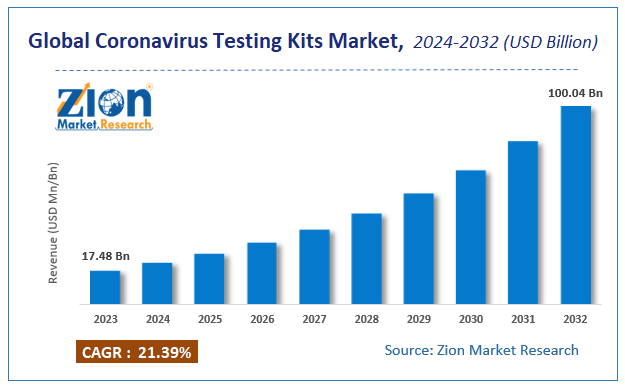
Zion Market Research has published a report on the global Coronavirus Testing Kits Market, estimating its value at USD 17.48 billion in 2023, with projections indicating that it will reach USD 100.04 billion by 2032. The market is expected to expand at a compound annual growth rate (CAGR) of 21.39% over the forecast period 2024-2032.
This report provides a comprehensive analysis of the growth drivers, restraints, and challenges shaping demand across the global Coronavirus Testing Kits market throughout the forecast period, while highlighting high-potential emerging opportunities within the industry.
Key Insights
- According to our research analyst, the global Coronavirus Testing Kits Market is estimated to grow at a CAGR of around 21.39% over the forecast period (2024-2032).
- In terms of revenue, the global Coronavirus Testing Kits Market size was valued at around USD 17.48 billion in 2023 and is projected to reach USD 100.04 billion by 2032.
- Based on the Type of Test, the Molecular tests, particularly RT-PCR assay kits, have held the majority share due to their high sensitivity and specificity in detecting SARS-CoV-2.
- Based on the Technology, this RT-PCR Technology is Reverse Transcription Polymerase Chain Reaction (RT-PCR) technology is the predominant segment, widely adopted for its accuracy in quantifying viral RNA.
- Based on the Specimen type, nasopharyngeal swabs are the most commonly used specimen type, recognized for their high sensitivity and accuracy in detecting COVID-19.
- Based on the End User, hospitals and clinics represent the largest end-user segment, driven by the high volume of tests conducted to manage and control the spread of the virus.
- Based on the Region, Europe accounts for the largest market share, attributed to the significant surge in COVID-19 cases and the substantial demand for diagnostic kits to control the outbreak.
Coronavirus Testing Kits Market: Overview
Coronavirus testing kits are diagnostic tools designed to detect the presence of SARS-CoV-2 infection by analyzing clinical samples. These kits identify viral genetic material or antibodies through methods such as molecular assays and serological tests, enabling confirmation of active or past infection. They play a critical role in clinical diagnosis, public health surveillance, outbreak control, and patient management by providing timely and reliable results from specimens including nasal and throat swabs, blood, sputum, and nasal aspirates.
Coronavirus Testing Kits Market: Dynamics
Key Growth Drivers
The coronavirus testing kits market has experienced significant growth, primarily driven by the ongoing need for effective diagnostic solutions during the COVID-19 pandemic. Government initiatives and funding for large-scale testing programs have accelerated the adoption of rapid and reliable testing kits. Additionally, the increasing awareness about the importance of early detection and containment has further fueled demand. Technological advancements, including the development of rapid antigen tests, RT-PCR kits, and self-testing kits, have made testing more accessible and efficient. The emergence of new virus variants has also sustained the need for continuous testing, further supporting market growth.
Restraints
Despite strong market demand, several factors act as restraints in the coronavirus testing kits market. The high cost of advanced testing kits, particularly in low- and middle-income countries, limits their widespread adoption. Supply chain disruptions and shortages of raw materials during the pandemic have also hampered manufacturing and distribution. Additionally, the lack of accuracy in some rapid test kits, leading to false negatives or false positives, has raised concerns over reliability. Regulatory challenges and the need for stringent approvals further delay the introduction of new testing solutions, restraining market growth.
Opportunities
The growing emphasis on public health preparedness and strengthening healthcare infrastructure creates numerous opportunities in the coronavirus testing kits market. Governments and healthcare organizations are investing in decentralized testing facilities, increasing the accessibility of testing in rural and underserved areas. The development of multiplex diagnostic kits capable of detecting multiple respiratory pathogens simultaneously is another emerging opportunity. Furthermore, the rising adoption of home-based and point-of-care testing kits provides convenience and reduces the burden on healthcare facilities. Continuous research in molecular diagnostics and advancements in biosensors further expand growth prospects in the market.
Challenges
The coronavirus testing kits market faces challenges related to evolving virus strains, which may reduce the effectiveness of existing diagnostic kits. Ensuring the accuracy and sensitivity of testing kits remains a persistent challenge for manufacturers. Additionally, the global shift toward vaccination campaigns and declining COVID-19 cases in some regions may reduce the demand for frequent testing, impacting market growth. Competing priorities in healthcare budgets and the presence of counterfeit or low-quality testing kits also pose risks to market stability. Maintaining a balance between affordability, accessibility, and accuracy is essential for overcoming these challenges.
Coronavirus Testing Kits Market: Report Scope
| Report Attributes | Report Details |
|---|---|
| Report Name | Coronavirus Testing Kits Market |
| Market Size in 2023 | USD 17.48 Billion |
| Market Forecast in 2032 | USD 100.04 Billion |
| Growth Rate | CAGR of 21.39% |
| Number of Pages | 220 |
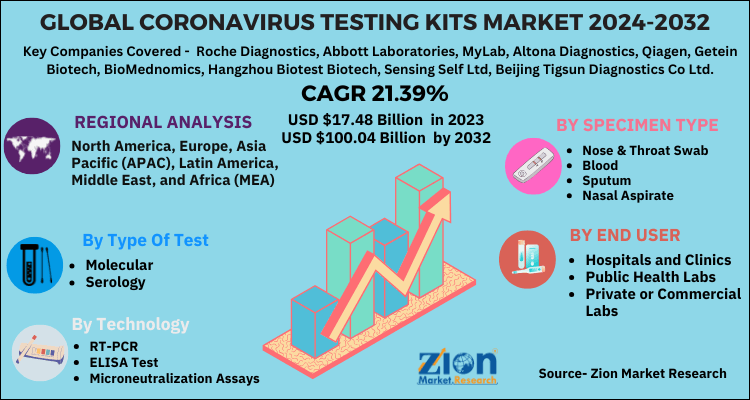
| Key Companies Covered | Roche Diagnostics, Abbott Laboratories, MyLab, Altona Diagnostics, Qiagen, Getein Biotech, BioMednomics, Hangzhou Biotest Biotech, Sensing Self Ltd, Beijing Tigsun Diagnostics Co Ltd, AmonMed Biotechnology Co, CTK Biotech and Biomaxima |
| Segments Covered | By Type Of Test, By Technology, By Specimen Type, By End User, and By Region |
| Regions Covered | North America, Europe, Asia Pacific (APAC), Latin America, Middle East, and Africa (MEA) |
| Base Year | 2023 |
| Historical Year | 2018 - 2022 |
| Forecast Year | 2024 - 2032 |
| Customization Scope | Avail customized purchase options to meet your exact research needs. Request For Customization |
Coronavirus Testing Kits Market: Segmentation
The coronavirus testing kits market is segmented by type of test, technology, specimen type, end user, and region.
Based on type of test, the global coronavirus testing kits market is bifurcated into molecular and serology. Molecular tests, particularly RT-PCR assay kits, have held the majority share due to their high sensitivity and specificity in detecting SARS-CoV-2 genetic material. This dominance drives market reliability and clinical confidence by providing accurate confirmation of active infection. Serology tests complement molecular methods by detecting antibodies that indicate past exposure or immune response, supporting broader epidemiological and surveillance applications.
Based on technology, the global coronavirus testing kits market is categorized into RT-PCR, ELISA tests, and microneutralization assays. RT-PCR technology is the predominant segment, widely adopted for its accuracy in quantifying viral RNA and serving as a gold-standard diagnostic approach. This leadership underpins high-volume clinical and public health testing.
Based on specimen type, the market is segmented into nose & throat swab, blood, sputum, and nasal aspirate. Nose & Throat Swab (including nasopharyngeal swabs) is the most commonly used specimen type, recognized for its high sensitivity and accuracy in detecting COVID-19. This preference drives standardized sample collection protocols across healthcare settings.
Based on end user, the market is segmented into hospitals and clinics, public health labs, private or commercial labs, and other end users. Hospitals and Clinics represent the largest end-user segment, driven by the high volume of tests conducted to diagnose, manage, and control the spread of the virus in clinical settings. This leadership anchors overall market demand.
Coronavirus Testing Kits Market: Regional Analysis
Why will Europe continue to account for a leading share during the projection period?
Europe accounts for the largest market share, attributed to the significant surge in COVID-19 cases and the substantial demand for diagnostic kits required to control the outbreak. Strong public health infrastructure, coordinated testing programs, and high clinical testing volumes have supported widespread adoption of both molecular and serological kits. Continued emphasis on surveillance, preparedness, and integration of advanced diagnostic technologies further reinforces the region’s contribution to global market activity and innovation.
North America maintains robust demand supported by advanced healthcare systems, extensive laboratory networks, and ongoing public health monitoring requirements. High testing capacity and rapid adoption of new diagnostic technologies sustain regional importance.
Asia Pacific demonstrates substantial activity driven by large population bases, expanding healthcare infrastructure, and government-led testing initiatives in key countries. Growing domestic manufacturing capabilities and rising awareness of diagnostic preparedness contribute to progressive market expansion.
Coronavirus Testing Kits Market: Competitive Analysis
Some major players in the coronavirus testing kits market are;
- Roche Diagnostics
- Abbott Laboratories
- MyLab
- Altona Diagnostics
- Qiagen
- Getein Biotech
- BioMednomics
- Hangzhou Biotest Biotech
- Sensing Self Ltd
- Beijing Tigsun Diagnostics Co Ltd
- AmonMed Biotechnology Co
- CTK Biotech
- Biomaxima.
The report segments of the global coronavirus testing kits market are as follows:
By Type of Test
- Molecular
- Serology
By Technology
- RT-PCR
- ELISA Test
- Microneutralization Assays
By Specimen Type
- Nose & Throat Swab
- Blood
- Sputum
- Nasal Aspirate
By End User
- Hospitals and Clinics
- Public Health Labs
- Private or Commercial Labs
- Other End Users (Physician Labs, Research Institutes, etc.)
By Region
- North America
- The U.S.
- Canada
- Mexico
- Europe
- France
- The UK
- Spain
- Germany
- Italy
- Rest of Europe
- Asia Pacific
- China
- Japan
- India
- Australia
- South Korea
- Rest of Asia Pacific
- The Middle East & Africa
- Saudi Arabia
- UAE
- Egypt
- Kuwait
- South Africa
- Rest of the Middle East & Africa
- Latin America
- Brazil
- Argentina
- Rest of Latin America
Table Of Content
Methodology
FrequentlyAsked Questions
Coronavirus testing kits are diagnostic products used to detect SARS-CoV-2 infection by analyzing clinical samples for viral genetic material or antibodies through molecular methods such as RT-PCR or serological assays such as ELISA.
Key growth drivers include the ongoing need for effective diagnostic solutions, government initiatives and funding for large-scale testing, increasing awareness of early detection and containment, technological advancements in RT-PCR and rapid tests, and the continued requirement for testing amid emerging variants.
According to study, the global Coronavirus Testing Kits market size was worth around USD 17.48 Billion in 2023 and is predicted to grow to around USD 100.04 Billion By 2032.
The global Coronavirus Testing Kits market is expected to grow at a Compound Annual Growth Rate (CAGR) of around CAGR 21.39% during the forecast period from 2024-2032.
The global Coronavirus Testing Kits industry is projected to be challenged by Challenges include fluctuating demand, pricing pressure, and regulatory compliance updates.
The Opportunities include surveillance testing, rapid diagnostics adoption, preparedness programs, and emerging infectious disease monitoring will offer significant growth opportunities in the Coronavirus Testing Kits market.
High-sensitivity antigen and molecular kits; self-test and home-use formats; faster turnaround and mass screening focus are the emerging trends and innovations impacting the Coronavirus Testing Kits market.
Europe accounts for the largest market share due to high testing demand and public health response needs, while North America and Asia Pacific also contribute significantly through advanced infrastructure and large-scale programs.
Some of the prominent players operating in the global Coronavirus Testing Kits market are; Roche Diagnostics, Abbott Laboratories, MyLab, Altona Diagnostics, Qiagen, Getein Biotech, BioMednomics, Hangzhou Biotest Biotech, Sensing Self Ltd, Beijing Tigsun Diagnostics Co Ltd, AmonMed Biotechnology Co, CTK Biotech and Biomaxima and others.
The report explores crucial aspects of the Coronavirus Testing Kits market, including a detailed discussion of existing growth factors and restraints, while also browsing future growth opportunities and challenges that impact the market.

HappyClients

