
Global Chemical Reagents Market Size, Share, Trends, Growth and Forecast 2034

Chemical Reagents Market By Product Type (Organic Reagents, Inorganic Reagents, Analytical Reagents, Biochemical Reagents), By Application (Pharmaceutical Research, Environmental Testing, Academic and Research Laboratories, Industrial Quality Control), By Grade (Laboratory Grade, Analytical Grade, Technical Grade, Pharmaceutical Grade), By End-User (Pharmaceutical Companies, Research Institutes, Diagnostic Laboratories, Chemical Manufacturers), and By Region - Global and Regional Industry Overview, Market Intelligence, Comprehensive Analysis, Historical Data, and Forecasts 2026 - 2034
| Market Size in 2025 | Market Forecast in 2034 | CAGR (in %) | Base Year |
|---|---|---|---|
| USD 14.8 Billion | USD 26.5 Billion | 6.69% | 2025 |
Chemical Reagents Industry Perspective:
What will be the size of the chemical reagents market during the forecast period?
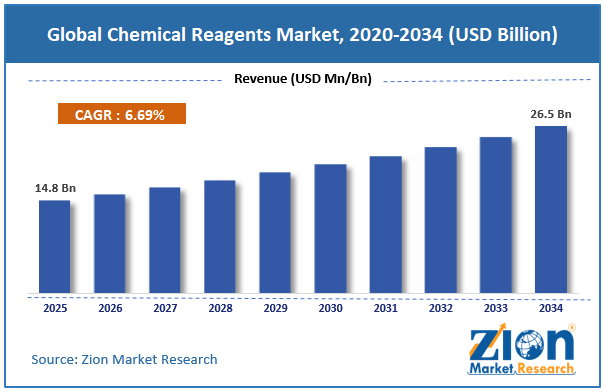
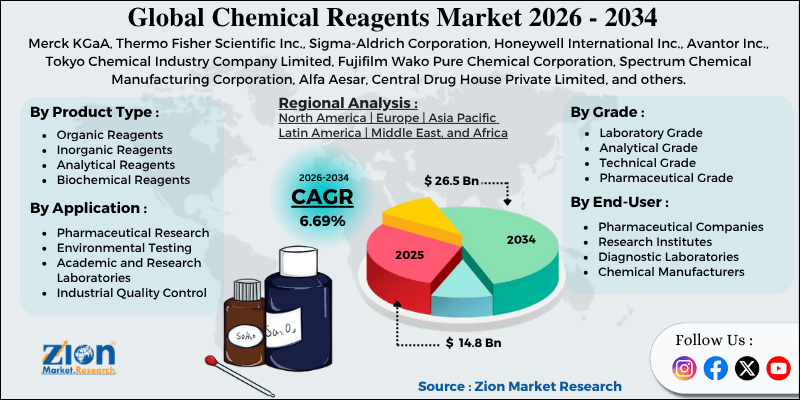
The global chemical reagents market size was approximately USD 14.8 billion in 2025 and is projected to reach around USD 26.5 billion by 2034, with a compound annual growth rate of roughly 6.69% between 2026 and 2034.
Key Insights
- As per the analysis shared by our research analyst, the global chemical reagents market is estimated to grow annually at a compound annual growth rate of around 6.69% over the forecast period from 2026 to 2034.
- In terms of revenue, the global chemical reagents market size was valued at approximately USD 14.8 billion in 2025 and is projected to reach USD 26.5 billion by 2034.
- The chemical reagents market is expected to grow steadily, driven by rising pharmaceutical research activity, growing demand for environmental testing, expanding academic research programs, and continuous improvements in reagent purity and consistency.
- Based on product type, organic reagents are expected to lead the market, while biochemical reagents are anticipated to grow rapidly as demand for advanced biological testing methods increases.
- Based on application, pharmaceutical research is expected to lead the chemical reagents market, while environmental testing is anticipated to grow quickly, supported by stricter environmental regulations and monitoring requirements.
- Based on grade, analytical grade reagents are the largest current segment. In contrast, pharmaceutical grade reagents are expected to grow rapidly during the forecast period as drug development activity continues to expand.
- Based on end-user, pharmaceutical companies are the largest current end-user group, while diagnostic laboratories are expected to grow steadily as demand for accurate testing services continues to rise.
- Based on region, the Asia Pacific is projected to dominate the global chemical reagents market during the estimated period, followed by North America.
Chemical Reagents Market: Overview
Chemical reagents are chemical substances used in laboratories to test, measure, identify, and study different materials during scientific research, product development, and quality testing. They are essential for carrying out accurate chemical reactions and are widely used in pharmaceuticals, biotechnology, healthcare, environmental testing, food and beverage, academic research, and industrial manufacturing. Chemical reagents help scientists identify unknown substances, check the purity of raw materials, develop new medicines, and ensure products meet quality and safety standards. Pharmaceutical companies rely on them for drug discovery, clinical research, and quality control, while environmental laboratories use them to test water, air, and soil for pollutants. Research institutions and universities depend on chemical reagents for laboratory experiments, education, and scientific innovation. Industries also use them to maintain consistent product quality and comply with regulatory standards. As global investments in research and development continue to increase, the demand for high-quality and high-purity chemical reagents is growing rapidly. Rising pharmaceutical research, expanding environmental testing, stricter quality regulations, and continuous advancements in laboratory technologies are driving the growth of the chemical reagents market worldwide.
The chemical reagents industry is growing due to rising pharmaceutical research and development spending, expanding environmental testing requirements, and increasing demand for accurate laboratory analysis across multiple industries.
Impact of the USA-Israel War on Iran on the Chemical Reagents Market
Ongoing tensions among the United States, Israel, and Iran may cause short-term disruptions in the supply of certain raw chemical feedstocks used to produce laboratory reagents, as several trade routes for base chemicals pass through affected regions. Manufacturers relying on imported raw materials could face temporary price increases and delivery delays. However, steady demand from pharmaceutical companies, research institutes, and diagnostic laboratories is expected to keep the chemical reagents market on a stable growth path despite short-term regional disruptions.
Chemical Reagents Market: Technology Roadmap 2026–2034
What is the projected development roadmap for the chemical reagents market over the forecast period?
The chemical reagents market is progressing through improved purity standards, smarter production processes, and materials designed for safer laboratory use. The market is expected to grow at a compound annual growth rate of around 6.69% over the forecast period, supported by rising global demand for accurate testing and expanding research activities.
The following roadmap outlines key development phases expected through 2034.
2026–2028: Purity Enhancement and Safer Handling Phase
- Manufacturers are expected to produce higher-purity chemical reagents to meet the increasing accuracy needs of pharmaceutical companies and research laboratories.
- Automated reagent production lines are expected to expand, reducing the chances of contamination and improving consistency across large production batches.
- Better packaging and handling solutions are expected to keep reagents stable for longer while reducing the risk of exposure during storage and transportation.
2029–2031: Smart Quality Control and Digital Integration Phase
- Companies are expected to use sensor-based quality monitoring systems during reagent production to detect impurities in real time.
- Better integration between reagent suppliers and laboratory information management systems is expected to help researchers track reagent use and expiration dates more easily.
- Eco-friendly and low-toxicity chemical reagents are expected to become more widely used, especially in laboratories looking to reduce hazardous waste.
2032–2034: Fully Automated and Sustainable Production Phase
- Reagent manufacturing facilities are expected to become more automated by connecting raw material sourcing, production, and quality control into one integrated system.
- Self-adjusting production systems are expected to reduce manual settings, making large-scale reagent production more consistent and less dependent on skilled workers.
- Advanced recycling and waste reduction systems are expected to improve the safe disposal and reuse of chemical byproducts, supporting sustainability across the laboratory products industry.
Chemical Reagents Market: Dynamics
Growth Drivers
How is rising pharmaceutical research activity driving the chemical reagents market?
The chemical reagents market is growing as pharmaceutical companies, research laboratories, and healthcare organizations increasingly rely on high-quality reagents for accurate testing and scientific research. Chemical reagents play a vital role in drug discovery, quality control, disease research, and laboratory analysis by helping scientists identify substances, verify purity, and ensure reliable results. As more new medicines enter development, the demand for high-purity chemical reagents continues to increase. Strict government regulations for drug safety and product quality are also encouraging the use of advanced laboratory reagents that meet high-performance standards. Beyond pharmaceuticals, chemical reagents are widely used in biotechnology, environmental testing, food and beverage analysis, agriculture, and cosmetic research to ensure product safety and regulatory compliance. Manufacturers value these reagents because they improve testing accuracy, reduce errors, and speed up product development. Continuous investments in research and development, expanding laboratory infrastructure, and growing demand for precise analytical testing are driving the adoption of high-performance chemical reagents, supporting steady growth across healthcare, industrial, and scientific research sectors worldwide.
Growing demand for environmental testing and expanding academic research programs is accelerating the chemical reagents market.
The chemical reagents industry is growing as environmental agencies, research institutions, universities, and manufacturers need reliable materials for testing, analysis, and quality control. Chemical reagents are widely used to detect pollutants, test water and air quality, and monitor environmental safety, helping organizations meet strict government regulations. As environmental standards become more demanding, laboratories are adopting high-quality reagents to achieve accurate and consistent test results. Universities and research institutes also rely on chemical reagents for laboratory experiments, scientific research, and student training in chemistry, biology, and life sciences. These reagents help researchers perform precise experiments and produce dependable results.
In addition, manufacturers use chemical reagents to check the quality, purity, and safety of raw materials and finished products before they reach the market. Industries such as pharmaceuticals, food and beverages, biotechnology, and chemicals depend on reliable testing to meet regulatory standards and maintain product quality. Rising demand for accurate laboratory testing, scientific research, environmental monitoring, and industrial quality assurance is driving the adoption of advanced chemical reagents across multiple industries worldwide.
Restraints
Strict safety regulations and raw material price fluctuations are key challenges in the chemical reagents market.
The chemical reagents market faces several challenges that may affect its growth. One of the biggest challenges is meeting strict safety and handling regulations for the production, storage, and transportation of chemical reagents, especially those that are hazardous or toxic. Manufacturers must invest heavily in safety equipment, employee training, and regulatory compliance to meet these standards. Another challenge is the fluctuating cost of raw materials used to produce chemical reagents, as global chemical and petrochemical markets often influence prices. Companies must also maintain consistent product quality because low-purity or inconsistent reagents can produce inaccurate test results, particularly in pharmaceutical, biotechnology, and diagnostic applications.
In addition, many countries face a shortage of skilled chemists and laboratory professionals needed to manufacture and test high-purity reagents. These challenges increase production costs and can slow market growth. Despite these barriers, rising demand for accurate laboratory testing, reliable research materials, high-quality diagnostics, and advanced scientific analysis is expected to support the long-term growth of the market.
Opportunities
How are expanding diagnostic testing needs and growing biotechnology research driving the chemical reagents market?
The chemical reagents market offers significant growth opportunities as industries increasingly depend on accurate testing and high-quality laboratory materials. Rising demand for diagnostic testing across North America, Europe, and Asia Pacific is increasing the use of chemical reagents in disease diagnosis, clinical laboratories, and patient monitoring. Healthcare providers need reliable, easy-to-use, and consistent testing materials, encouraging manufacturers to develop advanced reagent formulations with higher accuracy and performance. The biotechnology sector is also expanding its use of specialized chemical reagents for genetic research, cell culture, molecular biology, and protein analysis.
In addition, the growing adoption of personalized medicine is creating demand for reagents that support precise and patient-specific testing. Modern manufacturing technologies, including automated production, advanced purification methods, and improved quality control, are making chemical reagents more affordable, reliable, and easier to produce in large volumes. These advancements are helping research laboratories, pharmaceutical companies, and diagnostic centers improve testing accuracy and operational efficiency. Growing investments in biotechnology, expanding healthcare infrastructure, continuous product innovation, and increasing research activities are expected to create new opportunities and support the long-term growth of the chemical reagents market worldwide.
Challenges
What challenges does the chemical reagents market face in quality consistency and workforce readiness amid rising competition?
The chemical reagents industry faces several challenges that may slow its growth. One of the biggest challenges is maintaining consistent product purity during manufacturing. Even small changes in raw material quality, temperature, or production conditions can affect the accuracy and reliability of chemical reagents. Low-quality reagents can produce incorrect test results, increase laboratory costs, and delay research, quality control, or diagnostic work. Manufacturers must also develop reagents that perform consistently across different laboratory environments and testing applications, requiring continuous research, quality testing, and investment. Another challenge is the shortage of skilled chemists and laboratory professionals who can safely produce, test, and handle high-purity chemical reagents.
As production processes become more automated and digitally connected, companies need workers with both scientific knowledge and technical skills. In addition, growing competition from established companies and new market entrants is creating pricing pressure while encouraging continuous product innovation, improved quality, and the development of advanced reagent solutions to meet changing laboratory and industry requirements worldwide.
Chemical Reagents Market: Report Scope
| Report Attributes | Report Details |
|---|---|
| Report Name | Chemical Reagents Market |
| Market Size in 2025 | USD 14.8 Billion |
| Market Forecast in 2034 | USD 26.5 Billion |
| Growth Rate | CAGR of 6.69% |
| Number of Pages | 229 |
| Key Companies Covered | Merck KGaA, Thermo Fisher Scientific Inc., Sigma-Aldrich Corporation, Honeywell International Inc., Avantor Inc., Tokyo Chemical Industry Company Limited, Fujifilm Wako Pure Chemical Corporation, Spectrum Chemical Manufacturing Corporation, Alfa Aesar, Central Drug House Private Limited, and others. |
| Segments Covered | By Product Type, By Application, By Grade, By End-User, and By Region |
| Regions Covered | North America, Europe, Asia Pacific (APAC), Latin America, Middle East, and Africa (MEA) |
| Base Year | 2025 |
| Historical Year | 2020 to 2024 |
| Forecast Year | 2026 - 2034 |
| Customization Scope | Avail customized purchase options to meet your exact research needs. Request For Customization |
Chemical Reagents Market: Segmentation
The global chemical reagents market is segmented by product type, application, grade, end-user, and region.
Why are organic reagents the preferred product type in the chemical reagents market?
Based on product type, the global chemical reagents market is segregated into organic reagents, inorganic reagents, analytical reagents, and biochemical reagents. Organic reagents hold about 40% of the market share, leading due to their widespread use in pharmaceutical synthesis, research chemistry, and industrial applications. Biochemical reagents hold around 22% of the market share. It is one of the fastest-growing segments, driven by increasing demand for advanced biological and genetic testing methods.
How does the pharmaceutical research application segment maintain its leading position in the chemical reagents market?
Based on application, the chemical reagents market is categorized into pharmaceutical research, environmental testing, academic and research laboratories, and industrial quality control. The pharmaceutical research segment accounts for about 37% of the global chemical reagents market, driven by rising drug development activity and increasing demand for accurate testing during clinical research. The environmental testing segment holds around 24% of the market share. It is one of the fastest-growing segments, driven by stricter environmental regulations and growing pollution monitoring needs.
Which grade segment dominates the chemical reagents market?
Based on grade, the chemical reagents industry is divided into laboratory grade, analytical grade, technical grade, and pharmaceutical grade. Analytical grade reagents lead with about a 36% share, driven by their widespread use in precise laboratory testing and research applications. Pharmaceutical grade reagents hold around 25% of the market share. It is growing rapidly as drug development and clinical testing activity continues to expand worldwide.
How do pharmaceutical companies dominate the end-user landscape in the chemical reagents market?
Based on end-user, the market is classified into pharmaceutical companies, research institutes, diagnostic laboratories, and chemical manufacturers. Pharmaceutical companies account for about 34% of the market, due to their continuous need for reliable reagents during drug discovery and quality testing. Diagnostic laboratories hold around a 26% share. They are growing steadily as demand for accurate disease detection and patient testing services continues to rise.
Chemical Reagents Market: Regional Analysis
What is driving Asia Pacific's leadership in the chemical reagents market?
Asia Pacific accounts for around 41% of the global chemical reagents market, making it the largest regional market. The region leads because of its strong pharmaceutical manufacturing industry, expanding research infrastructure, growing biotechnology sector, and increasing demand for laboratory testing. China holds the largest market share due to its large-scale chemical production, strong pharmaceutical exports, and rising investments in research and development. Manufacturers across China, Japan, South Korea, and India are increasingly using advanced reagent production technologies to support drug development, environmental testing, diagnostic laboratories, and scientific research. The rising demand for personalized medicine, molecular diagnostics, and clinical testing is also increasing the use of specialized chemical reagents across the region. India is contributing significantly to market growth through the rapid expansion of its pharmaceutical, biotechnology, and academic research sectors, along with increasing government support and foreign investments.
Universities, research institutes, and healthcare laboratories are adopting high-quality reagent formulations to improve testing accuracy and research outcomes. Strong collaboration among chemical manufacturers, pharmaceutical companies, research organizations, and healthcare providers continues to drive product innovation, improve quality standards, and expand production capacity. Growing investments in laboratory infrastructure, scientific research, and advanced manufacturing technologies are expected to support sustained regional market growth.
What factors are supporting the expansion of the chemical reagents market across North America?
North America accounts for around 29% of the global chemical reagents market, making it the second-largest regional market. The region is growing because of its strong pharmaceutical industry, advanced research facilities, expanding biotechnology sector, and increasing demand for accurate laboratory testing. The United States holds the largest market share due to its high spending on pharmaceutical research and development, well-established laboratory infrastructure, and continuous investments in advanced analytical technologies. Chemical reagents are widely used in drug discovery, clinical diagnostics, environmental monitoring, academic research, food safety testing, and industrial quality control across the country.
Canada is also contributing to market growth through increasing investments in biotechnology research, healthcare diagnostics, and environmental testing programs. Mexico is emerging as an important market with expanding pharmaceutical manufacturing, growing industrial production, and rising demand for affordable, high-quality laboratory reagents. Governments across North America continue to support scientific innovation by funding research institutions, universities, and healthcare organizations. Chemical manufacturers are working closely with pharmaceutical companies, diagnostic laboratories, and research centers to develop safer, more reliable, and higher-purity reagents. Rising investments in life sciences, growing diagnostic testing, continuous product innovation, and increasing focus on quality assurance are expected to support long-term regional market growth.
Recent Market Developments
- In June 2026, Merck KGaA announced its US$11.3 billion acquisition of Bio-Techne to strengthen its life science business, expanding its portfolio of research reagents, proteins, antibodies, and laboratory tools used in pharmaceutical research, biotechnology, and precision diagnostics.
Chemical Reagents Market: Competitive Analysis
The leading players in the global chemical reagents market are;
- Merck KGaA
- Thermo Fisher Scientific Inc.
- Sigma-Aldrich Corporation
- Honeywell International Inc.
- Avantor Inc.
- Tokyo Chemical Industry Company Limited
- Fujifilm Wako Pure Chemical Corporation
- Spectrum Chemical Manufacturing Corporation
- Alfa Aesar
- Central Drug House Private Limited
The global chemical reagents market is segmented as follows:
By Product Type
- Organic Reagents
- Inorganic Reagents
- Analytical Reagents
- Biochemical Reagents
By Application
- Pharmaceutical Research
- Environmental Testing
- Academic and Research Laboratories
- Industrial Quality Control
By Grade
- Laboratory Grade
- Analytical Grade
- Technical Grade
- Pharmaceutical Grade
By End-User
- Pharmaceutical Companies
- Research Institutes
- Diagnostic Laboratories
- Chemical Manufacturers
By Region
- North America
- The U.S.
- Canada
- Mexico
- Europe
- France
- The UK
- Spain
- Germany
- Italy
- Rest of Europe
- Asia Pacific
- China
- Japan
- India
- Australia
- South Korea
- Rest of Asia Pacific
- The Middle East & Africa
- Saudi Arabia
- UAE
- Egypt
- Kuwait
- South Africa
- Rest of the Middle East & Africa
- Latin America
- Brazil
- Argentina
- Rest of Latin America
Table Of Content
Methodology
FrequentlyAsked Questions
Chemical reagents are chemical substances used in laboratories to test, measure, identify, and study different materials during scientific research, product development, and quality testing. They are essential for carrying out accurate chemical reactions and are widely used in pharmaceuticals, biotechnology, healthcare, environmental testing, food and beverage, academic research, and industrial manufacturing.
The global chemical reagents market is expected to grow, driven by rising pharmaceutical research spending, expanding environmental testing needs, growing academic research programs, and continuous improvements in reagent purity standards.
According to research, the global chemical reagents market size was approximately USD 14.8 billion in 2025 and is projected to reach approximately USD 26.5 billion by 2034.
The compound annual growth rate value of the chemical reagents market is expected to be around 6.69% from 2026 to 2034.
The Asia Pacific is expected to lead the global chemical reagents market during the forecast period, driven by strong pharmaceutical manufacturing, expanding research infrastructure, and rising diagnostic testing demand.
The major players in the global chemical reagents market include Merck KGaA, Thermo Fisher Scientific Inc., Sigma-Aldrich Corporation, Honeywell International Inc., Avantor Inc., Tokyo Chemical Industry Company Limited, Fujifilm Wako Pure Chemical Corporation, Spectrum Chemical Manufacturing Corporation, Alfa Aesar, and Central Drug House Private Limited.
The report examines key aspects of the chemical reagents market, including growth drivers, restraints, emerging opportunities, challenges, a competitive landscape analysis, regional breakdowns, and a detailed future outlook across all major product types, applications, grades, end users, and geographies.
Which application areas will offer significant growth opportunities in the chemical reagents market?
The chemical reagents market is expected to see strong growth in pharmaceutical research, clinical diagnostics, biotechnology, environmental testing, food safety, and academic research. Rising demand for personalized medicine, molecular diagnostics, and advanced laboratory testing is creating new application opportunities.
The chemical reagents market offers attractive investment opportunities in high-purity reagent production, biotechnology, diagnostic testing, and sustainable manufacturing. Partnerships among chemical manufacturers, pharmaceutical companies, research institutions, and diagnostic laboratories are driving innovation and expanding product development.
The chemical reagents industry value chain includes raw material sourcing, chemical synthesis, purification, quality testing, packaging, distribution, and end use in pharmaceutical, biotechnology, environmental, industrial, and research laboratories.

HappyClients

