Blue Ammonia Market Size, Share, Trends, Growth and Forecast 2034
Blue Ammonia Market By Technology (Haber-Bosch Process, Steam Methane Reforming (SMR), Gas Partial Oxidation, and Autothermal Reforming (ATR)), By Manufacturing Process (Electrochemical Process, Steam Methane Reforming (SMR), and Thermochemical Process), By Application (Transportation Fuel, Fertilizers, Polymers, Pharmaceutical, Industrial Feedstock, Power & Energy, and Others), By End-User Industry (Automotive & Transportation, Power Generation, Agriculture, Pharmaceutical Industry, and Chemical & Petrochemical Industry), and By Region - Global and Regional Industry Overview, Market Intelligence, Comprehensive Analysis, Historical Data, and Forecasts 2026 - 2034
| Market Size in 2025 | Market Forecast in 2034 | CAGR (in %) | Base Year |
|---|---|---|---|
| USD 210.42 Million | USD 16,498.79 Million | 62.33% | 2025 |
Blue Ammonia Industry Perspective:
What is the anticipated size of the blue ammonia market during the projection period?
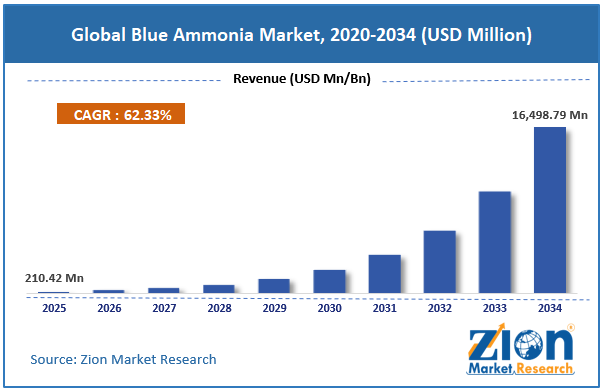
The global blue ammonia market size was worth around USD 210.42 million in 2025 and is predicted to grow to around USD 16,498.79 million by 2034, with a compound annual growth rate (CAGR) of roughly 62.33% between 2026 and 2034.
Key Insights:
- As per the analysis shared by our research analyst, the global blue ammonia market is estimated to grow annually at a CAGR of around 62.33% over the forecast period (2026-2034)
- In terms of revenue, the global blue ammonia market size was valued at around USD 210.42 million in 2025 and is projected to reach USD 16,498.79 million, by 2034.
- The blue ammonia market is projected to grow at a significant rate due to the increasing efforts toward decarbonization of the fertilizer sector.
- Based on the technology, the autothermal reforming (ATR) segment is anticipated to grow at a faster CAGR of 66% during the forecast period.
- Based on the manufacturing process, the electrochemical process segment is anticipated to command the largest market share.
- Based on the application, the fertilizers segment is expected to lead the market growth trends.
- Based on the end-user industry, the power generation segment is projected to influence revenue in the market.
- Based on region, North America is projected to dominate the global market during the forecast period.
Blue Ammonia Market: Overview
Blue ammonia refers to ammonia (NH3) produced by integrating carbon dioxide capture technologies. Blue ammonia is an excellent form of low-carbon ammonia, competing with grey and green ammonia. Blue hydrogen is the key input for producing blue ammonia. Carbon dioxide (CO2) emitted during hydrogen production is subsequently captured, stored, and transported through a pipeline to injection wells. Here, the captured CO2 is injected underground through a process known as Carbon Capture and Storage (CCS). During the forecast period, demand for blue ammonia is expected to be driven by increasing efforts to decarbonize the fertilizer sector. Additionally, applications as shipping fuel and as a future fuel will further help market growth. However, its dependency on non-renewable fossil-fuel and limited research proving the efficiency of the Carbon Capture and Storage process may limit market expansion in the coming years.
Impact of the USA-Israel and Iran war on the Blue Ammonia Market:
The USA-Israel and Iran war has significantly affected the blue ammonia market. According to recent reports, Iran has stopped urea and ammonia production. Israel, meanwhile, has reduced natural gas output. These factors have affected feedstock availability for regional companies. Middle Eastern countries are more significantly affected due to the war at present. Around 30% of global seaborne ammonia trade occurs through the Strait of Hormuz. Its partial closure has impacted global supply chains and the cost of commodities. In the coming years, the war may influence domestic reliance and new strategic partnerships that are more resilient to geopolitical changes.
Blue Ammonia Market: Dynamics
Growth Drivers
Why will decarbonization of the fertilizer sector influence growth in the blue ammonia market?
The global blue ammonia market is expected to be driven primarily by growing efforts to decarbonize the fertilizer sector. According to the International Energy Agency (IEA), around 70% of global ammonia production is used for producing fertilizers. A growing world population and rising food demand have intensified ammonia-based fertilizer use in agriculture. However, reports also confirm that excessive ammonia use can cause serious environmental damage, harm health, and contribute to plant toxicity. Conventional ammonia production contributes significantly to a growing carbon footprint. This is driving a shift away from traditional ammonia toward blue ammonia, which captures and stores released carbon for further use.
Expansion of production facilities to fuel market revenue during the projection period
In recent years, investments toward expansion of blue ammonia production facilities have increased significantly. Some of these investments are supported by government grants, while others come from private investment. In August 2026, CF Industries, Mitsui & Co., and JERA broke ground for a blue ammonia-based USD 3.7 billion project. This facility is being considered the world’s biggest low-carbon project and largest ammonia facility in the world. Blue Point One will produce 1.4 million metric tons of ammonia annually once it starts operating in 2029. Yara, a leading fertilizers, ammonia and crop nutrition provider, signed a letter of intent with Enbridge. The latter is a Canadian energy infrastructure company. The companies have partnered to construct a world-class low-carbon blue ammonia facility in the coming years. Such investments will drive revenue in the global blue ammonia market during the forecast period.
Restraints
Which factors will limit expansion of the blue ammonia industry in the coming years?
The global blue ammonia industry is expected to be restricted due to concerns over the ineffectiveness of the process in eliminating CO2 emissions. Blue ammonia production does not completely eliminate carbon dioxide emissions. It also deals with capturing CO2 for further use. Years of research have been inconclusive in confirming whether commercial-scale CCS projects can achieve 90 to 95% efficacy, as claimed by industry players.
Opportunities
How will applications as a future fuel generate growth opportunities in the blue ammonia market?
The global blue ammonia market is expected to generate growth opportunities, as the fuel is often referred to as a future fuel. According to market research, blue ammonia can be used as a direct fuel and as an efficient energy carrier, with the ability to disrupt existing energy systems. Blue ammonia is an excellent, safe, and dense carrier for hydrogen. The rapid shift toward the hydrogen economy will push for more investments in blue ammonia production in the coming years. In addition, several Southeast Asian countries, including Japan and South Korea, have already begun using blue ammonia to generate power. The fuel is being co-fired in thermal power plants to reduce carbon emissions. In September 2026, researchers at the Massachusetts Institute of Technology (MIT) demonstrated a breakthrough method to turn ammonia into pure hydrogen. The novel electrochemical process reduces the energy and temperature required to recover hydrogen from carrier molecules.
Challenges
Competition from alternatives and high cost challenge blue ammonia industry expansion
The global blue ammonia industry is expected to face competition from other cost-effective and efficient alternatives, especially grey and green ammonia. The latter does not emit CO2 during the production process, making it a more lucrative investment opportunity. Additionally, the high cost of investment and dependency on non-renewable fuel will further affect industry growth in the coming years.
Blue Ammonia Market: Report Scope
| Report Attributes | Report Details |
|---|---|
| Report Name | Blue Ammonia Market |
| Market Size in 2025 | USD 210.42 Million |
| Market Forecast in 2034 | USD 16,498.79 Million |
| Growth Rate | CAGR of 62.33% |
| Number of Pages | 229 |
| Key Companies Covered | CF Industries, Yara International, Technip Energies, Saudi Aramco, IHI Corporation, Mitsubishi Heavy Industries, ExxonMobil, OCI N.V., Air Products, Ma’aden, Qatar Fertiliser Company, Linde, Equinor, Uniper, INPEX Corporation, and others. |
| Segments Covered | By Technology, By Manufacturing Process, By Application, By End-User Industry, and By Region |
| Regions Covered | North America, Europe, Asia Pacific (APAC), Latin America, Middle East, and Africa (MEA) |
| Base Year | 2025 |
| Historical Year | 2020 - 2024 |
| Forecast Year | 2026 - 2034 |
| Customization Scope | Avail customized purchase options to meet your exact research needs. Request For Customization |
Blue Ammonia Market: Segmentation
The global blue ammonia market is segmented based on technology, manufacturing process, application, end-user industry, and region.
Why will the technology segment lead the blue ammonia industry revenue during the forecast period?
Based on technology, the global market segments are Haber-Bosch process, steam methane reforming (SMR), gas partial oxidation, and autothermal reforming (ATR). In 2025, the steam methane reforming (SMR) segment showed the highest growth. It accounted for 48% of the global revenue. During the forecast period, autothermal reforming (ATR) is anticipated to grow at a faster CAGR of 66%. ATR has high CO2 capture potential and is hence considered ideal for large-scale installations, driving segmental investments.
Which will be the fastest-growing manufacturing process during the forecast period in the blue ammonia market?
Based on manufacturing process, the global blue ammonia industry is fragmented into electrochemical process, steam methane reforming (SMR), and thermochemical process. In 2025, the steam methane reforming (SMR) segment was leading the market growth trends. During the forecast period, the electrochemical process segment will emerge as the fastest-growing, due to rising research & development (R&D) work to reduce dependency on fossil fuels.
Which factors drive demand in the application segment in the blue ammonia industry?
By application, the global market is divided into transportation fuel, fertilizers, polymers, pharmaceutical, industrial feedstock, power & energy, and others. In 2025, fertilizers emerged as the highest revenue generators for the market players. They will continue to lead the market with a significant CAGR. Growing efforts to decarbonize the fertilizer industry will propel segmental growth in the coming years.
What will be the influence of the power generation segment on the blue ammonia market?
Based on the end-user industry, the global market divisions are automotive & transportation, power generation, agriculture, pharmaceutical industry, and chemical & petrochemical industry. In 2025, agriculture was the leading market demand driver. However, the power generation segment holds tremendous growth potential. Blue ammonia can be co-fired with other fuels such as coal or gas to produce energy with relatively low carbon emissions.
Blue Ammonia Market: Regional Analysis
Why will North America lead the blue ammonia market in the coming years?
The global blue ammonia market is currently led by North America. In 2025, it accounted for 43% of the global revenue and will grow at a CAGR of 62.01% during the forecast period. North America has access to an abundant supply of natural gas. Increasing Gulf Coast projects across the US, Canada, and Mexican orders will fuel investments in blue ammonia initiatives. Moreover, increasing government support and the presence of an existing CCS infrastructure will further aid regional growth.
Why will Asia-Pacific generate the fastest CAGR in the blue ammonia market during the forecast period?
Asia-Pacific is expected to emerge as the fastest-growing region in the blue ammonia market with a CAGR of 65.12% during the forecast period. In 2025, it accounted for 25% of the global revenue. Growing fertilizer demand in agricultural countries such as China and India, along with efforts to decarbonize the regional fertilizer sector, will support regional growth. Japan and South Korea have already begun using blue ammonia for generating power, and more such investments are expected in the future.
Blue Ammonia Market: Competitive Analysis
The global blue ammonia market is led by players like:
- CF Industries
- Yara International
- Technip Energies
- Saudi Aramco
- IHI Corporation
- Mitsubishi Heavy Industries
- ExxonMobil
- OCI N.V.
- Air Products
- Ma’aden
- Qatar Fertiliser Company
- Linde
- Equinor
- Uniper
- INPEX Corporation
What are the latest key trends in the blue ammonia market?
Expansion of CCS infrastructure
Current initiatives are being directed toward expanding the carbon capture and storage capacity of the facilities. Companies are aiming to permanently capture and store carbon rather than limiting carbon emissions. This could prove beneficial in the long run.
Use as shipping fuel
Blue ammonia is being increasingly promoted as a future clean shipping fuel. Yara is developing blue ammonia storage and distribution facilities, aiming to tap into the growing potential of blue ammonia as a promising shipping fuel.
The global blue ammonia market is segmented as follows:
By Technology
- Haber-Bosch Process
- Steam Methane Reforming (SMR)
- Gas Partial Oxidation
- Autothermal Reforming (ATR)
By Manufacturing Process
- Electrochemical Process
- Steam Methane Reforming (SMR)
- Thermochemical Process
By Application
- Transportation Fuel
- Fertilizers
- Polymers
- Pharmaceutical
- Industrial Feedstock
- Power & Energy
- Others
By End-User Industry
- Automotive & Transportation
- Power Generation
- Agriculture
- Pharmaceutical Industry
- Chemical & Petrochemical Industry
By Region
- North America
- The U.S.
- Canada
- Mexico
- Europe
- France
- The UK
- Spain
- Germany
- Italy
- Rest of Europe
- Asia Pacific
- China
- Japan
- India
- Australia
- South Korea
- Rest of Asia Pacific
- The Middle East & Africa
- Saudi Arabia
- UAE
- Egypt
- Kuwait
- South Africa
- Rest of the Middle East & Africa
- Latin America
- Brazil
- Argentina
- Rest of Latin America
Table Of Content
Methodology
FrequentlyAsked Questions
Blue ammonia refers to ammonia (NH3) produced by integrating carbon dioxide capture technologies.
The global blue ammonia market is expected to be primarily driven by growing efforts toward decarbonization of the fertilizer sector.
According to study, the global blue ammonia market size was worth around USD 210.42 million in 2025 and is predicted to grow to around USD 16,498.79 million by 2034.
The CAGR value of the blue ammonia market is expected to be around 62.33% during 2026-2034.
The global blue ammonia industry is expected to be challenged by competition from other cost-effective and efficient alternatives, especially grey and green ammonia.
Expansion of CCS infrastructure and use as shipping fuel are the emerging trends and innovations impacting the blue ammonia market.
How has the global blue ammonia market performed so far and how will it perform in the coming years?
The global blue ammonia market has performed well so far and will offer similar trends in the coming years.
North America will contribute notably towards the blue ammonia market value.
The global blue ammonia market is led by players like CF Industries, Yara International, Technip Energies, Saudi Aramco, IHI Corporation, Mitsubishi Heavy Industries, ExxonMobil, OCI N.V., Air Products, Ma’aden, Qatar Fertiliser Company, Linde, Equinor, Uniper, and INPEX Corporation.
The report explores crucial aspects of the blue ammonia market, including a detailed discussion of existing growth factors and restraints, while also browsing future growth opportunities and challenges that impact the market.

HappyClients