
Bio Based Propylene Glycol Market Size, Share, Trends, Growth 2034

Bio Based Propylene Glycol Market By Source (Sugarcane-Based, Sorbitol-Based, Corn-Based, Glycerin-Based, Vegetable Oil-Based, Lignocellulosic Biomass-Based, and Others), By Application (Agriculture, Building & Construction, Furniture & Joinery, Cosmetic Products & Personal Care, Electronics & Electricals, Pharmaceuticals, Food & Beverage, Industrial Fluids, and Others), and By Region - Global and Regional Industry Overview, Market Intelligence, Comprehensive Analysis, Historical Data, and Forecasts 2026 - 2034
| Market Size in 2025 | Market Forecast in 2034 | CAGR (in %) | Base Year |
|---|---|---|---|
| USD 4.76 Billion | USD 7.03 Billion | 4.50% | 2025 |
Bio Based Propylene Glycol Industry Perspective:
What is the anticipated size of the bio based propylene glycol market during the projection period?
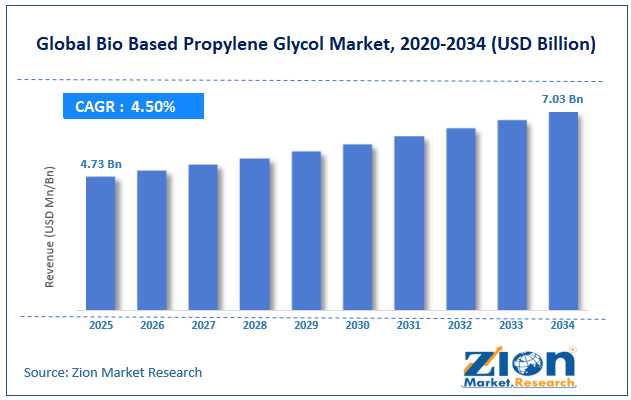
The global bio based propylene glycol market size was worth around USD 4.73 billion in 2025 and is predicted to grow to around USD 7.03 billion by 2034, with a compound annual growth rate (CAGR) of roughly 4.50% between 2026 and 2034.
Key Insights:
- As per the analysis shared by our research analyst, the global bio based propylene glycol market is estimated to grow annually at a CAGR of around 4.50% over the forecast period (2026-2034)
- In terms of revenue, the global bio based propylene glycol market size was valued at around USD 4.73 billion in 2025 and is projected to reach USD 7.03 billion, by 2034.
- The bio based propylene glycol market is projected to grow at a significant rate due to the rising demand for organic and chemical-free personal care items, evolving government stance on environmental impact of business operations, and a surge in biodiesel production.
- Based on the source, the glycerin-based segment is growing at a high rate and will continue to dominate the global market as per industry projection.
- Based on the application, the cosmetic products & personal care segment is anticipated to command the largest market share during the forecast period.
- Based on region, North America is projected to dominate the global market during the forecast period.
Bio Based Propylene Glycol Market: Overview
Bio-based propylene glycol (bio-PG) is a widely used chemical compound produced from renewable sources. Unlike synthetic propylene glycol, this variant is environmentally friendly and has a lower carbon footprint. Bio-based propylene glycol delivers the same chemical structure, with the difference being the origin of the carbon. Bio-based variants are produced from plant-based glycerin or fermented plant sugars, according to market research. In recent years, bio-based propylene glycol has entered several industries, replacing conventionally used petroleum-based products. During the forecast period, demand for bio-based propylene glycol is expected to be driven by rising demand for organic and chemical-free personal care items, evolving government stance on environmental impact of business operations, and a surge in biodiesel production. However, a limited number of players, high cost of investment, and competition from traditional propylene glycol will impact market revenue in the coming years.
Impact of the USA-Israel and Iran war on the Bio Based Propylene Glycol Market:
The USA-Israel and Iran war has affected the bio-based propylene glycol market in multiple ways. While the short-term impact has been largely negative, the war could influence more investment in the coming years. For instance, presently, this geopolitical conflict has affected the supply chain of raw materials and energy sources used for powering bio-based propylene glycol facilities. However, the war will encourage a shift away from petroleum-based products to more stable alternatives such as bio-based compounds and materials.
Bio Based Propylene Glycol Market: Dynamics
Growth Drivers
How will increasing demand for chemical-free personal care items drive the bio based propylene glycol market?
The global bio based propylene glycol market is expected to be driven by the rising demand for chemical-free and organic cosmetic products or personal care items. Bio-based propylene glycol is widely used in hygiene products as a skin conditioning agent and humectant. Consumers worldwide are proactively choosing organic and natural cosmetic products as opposed to conventionally popular chemical counterparts. This trend is driven by an amalgamation of growing environmental and health-based public awareness about natural personal care. Some of these advantages include relatively less risk of allergic reaction, reduced non-biodegradable or toxic waste, and lower exposure to harmful chemicals. Growing concerns over carcinogenic contents of chemical cosmetic and personal care items will further promote demand for natural alternatives, fueling market revenue.
Increasing biodiesel production to work in favor of the market players during the forecast period
Glycerol, a byproduct of biodiesel production, is an important feedstock for bio-PG manufacturing. Growing production volume of biodiesel translates to greater availability of low-cost raw material. This can subsequently drive investments in the global bio based propylene glycol market during the forecast period. The soaring oil prices worldwide and increasing cost of living are driving investments toward biodiesel. In September 2026, Sunoil Biodiesel, a Netherlands-based biofuel producer, announced regulatory approval of Belgium officials to supply its sustainable fuel in the regional market.
Restraints
High cost of investment and limited players to restrict expansion of the bio based propylene glycol industry
The global bio based propylene glycol industry is projected to be restricted due to high cost of investment and limited number of players. A commercial bio-PG facility requires specialized equipment, extensive research & development, storage facilities, and a transportation network. Moreover, obtaining licenses and certifications further increases overall production expenses. In addition, the industry has limited participation. The industry is currently competing with a well-established infrastructure for conventional PG, restricting overall revenue.
Opportunities
How will technological advancements support expansion of the bio based propylene glycol market?
The global bio based propylene glycol market is anticipated to come across growth opportunities due to increasing technological advancements directed at improving process output, reducing excessive waste, and achieving energy efficiency. In March 2024, Dow Chemical, a leading player in the chemical & material market, launched two new sustainable varieties of propylene glycol solutions in North America. These products, Renuva™ and Ecolibrium™, contain bio-circular and circular feedstocks and offer a broad range of applications. The company is using the International Sustainability and Carbon Certification PLUS-certified verifiable bookkeeping approach to trace the flow of bio-circular and circular materials.
Government support to remain crucial for market expansion during the forecast period
Ongoing government support for biofuel production and distribution will prove beneficial in the long run. Governments are working on establishing more robust and transparent networks that support feedstock procurement, production, and distribution of bio-PG. Governments primarily aim to leverage domestically available feedstock such as sugarcane molasses, animal fats, and non-edible oilseeds to encourage bio-PG production.
Challenges
Which are the leading challenges in the bio based propylene glycol industry?
The global bio based propylene glycol industry is anticipated to be challenged by limitations in terms of feedstock availability, and price volatility. Bio-PG production depends heavily on renewable feedstock such as agricultural and animal waste. However, this form of feedstock suffers from inconsistent supply and varying quality. Additionally, competition from conventional PG and lack of standardized processes will further affect industry revenue in the long run.
Bio Based Propylene Glycol Market: Report Scope
| Report Attributes | Report Details |
|---|---|
| Report Name | Bio Based Propylene Glycol Market |
| Market Size in 2025 | USD 4.73 Billion |
| Market Forecast in 2034 | USD 7.03 Billion |
| Growth Rate | CAGR of 4.50% |
| Number of Pages | 229 |
| Key Companies Covered | Dow Inc., Archer Daniels Midland (ADM), Global Bio-Chem Technology Group, BASF SE, Mitsubishi Chemical Corporation, DuPont Tate & Lyle Bio Products, SK Global Chemical, Oleon NV, Huntsman International, P&G Chemicals, Cargill Incorporated, Ashland Global, LyondellBasell Industries, Repsol S.A., ExxonMobil Corporation, and others. |
| Segments Covered | By Source, By Application, and By Region |
| Regions Covered | North America, Europe, Asia Pacific (APAC), Latin America, Middle East, and Africa (MEA) |
| Base Year | 2025 |
| Historical Year | 2020 - 2024 |
| Forecast Year | 2026 - 2034 |
| Customization Scope | Avail customized purchase options to meet your exact research needs. Request For Customization |
Bio Based Propylene Glycol Market: Segmentation
The global bio based propylene glycol market is segmented based on source, application, and region.
Why will the glycerin-based segment lead the bio based propylene glycol industry revenue during the forecast period?
Based on source, the global market segments are sugarcane-based, sorbitol-based, corn-based, glycerin-based, vegetable oil-based, lignocellulosic biomass-based, and others. In 2025, the glycerin-based segment showed the highest growth. It accounted for 39% of the total market share and will continue to dominate the market due to the abundant availability of raw materials and an established production chain. During the forecast period, lignocellulosic biomass-based may emerge as the fastest-growing with a CAGR of 10.56% due to a surge in demand for non-food renewable feedstock base.
Which will be the fastest-growing application during the forecast period in the bio based propylene glycol market?
Based on application, the global market divisions are agriculture, building & construction, furniture & joinery, cosmetic products & personal care, electronics & electricals, pharmaceuticals, food & beverage, industrial fluids, and others. In 2025, building & construction applications of bio-PG were the leading revenue generators. During the forecast period, cosmetic products & personal care will lead the market growth rate. Increasing demand for natural cosmetic items, rising skin allergy concerns, and proliferation of beauty e-commerce will drive segmental growth.
Bio Based Propylene Glycol Market: Regional Analysis
Why will North America lead the bio based propylene glycol market in the coming years?
The global bio based propylene glycol market is currently led by North America. In 2025, it accounted for 36.05% of the global revenue and will grow at a CAGR of 8.55% during the forecast period. North America has an established chain of bio-PG which aids regional market dominance. Increasing government support, rising shift toward biofuel, and strategic partnerships of regional players across geographical locations will aid regional growth in the coming years.
Why will Asia-Pacific generate the fastest CAGR in the bio based propylene glycol market during the forecast period?
Asia-Pacific is expected to emerge as the fastest-growing region in the bio based propylene glycol market, with a CAGR of 9.69% during the forecast period. In 2025, it accounted for 30.72% of the global revenue. Growth in Asia-Pacific will be led by China and India. The former has robust bio-PG manufacturing capabilities. India, on the other hand, is pushing aggressively toward biofuel to meet its energy demands and ensure national energy security. Ongoing work toward establishing an organized network of feedstock suppliers, bio-PG producers, and distributors will aid regional growth.
Bio Based Propylene Glycol Market: Competitive Analysis
The global bio based propylene glycol market is led by players like:
- Dow Inc.
- Archer Daniels Midland (ADM)
- Global Bio-Chem Technology Group
- BASF SE
- Mitsubishi Chemical Corporation
- DuPont Tate & Lyle Bio Products
- SK Global Chemical
- Oleon NV
- Huntsman International
- P&G Chemicals
- Cargill Incorporated
- Ashland Global
- LyondellBasell Industries
- Repsol S.A.
- ExxonMobil Corporation
What are the latest key trends in the bio based propylene glycol market?
Shift toward non-food feedstock
Efforts are growing to reduce dependence on food-based feedstocks. Market players are experimenting with agricultural residues and lignocellulosic biomass to ensure sustained feedstock supply for smooth business operations.
Demand for eco-friendly industrial fluids
The increasing demand for eco-friendly industrial fluids is a prominent market trend. Regulatory pressures and corporate Environmental, Social, and Governance (ESG) requirements will encourage industry applications in the coming years.
The global bio based propylene glycol market is segmented as follows:
By Source
- Sugarcane-Based
- Sorbitol-Based
- Corn-Based
- Glycerin-Based
- Vegetable Oil-Based
- Lignocellulosic Biomass-Based
- Others
By Application
- Agriculture
- Building & Construction
- Furniture & Joinery
- Cosmetic Products & Personal Care
- Electronics & Electricals
- Pharmaceuticals
- Food & Beverage
- Industrial Fluids
- Others
By Region
- North America
- The U.S.
- Canada
- Mexico
- Europe
- France
- The UK
- Spain
- Germany
- Italy
- Rest of Europe
- Asia Pacific
- China
- Japan
- India
- Australia
- South Korea
- Rest of Asia Pacific
- The Middle East & Africa
- Saudi Arabia
- UAE
- Egypt
- Kuwait
- South Africa
- Rest of the Middle East & Africa
- Latin America
- Brazil
- Argentina
- Rest of Latin America
Table Of Content
Methodology
FrequentlyAsked Questions
Bio-based propylene glycol (bio-PG) is a widely used chemical compound produced from renewable sources.
The global bio based propylene glycol market is expected to be driven by the rising demand for chemical-free and organic cosmetic products or personal care items.
According to study, the global bio based propylene glycol market size was worth around USD 4.73 billion in 2025 and is predicted to grow to around USD 7.03 billion by 2034.
The CAGR value of bio based propylene glycol market is expected to be around 4.50% during 2026-2034.
The global bio based propylene glycol industry is anticipated to be challenged by limitations in terms of feedstock availability and price volatility.
Shift toward non-food feedstock and demand for eco-friendly industrial fluids are the emerging trends and innovations impacting the bio based propylene glycol market.
The global bio based propylene glycol market has performed well so far and will offer similar trends in the coming years.
North America will contribute notably towards the bio based propylene glycol market value.
The global bio based propylene glycol market is led by players like Dow Inc., Archer Daniels Midland (ADM), Global Bio-Chem Technology Group, BASF SE, Mitsubishi Chemical Corporation, DuPont Tate & Lyle Bio Products, SK Global Chemical, Oleon NV, Huntsman International, P&G Chemicals, Cargill Incorporated, Ashland Global, LyondellBasell Industries, Repsol S.A., and ExxonMobil Corporation.
The report explores crucial aspects of the bio based propylene glycol market, including a detailed discussion of existing growth factors and restraints, while also browsing future growth opportunities and challenges that impact the market.

HappyClients

