
Global Baby Food Market Size, Share, Growth Report 2032

Baby Food Market By Product Type (Bottled Baby Food, Baby Food Cereals, Baby Food Snacks, Baby Food Soup, Frozen Baby Food), By Demography (Infant, Toddler, Preschooler), By Nature (Organic, Inorganic), By Distribution Channel (Supermarkets/Hypermarkets, Grocery Stores & Pharmacy Stores, Online Stores, Others), and By Region - Global and Regional Industry Overview, Market Intelligence, Comprehensive Analysis, Historical Data, and Forecasts 2024 - 2032
| Market Size in 2023 | Market Forecast in 2032 | CAGR (in %) | Base Year |
|---|---|---|---|
| USD 6.48 Billion | USD 21.25 Billion | 14.1% | 2023 |
Baby Food Industry Perspective
What will be the global baby food market size during the forecast period?
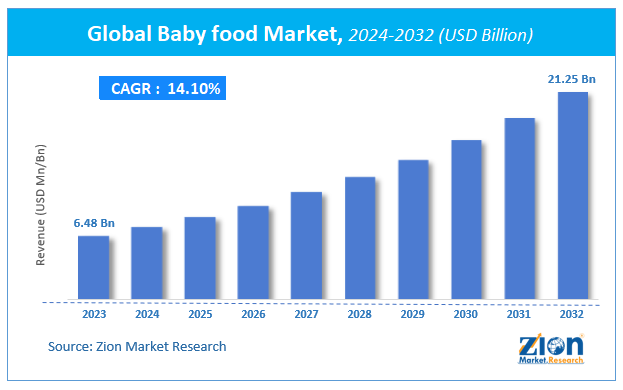
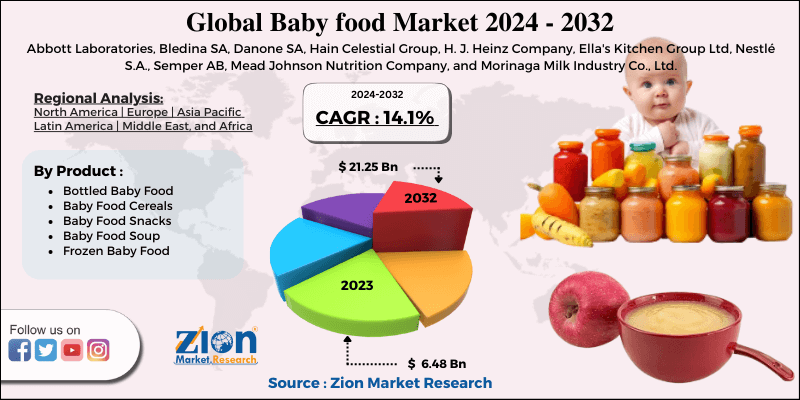
The global baby food market size was worth around USD 6.48 billion in 2023 and is predicted to reach around USD 21.25 billion by 2032, with a compound annual growth rate (CAGR) of roughly 14.1% between 2024 and 2032.
This report provides a comprehensive analysis of the growth drivers, restraints, and challenges shaping demand across the global baby food market throughout the forecast period, while highlighting high-potential emerging opportunities within the industry.
Key Insights
- As per the analysis shared by our research analyst, the global baby food market is estimated to grow annually at a CAGR of around 14.1% over the forecast period (2024-2032).
- In terms of revenue, the global baby food market size was valued at around USD 6.48 billion in 2023 and is projected to reach USD 21.25 billion by 2032.
- The market is driven by the rising population of working women, increasing parental focus on nutrition, and growing preference for convenient, additive-free baby food options.
- By product type, bottled baby food dominated the market because of its easy availability, convenience, and widespread consumer preference for ready-to-use formats.
- In the demography segment, the infant category led because of critical early nutritional needs and heavy reliance on specialized formulated foods during the first years of life.
- Based on the nature segment, inorganic products accounted for the larger share owing to broader accessibility, established distribution networks, and competitive pricing that appeal to a wider consumer base.
- In the distribution channel segment, supermarkets/hypermarkets dominated because they offer extensive product variety, one-stop shopping convenience, and strong visibility for both premium and standard baby food brands.
- Asia Pacific dominated the global baby food market with the largest regional share, driven by high birth rates, rising per capita income, and increasing awareness of infant nutrition in countries such as China and India.
Global Baby Food Market: Overview
Baby food is a soft, easy-to-eat food, other than breast milk or infant formula, made specifically for babies, roughly between the ages of four to six months and two years. Baby food is available in multiple varieties, tastes, and forms. It includes table food that has been mashed or is readily available for purchase at retail shops. As the number of working women and parental concerns about nutrition increase, the global baby food market has been growing faster. Baby food is made professionally, which helps working women manage feeding time. Professionally made baby food is considered one of the best solutions for breastfeeding problems. By meeting babies' nutritional needs, it also helps prevent undernutrition.
Consumers now prefer superfood flavors for their babies, such as beetroot- and blueberry-flavored products, because they contain additional antioxidants and higher levels of nutrition. Moreover, when choosing baby food, consumers also focus on the nutritional value and aim to select products free from additives. The rising number of working women globally is expected to boost overall growth in the baby food market during the forecast period. For instance, in 2020, the employment rate of women in Europe will account for 67%, a major factor contributing to the growth of the global baby food market.
Major manufacturers in the baby food market are focusing on strategies such as new product launches and mergers and acquisitions to strengthen their position. For instance, in January 2021, Timios, an India-based health snacks brand, entered the baby food market by launching a new "Made to Order" porridge range for infants and toddlers. The new product was designed for the nutritional needs of babies aged 6 to 18 months and is available in 12 variants. Additionally, in February 2020, Happy Family Organics, one of the leading baby food brands in the U.S., launched a new baby food line. Happy Baby Organics Regenerative and Organic Baby Food is recommended for babies aged 6 months and up.
Baby Food Market: Growth Drivers
What factors are primarily accelerating demand in the baby food market?
New and improved packaging adopted by major manufacturers is boosting the growth of the baby food market. For instance, recently, Nestle launched the first-of-its-kind single-material pouch packaging for its baby food products. The new, designed-to-be-recyclable pouch is made from polypropylene (PP). With the launch of this new packaging, the company aims to manufacture 100% of its packaging in a recyclable or reusable format by 2025. Additionally, to attract retail customers, key manufacturers are launching new and improved products, which in turn is driving growth in the global baby food market. For instance, in April 2021, Heinz launched three new plant-based baby food products. The new products include saucy pasta stars with beans and carrots, risotto with chickpeas and pumpkin, and potato bake with green beans and sweet garden peas.
Vegetables and other green plant proteins are key ingredients in baby foods that are low in sugar and high in nutrition. Additionally, growing concerns about added chemicals and increasing health awareness are contributing to increased demand for natural and organic food products among consumers. Therefore, rising demand for vegetable content in baby food is expected to bolster the growth of the baby food market during the forecast period.
Baby Food Market: Restraints
What factors are limiting the expansion of the baby food market?
Declining birth rates in several developed regions reduce the overall addressable consumer base and temper volume growth. Milk intolerance among infants also restricts the adoption of certain dairy-based products, prompting parents to seek specialized alternatives that may not always be readily available or affordable.
Heightened scrutiny of food safety and additives can slow purchasing decisions, particularly when regulatory or media attention highlights quality concerns. These factors collectively moderate the pace of market expansion in mature economies.
Baby Food Market: Report Scope
| Report Attributes | Report Details |
|---|---|
| Report Name | Baby Food Market |
| Market Size in 2023 | USD 6.48 Billion |
| Market Forecast in 2032 | USD 21.25 Billion |
| Growth Rate | CAGR of 14.1% |
| Number of Pages | 240 |
| Key Companies Covered | Abbott Laboratories, Bledina SA, Danone SA, Hain Celestial Group, H. J. Heinz Company, Ella's Kitchen Group Ltd, Nestlé S.A., Semper AB, Mead Johnson Nutrition Company, and Morinaga Milk Industry Co., Ltd. |
| Segments Covered | By Product Type, By Demography, By Nature, By Distribution Channel, and By Region |
| Regions Covered | North America, Europe, Asia Pacific (APAC), Latin America, Middle East, and Africa (MEA) |
| Base Year | 2023 |
| Historical Year | 2018 - 2022 |
| Forecast Year | 2024 - 2032 |
| Customization Scope | Avail customized purchase options to meet your exact research needs. Request For Customization |
Baby Food Market: Segmentation
The baby food market is segmented by product type, demography, nature, distribution channel, and region. All the segments of the baby food market have been analyzed based on present and future trends, and the market is estimated from 2024 to 2032.
Based on Product Type, the baby food market is divided into bottled baby food, baby food cereals, baby food snacks, baby food soup, and frozen baby food. Bottled baby food holds the dominant position because of its easy availability, convenience in handling, and strong consumer preference for ready-to-use formats that simplify feeding routines for busy parents. This dominance supports overall market growth by reinforcing brand loyalty and encouraging repeat purchases across retail channels. Baby food cereals rank as the second most prominent category, benefiting from their role as an early complementary food that delivers essential nutrients during the transition from milk-based diets. Their established presence helps drive innovation in fortified and flavored variants, expanding the overall product portfolio and attracting parents seeking progressive feeding options.
Based on Demography, the baby food market is divided into infant, toddler, and preschooler. The infant segment leads because of critical nutritional needs in the earliest stages of life and the heavy reliance on specialized commercial formulations when breastfeeding is supplemented or replaced. This leadership drives market volume through consistent demand for age-appropriate, nutrient-dense products and stimulates continuous product development focused on developmental needs. The toddler category follows as the second largest, supported by the growing need for convenient snacks and meals that accommodate increasing independence and varied dietary preferences. Its strength encourages manufacturers to expand offerings that bridge the gap between purees and family foods, thereby sustaining category momentum.
Based on Nature, the baby food market is divided into organic and inorganic. Inorganic products currently dominate because of wider availability, established distribution networks, and more accessible price points that appeal to a broad consumer base. This position underpins market stability by ensuring volume sales through mass-market channels and supporting extensive promotional activities. Organic variants represent the second major segment and are gaining traction because of rising parental concerns about chemicals and a preference for natural ingredients. Their growth trajectory fuels innovation in clean-label formulations and premium positioning, helping elevate overall category value and attract health-focused buyers.
Based on Distribution Channel, the baby food market is divided into supermarkets/hypermarkets, grocery stores & pharmacy stores, online stores, and others. Supermarkets and hypermarkets hold the leading share thanks to their extensive product assortment, one-stop shopping convenience, and strong in-store visibility for both mainstream and premium brands. This dominance accelerates market growth by facilitating impulse purchases and enabling effective merchandising of new launches. Online stores constitute the second key channel, driven by rising e-commerce adoption, subscription models, and the convenience of home delivery for busy parents. Their rapid expansion supports broader geographic reach and data-driven personalization, contributing to sustained category development.
Baby Food Market: Regional Analysis
Why will Asia Pacific continue to dominate the global market during the projection period?
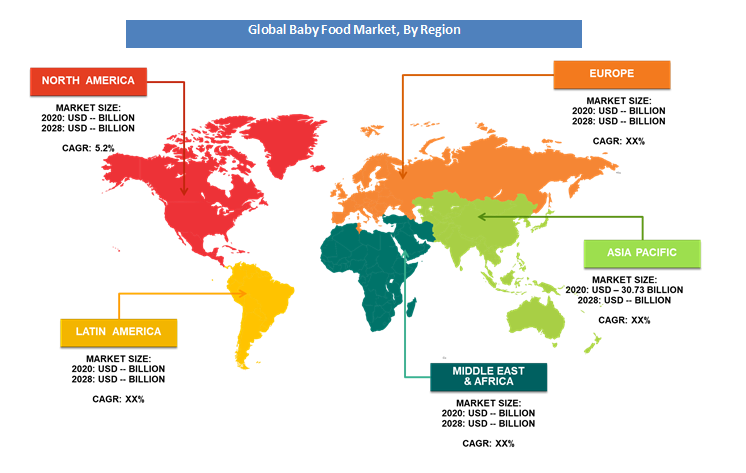
Asia Pacific maintains its leading position in the global baby food market, supported by high birth rates, rising per capita incomes, and growing awareness of infant nutrition across major economies. China stands out as a key contributing country, with substantial annual births creating consistent demand for both traditional and modern commercial products. India further strengthens regional performance through shifting consumer mindsets that increasingly prioritize proper nutrition and convenient feeding solutions.
Demographic momentum, urbanization, and expanding organized retail enable manufacturers to scale operations and introduce localized innovations. This regional strength drives overall market growth by generating high-volume sales, encouraging product adaptation to local tastes, and fostering investment in manufacturing and distribution infrastructure. Continuous innovation in packaging and formulations tailored to regional preferences further reinforces Asia Pacific’s influence on global trends and expansion strategies.
Global Baby Food Market: Competitive Landscape
The global baby food market is dominated by players:
- Abbott Laboratories
- Bledina SA
- Danone SA
- Hain Celestial Group
- H. J. Heinz Company
- Ella's Kitchen Group Ltd
- Nestlé S.A.
- Semper AB
- Mead Johnson Nutrition Company
- Morinaga Milk Industry Co., Ltd.
Segments Covered
The global baby food market is segmented as follows
By Product Type
- Bottled Baby Food
- Baby Food Cereals
- Baby Food Snacks
- Baby Food Soup
- Frozen Baby Food
By Demography
- Infant
- Toddler
- Pre Schooler
By Nature
- Organic
- Inorganic
By Distribution Channel
- Supermarkets/Hypermarkets
- Grocery Stores & Pharmacy Stores
- Online Stores
- Others
By Region
- North America
- The U.S.
- Canada
- Mexico
- Europe
- France
- The UK
- Spain
- Germany
- Italy
- Rest of Europe
- Asia Pacific
- China
- Japan
- India
- Australia
- South Korea
- Rest of Asia Pacific
- The Middle East & Africa
- Saudi Arabia
- UAE
- Egypt
- Kuwait
- South Africa
- Rest of the Middle East & Africa
- Latin America
- Brazil
- Argentina
- Rest of Latin America
Table Of Content
Methodology
FrequentlyAsked Questions
The baby food market includes soft, easy-to-eat foods other than breast milk or infant formula, specifically formulated for babies between about four and six months and two years old. These products are available in varied forms, tastes, and nutritional profiles and are designed to support healthy growth and development while offering convenience to caregivers.
Key growth drivers include the rising population of working women, increasing parental focus on nutrition and additive-free products, demand for convenient ready-to-use formats, and the introduction of innovative plant-based and nutrient-dense formulations.
The global baby food market was valued at approximately USD 6.48 billion in 2023 and is projected to reach around USD 21.25 billion by 2032.
The global baby food market is expected to expand at a compound annual growth rate of approximately 14.1% between 2024 and 2032.
Asia Pacific is expected to continue contributing the largest share, supported by high birth rates, rising incomes, and increasing nutritional awareness in countries such as China and India.
Some of the key players in the baby food market are Abbott Laboratories, Bledina SA, Danone SA, Hain Celestial Group, H. J. Heinz Company, Ella's Kitchen Group Ltd, Nestlé S.A., Semper AB, Mead Johnson Nutrition Company, and Morinaga Milk Industry Co., Ltd.
The report offers comprehensive analysis of market size, growth drivers, restraints, opportunities, segmentation, regional dynamics, competitive landscape, recent developments, and future outlook for the period 2024-2032, enabling informed strategic decision-making.

HappyClients

