
Global Automotive Wiper System Market Size, Share, Trends, and Forecasts 2034

Automotive Wiper System Market By Type (Conventional Wiper Systems, Flat Blade Wiper Systems, Rear Wiper Systems, Rain Sensing Wiper Systems), By Application (Passenger Cars, Commercial Vehicles, Electric Vehicles, Off Road and Specialty Vehicles), By End-User (Original Equipment Manufacturers, Aftermarket Service Providers, Fleet Operators, Individual Vehicle Owners), By Distribution Channel (Direct OEM Supply, Authorized Automotive Parts Distributors, Retail Auto Parts Stores, Digital and Online Auto Parts Channels), and By Region - Global and Regional Industry Overview, Market Intelligence, Comprehensive Analysis, Historical Data, and Forecasts 2026 - 2034
| Market Size in 2025 | Market Forecast in 2034 | CAGR (in %) | Base Year |
|---|---|---|---|
| USD 10.2 Billion | USD 14.7 Billion | 4.14% | 2025 |
Automotive Wiper System Industry Perspective:
What will be the size of the automotive wiper system market during the forecast period?
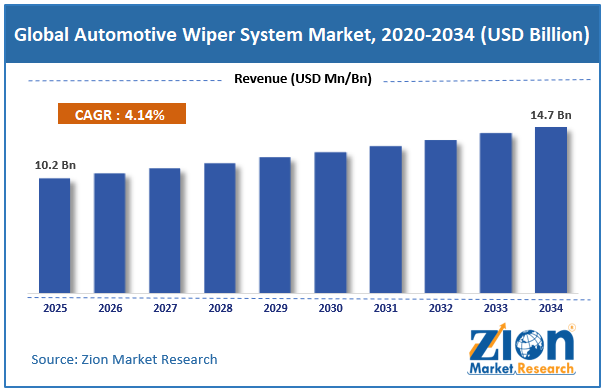
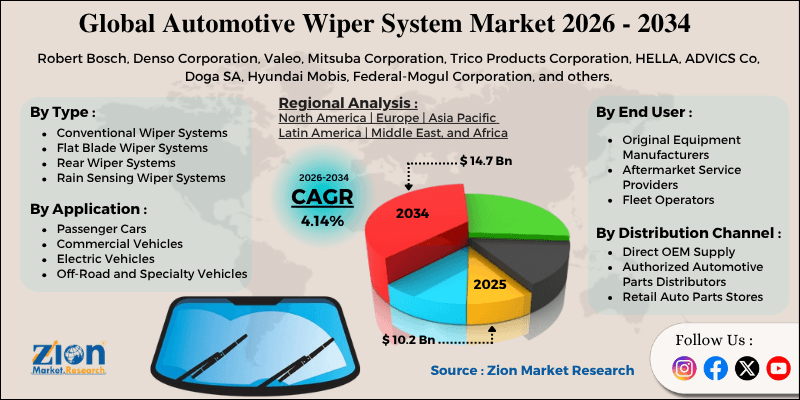
The global automotive wiper system market size was valued at approximately USD 10.2 billion in 2025 and is projected to reach around USD 14.7 billion by 2034, growing at a compound annual growth rate of approximately 4.14% between 2026 and 2034.
Key Insights
- As per the analysis shared by our research team, the global automotive wiper system market is estimated to grow at a compound annual growth rate of approximately 4.14% during the forecast period from 2026 to 2034.
- In terms of revenue, the global automotive wiper system market was valued at approximately USD 10.2 billion in 2025 and is projected to reach USD 14.7 billion by 2034.
- The automotive wiper system market is expected to grow strongly due to rising global vehicle production, increasing consumer focus on driving safety, growing demand for rain-sensing technology, and expanding adoption of electric vehicles.
- Based on type, conventional wiper systems lead the market because of their affordability and widespread use across vehicle categories, while rain-sensing wiper systems are seeing strong demand as automakers add more advanced safety features to new vehicles.
- Based on application, passenger cars lead the market due to high global production volumes. At the same time, electric vehicles are the fastest-growing segment due to the rapid rise in sales worldwide.
- Based on end-user, original equipment manufacturers lead the market due to consistent demand from new-vehicle production lines, while aftermarket service providers are steadily growing as vehicle owners replace worn-out wiper components.
- Based on distribution channel, direct OEM supply leads the market, as vehicle manufacturers prefer to work closely with wiper system suppliers to ensure consistent quality and timely integration into production lines.
- Based on region, Asia Pacific leads the global automotive wiper system market. At the same time, North America is the fastest-growing region due to rising demand for advanced vehicle safety features and growing electric vehicle adoption.
Automotive Wiper System Market: Overview
An automotive wiper system is a vehicle safety system that uses wiper blades, a motor, and connected components to remove rain, snow, dust, mud, and other debris from the windshield and rear window, helping drivers maintain clear visibility in all weather conditions. The system usually includes an electric motor, linkage arms, wiper blades, a washer system, and, in many modern vehicles, rain sensors that automatically adjust the wiping speed based on weather conditions. Automotive wiper systems are designed to work efficiently in hot, cold, wet, and dusty environments while providing reliable performance over many years of regular use. They are widely used in passenger cars, commercial vehicles, electric vehicles, buses, trucks, agricultural machinery, construction equipment, and other specialty vehicles.
As vehicle technology continues to improve, manufacturers are introducing quieter motors, longer-lasting wiper blades, and smart sensor-based systems that enhance driver convenience and road safety. The automotive wiper system market is growing due to increasing vehicle production, rising awareness of road safety, stricter government safety regulations, and growing demand for advanced driver assistance systems (ADAS). The rapid adoption of electric vehicles and the need for better visibility in all weather conditions are also supporting the steady growth of the global automotive wiper system market.
The automotive wiper system industry continues to grow steadily as automakers and parts suppliers collaborate to enhance driver visibility and safety across all vehicle types and weather conditions.
Impact of the USA-Israel War on Iran on the Automotive Wiper System Market
The automotive wiper system market may face short-term disruptions in raw material supply, semiconductor availability, and international shipping routes due to geopolitical tensions involving the United States, Israel, and Iran. However, manufacturers are diversifying their supplier base and strengthening regional production capabilities to reduce these risks. Continued global demand for vehicles and steady growth in automotive production are expected to support the market's long-term growth despite short-term uncertainty.
Automotive Wiper System Market: Technology Roadmap 2026-2034
What is the projected development roadmap of the automotive wiper system market over the forecast period?
The automotive wiper system market is advancing through improved motor efficiency, smarter sensor technology, quieter operation, and growing integration with vehicle safety systems, making wiper systems more reliable and convenient for drivers. The market is expected to grow at a compound annual growth rate of approximately 4.14% over the forecast period, driven by accelerating demand from vehicle manufacturers, developing safety regulations, and continuous refinement of motor and sensor technology.
The following roadmap outlines key development phases expected through 2034.
2026-2028: Efficiency Improvement and Sensor Integration Phase
- Manufacturers are expected to develop more energy-efficient wiper motors that consume less power, which is especially valuable for electric vehicles where every bit of battery efficiency matters.
- The growing use of rain-sensing technology is expected to become more common across mid-range vehicles, not just premium models, helping more drivers benefit from automatic wiper activation.
- Closer collaboration between wiper system manufacturers and automakers is expected to support the development of quieter, smoother-operating systems tailored to different vehicle types.
2029-2031: Smart Connectivity and Expanded Application Phase
- Automated manufacturing technologies are expected to become more widespread, helping produce wiper components with better precision, fewer defects, and lower production costs.
- The growing use of advanced wiper systems in electric and autonomous vehicles is expected to increase demand for components that work seamlessly with other onboard sensors and cameras.
- Improved blade coating technologies are expected to reduce streaking and noise, extend the life of wiper blades, and improve the overall driver experience.
2032-2034: Intelligent Wiper Systems Phase
- Automotive wiper systems are expected to include smarter weather-detection features that automatically adjust wiping patterns based on precipitation intensity and type.
- More compact and lightweight wiper components are expected to support the growing demand for sleeker vehicle designs and improved aerodynamics.
- Wiper systems with built-in connectivity features are expected to enable real-time performance monitoring, helping alert drivers when maintenance or replacement is needed.
Automotive Wiper System Market: Dynamics
Growth Drivers
What is driving growth in the automotive wiper system market as demand for advanced vehicle safety rises?
The automotive wiper system market is growing steadily as vehicle manufacturers, fleet operators, and consumers place greater importance on road safety and clear driver visibility. Increasing vehicle production, rising demand for advanced safety features, and the rapid adoption of electric vehicles are driving global market growth. Automotive wiper systems are essential because they help drivers maintain a clear view during rain, snow, dust, and other challenging weather conditions. These systems are widely used in passenger cars, commercial vehicles, buses, trucks, and specialty vehicles to improve driving safety. Automakers are also investing in advanced wiper technologies, including rain-sensing systems, quieter motors, and longer-lasting blades, to enhance vehicle performance and safety ratings.
In addition, the growing use of advanced driver assistance systems (ADAS) and connected vehicle technologies is increasing the demand for wiper systems that work efficiently with cameras and sensors. Rising road safety awareness, advancements in vehicle technology, and stricter regulations are expected to drive the market throughout the forecast period.
The growing demand for rain sensing technology is driving the automotive wiper system market.
The automotive wiper system industry is witnessing significant growth opportunities as vehicle manufacturers and consumers place greater importance on driving safety, convenience, and comfort. Automakers are increasingly equipping vehicles with rain-sensing wiper systems that automatically detect rainfall and adjust the wiping speed without requiring driver input. These advanced systems improve visibility, reduce distractions, and make driving safer during changing weather conditions. Automotive wiper systems are known for their reliability, quick response, and ability to perform effectively in rain, snow, and dusty environments.
As sensor technology becomes more affordable, these smart wiper systems are being introduced not only in premium vehicles but also in mid-range and entry-level models. Commercial vehicles, buses, trucks, and fleet operators also rely on dependable wiper systems to ensure clear visibility and safe transportation in all weather conditions. The growing production of electric vehicles, increasing adoption of advanced driver assistance systems (ADAS), and rising consumer demand for smarter vehicle features are further boosting market growth. Growing adoption of smart vehicle technologies, continuous product innovation, and increasing emphasis on road safety are expected to support sustained market growth throughout the forecast period.
Restraints
High production costs and strict quality requirements remain significant barriers in the automotive wiper system market.
The automotive wiper system market faces several challenges that could slow its growth. Manufacturing high-quality wiper systems requires advanced technology, precision engineering, and strict quality standards, making production expensive, especially for small manufacturers. Many smaller suppliers find it difficult to invest in modern equipment and testing facilities needed to meet the requirements of major automakers. In addition, vehicle manufacturers demand extensive safety, durability, and performance testing before approving new wiper systems, which can increase development time and costs. Companies must also comply with quality certifications and industry regulations, adding to overall operating expenses.
Another challenge is the shortage of skilled engineers and technicians with expertise in automotive component design and manufacturing. These factors can limit production capacity and market expansion, particularly in developing regions with less advanced manufacturing infrastructure. However, ongoing improvements in manufacturing processes, automation, materials technology, and engineering expertise are expected to lower production costs and strengthen the market's long-term growth.
Opportunities
How are expanding applications for vehicles and emerging markets creating opportunities in the automotive wiper system market?
The automotive wiper system industry offers significant growth opportunities as vehicle manufacturers continue adding advanced safety, comfort, and smart driving features to modern vehicles. Automotive wiper systems play a vital role in maintaining clear windshield visibility during rain, snow, dust, and other challenging weather conditions, making them an essential safety component in passenger and commercial vehicles. The growing production of electric vehicles is creating additional demand for lightweight, energy-efficient, and sensor-compatible wiper systems that support modern vehicle designs. Rising adoption of advanced driver assistance systems (ADAS) and connected vehicle technologies is also increasing the need for wiper systems that operate smoothly alongside cameras, sensors, and other electronic safety features. Emerging automotive manufacturing hubs such as China, India, Brazil, and Southeast Asian countries are creating new business opportunities for wiper system manufacturers and suppliers.
At the same time, companies are investing in automation, improved materials, and advanced production technologies to lower manufacturing costs while maintaining high product quality and durability. Rising vehicle production, road safety awareness, and electric vehicle adoption are expected to drive the market during the forecast period.
Challenges
What challenges does the automotive wiper system market face in sustaining growth and achieving widespread adoption?
The automotive wiper system industry faces several challenges that could slow its growth. Manufacturing high-quality wiper systems requires precision engineering, advanced production technologies, and strict quality standards, making production costly, especially for smaller companies. Vehicle manufacturers also require extensive testing and certification before approving new suppliers, which can delay product launches and increase development costs. In addition, changing safety regulations across different countries require manufacturers to update their designs and compliance processes regularly.
The industry also faces a shortage of skilled engineers and technical experts needed to maintain consistent product quality and performance during large-scale production. Supply chain disruptions and fluctuations in the availability of raw materials and electronic components can further affect manufacturing schedules. In some cases, automotive wiper systems also compete with alternative visibility solutions, such as hydrophobic windshield coatings. Despite these challenges, continuous advancements in manufacturing technology, material innovation, and product design are expected to improve efficiency and support the long-term growth of the automotive wiper system market.
Automotive Wiper System Market: Report Scope
| Report Attributes | Report Details |
|---|---|
| Report Name | Automotive Wiper System Market |
| Market Size in 2025 | USD 10.2 Billion |
| Market Forecast in 2034 | USD 14.7 Billion |
| Growth Rate | CAGR of 4.14% |
| Number of Pages | 228 |
| Key Companies Covered | Robert Bosch, Denso Corporation, Valeo, Mitsuba Corporation, Trico Products Corporation, HELLA, ADVICS Co, Doga SA, Hyundai Mobis, Federal-Mogul Corporation, and others. |
| Segments Covered | By Type, By Application, By End User, By Distribution Channel, and By Region |
| Regions Covered | North America, Europe, Asia Pacific (APAC), Latin America, Middle East, and Africa (MEA) |
| Base Year | 2025 |
| Historical Year | 2020 - 2024 |
| Forecast Year | 2026 - 2034 |
| Customization Scope | Avail customized purchase options to meet your exact research needs. Request For Customization |
Automotive Wiper System Market: Segmentation
The global automotive wiper system market is segmented by type, application, end-user, distribution channel, and region.
What makes conventional wiper systems the dominant type in the automotive wiper system market?
Based on type, the global automotive wiper system industry is segregated into conventional wiper systems, flat-blade wiper systems, rear wiper systems, and rain-sensing wiper systems. Conventional wiper systems hold about 46% market share, leading due to their affordability, simplicity, and compatibility with a wide range of vehicle models. Rain-sensing wiper systems hold around 21% market share. They are the fastest-growing segment as automakers increasingly add automatic wiping features to improve driver convenience and safety.
How does passenger car application maintain its leading position in the automotive wiper system market?
Based on application, the automotive wiper system market is categorized into passenger cars, commercial vehicles, electric vehicles, and off-road and specialty vehicles. Passenger cars account for approximately 52% of the global market share, driven by high global production volumes and consistent consumer demand for personal vehicles. Electric vehicles hold around 18% market share. It is the fastest-growing segment due to the rapid worldwide increase in electric vehicle sales and production.
What makes original equipment manufacturers the dominant end users in the automotive wiper system market?
Based on end-user, the market is divided into original equipment manufacturers, aftermarket service providers, fleet operators, and individual vehicle owners. Original equipment manufacturers lead with about 58% of the market share due to consistent demand from new-vehicle assembly lines worldwide. Aftermarket service providers hold around 23% market share. They are growing steadily as vehicle owners increasingly replace worn wiper blades and components.
How do direct OEM supply channels shape the distribution landscape of the automotive wiper system market?
Based on distribution channel, the automotive wiper system market is classified into direct OEM supply, authorized automotive parts distributors, retail auto parts stores, and digital and online auto parts channels. Direct OEM supply accounts for about 49% of the market, leading because vehicle manufacturers prefer to work closely with wiper suppliers to maintain strict quality control and ensure timely integration into production. Authorized automotive parts distributors hold around 27% market share. They are expanding steadily, particularly in emerging markets where local distribution networks support wider product availability.
Automotive Wiper System Market: Regional Analysis
Why is Asia Pacific leading the global automotive wiper system market?
The Asia Pacific automotive wiper system market dominates the global market and is expected to grow at a CAGR of around 8.4% during the forecast period. China holds the largest market share, driven by its position as the world's biggest automobile producer, a well-established automotive supply chain, and strong demand for passenger and commercial vehicles. Japan is another major contributor, supported by its advanced automotive industry, high manufacturing standards, and continuous innovation in vehicle technologies. South Korea is experiencing steady market growth due to increasing production of conventional and electric vehicles by leading automakers. India is emerging as a high-growth market due to expanding vehicle manufacturing, rising disposable incomes, rapid urbanization, and increasing vehicle ownership.
Other countries, including Thailand, Malaysia, Australia, Indonesia, and Singapore, are also contributing to regional growth through expanding automotive production, improving infrastructure, and stronger investments in the automotive sector. Rising demand for safer vehicles, increasing adoption of advanced driver assistance systems (ADAS), and growing production of electric vehicles are boosting demand for reliable automotive wiper systems across the region. Ongoing investments in manufacturing, research and development, and advanced automotive technologies are expected to strengthen the Asia-Pacific automotive wiper system market throughout the forecast period.
What makes North America the fastest-growing region in the automotive wiper system market?
The North America automotive wiper system market is one of the fastest-growing regional markets and is expected to grow at a CAGR of around 9.2% during the forecast period. The United States accounts for the largest market share, supported by strong vehicle production, high demand for advanced safety features, and increasing adoption of electric vehicles. Canada is another important market, driven by its expanding automotive manufacturing industry and growing consumer preference for vehicles equipped with modern safety technologies.
Mexico is strengthening its position as a major automotive manufacturing hub due to its skilled workforce, cost-effective production capabilities, and strong trade relationships with the United States and Canada. Rising demand for rain-sensing wiper systems, durable wiper blades, and energy-efficient wiper motors is further boosting market growth across the region. The increasing use of advanced driver assistance systems (ADAS) and connected vehicle technologies is also creating greater demand for high-performance wiper systems that work seamlessly with cameras and sensors. Well-developed supply chains, continuous investments in automotive innovation, and growing vehicle production are expected to support the long-term expansion of the North America automotive wiper system market throughout the forecast period.
Recent Market Developments
- In July 2026, Robert Bosch announced the expansion of its Aerotwin J.E.T.-Blade program with additional set variants and wiper lengths, extending its integrated washer nozzle technology to a broader range of vehicle models from September 2026.
Automotive Wiper System Market: Competitive Analysis
The leading players in the global automotive wiper system market are:
- Robert Bosch
- Denso Corporation
- Valeo
- Mitsuba Corporation
- Trico Products Corporation
- HELLA
- ADVICS Co
- Doga SA
- Hyundai Mobis
- Federal-Mogul Corporation
The global automotive wiper system market is segmented as follows:
By Type
- Conventional Wiper Systems
- Flat Blade Wiper Systems
- Rear Wiper Systems
- Rain Sensing Wiper Systems
By Application
- Passenger Cars
- Commercial Vehicles
- Electric Vehicles
- Off-Road and Specialty Vehicles
By End User
- Original Equipment Manufacturers
- Aftermarket Service Providers
- Fleet Operators
- Individual Vehicle Owners
By Distribution Channel
- Direct OEM Supply
- Authorized Automotive Parts Distributors
- Retail Auto Parts Stores
- Digital and Online Auto Parts Channels
By Region
- North America
- The U.S.
- Canada
- Mexico
- Europe
- France
- The UK
- Spain
- Germany
- Italy
- Rest of Europe
- Asia Pacific
- China
- Japan
- India
- Australia
- South Korea
- Rest of Asia Pacific
- The Middle East & Africa
- Saudi Arabia
- UAE
- Egypt
- Kuwait
- South Africa
- Rest of the Middle East & Africa
- Latin America
- Brazil
- Argentina
- Rest of Latin America
Table Of Content
Methodology
FrequentlyAsked Questions
An automotive wiper system is a vehicle safety system that uses wiper blades, a motor, and connected components to remove rain, snow, dust, mud, and other debris from the windshield and rear window, helping drivers maintain clear visibility in all weather conditions.
The global automotive wiper system market is expected to grow due to rising global vehicle production, increasing demand for advanced safety features, growing adoption of rain-sensing technology, and expanding electric-vehicle production worldwide.
According to research, the global automotive wiper system market was valued at approximately USD 10.2 billion in 2025 and is projected to reach approximately USD 14.7 billion by 2034.
The compound annual growth rate of the automotive wiper system market is expected to be approximately 4.14% from 2026 to 2034.
Asia Pacific is expected to lead the global automotive wiper system market throughout the forecast period, driven by its position as the world's largest vehicle producer and its strong domestic automotive supply chain.
The major players in the global automotive wiper system market include Robert Bosch, Denso Corporation, Valeo, Mitsuba Corporation, Trico Products Corporation, HELLA, ADVICS Co, Doga SA, Hyundai Mobis, and Federal-Mogul Corporation.
The report examines key aspects of the automotive wiper system market, including manufacturing drivers, adoption barriers, application opportunities, competitive landscape dynamics, detailed regional market performance analysis, and a comprehensive forward-looking outlook across all major types, applications, end user segments, distribution channels, and geographic regions through 2034.
The global automotive wiper system industry value chain includes raw material sourcing, component manufacturing (motors, blades, linkages, and sensors), system assembly, quality testing, OEM and aftermarket distribution, vehicle integration, retail sales, installation, and after-sales replacement and maintenance services.
The automotive wiper system market is experiencing stable to moderate price increases due to rising costs of raw materials and electronic components. However, automation, large-scale production, and improved manufacturing efficiency are helping manufacturers control costs while offering advanced and durable wiper systems.
The OEM (Original Equipment Manufacturer) segment holds the largest share of the automotive wiper system market because most wiper systems are factory-installed during vehicle production. The aftermarket segment also accounts for a significant share, driven by the regular replacement of worn-out wiper blades and components.

HappyClients

