
Automotive Constant Velocity Joint Market Size, Share Report 2034

Automotive Constant Velocity Joint Market By Joint Type (Double Offset Joint, Tripod Joint, Rzeppa Joint, Cross Groove Joint, and Others), By Vehicle Type (Passenger Vehicles and Commercial Vehicles), By Material (Composite, Aluminum, and Steel), By Propulsion System (Hybrid, Electric, and Internal Combustion Engines (ICE), and By Region - Global and Regional Industry Overview, Market Intelligence, Comprehensive Analysis, Historical Data, and Forecasts 2025 - 2034
| Market Size in 2024 | Market Forecast in 2034 | CAGR (in %) | Base Year |
|---|---|---|---|
| USD 3.38 Billion | USD 5.11 Billion | 5.28% | 2024 |
Automotive Constant Velocity Joint Industry Perspective:
What will be the size of the global automotive constant velocity joint market during the forecast period?
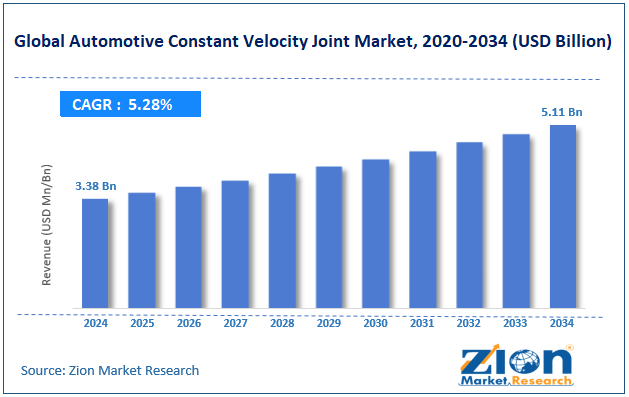
The global automotive constant velocity joint market size was worth around USD 3.38 billion in 2024 and is predicted to grow to around USD 5.11 billion by 2034, with a compound annual growth rate (CAGR) of roughly 5.28% between 2025 and 2034.
Key Insights:
- As per the analysis shared by our research analyst, the global automotive constant velocity joint market is estimated to grow annually at a CAGR of around 5.28% over the forecast period (2025-2034)
- In terms of revenue, the global automotive constant velocity joint market size was valued at around USD 3.38 billion in 2024 and is projected to reach USD 5.11 billion by 2034.
- The automotive constant velocity joint market is projected to grow at a significant rate due to the rising consumer awareness about the importance of vehicle safety.
- Based on the joint type, the Rzeppa joint segment is growing at a high rate and will continue to dominate the global market, as per industry projections
- Based on the material, the steel segment is anticipated to command the largest market share
- Based on region, the Asia-Pacific is projected to dominate the global market during the forecast period
Automotive Constant Velocity Joint Market: Overview
Automotive constant velocity (CV) joints are essential components of modern vehicles and a part of the automobile’s drivetrain system. CV joints are situated at the ends of axle shafts. They are used to facilitate uniform power transfer from the transmission to the wheels. CV joints allow smooth rotation across different angles and are, hence, widely preferred in automotive drivetrain design. CV joints consist of different segments that are inner & outer races, cage, ball bearings, and a protective boot. During the forecast period, demand for automotive constant velocity joints is expected to continue growing, driven by several favorable factors. This includes rising awareness among vehicle owners about the importance of consistent vehicle repair and maintenance.
In addition, growing vehicle ownership worldwide, in addition to rising demand for automotive products across logistics and e-commerce segments, will facilitate improved revenue. A major growth-limiting factor for industry players may emerge in the form of the high cost of CV joint replacement and the limited applications of constant velocity joints in electric vehicles (EVs).
Automotive Constant Velocity Joint Market: Dynamics
Growth Drivers
How will increased consumer awareness of vehicle safety influence the growth of the automotive constant velocity joint market?
The global automotive constant velocity joint market is expected to be led by the rising consumer awareness about the importance of vehicle safety. Increasing collision accidents across the globe have had a significant impact on vehicle users and their investments associated with vehicle repair and maintenance. In addition, government-led safety awareness drives and initiatives have further escalated demand for effective vehicle repair and maintenance services. According to industry research, automotive constant velocity joints are subject to wear and tear after consistent use.
For instance, CV joints can last up to 80,000 to 100,000 miles with proper care. However, automotive experts recommend constant vehicle check-ups and replacement of worn-out parts. Driving with damaged CV joints can lead to extended damage to the drivetrain system, along with putting the passenger’s life at risk. These factors are likely to work in tandem and influence demand for automotive CV joints in the coming years.
Rising demand for user cars is expected to influence the applications of CV joints during the projection period
According to industry research, the used cars market is thriving at an unprecedented rate. In 2024, the global used car market was valued at over USD 1.91 trillion and is projected to generate a significant CAGR during the projection period. The ongoing measures to standardize and regulate the sale of used cars have played a pivotal role in fueling demand for pre-owned vehicles.
However, these automotives are more vulnerable to damage and require frequent maintenance or repair. The surge in the number of used cars in the market, aided by digitization and standardization of the industry, will influence the global automotive constant velocity joint market growth during the projection period.
Restraints
What will be the impact of the high cost of services on the automotive constant velocity joint industry?
The global automotive constant velocity joint industry is projected to be restricted due to the high cost of services associated with the market. According to industry analysis, replacing or repairing CV joints can cost between USD 120 and USD 350, depending on the extent of the damage and the service providers. The growing economic uncertainty worldwide is projected to have a direct impact on demand for CV joints during the projection period.
Opportunities
Ongoing technological innovations in the market are opening new growth opportunities for the industry players
The global automotive constant velocity joint market is projected to offer growth opportunities driven by technological innovations in the industry. Recent trends indicate growing use of modern materials to enhance the overall durability of CVs and their applications.
For instance, growing use of high-strength alloy steels or next-generation surface coatings helps improve the overall lifecycle of CVs. Other areas of constant velocity joints gaining global attention include noise, vibration & harshness (NNV) reduction and low-friction & high-efficiency joints. For instance, in December 2025, JTEKT India, a leading automotive components manufacturer, announced plans to expand its CV joint production line amid rising global demand. The company is expected to add 0.4 million units of capacity to its existing line, bringing the total to 0.8 million units.
In October 2024, MOOG® launched The Problem Solver. It is a new line of CV Axles designed for high performance and extensive reliability. These axles are designed from high-quality materials and can withstand rigorous conditions. These advancements are likely to trigger increased innovation in the CV joint segment as well, to align both parameters of the drivetrain structure.
Challenges
How will the expansion of the EV sector challenge the automotive constant velocity joint market growth rate?
The global automotive constant velocity joint industry is projected to be challenged by the rising expansion of the EV sector. According to industry analysis, hub-motor electric vehicles do not require constant-velocity joints because they lack an axle shaft for CV joint installation. In addition, EVs demand more strategically designed automotive constant velocity joints, further creating market challenges for industry players.
Automotive Constant Velocity Joint Market: Report Scope
| Report Attributes | Report Details |
|---|---|
| Report Name | Automotive Constant Velocity Joint Market |
| Market Size in 2024 | USD 3.38 Billion |
| Market Forecast in 2034 | USD 5.11 Billion |
| Growth Rate | CAGR of 5.28% |
| Number of Pages | 216 |
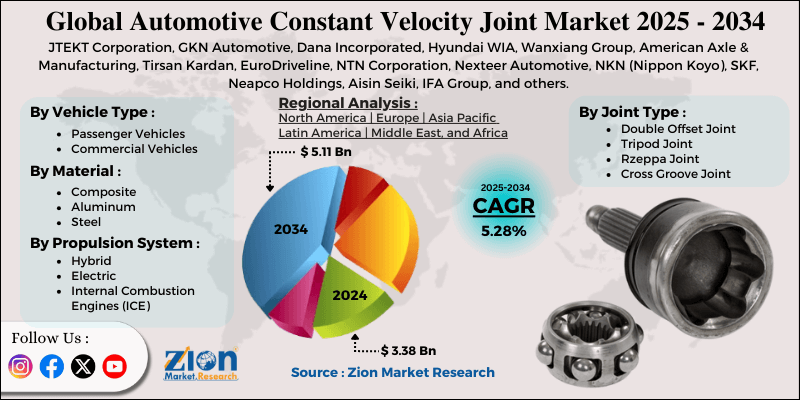
| Key Companies Covered | JTEKT Corporation, GKN Automotive, Dana Incorporated, Hyundai WIA, Wanxiang Group, American Axle & Manufacturing, Tirsan Kardan, EuroDriveline, NTN Corporation, Nexteer Automotive, NKN (Nippon Koyo), SKF, Neapco Holdings, Aisin Seiki, IFA Group, and others. |
| Segments Covered | By Joint Type, By Vehicle Type, By Material, By Propulsion System, and By Region |
| Regions Covered | North America, Europe, Asia Pacific (APAC), Latin America, Middle East, and Africa (MEA) |
| Base Year | 2024 |
| Historical Year | 2019 to 2023 |
| Forecast Year | 2025 - 2034 |
| Customization Scope | Avail customized purchase options to meet your exact research needs. Request For Customization |
Automotive Constant Velocity Joint Market: Segmentation
The global automotive constant velocity joint market is segmented based on type, vehicle drive type, material, application, and region.
Based on joint type, the global market is segmented into double offset joint, tripod joint, Rzeppa joint, cross groove joint, and others. In 2024, the highest growth was listed in the Rzeppa joint segment, accounting for nearly 44.05% of the total revenue. The extensive use of Rzeppa joints in all-wheel drive (AWD) and front-wheel drive (FWD) is expected to aid segmental demand in the coming years. Growing vehicle ownership worldwide may favor the segment during the projection period.
Based on vehicle type, the global automotive constant velocity joint industry is segmented into passenger vehicles and commercial vehicles.
Based on material, the global market is divided into composite, aluminum, and steel. In 2024, industry research indicates that steel dominates the automotive constant velocity joint sector. The material offers excellent strength, durability, and resistance to damage. Furthermore, steel can be subject to precision machining, which is difficult to achieve in other materials. These factors will aid segmental expansion in the future.
Based on the propulsion system, the global industry is fragmented into hybrid, electric, and internal combustion engines (ICE).
Automotive Constant Velocity Joint Market: Regional Analysis
Why will Asia-Pacific continue to dominate the automotive constant velocity joint market?
The global automotive constant velocity joint market is projected to be led by Asia-Pacific during the forecast period. In 2024, the regional market accounted for around 40.05% of the global revenue, with Japan, China, and India playing prominent roles in driving revenue in Asia-Pacific. Japanese automakers are credited as the initial companies to introduce constant velocity joints to the automotive market.
Since then, Japan has continued to remain an unbreakable force in the global landscape of CV joints. In addition, the region’s automobile industry in Asia-Pacific and other international markets is expected to expand further, helping the region thrive during the forecast period.
Europe is projected to emerge as the second-highest revenue generator in the coming years. The growing demand for lightweight and fuel-efficient vehicles across European countries will propel regional growth. In addition, luxury car makers in Europe are seeking automotive solutions that are durable and have low noise & vibration. These parameters can be achieved with specially designed constant velocity joints, further helping the region generate significant revenue. Additionally, rising demand for aftermarket services across Europe and an increasing focus on vehicle safety will enable Europe to remain a prominent force in the global market.
Automotive Constant Velocity Joint Market: Competitive Analysis
The global automotive constant velocity joint market is led by players like:
- JTEKT Corporation
- GKN Automotive
- Dana Incorporated
- Hyundai WIA
- Wanxiang Group
- American Axle & Manufacturing
- Tirsan Kardan
- EuroDriveline
- NTN Corporation
- Nexteer Automotive
- NKN (Nippon Koyo)
- SKF
- Neapco Holdings
- Aisin Seiki
- IFA Group
Automotive Constant Velocity Joint Market: Key Market Trends
CV joints compatible with modern EVs
A prominent trend in the automotive constant-velocity joint market is the growing introduction of CV joints compatible with electric vehicles. EVs demand customized and specially designed drivetrains, creating innovation opportunities for CV joint makers in the future.
Lightweight CV joints
The ongoing efforts to enhance vehicle fuel efficiency and reduce emissions have created demand for lightweight automotive parts such as CV joints. Such trends are likely to promote sustainability in the automobile industry, further helping the market grow.
The global automotive constant velocity joint market is segmented as follows:
By Joint Type
- Double Offset Joint
- Tripod Joint
- Rzeppa Joint
- Cross Groove Joint
- Others
By Vehicle Type
- Passenger Vehicles
- Commercial Vehicles
By Material
- Composite
- Aluminum
- Steel
By Propulsion System
- Hybrid
- Electric
- Internal Combustion Engines (ICE)
By Region
- North America
- The U.S.
- Canada
- Europe
- France
- The UK
- Spain
- Germany
- Italy
- Rest of Europe
- Asia Pacific
- China
- Japan
- India
- South Korea
- Southeast Asia
- Rest of Asia Pacific
- Latin America
- Brazil
- Mexico
- Rest of Latin America
- Middle East & Africa
- GCC
- South Africa
- Rest of Middle East & Africa
Table Of Content
Methodology
FrequentlyAsked Questions

HappyClients

