
Global Automotive Blockchain Market Size, Share, Trends, Growth, Forecasts, 2032

Automotive Blockchain Market By Application (Supply Chain, Smart Contracts, Mobility Solutions, Financing, and Others), By Mobility Type (Commercial Mobility, Shared Mobility, and Personal Mobility), By Provider (Application and Solution Provider, Infrastructure and Protocols Provider, and Middleware Provider), and By Region - Global and Regional Industry Overview, Market Intelligence, Comprehensive Analysis, Historical Data, and Forecasts 2024 - 2032
| Market Size in 2023 | Market Forecast in 2032 | CAGR (in %) | Base Year |
|---|---|---|---|
| USD 462.83 Million | USD 3806.51 Million | 26.38% | 2023 |
How big is the Automotive Blockchain Market?
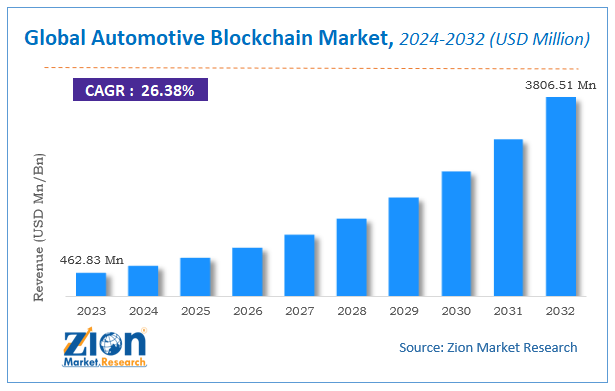
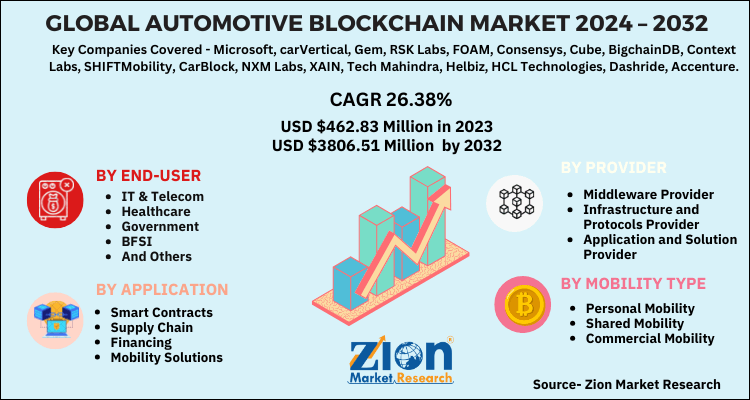
Zion Market Research has published a report on the global automotive blockchain market, estimating its value at USD 462.83 million in 2023, with projections indicating that it will reach USD 3806.51 million by 2032. The market is expected to expand at a compound annual growth rate (CAGR) of 26.38% over the forecast period 2024-2032. This report provides a comprehensive analysis of the growth drivers, restraints, and challenges shaping demand across the global automotive blockchain market throughout the forecast period, while highlighting high-potential emerging opportunities within the industry.
Key Insights
- According to our research analyst, the global automotive blockchain market is estimated to grow at a CAGR of around 26.38% over the forecast period (2024-2032).
- In terms of revenue, the global automotive blockchain market size was valued at around USD 462.83 million in 2023 and is projected to reach USD 3806.51 million by 2032.
- The automotive blockchain market is projected to grow at a significant rate due to reduced overall ownership cost, speedy transactions, focus on lowering manipulations and data leaks, growing need for stability and transparency in complex automotive ecosystems, and rising automobile production.
- Based on the application, the supply chain segment is growing at a high rate and is projected to dominate the global market.
- Based on the mobility type, the commercial segment held the largest market share in 2023 and is expected to grow at a significant rate over the forecast period
- Based on the provider, the application and solution providers segment is projected to swipe the largest market share.
- Based on region, North America is expected to emerge as a major contributor and lead the market due to its pioneering role in adopting blockchain technologies for automotive applications focused on operational stability and improved transparency.
Automotive Blockchain Market: Overview
Automotive blockchain has various advantages, such as reduced overall ownership cost, speedy transactions, and a rise in the focus on lowering manipulations and data leaks. Thus, this technology is being adopted by various market players to simplify their business processes along with creating stability and transparency. The demand and popularity of the automotive blockchain market on a global scale can be attributed to the growing market capital of cryptocurrency and the increasing adoption rate of automotive blockchain for usage-based insurance, transportation and logistics, and payments.
Automotive Blockchain Market: Dynamics
The major growth drivers in the global automotive blockchain market are reduced overall ownership costs, speedy transactions, and a rise in the focus on lowering manipulations and data leaks. Owing to substantial developments, such as the growing need for stability and better transparency in complex automotive ecosystems and testing blockchain use cases, the automobile industry across the world is growing by leaps and bounds. The global automobile industry is fuelled by increasing automobile production as a result of a growing population, improved economic conditions, increased purchasing power of the population, and rapid urbanization. This, in turn, is anticipated to drive the global automotive blockchain market over the estimated timeframe.
However, uncertain government regulations regarding automotive blockchain technology due to the nascent stage of the automotive blockchain market globally might limit this market on a global scale over the estimated time period. Other restraining factors include concerns related to control, security, and privacy, limited scalability, and the lack of technical expertise.
Automotive Blockchain Market: Report Scope
| Report Attributes | Report Details |
|---|---|
| Report Name | Automotive Blockchain Market |
| Market Size in 2023 | USD 462.83 Million |
| Market Forecast in 2032 | USD 3806.51 Million |
| Growth Rate | CAGR of 26.38% |
| Number of Pages | 220 |
| Key Companies Covered | Microsoft, carVertical, Gem, RSK Labs, FOAM, Consensys, Cube, BigchainDB, Context Labs, SHIFTMobility, CarBlock, NXM Labs, XAIN, Tech Mahindra, Helbiz, HCL Technologies, Dashride, Accenture, and IBM, among others |
| Segments Covered | By Application, By Mobility Type, By Provider, and By Region |
| Regions Covered | North America, Europe, Asia Pacific (APAC), Latin America, Middle East, and Africa (MEA) |
| Base Year | 2023 |
| Historical Year | 2018 - 2022 |
| Forecast Year | 2024 - 2032 |
| Customization Scope | Avail customized purchase options to meet your exact research needs. Request For Customization |
Automotive Blockchain Market: Segmentation
The automotive blockchain market is segmented by application, mobility type, provider, and region. All the segments of the automotive blockchain market have been analyzed based on present and future trends and the market is estimated from 2024 to 2032.
By Application, this market includes supply chains, smart contracts, mobility solutions, financing, and others (IoT, safety and security, insurance, and fleet management). Supply chain applications are central because blockchain enables immutable tracking of components, reduces counterfeit risk, and improves transparency across multi-tier supplier networks. Smart contracts support automated processes for payments, warranties, and service agreements, reducing friction and improving trust among participants. Mobility solutions, financing, and other uses such as IoT, safety and security, insurance, and fleet management further expand the addressable market. Strong demand for transparency and fraud reduction in supply chains, combined with automation benefits from smart contracts, helps drive overall market growth and encourages continued platform development.
Based on Mobility Type, this global market is segmented into commercial mobility, shared mobility, and personal mobility. Commercial mobility benefits from blockchain for fleet management, logistics transparency, and secure data exchange among operators and partners. Shared mobility platforms use the technology to support secure identity, payments, and service coordination across users and providers. Personal mobility applications focus on vehicle data security, ownership records, and related services. The combination of these mobility models creates diverse use cases that broaden adoption and support sustained market expansion as mobility ecosystems become more connected and data-driven.
On the basis of Provider, this market is divided into application and solution providers, infrastructure and protocols providers, and middleware providers. Application and solution providers deliver end-user platforms and industry-specific use cases that directly address automotive needs such as supply chain tracking and mobility services. Infrastructure and protocols providers supply the underlying blockchain frameworks and standards required for secure, scalable networks. Middleware providers enable integration between blockchain layers and existing automotive systems.
Automotive Blockchain Market: Regional Analysis
Why will North America continue to dominate the global market during the projection period?
North America is projected to emerge as the major contributor to the global automotive blockchain market. The region has been a pioneer in adopting blockchain technologies for varied automotive applications, including improved stability of business operations and greater transparency. Strong presence of technology vendors, early enterprise experimentation, and a mature connected-vehicle and mobility ecosystem support continued leadership. These factors drive overall market growth by setting implementation benchmarks, accelerating innovation in secure data sharing and supply chain solutions, and encouraging broader industry investment in blockchain-enabled automotive processes.
The Asia Pacific region is likely to register the fastest rate of growth in the automotive blockchain market over the estimated time period. This can be attributed to the region’s increasing automobile production as a result of a growing population, improved economic conditions, the increased purchasing power of the population, and rapid urbanization. This, in turn, is likely to drive the automotive blockchain market in the upcoming years, as the automotive industry is ready to adopt blockchain technology for combating fraud and increasing transparency. China and India are anticipated to be the leading market contributors in this regional market.
Automotive Blockchain Market: Competitive Players
Some of the most important market players in the global automotive blockchain market include
- Microsoft
- carVertical
- Gem
- RSK Labs
- FOAM
- Consensys
- Cube
- BigchainDB
- Context Labs
- SHIFTMobility
- CarBlock
- NXM Labs
- XAIN
- Tech Mahindra
- Helbiz
- HCL Technologies
- Dashride
- Accenture
- IBM
The global automotive blockchain market is segmented as follows:
By Application
- Supply Chain
- Smart Contracts
- Mobility Solutions
- Financing
- Others
By Mobility Type
- Commercial Mobility
- Shared Mobility
- Personal Mobility
By Provider
- Application and Solution Provider
- Infrastructure and Protocols Provider
- Middleware Provider
By Region
- North America
- The U.S.
- Canada
- Mexico
- Europe
- France
- The UK
- Spain
- Germany
- Italy
- Rest of Europe
- Asia Pacific
- China
- Japan
- India
- Australia
- South Korea
- Rest of Asia Pacific
- The Middle East & Africa
- Saudi Arabia
- UAE
- Egypt
- Kuwait
- South Africa
- Rest of the Middle East & Africa
- Latin America
- Brazil
- Argentina
- Rest of Latin America
Table Of Content
Methodology
FrequentlyAsked Questions
Automotive blockchain applies blockchain technology to vehicle data management and automotive processes. It improves security, transparency, and data sharing while supporting use cases such as supply chain tracking, smart contracts, mobility solutions, and financing.
Key growth drivers include reduced overall ownership cost, speedy transactions, focus on lowering manipulations and data leaks, growing need for stability and transparency in complex automotive ecosystems, testing of blockchain use cases, and rising automobile production linked to population growth, economic improvement, and urbanization.
According to a study, the global automotive blockchain market size was worth around USD 462.83 million in 2023 and is predicted to grow to around USD 3806.51 million by 2032.
The global automotive blockchain market is expected to grow at a Compound Annual Growth Rate (CAGR) of around CAGR 26.38% during the forecast period from 2024 to 2032.
Major challenges include uncertain government regulations due to the nascent stage of the market, concerns related to control, security, and privacy, limited scalability, lack of technical expertise, unclear ROI, and ecosystem coordination challenges.
Emerging trends include secure vehicle data sharing, supply chain traceability, support for mobility services, and blockchain-enabled transactions related to EV charging and connected vehicle ecosystems.
The value chain typically includes blockchain protocol and infrastructure development, middleware and integration layers, application and solution development for automotive use cases, deployment with OEMs and suppliers, ongoing network operation and governance, and continuous enhancement of security, scalability, and interoperability features.
North America is expected to emerge as the major contributor and lead the automotive blockchain market during the forecast period.
Some of the prominent players operating in the global automotive blockchain market are Microsoft, carVertical, Gem, RSK Labs, FOAM, Consensys, Cube, BigchainDB, Context Labs, SHIFTMobility, CarBlock, NXM Labs, XAIN, Tech Mahindra, Helbiz, HCL Technologies, Dashride, Accenture, and IBM, among others.
The report explores crucial aspects of the automotive blockchain market, including a detailed discussion of existing growth factors and restraints, while also examining future growth opportunities and challenges that impact the market.

HappyClients

