
Airships Market Size, Share, Trends, Growth and Forecast Report 2034

Airships Market By Type (Rigid, Non-Rigid, and Semi-Rigid), By Application (Surveillance, Commercial Tours, Research, Advertising, Cargo Transport, and Others), By End-User (Military, Government, Commercial, and Others), and By Region - Global and Regional Industry Overview, Market Intelligence, Comprehensive Analysis, Historical Data, and Forecasts 2026 - 2034
| Market Size in 2025 | Market Forecast in 2034 | CAGR (in %) | Base Year |
|---|---|---|---|
| USD 1.78 Billion | USD 3.62 Billion | 8.2% | 2025 |
Airships Industry Perspective:
What will be the size of the global airships market during the forecast period?
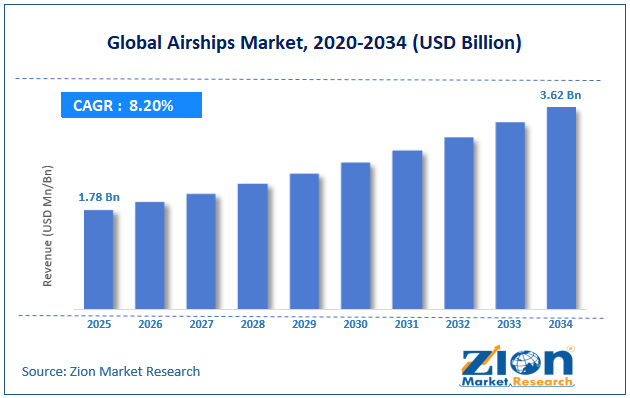
The global airships market size was worth around USD 1.78 billion in 2025 and is predicted to grow to around USD 3.62 billion by 2034, with a compound annual growth rate (CAGR) of roughly 8.2% between 2026 and 2034.
 Request Free SampleRequest Free Sample
Key Insights
- As per the analysis shared by our research analyst, the global airships market is estimated to grow annually at a CAGR of around 8.2% over the forecast period (2026-2034).
- In terms of revenue, the global airships market size was valued at around USD 1.78 billion in 2025 and is projected to reach USD 3.62 billion by 2034.
- Advancements in airship technology are expected to propel the airships market over the projected period.
- Based on the type, the non-rigid segment held the largest revenue share in 2025 of 58%.
- Based on the application, the surveillance segment holds a majority of market share in 2025 of 35%.
- Based on the end-user, the military segment held a prominent revenue share in 2025 of 42%.
- Based on region, North America dominates the airships market with a revenue share of 40% in 2025.
Airships Market: Overview
Airships are aircraft of the lighter-than-air category that employ a gasbag that is filled with a gas of lower density than air to produce lift. Unlike balloons, airships have propulsion and control systems that allow them to be steered while in flight. The design provides a vehicle capable of hovering and making slow flights for long periods. Airships can carry a variety of payloads, and are thus used for both commercial and military needs. These aircrafts are used for aerial surveying, tourism, advertising, research, carrying goods to inaccessible places, or military reconnaissance. They offer several advantages over other aircraft. They can cover great distances and hover over the ground, providing close observations. Their value in environmental study justifies their use; their ability to fly at low speeds, loiter over a place of interest, land and take off without requiring developed infrastructure, and reach remote places such as the North Pole and the South Pole.
Impact of the USA-Israel War on Iran on the Airships Market
The USA-Israeli dispute over Iran has had both positive and negative effects on the global airships market. The main positive effect is associated with increased defense spending and the corresponding need for surveillance and reconnaissance aircraft. Moreover, the conflict with Iran has led to temporary disruptions in the supply of some aircraft parts, as well as raw materials and helium, which is why aircraft prices have increased to higher levels than before. The increase in risk and uncertainty has led to the deferral of some commercial airship projects, including those related to tourism and advertising. Nevertheless, the growing importance of airships in humanitarian aid, disaster relief, and sensitive cargo transportation is driving global demand for airships. Thus, the market is expected to grow in the long run due to increasing defense needs and the use of airships in emergencies.
Airships Market: Dynamics
Growth Drivers
How do rising defense and surveillance investments drive airships market growth?
Growing government spending on defense and homeland security is a key factor driving the airships market. Stockholm International Peace Research Institute (SIPRI) data reveals that global military expenditure reached US$2.718 trillion in 2024, registering a 9.4% year-over-year increase and the largest rise since the end of the Cold War. Over 100 countries increased defense spending in 2024 due to heightened geopolitical tensions, including the conflicts in the Middle East and Europe. Defense budgets are driving demand for Intelligence, Surveillance, and Reconnaissance (ISR) platforms, and airships can provide persistent surveillance and reconnaissance from several days aloft while carrying electro-optical/infrared (EO/IR) sensors, radars, communication relay equipment, and other intelligence-gathering payloads. Airships offer a cost-effective alternative to traditional aircraft for border security, maritime patrol, and other surveillance missions that require persistent wide-area coverage.
Government spending on defense and homeland security is set to benefit the airships market. SIPRI estimates that NATO members’ defense spending was $1.506 trillion in 2024, accounting for 55% of global military expenditure, while the United States alone spent US$997 billion in 2024, accounting for 37% of global military expenditure. A sizeable portion of the budgets is expected to be allocated to surveillance, reconnaissance, and new technologies capable of incorporating airships.
Increased government spending on border security, maritime patrol, and surveillance is anticipated to propel the demand for long-endurance surveillance aircraft. As a result, the defense and security sector is expected to witness the highest growth in the global airships market in the years to come.
Restraints
Why do the high initial development and manufacturing costs act as a major restraint to the airships industry's growth?
High initial development and production costs associated with modern airships are a major restraint in the global airships market. Advanced airships’ production requires substantial investment in light composite materials, helium gas, hybrid or electric engines, flight control equipment, and flight safety systems.
Moreover, airship manufacturers face additional costs related to the development of specialized hangars, mooring masts, service centers, and other infrastructure facilities. Companies producing airships also encounter significant challenges linked to aircraft certification and regulation compliance that add to the R&D expenditures during the development of new aircraft models. The high capital investment required in the production of airships reduces the number of companies entering the market and limits the scale of commercial transportation and tourism networks’ development. As a result, market growth is restrained by the high costs of aircraft development and certification and the relatively long payback period for capital expenditures.
Opportunities
How does the rising partnership in the sector offer a lucrative opportunity for the airships market?
The growing partnership is expected to offer a potential opportunity to the airships market over the projected period. For instance, in February 2026, Transport Corporation of India Ltd (TCI) tied up with Flying Whales and its operating unit, Flying Whales Services, to develop the LCA60T aeronautical program. The LCA60T is a rigid cargo airship design that can carry up to 60 tonnes of cargo while hovering to allow loading and unloading. The development of the aircraft is expected to contribute to decarbonizing the transport of high-value, high-density cargo and facilitate strategic logistics and supply chain management for critical missions in India.
Challenges
Technological and payload limitations pose a significant threat to the growth of the airships industry
The global airships market is limited by two major difficulties, namely technological and payload restrictions. Airships have a few disadvantages compared to airplanes and helicopters. They cannot carry as much, and they cannot go as fast or carry as much payload. Furthermore, building airships with better cargo capacity and speed is difficult since, to carry more payload, larger envelopes with more gas volumes are needed, resulting in higher production costs. Integrating propulsion systems, autonomous technologies, and fuel storage is difficult, which reduces the efficiency of different aircraft types, such as hybrid airships.
Also, the applicability of airships is restricted by the impact of weather conditions on flight safety and performance, making them dependent on environmental conditions rather than inherent qualities. Generally, the identified parameters influencing airship payload restrict their use across different transportation sectors and influence the development of the global airships market.
Airships Market: Report Scope
| Report Attributes | Report Details |
|---|---|
| Report Name | Airships Market |
| Market Size in 2025 | USD 1.78 Billion |
| Market Forecast in 2034 | USD 3.62 Billion |
| Growth Rate | CAGR of 8.2% |
| Number of Pages | 227 |
| Key Companies Covered | Lockheed Martin Corporation, Aeroscraft Corporation, Lindstrand Technologies Ltd., Hybrid Air Vehicles Ltd., RosAeroSystems, Worldwide Aeros Corp., Skyship Services Inc., Zeppelin Luftschifftechnik GmbH & Co. KG, Airborne Industries, GEFA-FLUG GmbH, American Blimp Corporation, Shanghai Vantage Airship Manufacture Co. Ltd., Goodyear Tire & Rubber Company, Airship Management Services Inc., Aerostar International Inc., Cameron Balloons Ltd., Airship do Brasil Indústria Aeronáutica Ltda., Atlas LTA Advanced Technology Ltd., Solar Ship Inc., E-Green Technologies, and others. |
| Segments Covered | By Type, By Application, By End-User, and By Region |
| Regions Covered | North America, Europe, Asia Pacific (APAC), Latin America, Middle East, and Africa (MEA) |
| Base Year | 2025 |
| Historical Year | 2020 to 2024 |
| Forecast Year | 2026 - 2034 |
| Customization Scope | Avail customized purchase options to meet your exact research needs. Request For Customization |
Airships Market: Segmentation
Type Insights
Why does the non-rigid segment hold a prominent position in the airships market?
The non-rigid segment held the largest revenue share of the airships market in 2025 of 58%. The growth is primarily attributed to their cost-effectiveness, operational flexibility, and wide range of commercial and defense applications. Non-rigid airships utilize the internal pressure of the helium gas to maintain their shape as opposed to using an onboard structure like their rigid counterparts. This decreases the manufacturing and maintenance costs. The capability to stay airborne for a relatively long time while consuming lesser amounts of fuel has made them desirable for intelligence, surveillance, and reconnaissance, border security, maritime patrol, advertising, and media broadcast. Increasing investments in homeland security and persistent aerial surveillance are further projected to propel the market growth during the forecast period. Moreover, the tourism sector is also adopting non-rigid airships to provide a more comfortable and environmentally friendly transportation experience.
Application
How does the surveillance segment capture the largest market share in the airships market?
The surveillance segment held a majority of the airships market share in 2025 of 35%. The growth of this market is driven by the growing need for increased and sustained intelligence, surveillance, and reconnaissance (ISR) efforts in defense, homeland security, and civil applications. Modern airships can provide an extended presence in the air for days at a time while carrying EO/IR, SAR, communications relay, and electronic surveillance payloads. These airships offer the advantage of time spent over the target while providing greater flexibility than a satellite and at a much lower cost than conventional aircraft or helicopters. Growing defense budgets, rising geopolitical tensions, and an expanding need for border surveillance, maritime domain awareness, and protecting critical infrastructure will drive the demand for surveillance airships.
End-User Insights
Does the military segment capture the largest market share in the airships market?
The military segment held a prominent revenue share of the airships industry in 2025 of 42%. The market's growth is primarily attributed to escalating defense budgets, growing geopolitical tensions, and the need for cost-effective, long-endurance aircraft. Moreover, the rising adoption of airships for intelligence, surveillance, and reconnaissance (ISR), border security, maritime patrol, battlefield surveillance, early warning, and communication relays due to their ability to stay airborne for long periods of time, carrying sophisticated radars, EO/IR, ELINT, and communication payloads, is anticipated to propel market growth.
Besides, offering low operating costs and fuel consumption compared to conventional aircraft, the technology also enables constant surveillance over borders, coastal shipping lanes, and key installations, contributing to market growth. In addition, the demand for modernizing defense systems and improving homeland security and situational awareness is driving the need for advanced aerial surveillance platforms such as hybrid and autonomous airships.
Regional Insights
What factors drive the North America region in the airships market?
North America dominates the airships market with a revenue share of 40% in 2025. The market's growth is attributed to surging government expenditure on defense modernization, aerospace research, border security, and advanced aviation technology. The U.S. defense sector is the largest provider in the region and is investing heavily in surveillance, persistent intelligence, and communication relay systems. In addition, airships and aerostats provide the much-needed solution for uninterrupted surveillance and reconnaissance and are being adopted for use in maritime domains. Besides the defense sector, the FAA is also contributing to market growth by allocating funds from the Airport and Airway Trust Fund and the Capital Investment Plan (CIP). The CIP focuses on availing funds for capital assets, research, engineering, and NextGen air traffic technologies and procedures.
Moreover, the Airport and Airway Trust Fund had a cash balance of US$21.8 billion as of the end of fiscal year (FY) 2025. The FAA Reauthorization Act of 2024 is also supporting the development of aviation research, engineering, and related technologies that would facilitate the creation of better aerospace systems.
Airships Market: Competitive Analysis
The global airships market is dominated by players like:
- Lockheed Martin Corporation
- Aeroscraft Corporation
- Lindstrand Technologies Ltd.
- Hybrid Air Vehicles Ltd.
- RosAeroSystems
- Worldwide Aeros Corp.
- Skyship Services Inc.
- Zeppelin Luftschifftechnik GmbH & Co. KG
- Airborne Industries
- GEFA-FLUG GmbH
- American Blimp Corporation
- Shanghai Vantage Airship Manufacture Co. Ltd.
- Goodyear Tire & Rubber Company
- Airship Management Services Inc.
- Aerostar International Inc.
- Cameron Balloons Ltd.
- Airship do Brasil Indústria Aeronáutica Ltda.
- Atlas LTA Advanced Technology Ltd.
- Solar Ship Inc.
- E-Green Technologies
The global airships market is segmented as follows:
By Type
- Rigid
- Non-Rigid
- Semi-Rigid
By Application
- Surveillance
- Commercial Tours
- Research
- Advertising
- Cargo Transport
- Others
By End-User
- Military
- Government
- Commercial
- Others
By Region
- North America
- The U.S.
- Canada
- Mexico
- Europe
- France
- The UK
- Spain
- Germany
- Italy
- Rest of Europe
- Asia Pacific
- China
- Japan
- India
- Australia
- South Korea
- Rest of Asia Pacific
- The Middle East & Africa
- Saudi Arabia
- UAE
- Egypt
- Kuwait
- South Africa
- Rest of the Middle East & Africa
- Latin America
- Brazil
- Argentina
- Rest of Latin America
Table Of Content
Methodology
FrequentlyAsked Questions
Airships are aircraft of the lighter-than-air category that employ a gasbag that is filled with a gas of lower density than air to produce lift. Unlike balloons, airships have propulsion and control systems that allow them to be steered while in flight.
The key growth drivers for the airships market include rising defense and homeland security investments, increasing demand for long-endurance intelligence, surveillance, and reconnaissance (ISR) platforms, and the need for cost-effective cargo transportation in remote and infrastructure-limited regions. Market growth is also supported by advancements in lightweight materials, hybrid-electric propulsion, and autonomous flight technologies, along with expanding applications in tourism, environmental monitoring, disaster relief, and communication relay.
The major challenges restraining the airships market include high initial development and manufacturing costs, limited helium availability and price volatility, and stringent aviation certification requirements. Market growth is also constrained by weather sensitivity, relatively slow travel speeds, limited ground infrastructure such as mooring and maintenance facilities, and technological limitations related to payload capacity and propulsion systems.
Based on the application, the surveillance segment is expected to dominate the airships market growth during the projected period.
Emerging trends and innovations in the airships market include the development of hybrid-electric and autonomous airships, the use of lightweight composite materials, and the integration of advanced AI-enabled navigation, radar, and electro-optical/infrared (EO/IR) surveillance systems. Manufacturers are also focusing on heavy-lift cargo airships for remote logistics, sustainable low-emission aviation solutions, and high-altitude platforms for communications and environmental monitoring.
According to the report, the global airships market size was worth around USD 1.78 billion in 2025 and is predicted to grow to around USD 3.62 billion by 2034.
The global airships market is expected to grow at a CAGR of 8.2% during the forecast period.
The global airships industry growth is expected to be led by North America over the forecast period.
The global airships market is dominated by players like Lockheed Martin Corporation, Aeroscraft Corporation, Lindstrand Technologies Ltd., Hybrid Air Vehicles Ltd., RosAeroSystems, Worldwide Aeros Corp., Skyship Services Inc., Zeppelin Luftschifftechnik GmbH & Co. KG, Airborne Industries, GEFA-FLUG GmbH, American Blimp Corporation, Shanghai Vantage Airship Manufacture Co., Ltd., Goodyear Tire & Rubber Company, Airship Management Services, Inc., Aerostar International, Inc., Cameron Balloons Ltd., Airship do Brasil Indústria Aeronáutica Ltda., Atlas LTA Advanced Technology Ltd., Solar Ship Inc., and E-Green Technologies, among others.
The airships market report covers the geographical market along with a comprehensive competitive landscape analysis. It also includes cash flow analysis, profit ratio analysis, market basket analysis, market attractiveness analysis, sentiment analysis, PESTLE analysis, trend analysis, SWOT analysis, trade area analysis, demand & supply analysis, Porter’s five forces analysis, and value chain analysis.

HappyClients

