
Airport Cabin Baggage Scanner Market Size, Growth, Global Trends, Forecast 2034

Airport Cabin Baggage Scanner Market By Type (In-line, Integrated and Handheld), By Resolution (High Resolution (3D imaging), Low Resolution, and Medium Resolution), By Security Level (Standard, Prohibited, and Enhanced), By Technology (X-ray Scanning, Millimeter Wave Scanning, and CT Scanning), and By Region - Global and Regional Industry Overview, Market Intelligence, Comprehensive Analysis, Historical Data, and Forecasts 2026 - 2034
| Market Size in 2025 | Market Forecast in 2034 | CAGR (in %) | Base Year |
|---|---|---|---|
| USD 4.8 Billion | USD 8.4 Billion | 9.68% | 2025 |
Airport Cabin Baggage Scanner Industry Perspective:
What will be the size of the global airport cabin baggage scanner market during the forecast period?
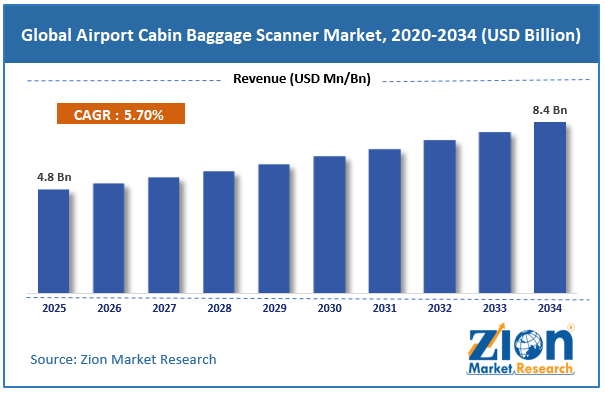
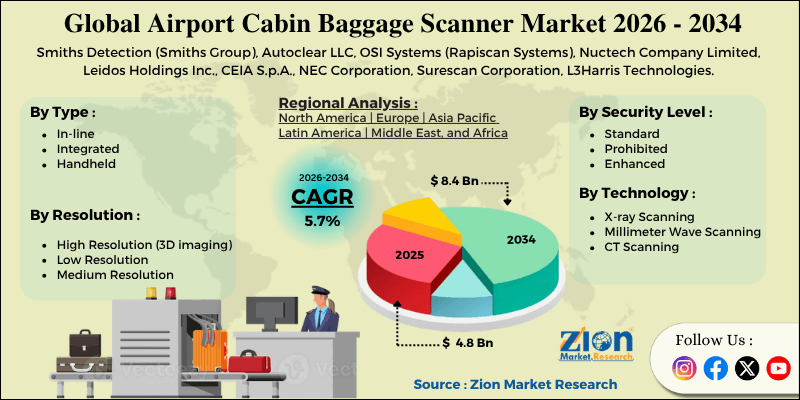
The global airport cabin baggage scanner market size was worth around USD 4.8 billion in 2025 and is predicted to grow to around USD 8.4 billion by 2034, with a compound annual growth rate (CAGR) of roughly 5.7% between 2026 and 2034.
Airport Cabin Baggage Scanner Market: Overview
The airport cabin baggage scanner is an airport security screening system that uses imaging technologies such as CT, X-ray, or dual-energy X-ray to create detailed images of the contents of bags and detect any hazardous materials or weapons before they can harm the plane or airport security. The scanner is normally employed at airport checkpoints, where it scans passengers' bags to determine whether their contents pose a security threat to passengers or airport employees. Most scanners used today employ artificial intelligence and 3D image generation systems.
Key Insights
- As per the analysis shared by our research analyst, the global airport cabin baggage scanner market is estimated to grow annually at a CAGR of around 5.7% over the forecast period (2026-2034).
- In terms of revenue, the global airport cabin baggage scanner market size was valued at around USD 4.8 billion in 2025 and is projected to reach USD 8.4 billion by 2034.
- Stringent aviation security regulations are expected to propel the airport cabin baggage scanner market over the projected period.
- Based on the type, the in-line segment held the largest market share in 2025.
- Based on the resolution, the high-resolution segment held a prominent market share in 2025.
- Based on the security level, the standard segment dominates the market.
- Based on the technology, the X-ray scanning segment dominates the market.
- Based on region, North America led the market with a revenue share of 33% in 2025.
Impact of the USA-Israel War on Iran on the Airport Cabin Baggage Scanner Market
The conflict between the U.S. and Israel regarding Iran has had a varied yet largely positive effect on the airport cabin baggage scanner market. Geopolitical instability, fear of terrorist attacks, and growing aviation security threats have forced governments and airports to improve passenger screening procedures and expedite the purchase of advanced cabin baggage scanners, including CT, AI, and automated threat detectors.
Meanwhile, the conflict has disrupted the global supply chain, raised transportation and parts costs, and even delayed equipment deliveries due to restricted airspace and high logistics costs. In general, although procurement costs have risen in the short term, the emphasis on aviation security and airport modernization will aid future demand for sophisticated cabin baggage scanners.
Airport Cabin Baggage Scanner Market: Dynamics
Growth Drivers
How does the rising air passenger traffic drive the airport cabin baggage scanner market?
The growing number of air travelers is a primary factor driving the airport cabin baggage scanner market, as increased passenger traffic demands greater screening capacity. With the growing number of passengers, the volume of baggage screened at airports will increase, requiring airlines to acquire new bag scanners with greater capacity to handle the growing number of bags. For instance, the International Civil Aviation Organization (ICAO) reports that there were 4.7 billion air passengers in 2024, 7.9% higher than the figure in 2023, while the number of air traffic movements was 37.4 million, 5.1% higher than the figure in 2023.
Restraints
How do the high maintenance and operating expenses hamper the growth of the airport cabin baggage scanner industry?
The exorbitant cost of DOACs relative to conventional anticoagulants is a major factor limiting Maintenance and operational costs are among the major constraints for the Airport Cabin Baggage Scanners Market due to the reason that the advanced scanners, such as CT-based and AI-integrated scanners, require calibration, maintenance on a periodic basis, upgrade, and replacement of their costly components, including X-ray tubes and detectors from time to time. This significantly increases the ownership costs for airports, particularly for those with constrained budgets, such as small regional airports. On the other hand, the costs associated with support, maintenance, operator training, and scanner upgrades, in accordance with evolving security standards in the aviation sector, are also major constraints to adopting the latest-generation scanners.
Opportunities
Why do the growing government investments in aviation security offer a lucrative opportunity for the airport cabin baggage scanner market?
Increasing expenditures on aviation security offer significant potential for the airport cabin baggage scanner market, as many governments worldwide continue to invest in securing airport infrastructure and implementing innovative technologies at security checkpoints. There has been a shift towards replacing traditional X-ray systems with computed tomography-based, AI-enabled cabin baggage scanners because these systems are more efficient at detecting potential threats and facilitating passenger screening. Expenditures on the aviation security industry are proof of this. The United States Transportation Security Administration received a budget of around USD 11.8 billion in FY 2025, which includes expenditure on screening services and operations, modernization of security technology, and checkpoint improvements.
Challenges
Shortage of skilled security personnel poses a significant challenge to the airport cabin baggage scanner market
The lack of well-trained security staff presents a major obstacle for the airport cabin baggage scanner market, as sophisticated cabin bag scanner systems, such as artificial intelligence-driven CT scan-based technologies, require trained professionals to correctly read complicated images and handle automated threat recognition alerts. Airports around the world, especially those in developing countries, struggle to recruit and retain qualified screening staff due to manpower shortages, training costs, and labor turnover. Insufficient expertise not only results in inefficiencies in the screening process but may also increase delays and reduce the effectiveness of modern technologies, thereby hindering the development of next-generation airport cabin baggage scanners.
Airport Cabin Baggage Scanner Market: Report Scope
| Report Attributes | Report Details |
|---|---|
| Report Name | Airport Cabin Baggage Scanner Market |
| Market Size in 2025 | USD 4.8 Billion |
| Market Forecast in 2034 | USD 8.4 Billion |
| Growth Rate | CAGR of 5.7% |
| Number of Pages | 226 |
| Key Companies Covered | Smiths Detection (Smiths Group), Autoclear LLC, OSI Systems (Rapiscan Systems), Nuctech Company Limited, Leidos Holdings Inc., CEIA S.p.A., NEC Corporation, Surescan Corporation, L3Harris Technologies, Analogic Corporation, Astrophysics Inc., Garrett Metal Detectors, Thales Group, Safeway Inspection Systems, Vanderlande Industries, CEIA & Associates, Unisys Corporation, VOTI Detection, Aventura Technologies, Adani Systems Inc., Gilardoni S.p.A., and others. |
| Segments Covered | By Type, By Resolution, By Security Level, By Technology, and By Region |
| Regions Covered | North America, Europe, Asia Pacific (APAC), Latin America, Middle East, and Africa (MEA) |
| Base Year | 2025 |
| Historical Year | 2020 - 2024 |
| Forecast Year | 2026 - 2034 |
| Customization Scope | Avail customized purchase options to meet your exact research needs. Request For Customization |
Airport Cabin Baggage Scanner Market: Segmentation
Type Insights
Why does the in-line segment hold a prominent position in the airport cabin baggage scanner market?
The in-line segment held the largest share in the airport cabin baggage scanner industry in 2025. The growth can be attributed to the capability of in-line scanners to provide automated screening of bags at airport conveyor systems. In-line scanners eliminate the need for manual handling of bags, reduce congestion at checkpoints, and help process large amounts of cabin luggage faster without compromising detection precision. Increased investment in airport modernization, expansion of smart airport facilities, and adoption of CT- and AI-based screening techniques are among the factors driving the rising demand.
Resolution Insights
How does the high resolution segment capture the largest market share in the airport cabin baggage scanner market?
The high resolution segment held a prominent share in the airport cabin baggage scanner market in 2025. The growth in this segment is due to improved imaging capabilities that help identify concealed weapons, explosives, drugs, and other restricted items. Higher-resolution scanners ensure improved image clarity and, consequently, minimize the risk of false alarms. The adoption of technologies such as computed tomography (CT) scanners, dual-energy X-ray imaging, and AI-assisted image analysis is expected to drive demand for higher-resolution scanners.
Security Level Insights
Why does the standard segment capture the largest market share in the airport cabin baggage scanner market?
The standard segment dominates the airport cabin baggage scanner market. These factors make growth possible: their relative cost-efficiency, high reliability, and extensive use in small and medium airports. The standard passenger baggage scanning system is an effective X-ray-based system that meets minimum aviation security requirements, but it does not require the expensive installation of a CT scanner. It also offers easier use, compliance with all regulations, and compatibility with airport security facilities.
Technology Insights
Does the X-ray scanning segment capture the largest market share in the airport cabin baggage scanner market?
The X-ray scanning segment dominates the airport cabin baggage scanner market. The growth in the segment can be attributed to its extensive use and to its proven cost-effectiveness and precision in detecting contraband in hand baggage. X-ray systems have remained the most common screening tool at airport security checkpoints because they offer high-quality images and fast processing while meeting international aviation security standards. Advances include dual-energy X-ray imaging, higher-resolution images, artificial intelligence threat detection, and image analysis software.
Regional Insights
Why does North America lead the airport cabin baggage scanner market?
North America led the airport cabin baggage scanner market with the highest revenue share, at 33%, in 2025. Growth is attributed to strict aviation security measures, airport modernization, a large number of passengers, and heavy government investment in installing screening technologies. Government data confirm this growth trend. The TSA states that "TSA continues to advance its portfolio of advanced screening technologies at U.S. airports as part of sustained federal investment in aviation security initiatives." Additionally, the high number of air travelers is leading to more replacement of older X-ray systems with new CT-based cabin baggage scanners to enhance security and efficiency at checkpoints. Product innovation is another factor driving market growth in the region.
For instance, in October 2025, Smiths Detection introduced the SDX 10080 SCT, a next-generation CT-based baggage screening technology compliant with TSA and ECAC standards.
Airport Cabin Baggage Scanner Market: Competitive Analysis
The global airport cabin baggage scanner market is dominated by players like:
- Smiths Detection (Smiths Group)
- Autoclear LLC
- OSI Systems (Rapiscan Systems)
- Nuctech Company Limited
- Leidos Holdings Inc.
- CEIA S.p.A.
- NEC Corporation
- Surescan Corporation
- L3Harris Technologies
- Analogic Corporation
- Astrophysics Inc.
- Garrett Metal Detectors
- Thales Group
- Safeway Inspection Systems
- Vanderlande Industries
- CEIA & Associates
- Unisys Corporation
- VOTI Detection
- Aventura Technologies
- Adani Systems Inc.
- Gilardoni S.p.A.
The global airport cabin baggage scanner market is segmented as follows:
By Type
- In-line
- Integrated
- Handheld
By Resolution
- High Resolution (3D imaging)
- Low Resolution
- Medium Resolution
By Security Level
- Standard
- Prohibited
- Enhanced
By Technology
- X-ray Scanning
- Millimeter Wave Scanning
- CT Scanning
By Region
- North America
- The U.S.
- Canada
- Mexico
- Europe
- France
- The UK
- Spain
- Germany
- Italy
- Rest of Europe
- Asia Pacific
- China
- Japan
- India
- Australia
- South Korea
- Rest of Asia Pacific
- The Middle East & Africa
- Saudi Arabia
- UAE
- Egypt
- Kuwait
- South Africa
- Rest of the Middle East & Africa
- Latin America
- Brazil
- Argentina
- Rest of Latin America
Table Of Content
Methodology
FrequentlyAsked Questions
The airport cabin baggage scanner is an airport security screening system that uses imaging technologies such as CT, X-ray, or dual-energy X-ray to create detailed images of the contents of bags and detect any hazardous materials or weapons before they can harm the plane or airport security.
The Airport Cabin Baggage Scanner Market is primarily driven by rising air passenger traffic, stringent aviation security regulations, and increasing government investments in airport security infrastructure. Growing concerns over terrorism and smuggling, rapid adoption of computed tomography (CT)-based and AI-enabled screening technologies, airport modernization projects, and the need for faster passenger throughput are further accelerating market growth.
The airport cabin baggage scanner market faces several challenges, including high maintenance and operating expenses, which increase the total cost of ownership for airport operators, and the shortage of skilled security personnel required to operate advanced CT- and AI-based screening systems efficiently.
Based on the technology, the X-ray scanning segment is expected to dominate the airport cabin baggage scanner market growth during the projected period.
Key emerging trends and innovations in the airport cabin baggage scanner market include the increasing adoption of computed tomography (CT)-based scanners, artificial intelligence (AI)-powered automated threat detection, and high-resolution 3D imaging to improve screening accuracy and passenger throughput.
According to the report, the global airport cabin baggage scanner market size was worth around USD 4.8 billion in 2025 and is predicted to grow to around USD 8.4 billion by 2034.
The global airport cabin baggage scanner market is expected to grow at a CAGR of 5.7% during the forecast period.
The global airport cabin baggage scanner industry growth is expected to be led by North America over the forecast period.
The global airport cabin baggage scanner market is dominated by players like Smiths Detection (Smiths Group), Autoclear LLC, OSI Systems (Rapiscan Systems), Nuctech Company Limited, Leidos Holdings, Inc., CEIA S.p.A., NEC Corporation, Surescan Corporation, L3Harris Technologies, Analogic Corporation, Astrophysics Inc., Garrett Metal Detectors, Thales Group, Safeway Inspection Systems, Vanderlande Industries, CEIA & Associates, Unisys Corporation, VOTI Detection, Aventura Technologies, Adani Systems, Inc., and Gilardoni S.p.A., among others.
The airport cabin baggage scanner market report covers the geographical market along with a comprehensive competitive landscape analysis. It also includes cash flow analysis, profit ratio analysis, market basket analysis, market attractiveness analysis, sentiment analysis, PESTLE analysis, trend analysis, SWOT analysis, trade area analysis, demand & supply analysis, Porter’s five forces analysis, and value chain analysis.

HappyClients

