
Global 3PL For Consumer Electronics Market Size, Share, Report 2034

3PL For Consumer Electronics Market By Service Type (Transportation Services and Warehousing Services), By Mode of Transportation (Air Freight, Ground Transportation, and Ocean Freight), By End-User (E-commerce and Brick-and-Mortar Retail), and By Region - Global and Regional Industry Overview, Market Intelligence, Comprehensive Analysis, Historical Data, and Forecasts 2025 - 2034
| Market Size in 2024 | Market Forecast in 2034 | CAGR (in %) | Base Year |
|---|---|---|---|
| USD 124.67 Billion | USD 338.36 Billion | 10.5% | 2024 |
3PL For Consumer Electronics Industry Prospective:
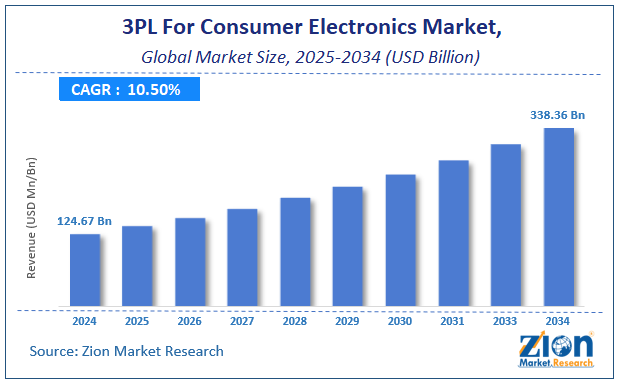
The global 3PL for consumer electronics market size was worth around USD 124.67 billion in 2024 and is predicted to grow to around USD 338.36 billion by 2034, with a compound annual growth rate (CAGR) of roughly 10.5% between 2025 and 2034.
Key Insights
- As per the analysis shared by our research analyst, the global 3PL for consumer electronics market is estimated to grow annually at a CAGR of around 10.5% over the forecast period (2025-2034).
- In terms of revenue, the global 3PL for consumer electronics market size was valued at around USD 124.67 billion in 2024 and is projected to reach USD 338.36 billion by 2034.
- The growing demand from the e-commerce sector is expected to drive the 3PL for the consumer electronics market over the forecast period.
- Based on the service type, the transportation services segment is expected to capture the largest market share over the projected period.
- Based on the mode of transportation, the ground transportation segment is expected to capture the largest market share over the projected period.
- Based on the end-user, the e-commerce segment is expected to capture the largest market share over the projected period.
- Based on region, North America is expected to dominate the market during the forecast period.
3PL For Consumer Electronics Market: Overview
Third-party logistics (3PL) is when companies that make consumer electronics contract with outside organizations to handle tasks like transportation, warehousing, and distribution. This lets them focus on their main business, which is making new products. In the consumer electronics business, 3PLs must deal with issues such as fragile, expensive items, short product cycles, and changes in global demand. 3PL suppliers offer tailored services for consumer electronics, including real-time inventory tracking, order fulfillment via pick-and-pack operations, and custom packaging to keep sensitive gadgets safe.
Other features include optimizing transportation and freight, kitting for bundled products, and integrating customer service. Working with a third-party logistics company (3PL) reduces costs by enabling larger operations and negotiated pricing. It also makes businesses more flexible, which is important in the electronics industry, where products have short lifecycles and must be delivered on time. Providers also help make the supply chain more efficient by reorganizing it and increasing its visibility through smart tracking systems.
3PL For Consumer Electronics Market Dynamics
Growth Drivers
How does the growing demand for end-to-end visibility and automation propel the 3PL for the consumer electronics industry growth?
There is a growing need for end-to-end visibility and automation in electronics supply chains, as they are high-value, fast-moving, and prone to errors. To address short product life cycles, frequent model launches, and changing demand, consumer electronics manufacturers and retailers are increasingly relying on real-time visibility across inbound freight, warehousing, order fulfillment, last-mile delivery, and reverse logistics. Advanced 3PL providers offer integrated digital platforms that include warehouse management systems (WMS), transportation management systems (TMS), order management, and track-and-trace features. These features give one a single, up-to-date view of their inventory, shipments, and order status. This kind of openness reduces stockouts and overstocking, makes demand forecasting easier, and speeds up decision-making.
Many electronics companies find it hard and expensive to do this in-house. At the same time, automation makes 3PLs in consumer electronics more valuable by enabling them to operate more quickly, accurately, and cost-effectively. 3PLs use automated storage and retrieval systems (AS/RS), robotics-assisted picking, automated sorting, and AI-driven route optimization to handle the high SKU complexity, small parcel volumes, and peak-season surges common in electronics sales. Automation in reverse logistics makes it easier to quickly test, grade, wipe data from, and get rid of returned equipment. This speeds up resale or refurbishing and slows down value loss. As companies that make consumer electronics look for logistics partners that can expand with them, use technology to give them real-time insights, tighter control, and automated execution across the whole supply chain, they rely more and more on specialist 3PL providers. This drives market growth.
Restraints
Why does compliance complexity pose a major restraint to the 3PL for consumer electronics market growth?
The rules for logistics in the consumer electronics industry are tougher than those in many other areas. This is because they have rules for lithium-ion batteries, dangerous materials, devices that hold data, and electronic waste. There are many rules that 3PL providers must follow regarding packing, labeling, testing (such as UN 38.3), limits on air and land travel, and on state of charge. If one doesn't follow the rules, deliveries may be delayed, one may be penalized, cargo may be rejected, or there may be safety issues. All of these things raise operational risk and costs. This complexity makes it difficult for smaller or mid-sized 3PLs to enter the market and inhibits the growth of existing providers.
Also, e-waste and extended producer responsibility (EPR) standards varied across regions. This meant that different paperwork, reporting, recycling partnerships, and audit trails were needed. This spread makes it tougher for 3PLs who handle reverse logistics to standardize their operations and costs more to manage the business. It costs more and takes longer to handle returned devices when you need to comply with data security and erasure laws, especially when you need certifications and inspections along the chain of possession. All of these compliance problems raise pricing, make it tougher to add new services, and make certain electronics companies less eager to fully outsource logistics. This is definitely bad for the industry's overall growth.
Opportunities
Will the growing e-commerce sector offer a potential opportunity for the 3PL for consumer electronics industry growth?
The rapid growth of e-commerce presents an enormous opportunity for 3PLs in the consumer electronics market, as it makes logistics operations much more complex and broader. As more consumer electronics are sold online, producers and retailers have to handle a large volume of orders, small packages, deliveries to many locations, and spikes in demand during peak seasons. Because of this trend, in-house logistics are becoming more expensive and less efficient. This is why companies are working with specialized 3PL suppliers who already have scalable fulfillment networks, warehouses in several locations, and optimized last-mile delivery systems. As a result, more people buying things online means more need outsourced warehousing, order fulfillment, and shipping services tailored to electronics.
Also, e-commerce in consumer electronics is associated with higher return rates and customers' desire for fast, clear delivery, making 3PLs even more important. Online shoppers want to be able to track their orders in real time, get their items quickly, return them easily, and get their money back quickly. All of these things need complicated IT systems, automation, and reverse logistics expertise. Electronics companies can address these needs by partnering with 3PL vendors that offer order management systems, track-and-trace platforms, and automated returns processing, without spending a lot of money. As e-commerce grows in both developed and developing countries, 3PL companies have more opportunities to offer end-to-end, technology-enabled logistics solutions, which will help the market flourish in the long run.
Challenges
Cost & margin pressure poses a major challenge to market expansion
Cost and margin pressures are major challenges for 3PL growth in the consumer electronics market, given the complexity of its services and intense price competition. Handling high-value, fragile goods, launching new items quickly, having short life cycles, and high return rates are all factors in consumer electronics logistics that increase 3PL costs. At the same time, big e-commerce sites and electronics makers put a lot of pressure on logistics partners to keep prices low, which makes it hard for 3PLs to pass on higher costs to customers.
This imbalance lowers profits and makes it less appealing to invest in long-term or aggressive capacity growth. Also, transportation and labor costs are exceedingly hard to anticipate, especially for last-mile deliveries and warehousing. Fuel price fluctuations, extra fees, labor shortages, and rising salaries all raise fulfillment costs. However, service-level agreements (SLAs) often require 3PLs to stick to predetermined prices and strict penalties for poor performance. Reverse logistics puts further pressure on margins because it requires time- and labor-intensive inspection, testing, data wiping, packing, and disposition decisions for returned gadgets, which are not always fully reimbursed. These problems with costs and margins make it hard to turn a profit, slow spending on infrastructure and technology, and ultimately stop long-term market growth.
3PL For Consumer Electronics Market: Report Scope
| Report Attributes | Report Details |
|---|---|
| Report Name | 3PL For Consumer Electronics Market |
| Market Size in 2024 | USD 124.67 Billion |
| Market Forecast in 2034 | USD 338.36 Billion |
| Growth Rate | CAGR of 10.5% |
| Number of Pages | 280 |
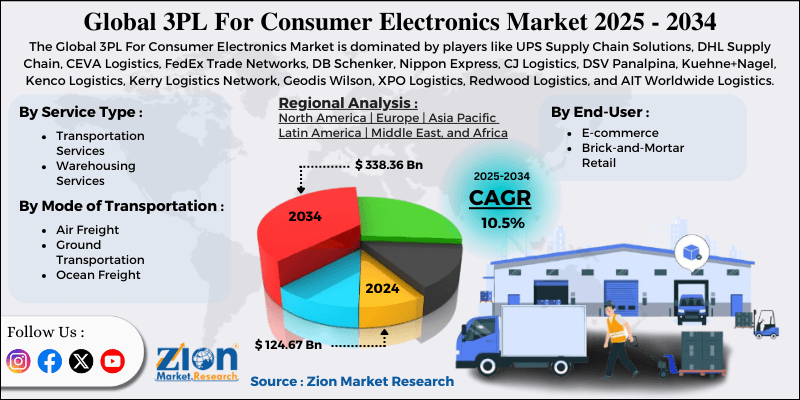
| Key Companies Covered | UPS Supply Chain Solutions, DHL Supply Chain, CEVA Logistics, FedEx Trade Networks, DB Schenker, Nippon Express, CJ Logistics, DSV Panalpina, Kuehne+Nagel, Kenco Logistics, Kerry Logistics Network, Geodis Wilson, XPO Logistics, Redwood Logistics, and AIT Worldwide Logistics, among others. |
| Segments Covered | By Service Type, By Mode of Transportation, By End-User and By Region |
| Regions Covered | North America, Europe, Asia Pacific (APAC), Latin America,The Middle East and Africa (MEA) |
| Base Year | 2024 |
| Historical Year | 2019 to 2023 |
| Forecast Year | 2025 - 2034 |
| Customization Scope | Avail customized purchase options to meet your exact research needs. Request For Customization |
3PL For Consumer Electronics Market: Segmentation
Service Type Insights
The transportation services segment dominates the market, capturing over 45% market share. The segment is expanding as e-commerce grows rapidly, shipments are increasing in size, and there is a growing need for fast and reliable delivery of high-value goods. Smartphones, computers, wearables, and other consumer products are quickly being offered online and through omnichannel platforms. This makes people want more modest, time-sensitive, and frequent mobility. This change has brought in more money for 3PL firms that carry electronics within the US, across borders, quickly, and to the last mile.
Mode of Transportation Insights
The ground transportation segment is expected to hold the largest revenue share over the projected period. The expansion of e-commerce and the increasing number of domestic electronics shipments are the primary drivers of growth. The majority of consumer electronics orders—such as cell phones, accessories, laptops, and home devices—are fulfilled in national or regional markets, making road transportation the most cost-effective and flexible route. As online sales rise, 3PL providers handle more small-parcel and less-than-truckload (LTL) shipments, which directly support revenue growth in ground transportation.
End-User Insights
The e-commerce segment is expected to capture a substantial market share of more than 48%. This is because most electrical goods are now sold online. Since switching to direct-to-consumer (DTC) and marketplace-based selling, the number of orders, shipments, and delivery points has gone up a lot. This surge immediately increases the need for 3PL services, including e-commerce fulfillment, warehousing, pick-and-pack operations, last-mile delivery, and order management. This means that consumer electronics logistics companies will make more revenue.
3PL For Consumer Electronics Market: Regional Analysis
North America is expected to capture the largest market share of more than 40% over the forecast period. High electronics consumption, a well-developed e-commerce infrastructure, and widespread outsourcing of logistics are driving the region's growth. The United States and Canada are both of the biggest countries in the region. Major consumer electronics companies, global e-commerce platforms, and technology-driven merchants that depend on third-party logistics providers to handle their supply chains from start to finish are all headquartered there.
Does e-commerce rise support the US 3PL for consumer electronics market growth?
The United States has one of the most developed e-commerce ecosystems in the world. A large share of consumer electronics, such as smartphones, laptops, gaming consoles, wearables, and accessories, is sold through online marketplaces and direct-to-consumer (DTC) channels. This change has led to a substantial increase in orders, shipments, and complex deliveries, making in-house logistics prohibitively expensive and ineffective for many electronics companies. Because of this, manufacturers and retailers are increasingly relying on third-party logistics companies for warehousing, e-commerce fulfillment, parcel shipping, and last-mile delivery. This is driving market expansion. Also, US online shoppers want fast shipping, real-time tracking, easy returns, and quick replacements, all of which require advanced logistics infrastructure and technology. Consumer electronics also have higher return rates when sold online, creating a significant need for reverse logistics services, including product inspection, data erasure, refurbishment, and redistribution. This is where specialized 3PLs can really help. As more people in the United States use e-commerce, the long-term demand for scalable, technology-enabled 3PL solutions grows. This helps the consumer electronics logistics industry continue to grow.
3PL For Consumer Electronics Market: Competitive Analysis
The global 3PL For Consumer Electronics market is dominated by players like-
- UPS Supply Chain Solutions
- DHL Supply Chain
- CEVA Logistics
- FedEx Trade Networks
- DB Schenker
- Nippon Express
- CJ Logistics
- DSV Panalpina
- Kuehne+Nagel
- Kenco Logistics
- Kerry Logistics Network
- Geodis Wilson
- XPO Logistics
- Redwood Logistics
- AIT Worldwide Logistics
- among others.
The global 3PL For Consumer Electronics market is segmented as follows:
By Service Type
- Transportation Services
- Warehousing Services
By Mode of Transportation
- Air Freight
- Ground Transportation
- Ocean Freight
By End-User
- E-commerce
- Brick-and-Mortar Retail
By Region
- North America
- The U.S.
- Canada
- Europe
- France
- The UK
- Spain
- Germany
- Italy
- Rest of Europe
- Asia Pacific
- China
- Japan
- India
- South Korea
- Southeast Asia
- Rest of Asia Pacific
- Latin America
- Brazil
- Mexico
- Rest of Latin America
- Middle East & Africa
- GCC
- South Africa
- Rest of Middle East & Africa
Table Of Content
Methodology
FrequentlyAsked Questions

HappyClients

