Wireless LAN Controller Market Size, Share, Trends, Growth 2032

Wireless LAN Controller Market By Type (Standalone and Integrated Types), By Enterprise Size (Large Enterprises and Small Offices), By Application (BFSI, Transport & Logistics, IT & Telecom, Retail, Government & Public Sector, Manufacturing, and Healthcare), And By Region - Global And Regional Industry Overview, Market Intelligence, Comprehensive Analysis, Historical Data, And Forecasts 2024 - 2032
| Market Size in 2023 | Market Forecast in 2032 | CAGR (in %) | Base Year |
|---|---|---|---|
| USD 1227.16 Million | USD 2162.95 Million | 6.5% | 2023 |
Description
What is the projected value for the Wireless LAN Controller Market during 2024 to 2032?
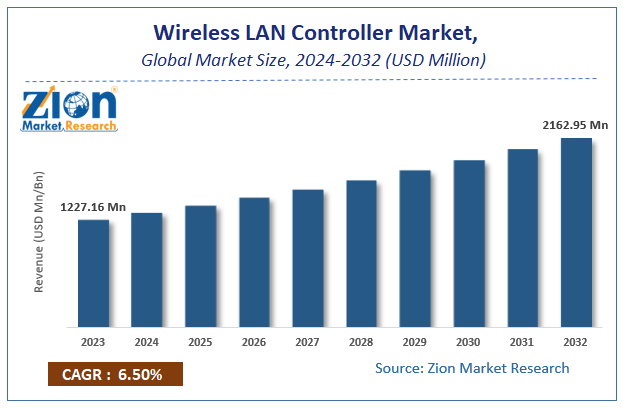
According to the report published by Zion Market Research, the global Wireless LAN Controller Market size was valued at USD 1227.16 Million in 2023 and is predicted to reach USD 2162.95 Million by the end of 2032. The market is expected to grow with a CAGR of 6.5% during the forecast period.
The report analyzes the global Wireless LAN Controller Market's growth drivers, restraints, and impact on demand during the forecast period. It will also help navigate and explore the arising opportunities in the Wireless LAN Controller industry.
Global Wireless LAN Controller Market: Overview
Wireless LAN controller is used along with lightweight access point protocol to effectively handle lightweight access points in huge quantities by either network operating center or network administrator. The product is a part of the data plane beneath the Cisco wireless model. It mechanically handles the wireless access point configuration.
Global Wireless LAN Controller Market: Growth Factors
The market is likely to gain traction over the years to come, owing to the growing need of firms to expand the business and support enterprise mobility. Additionally, the escalating requirement for supporting changing business environments such as low latency, high bandwidth, critical business applications, and firms depending on strong wireless network infrastructure will drive the expansion of the industry in the near future. Apart from this, the burgeoning demand for Wi-Fi access within myriad firms has become a challenging task for network admins to handle a large number of access points, thereby culminating in the lucrative demand for wireless LAN controllers.
Moreover, firms are drifting from wired networking towards wireless LAN systems for reducing maintenance costs, minimizing hardware procurement, and enhancing business output. In order to efficiently handle wireless LAN installation, enterprises are making use of wireless LAN controllers. This has boosted the market demand.
Global Wireless LAN Controller Market: Segmentation
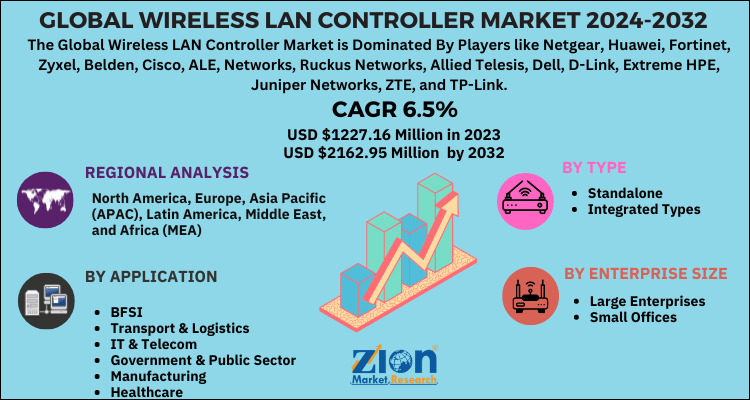
The wireless LAN controller market can be sectored into type, enterprise size, and application.
On the basis of type, the industry can be segmented into standalone and integrated types.
Based on the enterprise size, the wireless LAN controller market is divided into large enterprises and small offices.
Application wise, the wireless LAN controller industry can be divided into BFSI, transport & logistics, IT & Telecom, retail, government & public sector, manufacturing, and healthcare applications.
Wireless LAN Controller Market: Report Scope
| Report Attributes | Report Details |
|---|---|
| Report Name | Wireless LAN Controller Market |
| Market Size in 2023 | USD 1227.16 Million |
| Market Forecast in 2032 | USD 2162.95 Million |
| Growth Rate | CAGR of 6.5% |
| Number of Pages | 216 |
| Key Companies Covered | Netgear, Huawei, Fortinet, Zyxel, Belden, Cisco, ALE, Networks, Ruckus Networks, Allied Telesis, Dell, D-Link, Extreme HPE, Juniper Networks, ZTE, and TP-Link |
| Segments Covered | By type, By enterprise size, By application and By Region |
| Regions Covered | North America, Europe, Asia Pacific (APAC), Latin America, Middle East, and Africa (MEA) |
| Base Year | 2023 |
| Historical Year | 2018 - 2022 |
| Forecast Year | 2024 - 2032 |
| Customization Scope | Avail customized purchase options to meet your exact research needs. Request For Customization |
Global Wireless LAN Controller Market: Regional Analysis
Asia Pacific market is slated to witness lucrative growth over the coming years, owing to an increase in the use of laptops as well as smartphones in residential and commercial sectors. Apart from this, the BYOD trend along with the humungous need for bandwidth driven applications for fulfilling the business requirements as well as needs of entrepreneurs will succor the wireless LAN controller market expansion in the Asia Pacific zone. Densely populated regions such as India and China requiring effective and incessant connectivity are likely to make notable contributions towards the regional market earnings. Firms in these countries are installing cloud-based wireless LAN controllers to effectively handle numerous access points across the grid in a cost-efficient manner.
Europe and North American regions have advanced network connectivity and are on the verge of introducing 5G networks. These new initiatives and strategic moves will boost the growth of the overall market in the coming decade. Latin America and the Middle East and Africa markets have huge untapped market growth potential.
Wireless LAN Controller Market: Competitive Analysis
The global wireless LAN controller market is dominated by players like:
- Netgear
- Huawei
- Fortinet
- Zyxel
- Belden
- Cisco
- ALE
- Networks
- Ruckus Networks
- Allied Telesis
- Dell
- D-Link
- Extreme HPE
- Juniper Networks
- ZTE
- TP-Link
The global wireless LAN controller market is segmented as follows:
By Type
- Standalone
- Integrated Types
By Enterprise Size
- Large Enterprises
- Small Offices
By Application
- BFSI
- Transport & Logistics
- IT & Telecom
- Retail
- Government & Public Sector
- Manufacturing
- Healthcare
By Region
- North America
- The U.S.
- Canada
- Mexico
- Europe
- France
- The UK
- Spain
- Germany
- Italy
- Rest of Europe
- Asia Pacific
- China
- Japan
- India
- Australia
- South Korea
- Rest of Asia Pacific
- The Middle East & Africa
- Saudi Arabia
- UAE
- Egypt
- Kuwait
- South Africa
- Rest of the Middle East & Africa
- Latin America
- Brazil
- Argentina
- Rest of Latin America
What Reports Provides
- Full in-depth analysis of the parent market
- Important changes in market dynamics
- Segmentation details of the market
- Former, on-going, and projected market analysis in terms of volume and value
- Assessment of niche industry developments
- Market share analysis
- Key strategies of major players
- Emerging segments and regional markets
- Testimonials to companies in order to fortify their foothold in the market.
Table Of Content

FrequentlyAsked Questions
A wireless LAN controller manages multiple wireless access points. It ensures secure, efficient, and centralized network control.
The global Wireless LAN Controller market is expected to be driven by the Market expansion is driven by growing enterprise networks, rising demand for centralized network management, and increasing adoption of cloud-managed Wi-Fi solutions. Secure and scalable connectivity boosts growth.
According to study, the global Wireless LAN Controller market size was worth around USD 1227.16 Million in 2023 and is predicted to grow to around USD 2162.95 Million By 2032.
The global Wireless LAN Controller market is expected to grow at a Compound Annual Growth Rate (CAGR) of around CAGR 6.5% during the forecast period from 2024-2032.
The global Wireless LAN Controller industry is projected to be challenged by Challenges include shift toward cloud-managed Wi-Fi reducing on-prem demand, high upgrade costs, and complexity managing mixed-vendor environments.
The Opportunities include Wi-Fi 6/6E/7 upgrades, enterprise security demand, growth in campus and large venue connectivity, and hybrid architectures combining cloud and on-prem control will offer significant growth opportunities in the Wireless LAN Controller market.
Shift to cloud-managed WLAN and AI-driven optimization; zero-trust networking and automated threat detection; Wi-Fi 6/6E/7 readiness with policy-based automation are the emerging trends and innovations impacting the Wireless LAN Controller market.
The global Wireless LAN Controller market is expected to be led by North America during the forecast period.
Some of the prominent players operating in the global Wireless LAN Controller market are; Netgear, Huawei, Fortinet, Zyxel, Belden, Cisco, ALE, Networks, Ruckus Networks, Allied Telesis, Dell, D-Link, Extreme HPE, Juniper Networks, ZTE, and TP-Link and others.
The report explores crucial aspects of the Wireless LAN Controller market, including a detailed discussion of existing growth factors and restraints, while also browsing future growth opportunities and challenges that impact the market.
HappyClients