
Global Waste To Diesel Market Size, Share, Trends, Growth and Forecast 2032

Waste To Diesel Market By Source (Municipal Waste, Oil & Fat Waste, And Plastic Waste), By Technology (Pyrolysis, Incineration, Gasification, And Depolymerization), and by Region: Global Industry Perspective, Comprehensive Analysis and Forecast 2024-2032
| Market Size in 2023 | Market Forecast in 2032 | CAGR (in %) | Base Year |
|---|---|---|---|
| USD 578.61 Million | USD 1421.17 Million | 10.5% | 2023 |
What is Waste To Diesel Market Size?
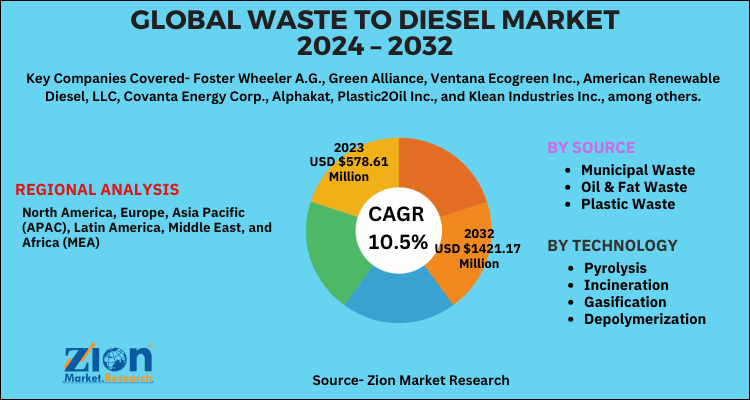
According to Zion Market Research, the global Waste To Diesel Market was worth USD 578.61 million in 2023. The market is forecast to reach USD 1421.17 million by 2032, growing at a compound annual growth rate (CAGR) of 10.5% during the forecast period 2024-2032. The report offers a comprehensive analysis of the market, highlighting the factors that will determine growth, potential challenges, and opportunities that could emerge in the Waste To Diesel industry over the next decade.
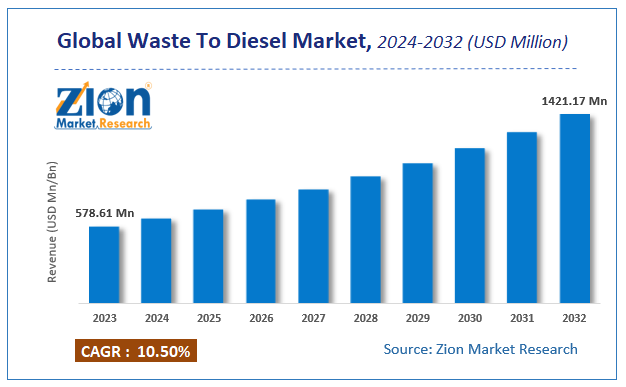
The demand for the Waste to Diesel Market has increased significantly due to increased applications of the diesel that is produced from waste in ships, diesel power generators, diesel boilers, tractors & trucks, and construction machinery, which have triggered the growth of the waste to diesel market.
Global Waste To Diesel Market: Overview
Managing waste is a very important factor and requires high capital but has a very low scale for the return on investment. Growing concerns regarding waste management and the soaring growth in waste have compelled the government and municipal bodies to look for effective ways for making the best use of the waste that has accumulated. Waste to diesel is one of the efficient methods that have emerged as an effective method for the production of fuel.
Key Insights
- As per the analysis shared by our research analyst, the global Waste to Diesel market is expected to expand at a CAGR of 10.5% from 2024 to 2032.
- In terms of revenue, the market is projected to increase from USD 578.61 million in 2023 to USD 1,421.17 million in 2032, reflecting sustained demand for waste-derived fuel and waste-management solutions.
- The market is driven by growing waste volumes, increasing demand for alternative fuels, expanding applications of waste-derived diesel, stricter environmental regulations, R&D to reduce processing-plant costs, and increasing investment in waste-to-diesel facilities.
- Based on Source, the Municipal Waste segment is expected to dominate the market.
- Based on Technology, the Pyrolysis segment is growing at a high rate and is projected to dominate the global market.
- Based on Region, Europe is expected to contribute the largest share during the forecast period, supported by major market participants and their involvement in research and development activities.
Global Waste To Diesel Market: Dynamics
Growth Factors
Increased applications of the diesel that are produced from the waste in ships, diesel power generators, diesel boilers, tractors & trucks, and construction machinery have triggered the growth of the waste to diesel market. EPA has implemented strict regulations regarding the harmful effects of the garbage, which has propelled the demand for the recycling industry. Augmented R&D activities in order to minimize the increased capital requirement for the installation of the processing plants have positively contributed to the growth of the waste to diesel market. Developments are being made to introduce a mobile reactor that will help in converting plastic to diesel, which, in turn, will open up several opportunities for the waste to diesel market. Growing spending on the advancements of waste to diesel facilities is triggering the demand for the market in the coming years. The technologies that are utilized for the processing treatments vary on the basis of the lead time, type of waste, and energy efficiency. Making use of appropriate technology for the processing of various types of waste is a major challenge for the waste to diesel market.
Opportunities
Where are the major opportunities emerging for the Waste To Diesel market?
Technological innovation offers significant opportunities for the industry. Research and development efforts focused on reducing the capital requirements of processing plants can improve the economic feasibility of waste-to-diesel projects. Improvements in conversion processes can also increase operational efficiency and broaden the range of waste materials that can be processed. These developments may help the market move toward more flexible and scalable waste-to-fuel systems.
The development of mobile reactors for converting plastic into diesel represents another important opportunity identified in the report. Mobile or modular processing systems could potentially bring conversion capabilities closer to waste sources, reducing the need to transport certain waste streams over long distances. Such solutions could support decentralized waste management and create additional applications for waste-derived fuel production.
Challenges
Why is technology selection across different waste streams a major industry challenge?
Waste-to-diesel technologies do not perform identically across all feedstocks. The characteristics of municipal waste, oil and fat waste, and plastic waste can differ considerably, requiring conversion systems to be selected according to the composition and characteristics of the available material. Processing lead time, energy efficiency, and waste type therefore become important considerations when designing or operating a facility.
The industry must consequently balance technological suitability with capital requirements, operating efficiency, and expected fuel output. An unsuitable processing technology can negatively affect operational performance and project economics. Developing adaptable systems capable of handling diverse waste streams while maintaining efficient conversion therefore remains an important challenge for market participants.
Global Waste To Diesel Market: Segmentation
The global waste to diesel market is segmented by source, technology, and region.
On the basis of the source, the global market is categorized into municipal waste, oil & fat waste, and plastic waste. Municipal waste represents an important feedstock category because the continued accumulation of waste creates a requirement for efficient processing and resource recovery. Converting municipal waste into diesel can simultaneously support waste reduction and energy recovery, making the segment relevant to municipalities and waste-management organizations. Its importance is reinforced by growing waste volumes and the need for alternatives to conventional disposal methods. Oil and fat waste provides another feedstock pathway for producing waste-derived fuel. The availability of these waste materials creates opportunities to recover energy from materials that would otherwise require disposal or additional treatment. The segment can benefit from the broader movement toward waste valorization and alternative fuel production.
Based on the technology, the waste to diesel market is segregated into pyrolysis, incineration, gasification, and depolymerization. Pyrolysis is an important conversion pathway within the waste-to-diesel industry because thermal processing can transform suitable waste feedstocks into products that can subsequently be upgraded into usable fuels. Its relevance is associated with the broader development of thermal waste-conversion technologies and the need to process different types of waste efficiently. Incineration is another technology identified in the market segmentation. It focuses on thermal treatment of waste and can contribute to waste-volume reduction and energy recovery. Its role within waste-to-diesel applications depends on the characteristics of the feedstock and the specific processing configuration used by a facility.
Waste To Diesel Market: Report Scope
| Report Attributes | Report Details |
|---|---|
| Report Name | Waste To Diesel Market |
| Market Size in 2023 | USD 578.61 Million |
| Market Forecast in 2032 | USD 1421.17 Million |
| Growth Rate | CAGR of 10.5% |
| Number of Pages | 110 |
| Key Companies Covered | Foster Wheeler A.G., Green Alliance, Ventana Ecogreen Inc., American Renewable Diesel, LLC, Covanta Energy Corp., Alphakat, Plastic2Oil Inc., and Klean Industries Inc., among others |
| Segments Covered | By Source, By Technology, and By Region |
| Regions Covered | North America, Europe, Asia Pacific (APAC), Latin America, Middle East, and Africa (MEA) |
| Base Year | 2023 |
| Historical Year | 2018 - 2022 |
| Forecast Year | 2024 - 2032 |
| Customization Scope | Avail customized purchase options to meet your exact research needs. Request For Customization |
Waste To Diesel Market: Regional Analysis
Why will Europe continue to dominate the global market during the projection period?
The majority of the shares in the waste to diesel market is expected to be contributed by Europe. The factors driving the growth of the market in Europe are the presence of the major market players and the active involvement of these organizations in the research and development activities. Rapid market development is anticipated in the North American region. In countries such as Mexico and the U.S., and in other countries, the rise in garbage collectors and the waste transfer stations has propelled the growth of the waste to diesel market. Increased consumption of diesel in the automotive sectors of several regions has increased the demand for the waste to diesel market. The growing technological advancements in the Asia Pacific and the growing number of processing plants in regions such as Europe and North America is positively increasing the popularity of waste to diesel market.
Waste To Diesel Market: Competitive Players
Some of the most important market players in the waste to diesel market include-
- Foster Wheeler A.G.
- Green Alliance
- Ventana Ecogreen Inc.
- American Renewable Diesel
- Covanta Energy Corp.
- Alphakat
- Plastic2Oil Inc.
- Klean Industries Inc.
The global Waste To Diesel market is segmented as follows
By Source
- Municipal Waste
- Oil & Fat Waste
- Plastic Waste
By Technology
- Pyrolysis
- Incineration
- Gasification
- Depolymerization
By Region
- North America
- The U.S.
- Canada
- Mexico
- Europe
- France
- The UK
- Spain
- Germany
- Italy
- Rest of Europe
- Asia Pacific
- China
- Japan
- India
- Australia
- South Korea
- Rest of Asia Pacific
- The Middle East & Africa
- Saudi Arabia
- UAE
- Egypt
- Kuwait
- South Africa
- Rest of the Middle East & Africa
- Latin America
- Brazil
- Argentina
- Rest of Latin America
Table Of Content
Methodology
FrequentlyAsked Questions
Waste to diesel is a process that converts waste materials into diesel fuel. It helps reduce waste and produce alternative energy
The global Waste To Diesel market is expected to be driven by the rising demand for alternative fuels, waste management challenges, and circular economy initiatives. Government incentives and fuel sustainability goals support market growth..
According to study, the global Waste To Diesel market size was worth around USD 578.61 Million in 2023 and is predicted to grow to around USD 1421.17 Million By 2032.
The global Waste To Diesel market is expected to grow at a Compound Annual Growth Rate (CAGR) of around CAGR 10.5% during the forecast period from 2024-2032.
The global Waste To Diesel industry is projected to be challenged by Challenges include high capital costs, feedstock availability variability, and regulatory approvals for fuel standards.
The Opportunities include waste reduction mandates, renewable fuel incentives, circular economy initiatives, and demand for low-carbon diesel alternatives will offer significant growth opportunities in the Waste To Diesel market.
Advanced thermal and catalytic conversion processes; circular economy and waste valorization focus; integration with renewable fuel standards are the emerging trends and innovations impacting the Waste To Diesel market.
The global Waste To Diesel market is expected to be led by Europe during the forecast period.
Some of the prominent players operating in the global Waste To Diesel market are; Foster Wheeler A.G., Green Alliance, Ventana Ecogreen Inc., American Renewable Diesel, LLC, Covanta Energy Corp., Alphakat, Plastic2Oil Inc., and Klean Industries Inc., among others and others.
The report explores crucial aspects of the Waste To Diesel market, including a detailed discussion of existing growth factors and restraints, while also browsing future growth opportunities and challenges that impact the market.

HappyClients

