
Global Visual Computing Market Size, Share, And Growth Trends, 2032

Visual Computing Market By Component (Software and Hardware), By Display Platform (Monitors, Interactive Whiteboards, and Others), By Industry (Media & Entertainment, Automotive, Healthcare, Gaming, and Others), and By Region - Global And Regional Industry Overview, market Intelligence, Comprehensive Analysis, Historical Data, And Forecasts 2024-2032
| Market Size in 2023 | Market Forecast in 2032 | CAGR (in %) | Base Year |
|---|---|---|---|
| USD 27.16 Billion | USD 169.95 Billion | 22.6% | 2023 |
Visual Computing Industry Perspective
What will be the global visual computing market size during the forecast period?
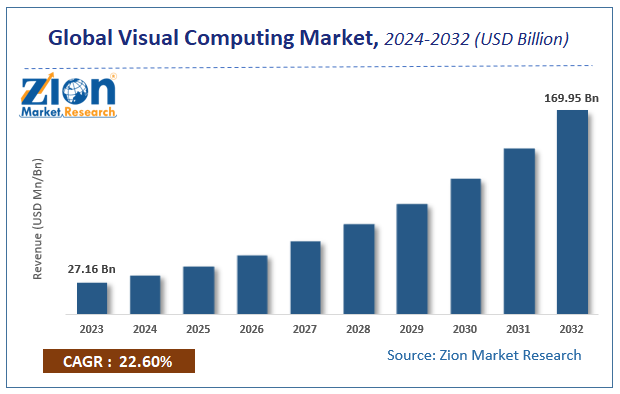
The global visual computing market size was valued at around USD 27.16 billion in 2023 and is projected to reach about USD 169.95 billion by 2032, with a compound annual growth rate (CAGR) of roughly 22.6% between 2024 and 2032.
This report provides a comprehensive analysis of the growth drivers, restraints, and challenges shaping demand across the global visual computing market throughout the forecast period, while highlighting high-potential emerging opportunities within the industry.
Key Insights
- As per the analysis shared by our research analyst, the global visual computing market is estimated to grow at a CAGR of approximately 22.6% during the forecast period from 2024 to 2032.
- In terms of revenue, the global visual computing market size was valued at around USD 27.16 billion in 2023 and is projected to reach USD 169.95 billion by 2032.
- The market is driven by rising demand for virtual reality and simulation products, increasing use of graphics cards in gaming to improve accuracy and appeal, continuous updates in gaming features and technology, and expanding applications of visual computing across automotive, media and entertainment, healthcare, and related industries.
- Based on the component, the hardware segment is growing at a high rate and is projected to dominate the global market.
- Based on the display platform, monitors form a core platform for visual computing output, while interactive whiteboards and other display formats support collaborative and specialized visualization use cases.
- Based on the industry, gaming is a major demand driver through graphics acceleration and advanced feature development, while automotive applications such as rearview camera systems and broader visual technologies are expanding with global vehicle demand.
- Regionally, North America is projected to hold a substantial share of the global visual computing market, owing to increasing demand for high-speed internet, significant research and development investments by prominent players, the presence of developed economies such as the United States and Canada, and rising use of smartphones for gaming.
Visual Computing Market: Overview
Visual computing is the study of computer systems that deal with analysis and synthesis of visual data with the help of images and 3D models, such as image processing, computer graphics and computer vision, visualization, and virtual and augmented reality. This study also includes human-computer interaction, pattern recognition, digital libraries, and machine learning. In terms of its application, computer facial modeling comprises applications in sketch-based approaches, audio-visual training for modeling, and both physically- and geometrically based animation approaches.
The demand for visual computing has increased in the cyber world, which helps in transforming huge volumes of data into visuals. The surging demand for virtual reality and simulation products is anticipated to drive the growth of the visual computing market globally in the future. The rising use of graphics cards in gaming to accelerate game accuracy levels is also projected to fuel the global visual computing market development in the years ahead. Additionally, the rising demand for versatile games has led to updates to the features and technology available in the gaming world, thereby driving the global gaming industry. This has led the gaming manufacturers to add advanced features to the gaming experience to make it more appealing and attractive. This, in turn, is fuelling the visual computing market.
Visual Computing Market: Dynamics
Growth Drivers
What factors are accelerating the expansion of the visual computing market?
Surging demand for virtual reality and simulation products is a primary driver of visual computing market growth. The ability to transform large volumes of data into usable visuals supports adoption across multiple digital and industrial contexts.
Rising use of graphics cards in gaming to improve accuracy and visual quality fuels market expansion. Continuous updates in gaming features and technology, driven by demand for more versatile and attractive experiences, encourage manufacturers to add advanced capabilities and thereby strengthen demand for visual computing hardware and software.
Restraints
What factors are limiting the growth of the visual computing market?
High development and deployment costs for advanced visual computing systems can constrain adoption among smaller organizations or in cost-sensitive applications. Complexity of integration with existing platforms and the need for specialized skills may also slow broader uptake.
Performance requirements, power consumption, and compatibility considerations across diverse hardware and software environments can present practical barriers to seamless deployment in some industry settings.
Opportunities
What emerging opportunities exist in the visual computing market?
Expanding applications in automotive, including rearview cameras and other visual systems, create significant opportunities as global vehicle demand grows. Healthcare, media and entertainment, and other industries continue to adopt visualization, simulation, and computer vision capabilities.
Advances in graphics processing, cloud and related platforms, and immersive technologies support new product development and broader use cases. Continued investment in research and development by leading technology providers further opens avenues for innovation and market expansion.
Challenges
What challenges does the visual computing market face?
Rapid technological change requires ongoing investment to remain competitive and compatible with evolving standards. Balancing performance, cost, and power efficiency across hardware and software solutions remains a persistent challenge.
Ensuring consistent user experience across diverse display platforms and industry applications, and addressing integration and skills gaps in some markets, continues to influence the pace of adoption.
Visual Computing Market: Report Scope
| Report Attributes | Report Details |
|---|---|
| Report Name | Visual Computing Market |
| Market Size in 2023 | USD 27.16 Billion |
| Market Forecast in 2032 | USD 169.95 Billion |
| Growth Rate | CAGR of 22.6% |
| Number of Pages | 265 |
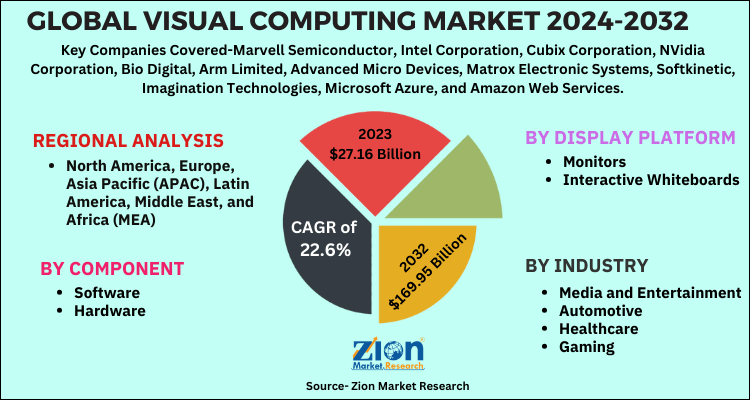
| Key Companies Covered | Marvell Semiconductor, Intel Corporation, Cubix Corporation, NVIDIA Corporation, Bio Digital, Arm Limited, Advanced Micro Devices, Matrox Electronic Systems, Softkinetic, Imagination Technologies, Microsoft Azure, and Amazon Web Services |
| Segments Covered | By Component, By Display Platform, By Industry, and By Region |
| Regions Covered | North America, Europe, Asia Pacific (APAC), Latin America, Middle East, and Africa (MEA) |
| Base Year | 2023 |
| Historical Year | 2018 - 2022 |
| Forecast Year | 2024 - 2032 |
| Customization Scope | Avail customized purchase options to meet your exact research needs. Request For Customization |
Visual Computing Market: Segmentation
The visual computing market is segmented by component, display platform, industry, and region. All the segments of the visual computing market have been analyzed based on present and future trends and the market is estimated from 2024 to 2032.
Based on Component, the visual computing market is divided into software and hardware. Hardware provides the processing and display foundation for graphics, visualization, and real-time interaction, while software enables analysis, synthesis, computer vision, and application-level capabilities. Both components are essential to delivering complete visual computing solutions. Demand for higher graphics performance in gaming and simulation continues to support hardware development, while software advances expand the range of practical applications across industries.
Based on Display Platform, the market is divided into monitors, interactive whiteboards, and others. Monitors remain a primary platform for delivering visual computing output in professional, gaming, and general computing environments. Interactive whiteboards support collaborative visualization and presentation use cases. Other display formats extend the reach of visual computing into specialized and emerging application settings, contributing to overall market breadth.
On the basis of industry, the visual computing market includes gaming, media and entertainment, healthcare, automotive, and others. Gaming is a major demand driver through the need for advanced graphics cards and continuous feature updates that improve accuracy and appeal. The automotive industry is applying visual computing technologies such as rearview cameras and related systems, with growth expected as global vehicle demand rises. Media and entertainment, healthcare, and other sectors further expand the addressable market through visualization, simulation, and computer vision applications.
Visual Computing Market: Regional Analysis
Why will North America continue to dominate the global market during the projection period?
North America is projected to hold a substantial share of the global visual computing market. This position is supported by increasing demand for high-speed internet, significant research and development investments by prominent market players, and the presence of developed economies such as the United States and Canada. Rising use of smartphones for gaming also contributes to regional market strength. These factors enable North America to lead in technology development, early adoption of advanced visual computing solutions, and influence over global product and application trends.
Europe maintains important demand supported by established technology industries, media and entertainment activity, and automotive and industrial applications of visualization and graphics technologies. Asia Pacific represents a major growth region driven by expanding electronics manufacturing, rising gaming and digital content consumption, and increasing adoption of visual computing in automotive and other industries. Latin America and the Middle East and Africa are emerging opportunities as digital infrastructure and industry applications of visualization and graphics technologies continue to develop.
Visual Computing Market: Competitive Players
Some prominent players of the global visual computing market are:
- Marvell Semiconductor
- Intel Corporation
- Cubix Corporation
- NVidia Corporation
- Bio Digital
- Arm Limited
- Advanced Micro Devices
- Matrox Electronic Systems
- Softkinetic
- Imagination Technologies
- Microsoft Azure
- Amazon Web Services
Segments Covered
The global visual computing market is segmented as follows:
By Component
- Software
- Hardware
By Display Platform
- Monitors
- Interactive Whiteboards
- Others
By Industry
- Media and Entertainment
- Automotive
- Healthcare
- Gaming
- Others
By Region
- North America
- The U.S.
- Canada
- Mexico
- Europe
- France
- The UK
- Spain
- Germany
- Italy
- Rest of Europe
- Asia Pacific
- China
- Japan
- India
- Australia
- South Korea
- Rest of Asia Pacific
- The Middle East & Africa
- Saudi Arabia
- UAE
- Egypt
- Kuwait
- South Africa
- Rest of the Middle East & Africa
- Latin America
- Brazil
- Argentina
- Rest of Latin America
Table Of Content
Methodology
FrequentlyAsked Questions
Visual computing is the study of computer systems that deal with the analysis and synthesis of visual data using images and three-dimensional models. It includes image processing, computer graphics, computer vision, visualization, virtual and augmented reality, human-computer interaction, pattern recognition, and related fields.
The global visual computing market is driven by rising demand for virtual reality and simulation products, increasing use of graphics cards in gaming, continuous updates in gaming features and technology, and expanding applications in automotive, media and entertainment, healthcare, and other industries.
The global visual computing market size was valued at approximately USD 27.16 billion in 2023 and is expected to reach around USD 169.95 billion by 2032.
The global visual computing market is expected to grow at a compound annual growth rate (CAGR) of approximately 22.6% during the forecast period from 2024 to 2032.
North America is projected to hold a substantial share and contribute notably, supported by high-speed internet demand, significant R&D investment, developed economies, and strong gaming and technology adoption.

HappyClients

